
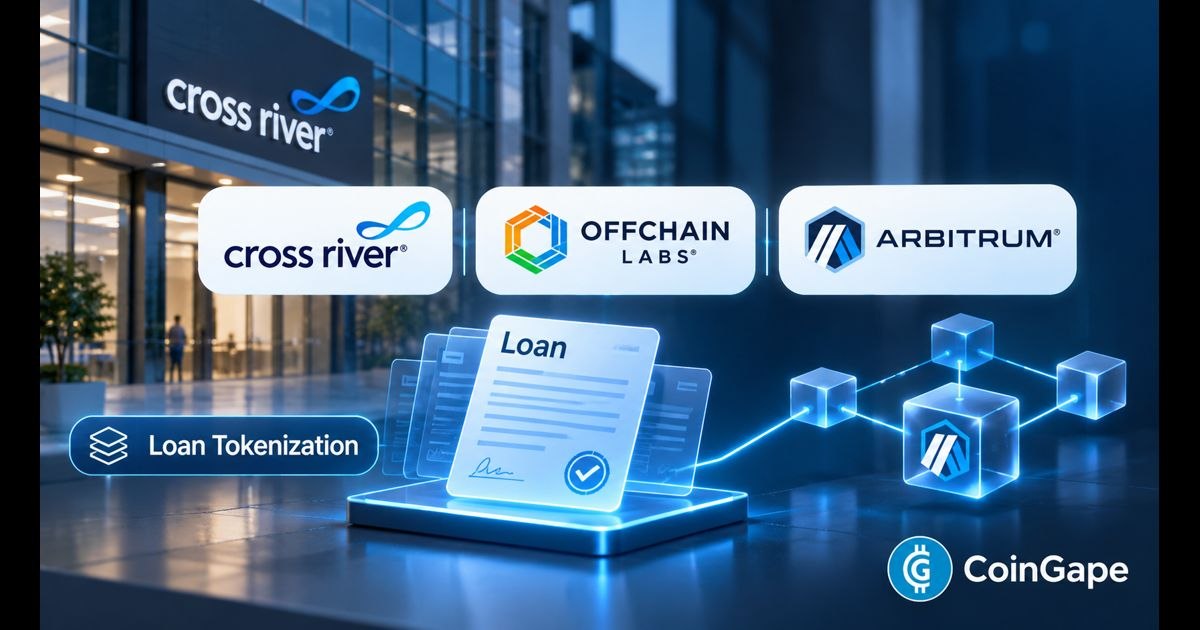
Cross River and Offchain have completed a proof of concept for tokenizing loans at origination, with production deployment targeted for early 2027. The initiative aims to connect regulated bank lending with blockchain-based funding, ownership, and servicing infrastructure.
Cross River and Offchain are working to integrate tokenization directly into Cross River’s lending platform, enabling loans to be represented on blockchain infrastructure from the moment they are originated.
The initiative uses Arbitrum One, with Offchain Enterprise Services supporting the development. The companies have completed a proof of concept and are now working toward production deployment, which they are targeting for early 2027.
The approach shifts tokenization earlier in the lending lifecycle. Rather than originating loans through conventional systems and moving them on-chain later, the proposed model is designed to support funding, ownership transfers, and servicing activity on a shared digital record from inception.
The companies say the change is intended to improve operational efficiency and support more flexible credit funding and distribution models. However, the solution remains in development and has not yet been described as a live production service.
Moving tokenization to the start of the loan lifecycle
Many lending tokenization initiatives begin after a loan has already been created. Origination, servicing, and distribution take place through existing infrastructure, with the asset subsequently represented on a blockchain.
Cross River and Offchain are pursuing a different sequence.
Under the proposed model, loans originated through Cross River’s platform can be funded, held, and transferred on Arbitrum One from origination. Ownership, funding, payment, and servicing activity would be maintained on a shared record throughout the asset’s lifecycle.
The companies argue that this could reduce the need to move information between separate systems whenever a loan changes hands.
Gilles Gade, founder and CEO of Cross River, said starting at origination means maintaining one record and reducing steps from funding through later transfers of ownership.
The intended change is primarily at the asset and capital markets level. Borrowers would continue to use existing customer-facing channels for applications, funding, and repayments.
Existing borrower experience, new infrastructure underneath
Cross River and Offchain say the tokenization process is designed to operate beneath the borrower experience.
Applications, funding, and repayments would continue through the channels borrowers already use. Offchain’s ZeroDev wallet infrastructure would be embedded into the underlying platform.
This separation is important for the companies’ model. The aim is to introduce blockchain-based asset infrastructure without requiring borrowers or fintech lending partners to adopt new customer-facing processes.
For fintechs using Cross River’s lending platform, the proposed capability could make tokenized funding and distribution available through existing origination workflows.
The announcement does not provide details about the specific loan products, transaction volumes, or fintech partners that would use the capability at launch.
Potential for more flexible credit funding and distribution
The companies see tokenization from origination as a way to support funding and distribution models that can be difficult to operate efficiently through traditional processes.
Potential use cases identified in the announcement include:
- Continuous forward-flow purchase programs
- More flexible commitment sizes
- New ways to package and distribute credit to investors
- Access to additional pools of capital, including onchain funds and international investors
Forward-flow arrangements involve agreements for the purchase of loans over time. The companies suggest that tokenized infrastructure could support more continuous and programmatic approaches to these arrangements.
The potential benefits will depend on how the model is implemented, the participation of investors, and the legal and operational arrangements governing each asset.
The announcement does not disclose committed capital, participating investors, expected transaction volumes, or quantified efficiency gains.
Regulated lending remains with Cross River.
Cross River will remain the regulated bank and lender of record for assets originated through its platform.
The companies state that tokenization will not change the underwriting, risk management, or compliance standards applied to the loans. Instead, it is intended to change how assets can be funded, owned, and distributed after origination.
That distinction is central to the initiative’s positioning: regulated bank-led lending combined with blockchain-based infrastructure for asset lifecycle management.
The announcement does not provide a detailed description of the legal structure for token ownership, investor eligibility, secondary transfers, or servicing responsibilities. Those details will be important to understanding how the model operates in production.
Offchain brings Arbitrum infrastructure into product design.
Offchain, the developer of Arbitrum, is supporting the initiative through its Enterprise Services offering.
Steven Goldfeder, CEO and co-founder of Offchain, said financial institutions need infrastructure they can shape around their business requirements. He also said the service brings the engineers building the underlying technology directly into product design.
The companies present this approach as a way for institutions to develop financial products while retaining control over how those products operate and grow.
For Arbitrum, the initiative represents another potential application of blockchain infrastructure in financial services. For Cross River, it provides a route to connect its lending platform with digital asset-based funding and distribution capabilities.
What to watch before production deployment
The proof of concept is complete, but production deployment remains a future milestone targeted for early 2027.
Key developments to watch include the first loan products to use the infrastructure, participating fintechs and investors, the legal framework for tokenized ownership, and how funding and servicing workflows operate in production.
The companies have not announced a live deployment, specific launch volumes, or a quantified financial impact.
TheFinRate takeaway: Cross River and Offchain are moving loan tokenization closer to the point where credit is created. If deployed as planned, the model could connect regulated lending with more programmatic funding and distribution—but its practical impact will depend on production execution and investor adoption.
Source note: This article is based on the supplied The Paypers report dated November 4, 2026. Product capabilities, project status, and expected timing are attributed to the companies as described in the source. Production deployment is targeted for early 2027, not confirmed as live.
Comments
No comments yet. Be the first to share your thoughts.
Leave a comment