
Introduction
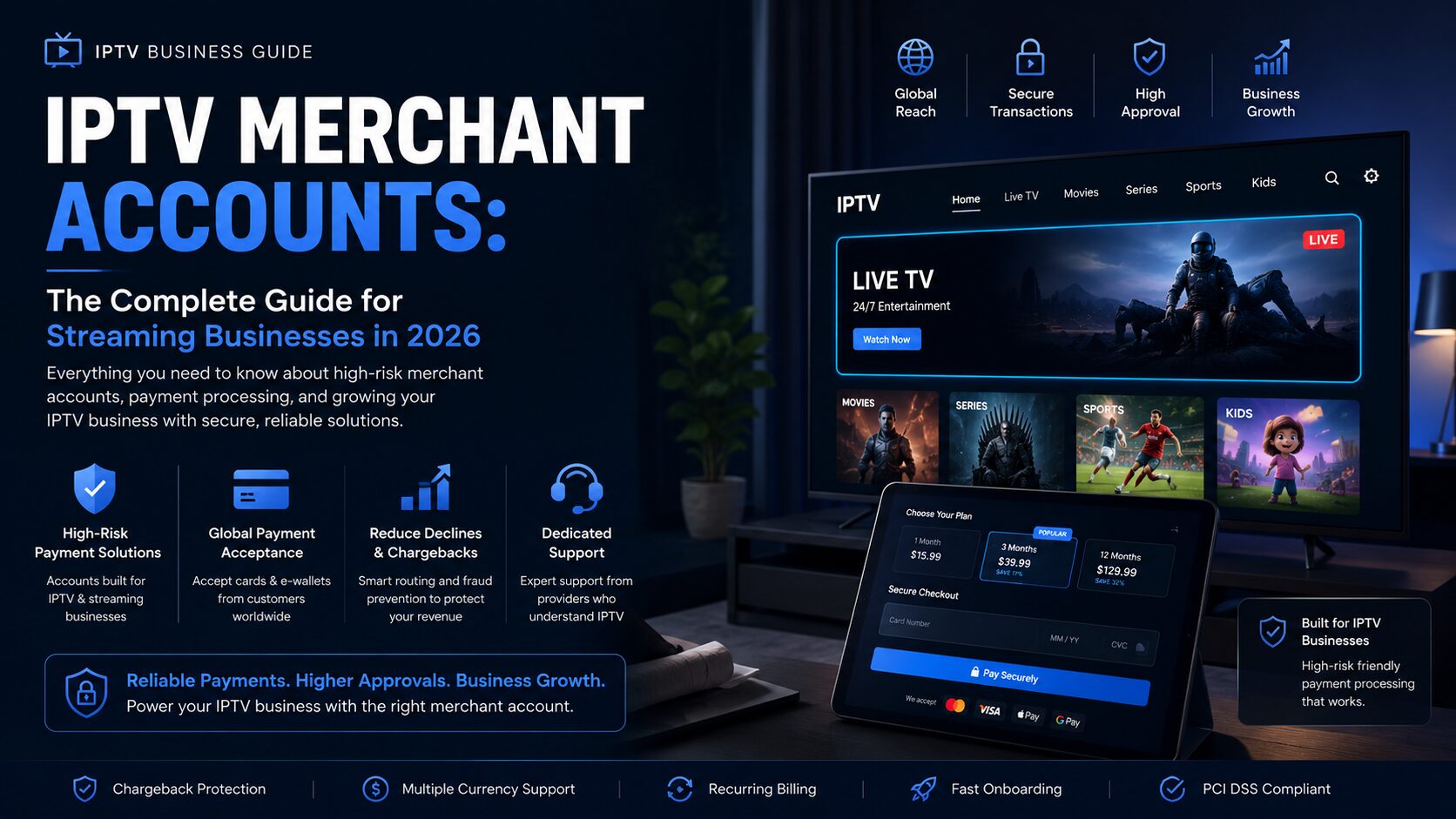
An IPTV merchant account is a specialised payment processing arrangement that enables Internet Protocol Television businesses — streaming platforms, subscription-based content providers, live TV services, and B2B IPTV panel operators — to accept card payments through acquiring banks that understand and underwrite the specific risk profile of the industry.
The global IPTV market reached $105.6 billion in 2026 and is projected to reach $304.9 billion by 2034, growing at a CAGR of 12.13%. IPTV now holds approximately 250 million active subscribers worldwide as of 2026, with projections indicating this will reach 398 million by end of 2026 — officially surpassing global cable TV subscriber numbers for the first time in history.
Despite this scale, mainstream payment processors including Stripe, PayPal, and Square decline IPTV businesses by policy. Banks and traditional financial institutions classify IPTV as high-risk, making standard merchant accounts inaccessible for most operators.
This guide explains why, what a properly structured IPTV merchant account looks like, how underwriting works, what it costs, and how to build the payment infrastructure that supports a scalable streaming business.
What Is an IPTV Merchant Account?
An IPTV merchant account enables streaming platforms and content providers to accept card payments for subscription services, pay-per-view events, and on-demand content access.
It differs from a standard merchant account in four specific ways:
Specialist underwriting. Acquiring banks that serve IPTV businesses have built underwriting frameworks that account for the industry’s specific chargeback profile, subscription billing model, cross-border transaction volume, and content licensing complexity.
Recurring billing infrastructure. Most IPTV revenue flows through subscription billing. A specialist IPTV merchant account includes recurring billing tools, retry logic for failed payments, automated renewal reminders, and dunning management — the infrastructure required to sustain a subscription revenue model at scale.
Multi-currency processing. IPTV businesses serve global audiences. Processing across multiple currencies, with local payment method support, is a core operational requirement — not an optional add-on.
Content compliance support. IPTV businesses operate under digital rights management obligations, broadcasting licences, and geo-restriction requirements that affect how payments are accepted and recorded. Specialist processors understand these compliance layers.
 Why IPTV Is Classified as High-Risk
Traditional banks and payment processors classify IPTV businesses as high-risk based on a specific combination of structural factors.
Subscription Billing Chargeback Exposure
The majority of IPTV revenue is subscription-based. Subscription billing accounts for 27.1% of all identified chargeback risk factors across payment processing. IPTV-specific subscription chargebacks are driven by:
- Customers who forget they subscribed and dispute the renewal charge
- Customers who find cancellation difficult and dispute the charge instead
- Customers who share account credentials and dispute charges from shared usage
- Trial-to-paid conversion disputes where ongoing billing terms were not sufficiently clear
Content Licensing and Piracy Exposure
IPTV exists alongside a significant illegal streaming ecosystem that directly affects legitimate operators. Visits to illegal streaming websites climbed from 130 billion in 2020 to 216 billion in 2024 — a 66% increase. Piracy costs Europe approximately $1 billion annually. In 2026, Europol coordinated its most aggressive EU-wide enforcement operations against IPTV networks across 15 countries, tracing €47 million in cryptocurrency linked to illegal streaming services.
This context matters for acquiring banks because: the association between IPTV and piracy creates reputational and compliance risk that standard underwriting frameworks are not built to navigate. Legitimate IPTV operators must clearly differentiate themselves from illegal streaming operations through content licensing documentation and compliance evidence.
Cross-Border Transaction Complexity
IPTV businesses serve international subscriber bases by nature. Cross-border transactions carry higher card-not-present fraud rates, more complex currency and FX requirements, and additional geo-restriction compliance obligations. Each cross-border transaction adds layers of risk that standard acquirers are not equipped to price.
Card-Not-Present Fraud Vulnerability
Every IPTV subscription payment is a card-not-present transaction — the highest-fraud category in card processing. Without specialist fraud management infrastructure, IPTV platforms face elevated exposure to stolen credential use, account takeover, and synthetic identity attacks specifically targeting subscription content services.
Regulatory Complexity
IPTV businesses must comply with: KYC and AML requirements from payment regulators, content licensing obligations from rights holders, broadcasting regulations in each operating jurisdiction, geo-restriction enforcement required by licence agreements, and DRM (Digital Rights Management) standards. Each regulatory layer adds complexity that standard processors have not built their compliance frameworks to support.
The IPTV Payment Processing Market Context
Understanding the market scale and structure clarifies both the opportunity and the payment infrastructure requirements.
The global IPTV market by the numbers:
- $105.6 billion market value in 2026 (IMARC Group)
- $304.9 billion projected by 2034 at 12.13% CAGR
- 250 million active global subscribers in 2026
- 398 million projected subscribers by end of 2026
- North America dominates with 40% of global market share
- Subscription-based IPTV led with 72.7% revenue share
- Smart TVs account for 48.2% of device revenue
- Live and linear TV accounts for 54.6% of streaming revenue
- Video-on-demand expanding at 15.61% CAGR
The subscription model dominates IPTV monetisation. This means recurring billing infrastructure is the central operational dependency — and recurring billing is the payment processing capability that standard acquirers are least equipped to support at scale for high-risk merchants.
The illegal IPTV ecosystem creates a specific underwriting challenge for legitimate operators. Acquiring banks cannot visually distinguish licensed streaming services from unlicensed ones without proper documentation. Legitimate IPTV operators must proactively provide the content licensing and compliance evidence that allows underwriters to make this distinction.
How IPTV Merchant Account Underwriting Works
IPTV merchant account underwriting is more documentation-intensive than most high-risk categories because of the content licensing and piracy risk factors that underwriters must assess alongside the standard financial risk criteria.
Business and Operational Documentation
Standard underwriting documentation for IPTV applications:
- Articles of incorporation and business registration
- Government-issued ID for all principals and Ultimate Beneficial Owners
- 3–6 months of business bank statements
- 3–6 months of existing processing statements (if available), with chargeback ratios annotated
Content Licensing Documentation
This is the IPTV-specific documentation that distinguishes legitimate operators from unlicensed streaming services:
- Content licensing agreements for all major content categories served
- Evidence of digital rights management implementation (DRM certificates, technology provider agreements)
- Geo-restriction technical documentation showing how geographic content limitations are enforced at the platform level
- DMCA compliance policy and takedown response procedure
Platform and Compliance Documentation
- Website and platform review: subscription terms, cancellation policy, billing descriptor, refund policy, and privacy policy
- KYC procedure documentation: how subscribers are verified
- AML policy: transaction monitoring procedures, suspicious activity reporting, MLRO designation (where applicable)
- Age verification for platforms with age-restricted content
Processing History and Chargeback Data
For established IPTV operators with existing processing history: six months of processing statements with chargeback ratios below 1% is the strongest underwriting asset available. Annotate any seasonal patterns — Q4 subscription spikes, major sporting event peaks — so underwriters understand volume patterns in context.
For new IPTV operators without processing history: expect initial volume limits, higher reserves, and a formal 90–180 day review period before terms can be renegotiated.
IPTV Merchant Account Costs: The Full Picture
Processing Fees
IPTV merchant accounts carry processing fees of 4–8% depending on licence quality, processing history, and the specific acquirer. Standard e-commerce pays 2–3%. Adult IPTV platforms may sit at the higher end of this range.
The annual cost differential on a subscription platform with 50,000 subscribers at $19.99/month ($1M MRR):
| Processing Rate | Monthly Cost | Annual Cost |
| 2.5% (standard) | $24,975 | $299,700 |
| 5% (IPTV mid) | $49,950 | $599,400 |
| 7% (IPTV high-end) | $69,930 | $839,160 |
The differential between standard and high-risk rates — $299,700 to $539,460 per year at this volume — must be modelled in your subscription unit economics from the outset.
Rolling Reserve
IPTV merchant accounts typically carry rolling reserves of 5–10% held for 90–180 days.
Working capital impact on $1M MRR at 7% reserve, 120-day hold:
| Month | Monthly Reserve | Cumulative Locked |
| 1 | $70,000 | $70,000 |
| 2 | $70,000 | $140,000 |
| 3 | $70,000 | $210,000 |
| 4 | $70,000 | $280,000 |
| 5+ | $70,000 | $280,000 (rolling) |
$280,000 permanently locked as a rolling buffer — working capital that cannot fund content acquisition, marketing, or platform development. Model this before signing any agreement.
Additional Fee Categories
| Fee Type | Typical Range |
| Setup fee | $100 – $500 |
| Monthly minimum | $25 – $100 |
| Chargeback fee | $25 – $75 per incident |
| Early termination | $250 – $500 (fixed-term contracts) |
| Currency conversion | 1.0% – 3.0% per cross-border transaction |
| Fraud screening | $0.05 – $0.25 per transaction |
Chargeback Management for IPTV Businesses
IPTV businesses face a subscription chargeback profile driven primarily by billing recognition failures and forgotten subscriptions — both of which are preventable through operational discipline.
Billing Descriptor Clarity
A subscriber who doesn’t recognise the charge on their bank statement will dispute it. Your billing descriptor must match the brand name your subscribers know. If your platform operates under a different entity name for payment purposes, this mismatch is the single most preventable source of chargebacks in your business. Correct it before any other chargeback prevention investment.
Renewal Reminder Sequences
Send a renewal reminder 7 days before every subscription charge. The email should confirm the amount, the billing date, the descriptor that will appear on the statement, and provide a direct cancellation link. Subscribers who know a charge is coming dispute it dramatically less than subscribers who are surprised by it.
One-Click Cancellation
The US Federal Trade Commission’s Click-to-Cancel rule, effective 2026, requires subscription businesses to make cancellation as easy as signup. This is a regulatory requirement and a chargeback prevention tool simultaneously. A subscriber who can cancel in one click does so. A subscriber who cannot cancel easily disputes the next charge instead.
Failed Payment Retry Logic
Subscription platforms lose revenue through failed payments when card details change — expiry dates, replacements, limit breaches. Implement:
- Visa Account Updater and Mastercard Automatic Billing Updater to automatically refresh stored card details
- A dunning sequence with optimised retry timing (Day 1, Day 3, Day 7 post-failure)
- Email notifications at each retry stage giving subscribers the opportunity to update payment details
Dispute Alert Integration
Ethoca and Verifi provide near-real-time dispute alerts before chargebacks are formally filed. For IPTV subscription chargebacks — where the underlying dispute is often a billing recognition failure or a service access complaint — early intervention at the alert stage resolves disputes for the cost of a refund rather than a formal chargeback fee.
3DS2 Authentication
3DS2 (3D Secure version 2) shifts chargeback liability from the merchant to the issuing bank for authenticated transactions. Implement it on all card-present and card-not-present transactions. For IPTV subscription renewals specifically, SCA (Strong Customer Authentication) requirements under PSD2 apply to European Economic Area transactions — compliance is mandatory, not optional.
Payment Methods for IPTV Businesses
The payment method stack for an IPTV business must support global subscriber acquisition while managing chargeback exposure and processing costs.
Credit and Debit Cards
Cards are the baseline deposit method for most subscriber markets. MCC codes commonly used by IPTV operators include 4816 (computer network services/streaming) and 7372 (software/subscriptions). Your MCC determines card scheme monitoring programme requirements and affects interchange rates.
Open Banking and Direct Debit
Bank-initiated payments carry no card scheme chargeback exposure. For established subscriber relationships — particularly in EU and UK markets with high open banking adoption — direct debit or open banking-initiated payments provide lower processing costs and eliminate the card scheme dispute pathway entirely.
E-Wallets
PayPal (where permitted), Apple Pay, Google Pay, and regional e-wallets reduce friction at checkout and carry lower dispute rates than standard card transactions due to authentication at point of payment. In markets with high e-wallet adoption — Southeast Asia, parts of LATAM, Eastern Europe — e-wallet support expands your accessible subscriber base.
Cryptocurrency
Crypto payment processing provides: processing fees of 1–2% versus 4–8% for card transactions, elimination of chargeback exposure on crypto transactions, and access to subscriber segments who prefer crypto for privacy and speed. Stablecoin settlement (USDT, USDC) provides price stability with the processing cost and chargeback advantages of crypto rails.
Building the IPTV Acquiring Stack
Primary Acquirer
A specialist with direct acquiring relationships, specific experience in subscription-based streaming businesses, and a compliance framework that includes content licensing and DRM risk assessment. Not a generalist high-risk processor who lists IPTV as a permitted category.
Secondary Acquirer
Operational, tested, and live before you need it. IPTV merchant accounts are terminated — sometimes because chargeback ratios spike during a major content release or sporting event peak, sometimes because acquirer risk appetite changes. A tested secondary acquirer prevents revenue disruption when the primary relationship is interrupted.
Multi-Currency Gateway
IPTV businesses serve global audiences. A multi-currency payment gateway with local payment method support reduces conversion friction, improves subscriber acquisition in international markets, and avoids currency conversion fees on cross-border transactions. Processing in local currency — GBP for UK subscribers, EUR for European, BRL for Brazilian — delivers materially better authorisation rates than single-currency processing.
Subscription Billing Platform
A dedicated subscription billing platform — Recurly, Chargebee, or custom-built — handles renewal scheduling, retry logic, dunning management, and subscriber lifecycle billing. This infrastructure layer sits between your platform and your payment processor and is essential for managing subscription chargeback risk at scale.
Compliance Requirements for IPTV Merchants
KYC and AML Obligations
IPTV merchant providers require strict verification of IPTV businesses through KYC and AML processes. Operators must maintain:
- Customer identity verification at subscription signup
- Transaction monitoring for suspicious activity patterns
- AML policy documentation and MLRO designation where required
- Sanctions screening for subscribers in restricted jurisdictions
PCI DSS Compliance
All card-processing IPTV merchants must comply with PCI DSS. Card data must be encrypted in transit and at rest. Tokenisation of stored payment credentials reduces PCI scope and simplifies compliance. Only 14.3% of companies achieved full PCI DSS compliance in 2023 — invest in this early.
Content Licensing Compliance
Every piece of content delivered through your IPTV platform must be covered by a valid licence agreement. Unlicensed content delivery creates both criminal liability and immediate acquirer termination risk. Maintain current, complete licensing documentation and make it available to underwriters as part of your application.
Geographic Restriction Enforcement
Content licensing agreements specify geographic territories. Your platform must enforce geo-restrictions at the technical level — IP geolocation blocking, VPN detection, and licence territory confirmation at checkout. Documenting your geo-restriction implementation is a standard underwriting requirement.
PSD2 and SCA
For IPTV businesses serving European Economic Area subscribers, PSD2’s Strong Customer Authentication requirements mandate additional authentication on transactions above €30 and on subscription renewals above applicable thresholds. Implement 3DS2 for SCA compliance on all EEA-facing transactions.
Benefits of a Specialist IPTV Merchant Account
Stable, continuous processing. A properly structured IPTV merchant account with primary and secondary acquirers ensures payment continuity regardless of individual acquirer risk appetite changes.
Subscription billing infrastructure. Retry logic, dunning management, account updater services, and renewal reminder automation reduce involuntary churn and recover failed payment revenue.
Global subscriber acquisition. Multi-currency processing and local payment method support expand your accessible subscriber base across international markets without conversion friction.
Content compliance support. Specialist acquirers who understand content licensing, DRM, and geo-restriction requirements provide the compliance framework that standard processors cannot.
Chargeback management tools. Dispute alert integration, 3DS2 authentication, and fraud detection built for subscription streaming protect your chargeback ratio and your acquiring relationship.
Frequently Asked Questions
Q1: What is an IPTV merchant account? A specialised payment processing account for IPTV businesses — streaming platforms, subscription content providers, live TV services, and B2B IPTV panel operators — that enables card payment acceptance through acquiring banks built to underwrite the IPTV industry’s specific risk profile.
Q2: Why can’t IPTV businesses use Stripe or PayPal? Stripe, PayPal, and Square prohibit IPTV and streaming businesses in their terms of service due to subscription billing chargeback exposure, content licensing complexity, and cross-border fraud risk. Accounts that process prohibited transactions are terminated, sometimes with funds held.
Q3: What documentation does IPTV underwriting require? Standard business and financial documentation plus IPTV-specific: content licensing agreements, DRM implementation documentation, geo-restriction enforcement evidence, KYC/AML policy, and processing history with chargeback annotation.
Q4: How much do IPTV merchant accounts cost? Processing fees of 4–8%, rolling reserves of 5–10% held for 90–180 days, setup fees of $100–$500, monthly minimums of $25–$100, and chargeback fees of $25–$75 per incident. Currency conversion fees of 1–3% apply to cross-border transactions.
Q5: How are subscription chargebacks managed for IPTV? Through billing descriptor clarity, renewal reminder sequences 7 days before each charge, one-click cancellation, Visa Account Updater and Mastercard Automatic Billing Updater for card detail refresh, dispute alert integration (Ethoca, Verifi), and 3DS2 authentication.
Q6: What MCC codes apply to IPTV businesses? Commonly 4816 (computer network/streaming services) or 7372 (software/subscriptions). Your MCC determines card scheme monitoring programme requirements and interchange rates. Confirm your MCC assignment with your acquiring bank at underwriting.
Q7: Is content licensing documentation required for underwriting? Yes. Underwriters must distinguish legitimate licensed IPTV operators from unlicensed streaming services. Content licensing agreements, DRM documentation, and geo-restriction evidence are standard requirements for IPTV merchant account applications.
Q8: What happens if my IPTV acquirer terminates my account? Processing stops immediately for card payments. This is why building a tested secondary acquirer relationship — before you need it — is essential. A live backup acquirer prevents the revenue disruption that single-acquirer dependency creates.
Q9: Does PSD2 affect IPTV subscription billing? Yes. PSD2’s Strong Customer Authentication requirements apply to IPTV businesses serving EEA subscribers. Subscription renewals above applicable thresholds require SCA-compliant authentication. Implement 3DS2 for all EEA-facing transactions to maintain compliance.
Q10: Can IPTV businesses use cryptocurrency for payments? Yes. Cryptocurrency payment gateways provide processing fees of 1–2% versus 4–8% for card transactions, eliminate chargeback exposure on crypto transactions, and support instant cross-border settlement. Stablecoin settlement (USDT, USDC) provides price stability alongside these advantages.
Conclusion
The IPTV market growing from $105.6 billion in 2026 to $304.9 billion by 2034 will not distribute evenly. The platforms that capture subscriber growth will be those with stable, scalable payment infrastructure — recurring billing that works, multi-currency support that converts, chargeback management that protects acquiring relationships, and an acquiring stack that survives individual provider failures.
An IPTV merchant account is the foundation. Getting it right — with the right specialist acquirer, the right subscription billing infrastructure, and the right compliance documentation — is what separates IPTV businesses that scale from those that spend their operational energy managing payment disruptions.
Comments
No comments yet. Be the first to share your thoughts.
Leave a comment