
Jul 8, 2025
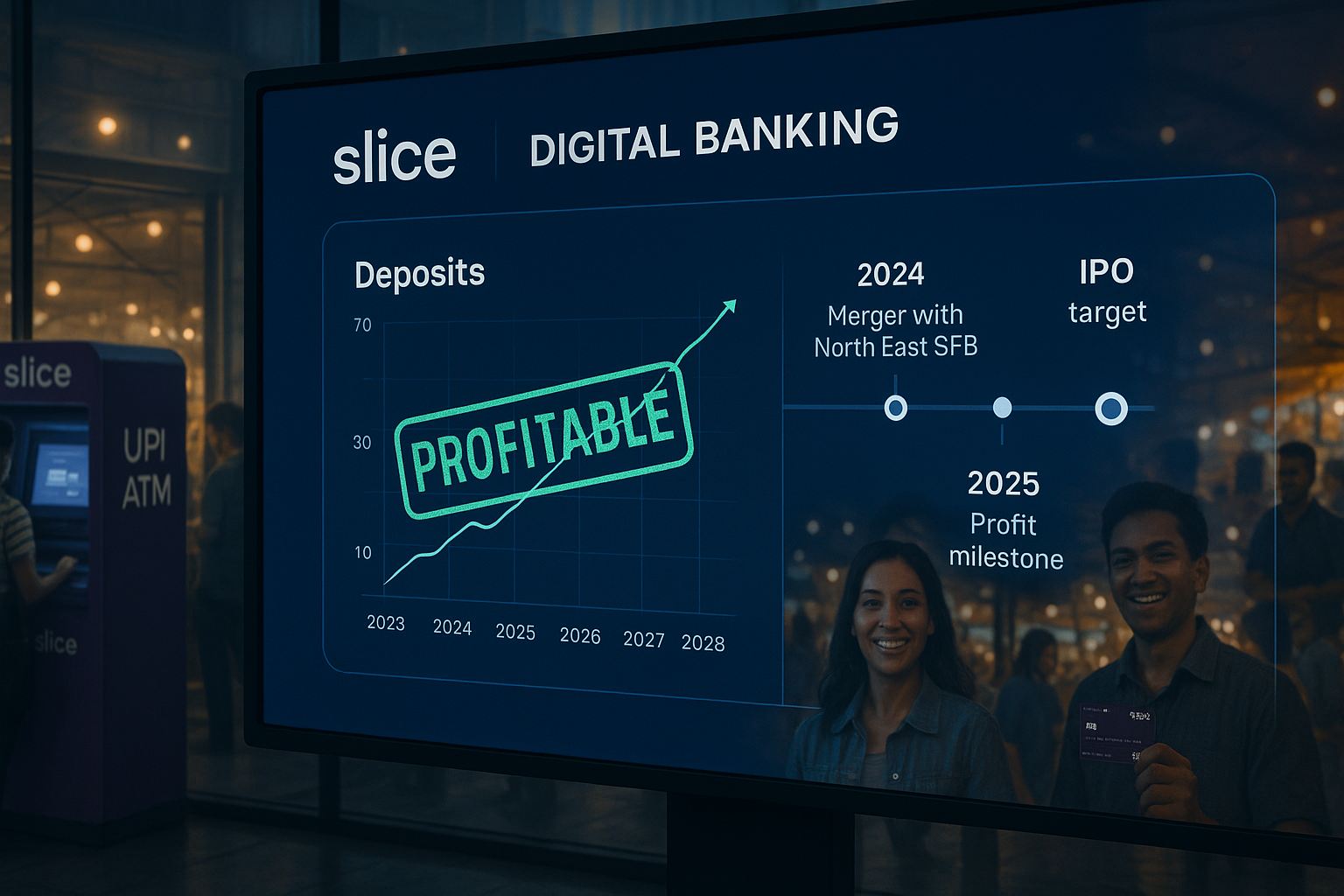
Slice Eyes Profitability and IPO After Bank Merger Milestone
Slice is now profitable and preparing for an IPO in 3–4 years, after merging with North East SFB and doubling its deposits.
<div class="qMYqUG_convSearchResultHighlightRoot"> <div class="" data-turn-id-container="request-WEB:4f963f5d-0bfa-479d-85a6-f2bb7e502ffd-10" data-is-intersecting="true"><section class="text-token-text-primary w-full focus:outline-none has-data-writing-block:pointer-events-none [&:has([data-writing-block])>*]:pointer-events-auto R6Vx5W_threadScrollVars scroll-mb-[calc(var(--scroll-root-safe-area-inset-bottom,0px)+var(--thread-response-height))] scroll-mt-[calc(var(--header-height)+min(200px,max(70px,20svh)))]" dir="auto" data-turn-id="request-WEB:4f963f5d-0bfa-479d-85a6-f2bb7e502ffd-10" data-turn-id-container="request-WEB:4f963f5d-0bfa-479d-85a6-f2bb7e502ffd-10" data-testid="conversation-turn-16" data-scroll-anchor="false" data-turn="assistant"> <div class="text-base my-auto mx-auto pb-10 [--thread-content-margin:var(--thread-content-margin-xs,calc(var(--spacing)*4))] @w-sm/main:[--thread-content-margin:var(--thread-content-margin-sm,calc(var(--spacing)*6))] @w-lg/main:[--thread-content-margin:var(--thread-content-margin-lg,calc(var(--spacing)*16))] px-(--thread-content-margin)"> <div class="[--thread-content-max-width:40rem] @w-lg/main:[--thread-content-max-width:48rem] mx-auto max-w-(--thread-content-max-width) flex-1 group/turn-messages focus-visible:outline-hidden relative flex w-full min-w-0 flex-col agent-turn"> <div class="flex max-w-full flex-col gap-4 grow"> <div class="min-h-8 text-message relative flex w-full flex-col items-end gap-2 text-start break-words whitespace-normal outline-none keyboard-focused:focus-ring [.text-message+&]:mt-1" dir="auto" data-message-author-role="assistant" data-message-id="376e2b1a-db78-41d7-9fb4-7c202eab5c40" data-message-model-slug="gpt-5-5" data-turn-start-message="true"> <div class="flex w-full flex-col gap-1 empty:hidden"> <div class="markdown prose dark:prose-invert wrap-break-word w-full light markdown-new-styling"> <h1 data-section-id="9ui7yk" data-start="284" data-end="348">UPI Banking: The Future of Digital Payments and Modern Finance</h1> <p data-start="350" data-end="773">Digital finance has evolved rapidly over the last decade, changing the way consumers and businesses interact with money. Among the biggest innovations in this transformation is UPI Banking, which has simplified real-time transactions and accelerated the shift toward cashless economies. What once required lengthy banking procedures can now be completed within seconds using mobile devices and digital payment applications.</p> <p data-start="775" data-end="1167">The success of UPI Banking is closely connected to rising smartphone adoption, internet accessibility, and changing customer expectations. Consumers today expect instant, secure, and seamless payment experiences that fit into their fast-moving lifestyles. Businesses also require efficient transaction systems capable of supporting both online and offline commerce without unnecessary delays.</p> <h2 data-section-id="m952cl" data-start="1169" data-end="1206">Why UPI Banking Is Growing Rapidly</h2> <p data-start="1208" data-end="1598">The global banking sector is witnessing a major digital shift as consumers move away from traditional payment methods. Younger generations especially prefer mobile-first financial experiences that offer convenience and flexibility. Consumers prefer UPI Banking because it allows instant transfers, QR-based payments, and simplified account management without complicated banking procedures.</p> <p data-start="1600" data-end="1927">Government support for digital finance has also contributed significantly to the expansion of digital payment ecosystems. Financial institutions and fintech companies continue investing heavily in payment infrastructure, mobile applications, and cybersecurity frameworks to improve user experiences and transaction reliability.</p> <p data-start="1929" data-end="2208">The rise of e-commerce, subscription platforms, and online services has further accelerated digital payment adoption. Customers now expect instant payment confirmation whether they are shopping online, ordering food, paying utility bills, or transferring money to family members.</p> <h2 data-section-id="1mirr0z" data-start="2210" data-end="2248">How UPI Banking Supports Businesses</h2> <p data-start="2250" data-end="2615">Small businesses and merchants have benefited enormously from digital payment systems over the past few years. Small merchants use UPI Banking to reduce dependency on cash while improving transaction speed and customer convenience. QR code payments and mobile-based transfers have become particularly popular among local stores, food vendors, and service providers.</p> <p data-start="2617" data-end="2995">Fintech firms expanded UPI Banking by introducing user-friendly applications that simplified onboarding and everyday financial transactions. These platforms encouraged millions of users to adopt digital payments for routine financial activities. As competition increased, banks also modernized their mobile banking services to remain relevant in an increasingly digital economy.</p> <p data-start="2997" data-end="3291">Large enterprises are also integrating digital payment systems into their operations. Businesses now rely on real-time payment processing for payroll management, vendor settlements, and customer refunds. Faster settlements improve cash flow management while reducing operational inefficiencies.</p> <p data-start="3293" data-end="3512">Another important advantage of digital transactions is transparency. Businesses can maintain better financial records, track payments instantly, and simplify accounting processes through automated transaction histories.</p> <h2 data-section-id="znmnw7" data-start="3514" data-end="3556">Security Challenges in Digital Payments</h2> <p data-start="3558" data-end="3863">As digital transactions continue growing, cybersecurity remains one of the biggest concerns for financial institutions and payment providers. As transaction volumes rise, UPI Banking platforms must constantly strengthen fraud detection systems and user authentication processes to maintain customer trust.</p> <p data-start="3865" data-end="4177">Cybercriminals increasingly target payment applications through phishing attacks, fake payment links, identity theft, and social engineering tactics. Financial institutions are investing heavily in encryption technologies, multi-factor authentication, and artificial intelligence-driven fraud monitoring systems.</p> <p data-start="4179" data-end="4414">Consumer awareness also plays a critical role in improving digital payment security. Users are encouraged to verify payment requests carefully, avoid suspicious links, and protect sensitive banking credentials from unauthorized access.</p> <p data-start="4416" data-end="4574">While security risks continue evolving, advancements in financial technology are helping digital payment ecosystems become safer and more resilient over time.</p> <h2 data-section-id="rgyfvo" data-start="4576" data-end="4609">Future of Digital Transactions</h2> <p data-start="4611" data-end="4955">The next phase of financial innovation is expected to bring even greater integration between banking, commerce, and technology platforms. Experts believe UPI Banking will continue evolving beyond simple peer-to-peer payments into a broader digital financial ecosystem supporting lending, investments, insurance, and subscription-based services.</p> <p data-start="4957" data-end="5273">Cross-border UPI Banking services could also transform international transactions by making global payments faster and more affordable. International payment partnerships may reduce dependency on expensive remittance channels while improving financial accessibility for travelers, freelancers, and global businesses.</p> <p data-start="5275" data-end="5591">Artificial intelligence may help UPI Banking providers improve customer experiences through personalized financial recommendations, predictive fraud detection, and automated support systems. AI-driven financial insights could help users manage spending habits, savings goals, and payment activities more effectively.</p> <p data-start="5593" data-end="5837">The expansion of wearable devices and voice-enabled payments may further change how consumers interact with financial services. Future payment systems are expected to become even more seamless, requiring minimal user effort during transactions.</p> <h2 data-section-id="1bijg6x" data-start="5839" data-end="5869">Role in Financial Inclusion</h2> <p data-start="5871" data-end="6255">One of the most significant impacts of digital finance has been its contribution to financial inclusion. In rural regions, UPI Banking has helped millions of individuals access formal financial systems through simple mobile-based payment solutions. Small business owners, gig workers, freelancers, and underserved communities now have greater access to digital commerce opportunities.</p> <p data-start="6257" data-end="6557">The accessibility of UPI Banking has reduced barriers that previously limited participation in modern financial systems. Individuals who lacked access to traditional banking infrastructure can now conduct digital transactions, receive payments instantly, and participate more actively in the economy.</p> <p data-start="6559" data-end="6741">This expansion of digital finance is creating new economic opportunities while encouraging broader adoption of banking services across different income groups and geographic regions.</p> <h2 data-section-id="8dtpi" data-start="6743" data-end="6756">Conclusion</h2> <p data-start="6758" data-end="7049">UPI Banking has changed the financial landscape by making transactions faster, simpler, and more accessible for consumers and businesses alike. Its influence extends far beyond digital payments, supporting fintech growth, business efficiency, and financial inclusion across modern economies.</p> <p data-start="7051" data-end="7394">Beyond payments, UPI Banking now represents a major step toward a fully connected digital financial ecosystem where banking services become increasingly integrated into everyday life. From retail shopping and e-commerce to business operations and cross-border transactions, digital payment infrastructure is reshaping how money moves globally.</p> <p data-start="7396" data-end="7552" data-is-last-node="" data-is-only-node="">With continued innovation, UPI Banking is expected to remain one of the most important drivers of digital transformation within the global banking industry.</p> </div> </div> </div> </div> </div> </div> </section></div> </div>
1 article
Jul 8, 2025
Slice is now profitable and preparing for an IPO in 3–4 years, after merging with North East SFB and doubling its deposits.