
Introduction
Modern applications rely heavily on APIs to exchange data, automate workflows, and connect systems across cloud platforms, financial services, e-commerce, healthcare, and enterprise software. Every time an application requests information, processes a payment, authenticates a user, or communicates with another service, an API is working behind the scenes. As organizations increase their reliance on APIs, maintaining visibility into every interaction becomes critical for ensuring performance, reliability, and security.API Logging provides that visibility by recording detailed information about API requests, responses, errors, authentication events, and system performance. These logs enable developers, security teams, and operations engineers to monitor application health, troubleshoot issues, detect suspicious activity, and optimize API performance.
As digital ecosystems become increasingly interconnected, API logging has evolved from a technical necessity into a strategic component of modern software development and cybersecurity.
What Is API Logging?
API Logging is the process of recording information about every interaction between an API and the applications or users that access it.
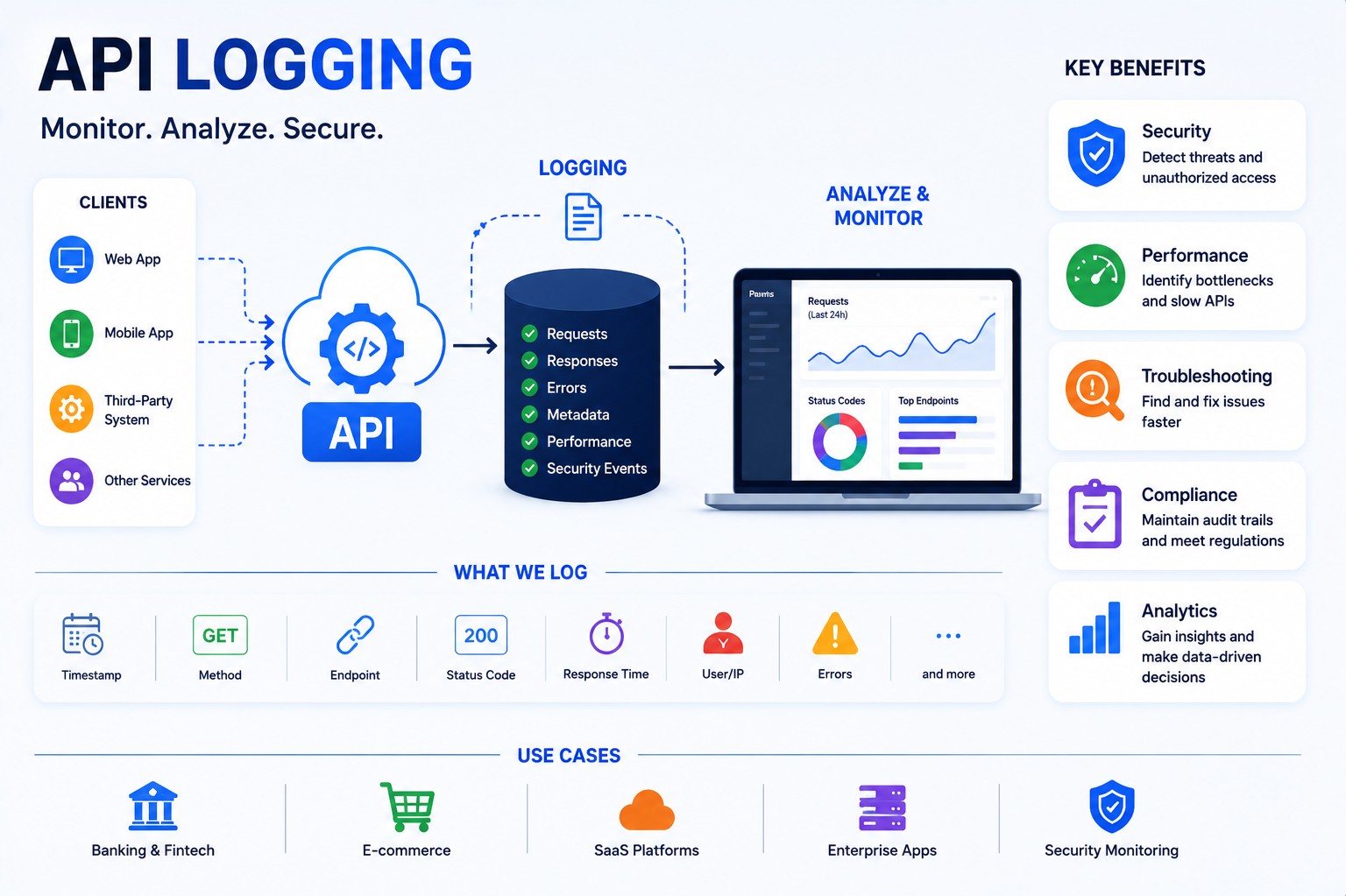
Each log entry typically captures details such as request time, endpoint accessed, HTTP method, response status, processing duration, user identity where applicable, IP address, authentication status, and error messages.
These records provide a complete history of API activity, helping organizations understand how their systems are being used and how they perform over time.
Why API Logging Matters
Without proper logging, identifying the cause of application failures or security incidents becomes extremely difficult.
API logging provides a detailed audit trail that helps teams investigate errors, diagnose performance bottlenecks, monitor system availability, and identify unauthorized access attempts.
It also supports compliance with industry regulations by maintaining accurate records of system activity.
As businesses increasingly depend on APIs for mission-critical operations, comprehensive logging has become essential for maintaining service reliability and customer trust.
How API Logging Works
Whenever an API receives a request, the logging system captures relevant information before, during, or after the request is processed.
The logged data is securely stored in centralized logging platforms or monitoring systems where it can be searched, analyzed, and visualized.
Operations teams use dashboards and automated alerts to monitor API performance in real time, while developers analyze logs to troubleshoot issues and improve application functionality.
Many organizations integrate logging with observability and security platforms for comprehensive system monitoring.
Information Captured in API Logs
API logs contain valuable operational and security information.
Common data includes timestamps, request URLs, HTTP methods, response codes, execution times, request sizes, response sizes, user authentication events, client IP addresses, device information, application identifiers, server responses, and error details.
Organizations carefully balance detailed logging with privacy requirements by avoiding the storage of sensitive customer information unless absolutely necessary.
Well-structured logs provide meaningful insights without exposing confidential data.
Benefits of API Logging
API logging improves operational visibility across complex applications.
Development teams can identify bugs more quickly, while operations teams monitor uptime and system performance. Security teams detect unauthorized access attempts, suspicious behavior, and potential cyber threats.
Businesses also gain valuable analytics regarding API usage, customer behavior, peak traffic periods, and service adoption.
These insights support better decision-making while improving overall system reliability.
API Logging and Security
Security is one of the primary reasons organizations implement API logging.
Detailed logs help identify failed login attempts, token misuse, abnormal request patterns, brute-force attacks, distributed denial-of-service (DDoS) activity, and unauthorized API access.
When combined with real-time monitoring and automated threat detection, logging enables security teams to respond quickly to incidents before they escalate.
Comprehensive audit trails also support forensic investigations following security events.
API Logging for Performance Monitoring
Performance monitoring relies heavily on API logs.
By analyzing request durations, latency, response times, throughput, and error rates, engineering teams can identify performance bottlenecks and optimize system resources.
Historical log analysis also helps organizations predict capacity requirements, improve scalability, and maintain consistent user experiences during periods of high demand.
Continuous monitoring ensures APIs remain responsive and reliable.
API Logging in Financial Services
Financial institutions rely extensively on API logging to support secure digital banking, payment processing, Open Banking, and regulatory compliance.
Every payment request, authentication attempt, account inquiry, and transaction event can be securely logged for monitoring and auditing purposes.
These logs help financial organizations detect fraud, investigate disputes, support Anti-Money Laundering (AML) monitoring, and maintain compliance with banking regulations.
Reliable logging strengthens both operational resilience and customer confidence.
Artificial Intelligence and API Log Analysis
Artificial intelligence is transforming API logging by automating the analysis of massive volumes of log data.
Machine learning algorithms identify unusual behavior, detect security threats, predict system failures, and recognize performance anomalies that traditional monitoring tools may overlook.
AI-powered observability platforms also automate alert prioritization, reducing operational workloads while improving incident response times.
These intelligent capabilities help organizations maintain highly available and secure API environments.
Best Practices for API Logging
Effective API logging requires careful planning and governance.
Organizations should define standardized log formats, capture meaningful operational data, protect sensitive information through masking or encryption, centralize log storage, automate monitoring, and establish appropriate log retention policies.
Regular log reviews and integration with security information and event management (SIEM) platforms further improve operational visibility and threat detection.
Following these practices ensures logging remains both useful and compliant.
Challenges of API Logging
While API logging provides significant benefits, it also presents operational challenges.
Large-scale applications generate enormous volumes of log data, requiring scalable storage and efficient search capabilities.
Organizations must also balance detailed monitoring with privacy regulations, avoid logging confidential customer information, and manage infrastructure costs associated with long-term log retention.
Selecting the right logging architecture helps address these challenges while maintaining high performance.
Future of API Logging
The future of API logging is closely connected to observability, artificial intelligence, cloud-native applications, and distributed microservices.
Modern logging platforms increasingly combine logs, metrics, and distributed tracing into unified observability solutions that provide complete visibility across complex digital systems.
As API usage continues growing across industries, intelligent logging systems will become even more important for supporting secure, scalable, and resilient digital infrastructure.
Organizations investing in advanced API observability today will be better prepared for tomorrow’s increasingly interconnected technology landscape.
Choosing the Right API Logging Solution
When evaluating an API logging platform, organizations should consider scalability, real-time monitoring, search performance, security capabilities, compliance support, cloud compatibility, API integration, alerting features, analytics dashboards, and ease of deployment.
A reliable solution should integrate seamlessly with existing infrastructure while supporting future business growth and evolving security requirements.
Selecting the right logging platform enables organizations to maintain high API availability, strengthen cybersecurity, and improve operational efficiency.
Conclusion
API Logging is an essential component of modern software development, providing the visibility needed to monitor API performance, troubleshoot issues, strengthen security, and support regulatory compliance. By recording every API interaction, organizations gain valuable insights into application health, customer behavior, and system reliability.
As APIs continue to power digital banking, e-commerce, cloud computing, and enterprise applications, effective API logging will remain fundamental to building secure, scalable, and high-performing digital services. Businesses that invest in robust logging strategies today will be better equipped to manage the growing complexity of tomorrow’s connected digital ecosystem.
Comments
No comments yet. Be the first to share your thoughts.
Leave a comment