
Introduction
The global payments industry is evolving rapidly as businesses and consumers demand faster, more secure, and more cost-effective ways to move money. While card payments continue to dominate online commerce, they often involve multiple intermediaries, transaction fees, and occasional payment failures caused by expired cards or declined authorizations. At the same time, customers increasingly expect greater control over their financial data and payment experiences.An Open Banking Payment Gateway addresses these challenges by enabling businesses to initiate secure payments directly from a customer’s bank account. Powered by regulated banking APIs, these gateways eliminate many of the traditional complexities associated with card payments while offering improved transparency, enhanced security, and real-time payment capabilities.
As Open Banking adoption accelerates worldwide, payment gateways built on this technology are becoming an important part of the digital payments ecosystem. They help businesses reduce payment costs, improve customer experiences, and support seamless account-to-account transactions across multiple industries.
What Is an Open Banking Payment Gateway?
An Open Banking Payment Gateway is a payment solution that allows businesses to accept payments directly from customers’ bank accounts using secure Open Banking APIs.
Instead of entering card details, customers authorize payments through their online banking application or mobile banking platform. The payment gateway securely communicates with the customer’s bank, initiates the transfer, and confirms the payment to the merchant.
This process enables direct account-to-account (A2A) payments while maintaining strong security and customer control.
How an Open Banking Payment Gateway Works
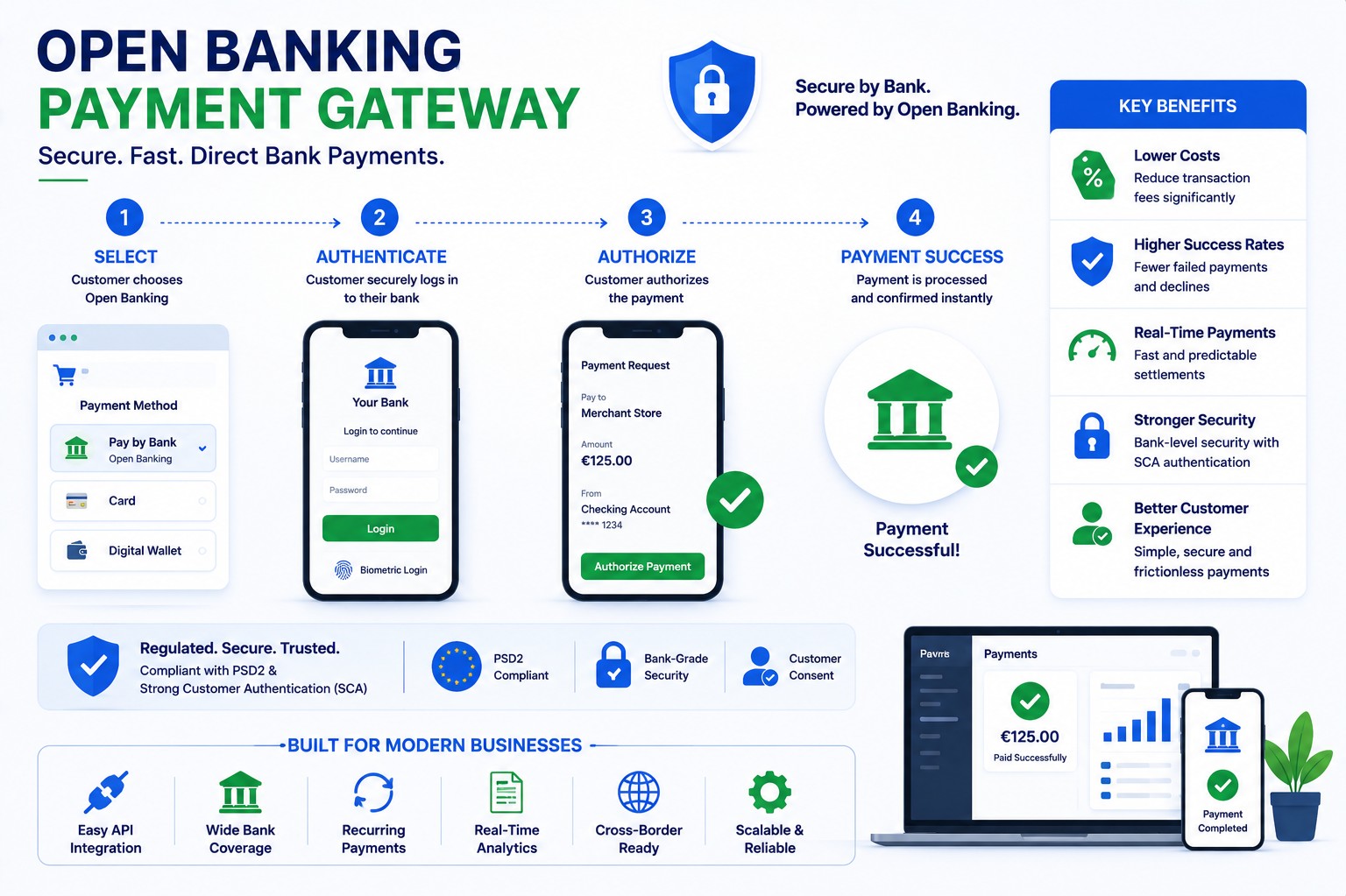
When a customer selects Open Banking as the preferred payment method during checkout, the payment gateway redirects them to their bank or banking application.
The customer securely authenticates using their bank’s existing security measures, such as biometric verification or multi-factor authentication, and approves the payment.
The gateway then sends a payment initiation request through Open Banking APIs. Once the bank authorizes the transaction, the funds are transferred directly from the customer’s account to the merchant’s account.
The merchant receives payment confirmation without requiring card processing.
Why Open Banking Payment Gateways Matter
Traditional payment systems often rely on multiple intermediaries, increasing processing costs and transaction complexity.
Open Banking payment gateways simplify this process by enabling direct bank-to-bank payments. Businesses can reduce payment processing fees, minimize failed transactions caused by expired cards, and improve payment transparency.
Customers benefit from secure authentication through their trusted banking applications while maintaining full control over payment authorization.
This combination of efficiency, security, and customer convenience is driving rapid adoption across the financial services industry.
Key Features of an Open Banking Payment Gateway
Modern Open Banking payment gateways offer a wide range of advanced capabilities.
They support secure payment initiation, direct bank transfers, real-time payment confirmation, API integration, recurring payment support, account verification, transaction reporting, payment reconciliation, refund management, and multi-bank connectivity.
Many providers also include dashboards, developer tools, and analytics that simplify payment management for businesses of all sizes.
Benefits for Businesses
Businesses adopting Open Banking payment gateways gain several operational advantages.
Direct account-to-account payments typically reduce transaction costs by eliminating certain card network fees. Payment settlements can occur more quickly, improving cash flow and reducing reconciliation effort.
Businesses also experience lower payment failure rates because transactions are linked directly to bank accounts rather than payment cards that may expire or be replaced.
The improved payment experience can increase customer satisfaction while supporting scalable business growth.
Benefits for Consumers
Consumers benefit from faster, more secure, and more transparent payment experiences.
Instead of entering sensitive card information during every purchase, customers authorize payments directly through their own banking applications using familiar authentication methods.
This reduces the risk of payment fraud while providing greater visibility into every transaction.
Customers also maintain full control over payment consent and account access.
Security and Customer Authentication
Security is one of the strongest advantages of Open Banking payment gateways.
Transactions are protected through encrypted API communication, Strong Customer Authentication (SCA), biometric verification, multi-factor authentication, and bank-level security controls.
Because customers authenticate directly with their financial institution, sensitive banking credentials are never shared with merchants.
Advanced fraud monitoring systems further strengthen payment security by identifying suspicious transaction patterns in real time.
Open Banking Payment Gateway vs Traditional Card Payments
Traditional payment gateways depend on card networks, payment processors, and acquiring banks to complete transactions.
An Open Banking payment gateway simplifies the process by enabling direct transfers between bank accounts through regulated APIs.
This reduces the number of intermediaries involved, lowers transaction costs, and improves payment transparency.
While card payments remain essential for many use cases, Open Banking offers an increasingly attractive alternative for businesses seeking efficient account-to-account payment solutions.
Industries Using Open Banking Payment Gateways
Open Banking payment gateways support businesses across numerous industries.
E-commerce retailers use them to reduce payment processing costs and improve checkout experiences. Subscription services automate recurring bank payments, while marketplaces process direct payments between buyers and sellers.
Financial institutions, utility providers, insurance companies, travel businesses, healthcare organizations, educational institutions, and government agencies also use Open Banking payment solutions to simplify payment collection and improve operational efficiency.
The technology continues expanding into new sectors as Open Banking adoption grows.
Artificial Intelligence and Payment Optimization
Artificial intelligence is enhancing Open Banking payment gateways by improving fraud detection, payment routing, and customer experience.
AI-powered systems analyze transaction behavior to identify suspicious activities, optimize payment authorization, predict payment failures, and automate payment reconciliation.
Machine learning continuously improves system performance by adapting to changing customer behavior and emerging fraud techniques.
These intelligent capabilities make Open Banking payments more secure and efficient.
Challenges and Considerations
Despite their many advantages, Open Banking payment gateways require widespread API availability, strong regulatory frameworks, and customer awareness.
Businesses should evaluate bank coverage, payment confirmation speeds, recurring payment capabilities, integration complexity, and regional Open Banking regulations before implementation.
Educating customers about Open Banking security and payment authorization can also help increase adoption.
Selecting an experienced payment provider simplifies implementation and ongoing support.
Future of Open Banking Payment Gateways
The future of Open Banking payment gateways is closely tied to the continued evolution of digital finance.
Real-time payments, embedded finance, Variable Recurring Payments (VRPs), digital identity, artificial intelligence, and cross-border Open Banking initiatives will continue expanding the capabilities of account-to-account payment systems.
As more financial institutions adopt standardized APIs, businesses will gain access to faster, more intelligent, and more flexible payment infrastructure.
Organizations investing in Open Banking today will be well positioned to compete in tomorrow’s digital economy.
Choosing the Right Open Banking Payment Gateway
Businesses selecting an Open Banking payment gateway should evaluate API quality, supported banks, payment initiation capabilities, recurring payment support, fraud prevention, reporting tools, developer resources, scalability, regulatory compliance, customer support, and pricing.
A reliable gateway should integrate seamlessly with existing payment infrastructure while supporting future business growth.
Choosing the right partner helps businesses maximize the benefits of Open Banking while delivering secure and frictionless payment experiences.
Conclusion
An Open Banking Payment Gateway is reshaping digital payments by enabling secure, direct account-to-account transactions through regulated banking APIs. By reducing reliance on traditional card networks, lowering transaction costs, improving payment security, and enhancing customer control, these gateways offer a modern alternative for businesses seeking efficient payment solutions.
As Open Banking continues to expand across global financial markets, payment gateways built on this technology will play a central role in the future of digital commerce. Businesses that adopt Open Banking payment solutions today will be better positioned to deliver faster, safer, and more seamless payment experiences while supporting long-term innovation and growth.
Comments
No comments yet. Be the first to share your thoughts.
Leave a comment