
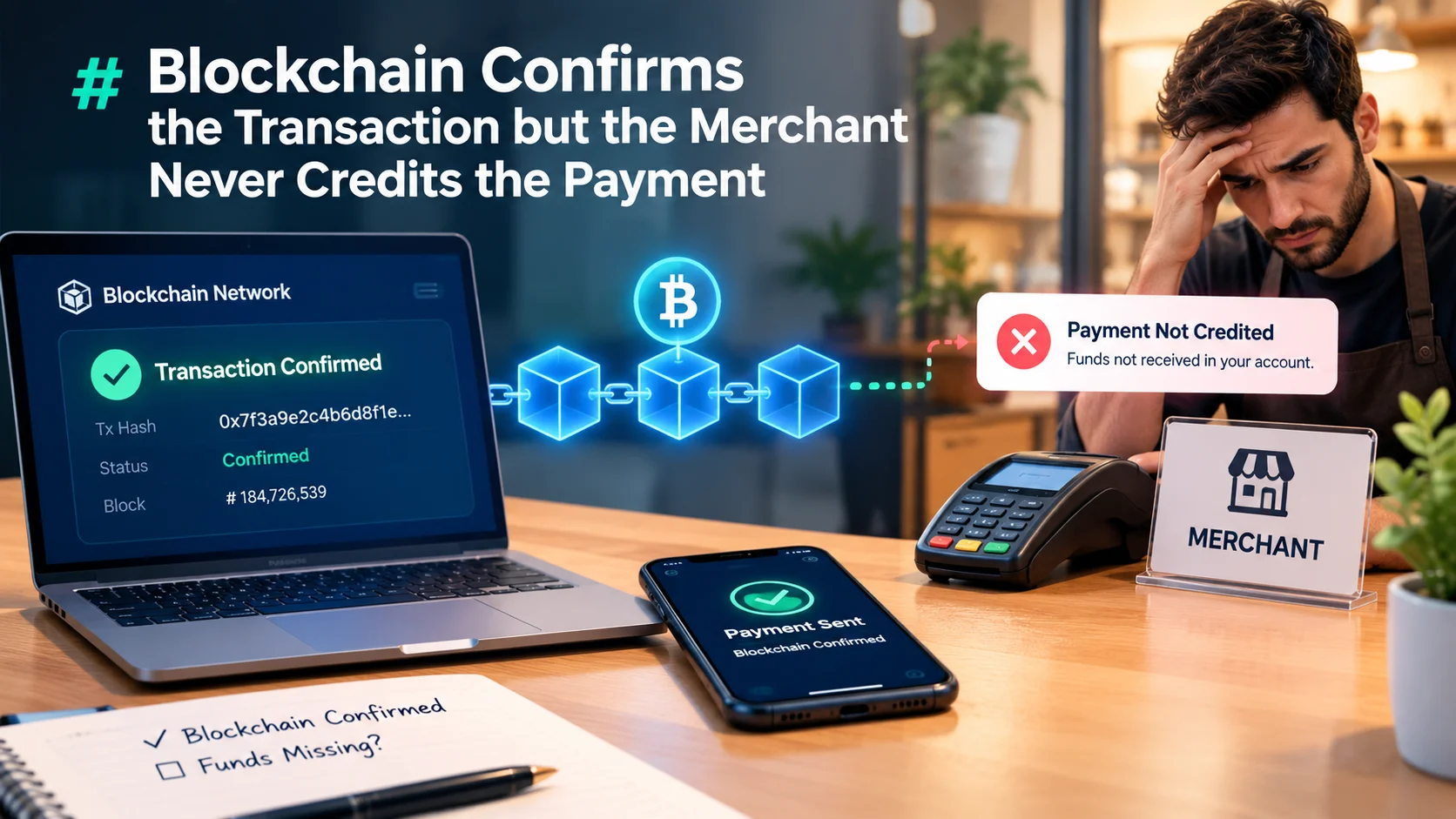
A customer sends a crypto payment and shows you a transaction hash. The blockchain explorer says it succeeded. Yet your order is still pending, your dashboard shows nothing, and your support inbox is filling up.
This situation is more common than most merchants expect, and it rarely means the blockchain failed. This guide explains why a confirmed transfer may never become a credited sale, how to diagnose each cause, and how to choose a setup that avoids the problem.
A confirmed on-chain transfer and a paid order live in two separate systems. The gap between them is where payments get lost, through wrong networks, missing tags, short payments, expired invoices, broken webhooks and compliance holds. Build a clear triage routine, write policies for exceptions, and choose payment providers that expose every payment state instead of hiding it.
Two Ledgers, One Order
A blockchain records that value moved from one address to another. It does not know about your invoice, your customer or your order number.
A crypto payment gateway is the layer between a business event and a blockchain transaction, and it is not the blockchain itself. It creates the invoice, watches for the transfer, tracks its status and tells your store when to release the order. In everyday crypto payment processing, that middle layer does most of the work, and most of the failures.
That is why a payment can be real on-chain and still invisible in your system. One analysis argues that most failed crypto payments come from interface and integration errors rather than blockchain failures.
The Journey a Payment Must Complete
For an order to be credited, several steps must all go right.
- Your system creates an invoice with an address, an amount and a time limit
- The customer sends the exact asset on the exact network
- The gateway detects the transfer
- The transfer reaches the required number of confirmations
- Any compliance checks pass
- The gateway credits the merchant account
- A webhook tells your store, and your store updates the order
One gateway describes a lifecycle with states for created, detected on the blockchain, credited, underpaid and expired. Each state is a place where a payment can stall.
Ten Reasons a Confirmed Payment Is Never Credited
1. The Wrong Network
This is the most common culprit. A customer can send a stablecoin such as USDT on a network the gateway does not watch, and the wallet raises no warning.
A familiar ticker can hide a different network, and that changes the address format, fee, confirmation behavior and recovery options. Blockchain transfers cannot be rejected or reversed by the recipient, so a wrong-network deposit is a permanent problem unless someone can recover it.
2. The Right Network, the Wrong Token
Deposits in unsupported tokens can reach the address on-chain but never appear in the merchant dashboard. Another gateway says a wrong currency or token cannot be processed in the normal way.
3. A Missing Memo or Destination Tag
Some networks need an extra identifier to match a payment to an account. Payments on Solana without a memo, or on XRP with a missing or invalid destination tag, are listed among the cases that cannot be processed automatically. Another processor says XRP deposits without the correct tag are not credited automatically.
4. The Customer Paid Too Little
Network fees, exchange withdrawal fees and rounding often shave a few units off the amount. An underpaid state exists for cases where funds arrive but fall short of the requested amount. One gateway's rules state that an underpayment is never treated as a completed payment.
Using a gateway where the displayed final amount already includes the network fee reduces this problem.
5. The Invoice Expired
Quotes in crypto are time-limited because prices move. A payment can arrive after the invoice has expired, and without a rule for late payments it becomes a manual support case. A single order may need multiple payment sessions if the first one expires.
6. Too Few Confirmations
A transfer included in a block is not the same as one your processor treats as final. One processor marks a Bitcoin invoice as confirmed after one confirmation, which averages about ten minutes, and as complete after two, about twenty minutes.
On Ethereum, blocks can take roughly 15 minutes to finalize, while a block explorer may show the transaction immediately. A low network fee can also leave a transaction waiting in the pool. A very low fee can freeze a transaction in the mempool.
7. The Webhook Never Arrived
Even when the gateway has credited the payment, your store may never hear about it. If the merchant's server is down or does not respond, the gateway's notification fails, which is why a retry mechanism matters.
Duplicates are the other side of the problem. A gateway may send the same notification twice. One SDK recommends verifying the webhook signature and matching the invoice, amount and asset against the local order before activating it.
8. The Payment Cannot Be Matched to an Order
Support may see a transaction hash but cannot find the order, while finance sees funds received but cannot match them to an invoice. This often traces back to missing order references or reused addresses.
9. A Compliance Hold
Compliance checks can delay credit even after the transfer is confirmed. Some transfers enter screening queues and manual reviews. Common outcomes include approving, approving with a hold, requesting more information or blocking.
10. Crediting Policy and Settlement Timing
Some processors only release funds once their own risk checks are satisfied. Crediting at zero confirmations can be exploited through replace-by-fee tricks or chain reorganizations. That is why careful processors wait, and why your dashboard may lag the chain.
Two Quick Examples
These are composite cases, not real ones, but they match common patterns.
The invisible stablecoin: A customer pays a 250 USDT invoice from an exchange and picks a cheaper network without noticing the difference. The explorer shows a success. The store never sees it, because the gateway watches only one network. Support spends a day tracing the hash and then explains that the funds may not be recoverable.
The short payment: A buyer sends exactly 99 units from an exchange that deducts a one-unit withdrawal fee, so 98 arrive. The invoice flips to underpaid, and the order stays locked. Without a tolerance rule, a small gap turns into a long email thread.
A Practical Triage Routine
When a customer says "I paid," follow the same steps every time.
- Collect the transaction hash, asset, network and amount sent.
- Check a block explorer. Confirm the network, token, destination address and confirmation count.
- Compare with the invoice. Does the address, asset and amount match?
- Check the gateway dashboard. Look for states such as underpaid, expired or on hold.
- Review webhook logs. Did your server receive and process the event?
- Ask the provider about holds. Request a status and an expected release time.
- Decide the outcome, credit, partial credit, refund, recovery request or escalation.
Keep a record of each case. Patterns tell you where your checkout needs fixing.
What Recovery Really Looks Like
Recovery depends on the provider and the mistake. These examples come from different exchanges and gateways, so treat them as illustrations, not rules.
- Some gateways say wrong-network payments usually cannot be recovered, though a technical review may sometimes succeed with an added fee.
- One exchange charges a standard recovery fee of around $100 and only collects it on success.
- Another charges €50 per eligible transaction and says deposits sent over Tron or Solana cannot be recovered.
- A processor warns that bitcoin sent to an Ethereum address cannot be accessed.
The lesson for merchants: prevention is cheaper than recovery, and recovery is never guaranteed.
How to Choose Payment Providers That Reduce These Failures
Not all setups are equal. Compare them on how they handle exceptions, not only on rates.
| Feature to check | Why it matters |
|---|---|
| Clear states for underpaid, overpaid, late and wrong network | Lets you act without guessing |
| Network and address validation at checkout | Prevents wrong-network payments |
| Fee-inclusive amounts | Reduces underpayments |
| Webhook retries and signed events | Prevents lost notifications |
| Dashboard visibility of unsupported deposits | Shows money that arrived but was not credited |
| Written recovery and refund policy | Avoids disputes later |
| Transparent compliance hold process | Sets expectations for merchant payment timing |
Custody and Settlement
Ask who controls the funds between payment and payout. Some designs send funds straight to the merchant wallet, while others route everything through a custodial processor. Custody affects who can hold, reverse or convert your money.
Also ask how settlement works. If your provider converts to fiat, find out the schedule, fees and conditions for each payment payout. Reserves and holds can apply to crypto merchant services just as they do for cards.
Policies Every Merchant Should Write Down
Decide your rules before the first dispute arrives.
- Underpayment tolerance: how much shortfall you will accept, and who pays for the difference
- Late payment rule: whether you honor expired invoices at the original or a new rate
- Refund rule: who pays network fees on a refund
- Recovery fees: whether you pass them to the customer
- Evidence: what the customer must provide, such as the hash, wallet and screenshot
- Response time: how quickly support replies
Publish a short version on your checkout and help pages. Clear rules reduce angry tickets.
Prevention: Fix the Checkout First
- Show the network name beside the address in large, plain text
- Display the exact amount, including fees, and a visible countdown
- Warn about required memos and tags
- Offer only the networks you actively monitor
- Keep a polling fallback so a missed webhook does not strand an order. One gateway's guide suggests polling the payment status after the final notification to confirm the paid amount.
- Make webhook handling idempotent so duplicates do no harm
- Reconcile daily, matching on-chain receipts to orders
FAQ
Does a confirmed transaction mean the merchant has been paid?
Not necessarily. It means the transfer is on the chain. Your gateway still has to detect it, match it to an invoice and credit it.
Can I get my money back if I sent the wrong network?
Sometimes, depending on the provider and asset, and usually for a fee. Some cases are not recoverable at all.
Why does my explorer show confirmed while the dashboard shows pending?
Your gateway may require more confirmations, run compliance checks or have indexing delays.
Who should handle these cases, support or finance?
Both. Support gathers evidence and finance decides on credit, refund or recovery. A shared process saves time.
The Bottom Line
When the chain says "confirmed" and your store says "pending," the problem is almost always in the middle: the network, the amount, the timing or the integration. Build a repeatable triage routine, publish clear policies and choose a provider that shows you every state a payment can be in.
Before you commit, compare crypto-ready payment providers and their settlement terms in the TheFinRate directory.
Comments
No comments yet. Be the first to share your thoughts.
Leave a comment