
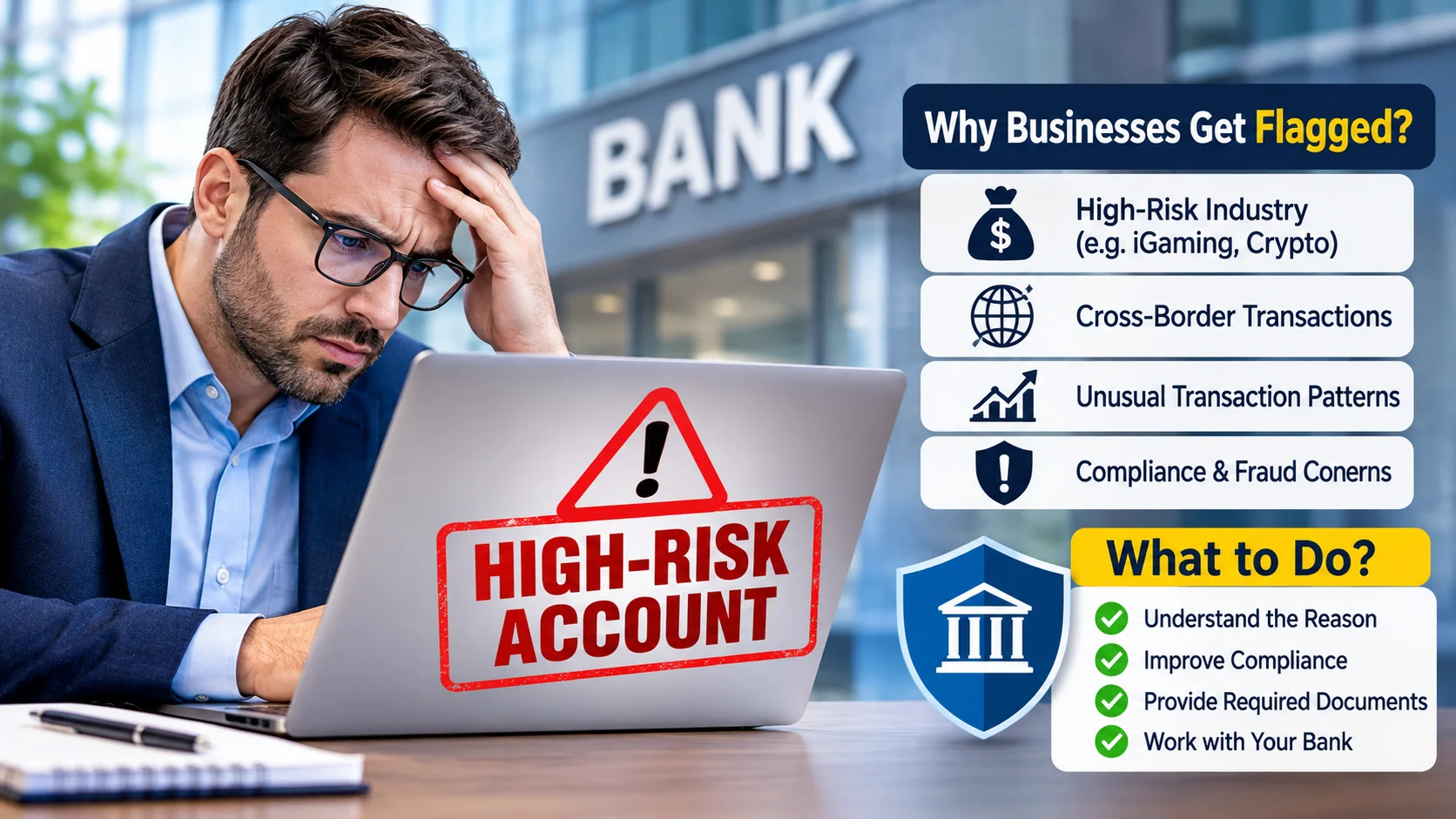
Getting a message that your bank has marked your business as "high risk" is stressful. It can mean extra paperwork, held payments, or even a closed account. The label is about the bank's own risk, not a judgement on whether your business is honest. This guide explains why it happens, how to spot it early and what to do next.
What does "high-risk account" mean at a bank?
Banks give every business customer a risk rating. The rating decides how much checking happens when you open the account and how closely the bank watches it afterwards.
A high-risk rating usually means more questions, more documents and closer monitoring. It does not mean you did something wrong.
This is also different from a high-risk merchant account, which is a card payment account for businesses that payment processors see as risky. We cover the difference near the end.
Why banks flag business accounts
Banks look at the whole picture, not only your industry. In the US, regulators have said banks can decide whether to open or keep an account based on factors such as the products and services you want, the locations you do business in, and the bank's ability to manage the risk.
The most common triggers are:
- Industry: sectors such as gambling, adult entertainment, crypto, forex, money transfer, tobacco and vaping. Banks differ on which ones they accept.
- Cross-border activity: payments to or from higher-risk countries, or many currencies moving through one account.
- Unclear ownership: layered companies or structures where it is hard to see who really owns the business.
- Unusual activity: sudden spikes, many small payments in and one large payment out, or activity that does not match what you told the bank at account opening.
- High refund or return rates: a pattern that can look like a problem with the business model.
- Weak paperwork: missing licences, a vague business description, or a website that does not match what you actually do.
- Negative news or screening hits: a name match on a sanctions or watch list, even a false one, can trigger a review.
One trigger alone rarely decides it. Banks usually weigh several of them together.
What the rules say in the US, UK and Singapore
United States: Banks must use a risk-based approach to customer due diligence, including building a risk profile for each customer. In July 2022 the Federal Reserve, FinCEN, the OCC and other agencies issued a joint statement. It encouraged banks to assess each customer individually instead of declining whole categories of customers. The same statement confirmed that banks still choose whether to open or keep a relationship.
United Kingdom and Singapore: Both also work on a risk-based approach. UK banks follow the UK's money laundering regulations, and Singapore banks follow the Monetary Authority of Singapore's anti-money-laundering requirements.
The practical point: the rules push banks to judge each business on its own facts, but they do not force a bank to take you on. Your best protection is a clear, well-documented file.
Warning signs your bank sees you as high risk
- A new questionnaire or request for extra documents outside the normal review cycle
- Questions about specific payments or customers
- Payments or wires held for review
- New limits, fees or reporting requirements
- An account review notice or a closure letter
Banks may not explain the full reason, especially where compliance rules limit what they can share. So treat early requests seriously and answer them quickly.
What to do if your bank flags your business
- Reply fast and completely: Missed deadlines are a common reason accounts get restricted.
- Explain your business in plain words: Say what you sell, who pays you, from which countries, and how the money flows.
- Back it up with documents: Contracts, invoices, licences, tax registration, supplier agreements and your website all help.
- Explain unusual activity before they ask: A big one-off payment, a new market or a seasonal spike is easier to accept with a short note.
- Ask for a named contact: such as a relationship manager, and keep a written record of every exchange.
- Know your options if the account is closed: Check your account terms for the notice period and use the bank's complaints process. In the UK, some small businesses can take a complaint to the Financial Ombudsman Service, but eligibility rules apply, so check them first.
- Open a backup account before you need one: Moving fast after a closure is much harder without one.
If your industry is high-risk, plan ahead
If you work in a sector banks watch closely, a little planning avoids most of the pain.
- Ask a bank directly whether it serves your industry before you apply.
- Be upfront at account opening. Hiding the business model is one of the fastest routes to a closure later.
- Keep personal and business money separate.
- Do not spread money across many accounts without a reason.
- Keep your documents current, so you can answer a review within a day or two.
High-risk bank account vs high-risk merchant account
These are two different things, and mixing them up causes confusion.
- A business bank account holds your money.
- A merchant account lets you accept card payments. It is provided by a payment processor working with an acquiring bank.
If you take card payments in a high-risk industry, you may need a specialist merchant account, and you will still need a bank account for the settlements. Compare providers carefully before signing. Check the reserve terms, fees, chargeback rules, settlement time and contract length. You can browse and compare high-risk payment providers in the TheFinRate directory.
Frequently asked questions
Does "high risk" mean my business is bad? No. A risk rating is an internal classification used by the bank, and it is not an accusation.
Can a bank close my business account? Usually yes. Terms vary by bank and country, and many account agreements allow closure with notice. Read your account terms and ask the bank about its process.
Can I open another account after a closure? Yes, but it can be harder. Be honest about the history, explain the business clearly, and choose a bank that serves your industry.
Is a high-risk bank rating the same as a high-risk merchant account? No. One is a risk rating on your bank account, and the other is a type of card payment account.
This article is general information, not legal or financial advice. Rules differ by country and by bank, so check with your bank or a qualified adviser for your situation.
Comments
No comments yet. Be the first to share your thoughts.
Leave a comment