
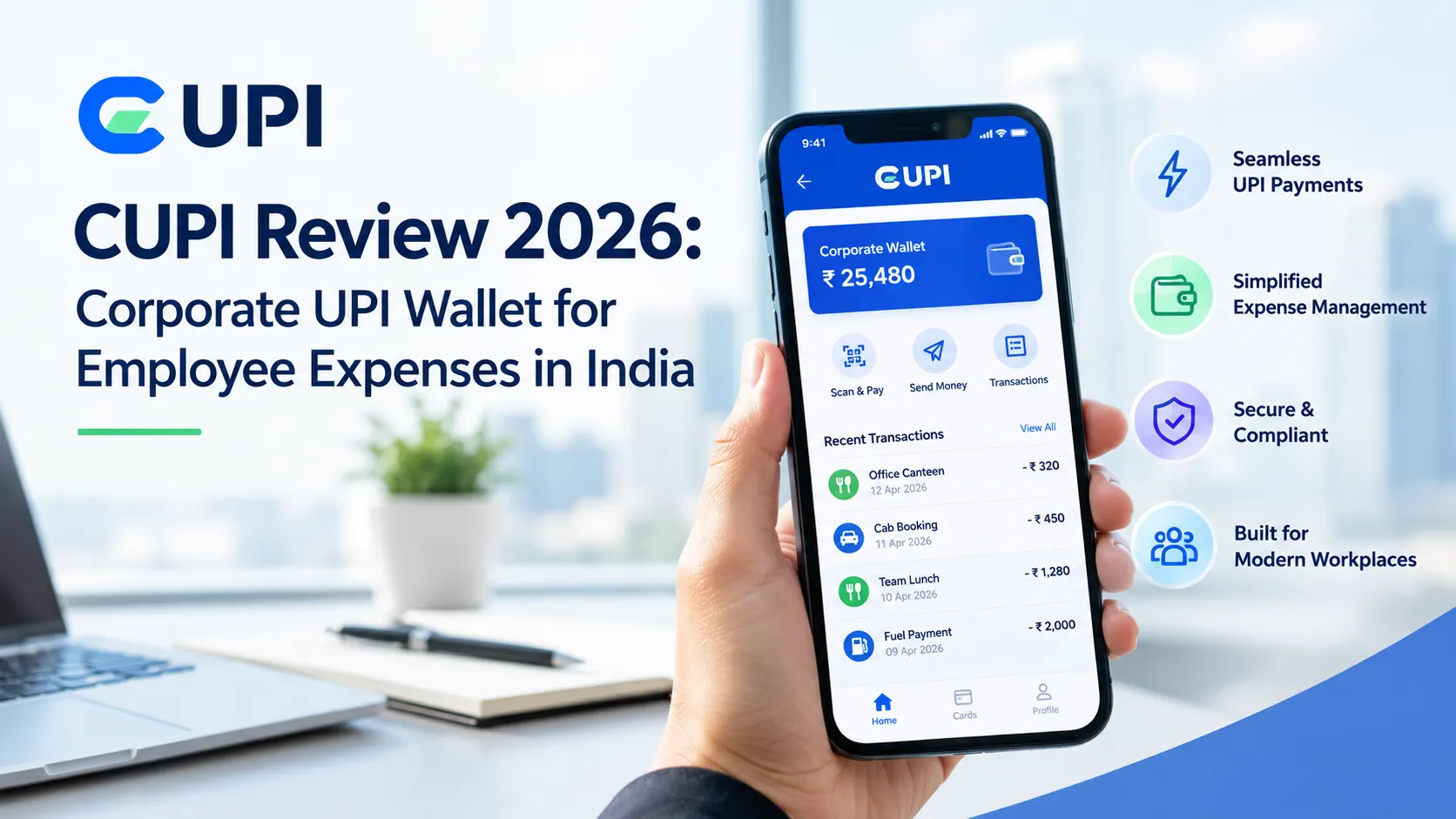
Quick verdict
CUPI is a corporate expense tool built around UPI, the payment rail most Indian vendors already accept. A company funds one wallet, gives employees spending limits, and sees every payment as it happens. It is a strong fit for businesses drowning in cash advances and reimbursement claims. It is also young, India-only and not a payment acceptance product, so it should be evaluated as expense software, not as a payment processor.
| Category | Corporate expense management via UPI |
| Based in | Bengaluru, India |
| Founded | 2025 |
| Pricing | ₹199 per employee per month (₹99 on the yearly plan) + ₹1.10 or 0.15% per transaction |
| Best for | Field teams, multi-site operations, SMEs replacing petty cash |
| Not for | Businesses outside India, or merchants wanting to accept payments |
What is CUPI?
CUPI describes itself as India's first corporate UPI platform. The idea is simple: instead of handing employees cash or asking them to pay out of pocket and claim later, the company issues a shared UPI wallet. Employees scan any UPI QR code or pay any UPI ID, and the spend is drawn from company funds.
The product is the flagship of EscrowStack, a fintech infrastructure company focused on UPI payments, API banking and digital escrow. According to Tracxn, CUPI itself was founded in 2025 in Bengaluru, has not raised outside funding, and had 37 employees as of August 2026. A trade press release dated 30 September 2026 says the company is aiming to reach thousands of businesses over the next 12 to 24 months. CUPI's own site claims 1,000+ businesses and 50,000+ employees; that figure is company-reported and not independently verified.
How CUPI works
- A company admin onboards employees to the platform (full-time or contract staff).
- Employees log in on the CUPI app with their mobile number and an OTP.
- The company funds the shared wallet from its corporate current account.
- Employees pay any UPI ID or QR code, choose a spend category and upload receipts.
- Finance sees each payment live and reconciles automatically.
Spending limits can be set per person, and the product describes pre-authorised spending rules so overspending is blocked before it happens.
Key features
- Company UPI wallet: one shared pool of funds, with individual limits per employee.
- Real-time tracking: every payment is logged and categorised as it happens, not weeks later.
- Auto-reconciliation: payments are matched automatically, reducing manual spreadsheet work.
- Admin dashboard: limits, approvals and reports in one place.
- Mobile apps: available on both the App Store and Google Play.
- Industry playbooks: dedicated pages for manufacturing, restaurants, pharma, hospitals, logistics, construction, events and hospitality, each built around that sector's everyday spends (fuel and tolls for logistics, MR travel for pharma, site purchases for construction).
CUPI pricing explained
CUPI's published pricing has three parts:
| Plan | Price | Notes |
|---|---|---|
| Monthly | ₹199 per employee per month | Charged only for active users; no transactions in a month means no charge |
| Yearly | ₹99 per employee per month (50% off) | Paid in advance for the year |
| Setup fee | ₹15,000 | Waived for sign-ups before 15 October (check the current date on the site) |
| Transaction fee | ₹1.10 or 0.15%, whichever is higher | Applies to payments |
What this means in practice: The ₹1.10 minimum and 0.15% rate cross over at roughly ₹733. Payments below that cost a flat ₹1.10; payments above it cost 0.15%. A ₹10,000 vendor payment would carry a ₹15 fee.
Example for a 50-person field team on the yearly plan:
- Subscription: 50 x ₹99 x 12 = ₹59,400 per year
- Setup: ₹15,000 (unless waived)
- Transaction fees: depend on volume, so model them using your own monthly spend
Always confirm GST treatment and whether the quoted prices are inclusive before comparing against other tools.
Strengths
- Fits how India pays: Small vendors, fuel stops and kirana stores take UPI, but often not corporate cards. CUPI works where cards don't.
- Kills the reimbursement cycle: Employees don't front money or chase claims, and finance doesn't chase receipts.
- Real-time visibility: Spend is visible the moment it occurs, which is the core difference from cash advances.
- Usage-based pricing: Paying only for active users keeps costs aligned with real use.
- Low barrier to start: Onboarding is app-based and described as taking minutes.
Limitations
- Very new, and unfunded: Founded in 2025 and without disclosed funding, so ask about roadmap, support commitments and financial stability.
- India only: UPI is an Indian rail. International teams or overseas spend are out of scope.
- Limited independent evidence: I found no third-party review sites with meaningful customer feedback, so most performance claims come from CUPI's own materials.
- Wallet funding means locked cash: A shared wallet still has to be funded in advance, although CUPI argues a single pooled fund locks up less capital than individual advances.
- Not a card replacement everywhere: Where a merchant accepts only cards or online checkout, UPI may not be an option.
How CUPI compares
CUPI sits between traditional petty cash and full spend-management suites. Tracxn lists Pice, BharatNXT and Transaction Solutions International among its closest competitors. Corporate cards give wider global acceptance but often lack the instant small-vendor reach that UPI provides. Reimbursement tools fix the paperwork but still require employees to pay first. CUPI's differentiator is paying with company money at the point of sale, using a rail every Indian vendor knows.
Who should consider CUPI?
- Companies with large field or sales teams that spend daily on fuel, travel and small purchases
- Manufacturers, hospitality groups and logistics firms paying many small vendors
- Finance teams that want live visibility without building a card programme
- Growing SMEs moving from cash and spreadsheets to something auditable
Who should look elsewhere?
- Businesses needing global or cross-border spend management
- Teams that only pay large vendors by bank transfer
- Companies that require long-established vendors with public track records
Questions to ask before signing
- Which bank or regulated entity holds and moves the funds?
- What security certifications apply? The CUPI site links what appears to be an ISO 27001 certificate for Escrow Stack; ask for the current copy.
- How are failed payments, refunds and disputes handled?
- What is the data export format for audits and accounting software?
- Is the setup fee waiver in writing, and until when?
FAQ
Is CUPI a payment gateway?
No. It is an expense-management platform that lets employees pay out through UPI. It does not help a business accept payments.
Do employees use personal bank accounts?
No. The company says employees pay with company funds, so personal reimbursements are not needed.
Who can be added as a user?
Both full-time and contract employees can be added through the admin dashboard, according to CUPI's FAQ.
How much does CUPI cost?
₹199 per employee per month, or ₹99 on the yearly plan, plus a transaction fee of ₹1.10 or 0.15%, whichever is higher, and a ₹15,000 setup fee that is sometimes waived.
Is CUPI available outside India?
It is built on UPI and designed for Indian businesses.
Final verdict
CUPI addresses a real, unglamorous problem: how field and office teams spend company money without cash, claims or blind spots. Its UPI-first design is a genuine advantage in the Indian market, and the pricing is easy to understand. The trade-offs are its short track record and the lack of independent reviews, so run a pilot with one team, confirm the compliance and banking details, and then scale.
Disclosure: This review is based on public information available in October 2026, including the company's website, app store listings, press coverage and third-party company profiles. Verify current pricing and terms with the vendor before purchase.
Comments
No comments yet. Be the first to share your thoughts.
Leave a comment