
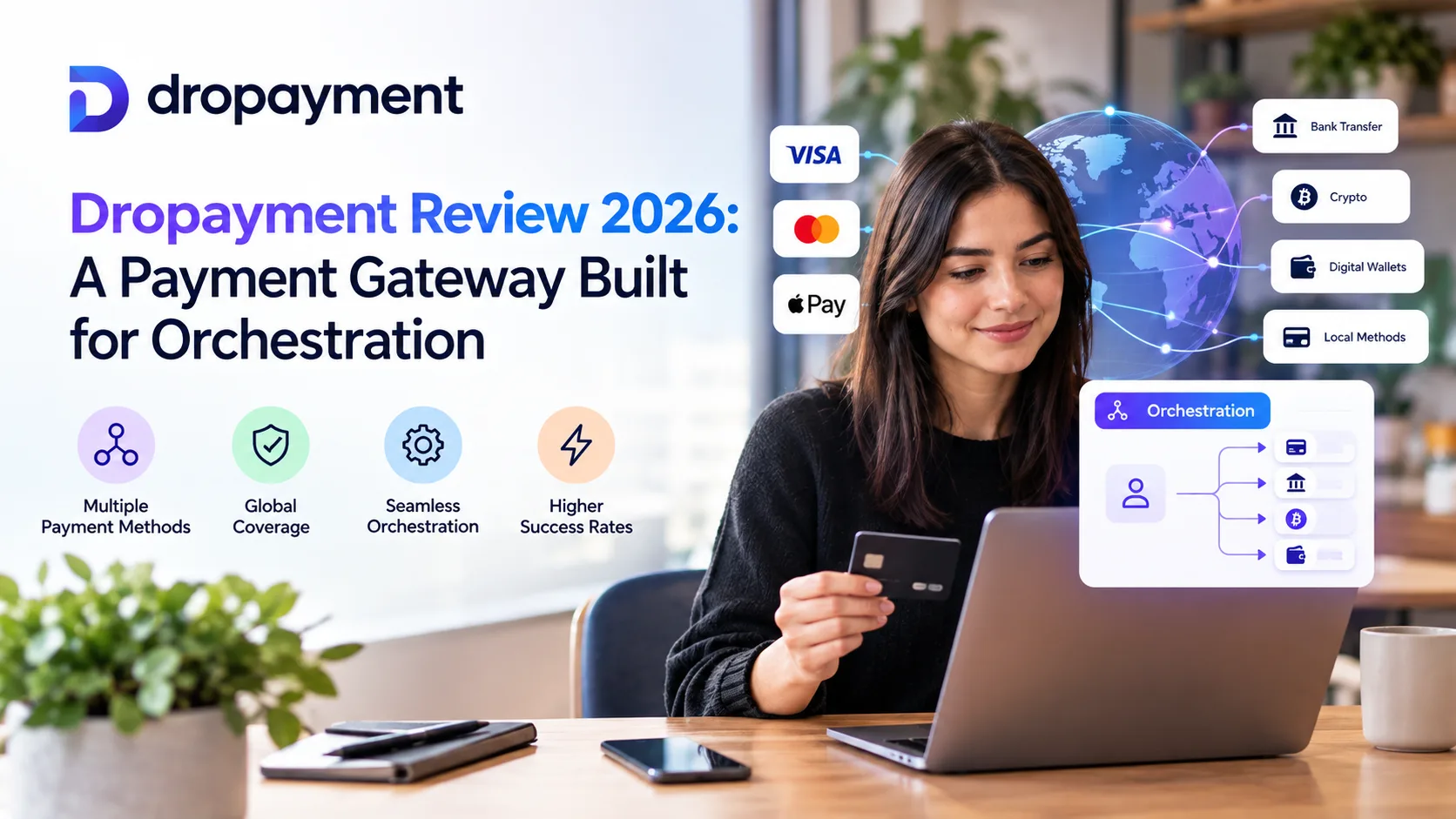
Most payment gateway comparisons assume a merchant is shopping for one direct relationship. Dropayment is built for a different buyer entirely, payment facilitators, resellers, and platforms that need to manage multiple processors, merchants, and payment flows from a single system, the plumbing behind other people’s payment experiences.
Dropayment is a PCI DSS-certified payment gateway platform founded by a team with 35-plus years of combined experience across payments, finance, and fintech in Europe, Africa, and Latin America. It supports card processing (Visa, Mastercard, American Express, Discover), payouts, transfers, and recurring payments via REST API, and is independently integrated as a connector within established payment orchestration platforms like Corefy and Rebilly, a meaningful form of third-party validation in a market where self-reported claims are easy and independent integration is harder to fake. For a business evaluating payment processing infrastructure at the orchestration or reseller level, the comparison criteria look different than for a typical merchant, and this review walks through exactly what to check.
Why Payment Orchestration Is a Different Buying Decision
A standard merchant evaluating a payment gateway asks, does it accept my customers’ preferred payment methods, at what rate, with what settlement speed? A payment facilitator, platform, or reseller evaluating a gateway like Dropayment asks a different set of questions entirely, can it manage multiple merchant accounts under one system, does it support white-labeled payment forms, can it route transactions across several processors, and does its API handle the operational complexity of managing payments on behalf of other businesses rather than just one?
This distinction matters because it changes what “good” looks like. A payment solution optimized for a single merchant’s checkout flow isn’t necessarily built for managing dozens or hundreds of sub-merchants, each potentially needing different processors, currencies, and risk profiles, which is precisely the use case Dropayment’s own documentation is built around.
What Dropayment Actually Offers
Dropayment’s technical documentation describes a system built around several core roles, Processors (integrations with external payment institutions and providers), Endpoints (uniquely identified terminals assigned to merchants), Projects (configurations connecting endpoints for one or multiple merchant accounts), and distinct Manager and Merchant account types with different levels of access. This is architecture built explicitly for a multi-party payment processing environment, a payment facilitator managing many underlying merchants, rather than a single-business checkout integration.
Functionally, the platform supports card processing with sale, refund, and query operations, SBP (a reference to Russia’s Faster Payments System), payouts, transfers, and recurring payments, accessible via REST API, server-to-server integration, or hosted payment forms depending on a connecting party’s PCI compliance level and technical requirements. Merchants and resellers get a dashboard for orders, reports, batch operations, and customer management, while Manager-level accounts, typically representatives of the PSP or payment institution itself, get broader configuration access across processors, gates, and connected projects.
The Independent Validation Worth Noting
One of the more useful signals in evaluating any B2B payment infrastructure provider is whether other established platforms have chosen to integrate with it, because that requires technical due diligence from a second party with its own reputation at stake. Dropayment appears as a documented connector within both Corefy and Rebilly, two established payment orchestration and subscription billing platforms respectively. Corefy’s own description of the integration frames Dropayment as “a payment processing platform designed to facilitate online and offline transactions,” offered as a payment method businesses can add to their existing payment stack through Corefy’s broader orchestration layer.
This kind of integration doesn’t guarantee a specific business relationship will go well, but it is a meaningfully stronger signal than a payment provider’s own marketing copy alone, since it means at least one other payments company evaluated Dropayment’s API and reliability closely enough to build and maintain a live connector to it.
2026 Context: Why Orchestration-Layer Gateways Matter More Now
The payment orchestration market has grown specifically because single-processor dependency has become a recognized operational risk rather than a theoretical one, businesses that route 100% of volume through one processor face real exposure if that processor experiences an outage, a sudden account review, or simply underperforms on approval rates for certain transaction types compared to a competitor. A gateway built from the ground up around multi-processor, multi-merchant architecture, like Dropayment, is structurally positioned for exactly this shift, rather than retrofitting orchestration features onto a single-merchant checkout product.
What to Verify Before Choosing Dropayment (or Any Orchestration Gateway)
- Your actual integration model: Confirm whether you need REST API, server-to-server, or hosted form integration based on your PCI compliance level, and ask for documentation specificity rather than general assurances.
- Supported processors and regions: A gateway’s value in an orchestration role depends entirely on which underlying processors and payment methods it can actually route to, ask for the current, specific list relevant to your markets.
- Reseller/Manager account structure: If you’re a payment facilitator rather than a single merchant, confirm exactly how multi-merchant management, reporting, and risk controls work in practice, not just in the sales deck.
- PCI DSS certification scope: Confirm what the certification actually covers for your specific integration method, since PCI requirements shift depending on how much cardholder data touches your own systems versus the gateway’s.
- Support and account management model: particularly if you’re managing multiple underlying merchants and need responsive support when a specific sub-merchant’s processing is affected.
Who Dropayment Fits
Payment facilitators, platforms building embedded payment features for their own merchants, and payment resellers needing multi-processor routing and management infrastructure are the clearest fit for Dropayment’s architecture, this is a payment provider built for exactly that operational model, evidenced by both its own documentation and its real-world integration into other orchestration platforms. Businesses in Europe, Africa, and Latin America specifically may find particular relevance given the founding team’s stated regional experience.
It’s a less direct fit for a single small business simply looking for a straightforward checkout integration, where the multi-merchant, multi-processor architecture adds complexity that isn’t needed for a simpler use case.
Final Take
Dropayment occupies a specific and genuinely useful niche, payment gateway infrastructure built for orchestration and reseller use cases rather than single-merchant checkout. The independent integration into Corefy and Rebilly is a real, verifiable signal of technical credibility beyond self-reported marketing claims, a distinction worth weighing seriously for any business evaluating it as infrastructure to build on top of, rather than a simple drop-in payment button.
FAQ
Is Dropayment suitable for a single small business, or only for platforms and resellers?
It’s architecturally built around multi-merchant, multi-processor management, which makes it most relevant for payment facilitators, platforms, and resellers rather than a single business seeking a simple checkout integration.
What does it mean that Dropayment is integrated into Corefy and Rebilly?
Both are established, independent payment orchestration and billing platforms that chose to build and maintain a technical connector to Dropayment, a stronger form of validation than self-reported claims, since it required independent technical evaluation.
What payment operations does Dropayment support?
Card processing (sale, refund, query), payouts, transfers, and recurring payments, accessible via REST API, server-to-server integration, or hosted payment forms depending on the connecting party’s PCI compliance needs.
Is Dropayment PCI DSS certified?
Yes, according to its own technical documentation, which states the platform is a PCI DSS certified system for accepting, processing, storing, and transmitting payment data.
Comments
No comments yet. Be the first to share your thoughts.
Leave a comment