
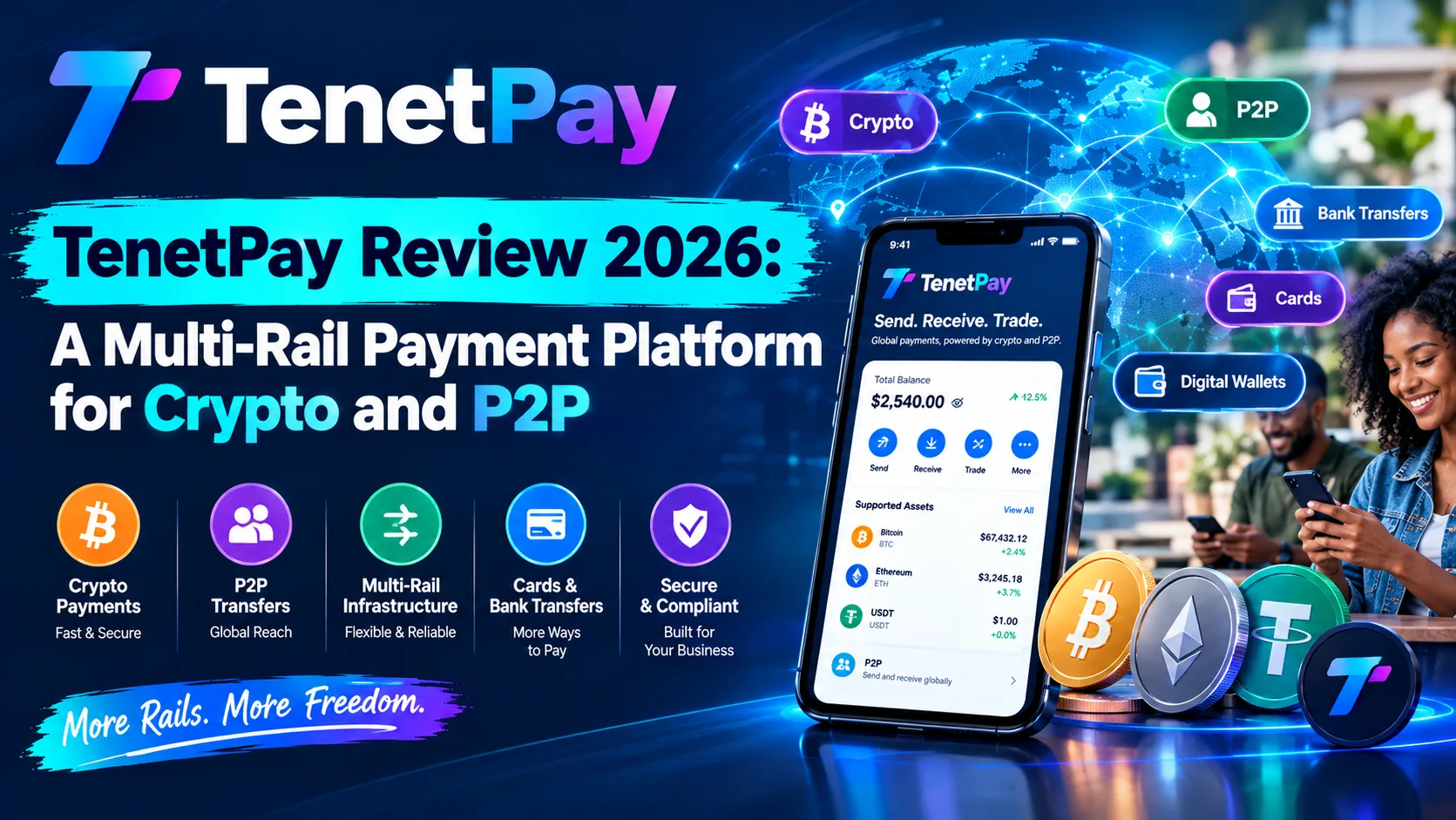
Businesses operating in markets where card infrastructure is unreliable or restricted increasingly need more than one payment rail just to keep revenue flowing. TenetPay’s positioning, crypto, P2P, mobile, and bank transfer under one platform, is a direct response to that reality.
TenetPay describes itself as a next-generation payment platform supporting cryptocurrency, P2P, mobile, and bank transfer payment acceptance for modern businesses. Multi-rail payment platforms like this have become more relevant as markets with restricted or unreliable card processing infrastructure push both consumers and merchants toward P2P and crypto-based alternatives, a shift visible in the data, cross-border crypto payments grew more than 40% year over year in 2025, and P2P crypto trading volumes in several regions have grown specifically as a workaround for banking and card limitations. The key evaluation question for a platform like TenetPay isn’t feature breadth, it’s how each individual rail actually performs in your specific market.
Why Multi-Rail Payment Platforms Are Growing
A single-rail payment gateway is a liability in any market where that one rail is unreliable, whether because of banking restrictions, card network limitations, or regulatory friction around specific payment types. The response across the industry has been a shift toward payment platforms that support several distinct rails simultaneously, crypto for markets with capital controls or banking gaps, P2P transfer for peer-driven markets where trust networks matter more than institutional rails, mobile payments for regions where smartphone penetration outpaces traditional banking, and standard bank transfer for everything else.
This is exactly the positioning TenetPay describes: crypto, P2P, mobile, and bank transfer together, aimed at businesses that can’t rely on a single payment method working consistently across their full customer base.
What TenetPay Offers
TenetPay’s stated proposition centers on flexibility across payment types rather than depth in any single one, the platform pitches itself as a payment solution for accepting crypto payments, P2P transfers, and both mobile and bank transfer-based payments through a unified system, aimed at merchants operating in markets where reliance on a single payment method creates real revenue risk.
For a merchant, the practical value of a platform like this shows up in a specific scenario: a customer whose bank card gets blocked mid-transaction, or who simply doesn’t trust card payments for a given purchase category, can complete the same transaction through a P2P or crypto rail instead, recovering a sale that a single-rail payment gateway would have simply lost.
The Real Data Behind This Shift
The move toward P2P and crypto rails alongside traditional payment processing isn’t a marginal trend, it’s showing up clearly in 2025-2026 data.
- Cross-border crypto payments grew more than 40% year over year in 2025, with stablecoins making up the majority of that volume.
- The global crypto payment gateway market reached an estimated $2.7-3.8 billion in 2026, growing at 18-22% annually, a pace well above traditional payment processing growth.
- B2B stablecoin payment volume specifically grew roughly 733% year over year to approximately $226 billion.
- In markets with tightened banking access to conventional crypto on-ramps, P2P platforms have absorbed meaningfully more transaction volume as users and merchants route around card and banking restrictions, a pattern documented across multiple regional markets facing similar constraints.
This context matters for evaluating any multi-rail payment provider: the demand for P2P and crypto alternatives alongside traditional bank transfer isn’t hypothetical, it’s a measurable and accelerating shift in how payment processing actually happens in constrained markets.
What to Scrutinize Before Choosing a Multi-Rail Platform
Breadth across four payment rails sounds appealing on a features page, but it raises a specific due-diligence question that a single-rail gateway doesn’t, is each rail genuinely well-supported, or is the platform stronger in one or two areas and thinner in the others? Before committing to any multi-rail payment provider, including TenetPay, it’s worth getting specific answers on.
- Per-rail transaction limits and fees: A platform advertising four payment types should be able to break down pricing and limits for each one individually, not just as “starting from” pricing that may only apply to the cheapest rail.
- P2P counterparty risk handling: P2P payment rails carry different risk characteristics than card or bank transfer, ask specifically how disputes, fraud, and counterparty verification are handled on the P2P side.
- Regulatory standing per rail: Crypto, P2P, and bank transfer can each fall under different regulatory frameworks depending on jurisdiction; confirm which specific licenses or registrations apply to which product.
- Settlement consistency: If a business accepts payments across all four rails, does everything reconcile into one unified settlement and reporting view, or does each rail require separate tracking?
- Independent verification: As with any newer or less widely covered payment platform, look for independent reviews, corporate registration details, and named leadership before committing meaningful volume, a genuine multi-rail platform should be able to provide all three on request.
Who This Type of Platform Fits
Businesses operating in markets where card infrastructure is inconsistent, heavily regulated, or subject to sudden restriction are the clearest fit for a multi-rail merchant payment platform, the ability to fail over to a different rail when one is blocked or unavailable is a genuine operational advantage in exactly those conditions. This includes businesses serving customer bases where P2P and crypto payment habits are already well-established as everyday behavior rather than a niche alternative.
It’s a less critical fit for merchants operating entirely in markets with stable, well-functioning card and bank infrastructure, where the added complexity of managing four rails may outweigh the redundancy benefit.
Final Take
The direction TenetPay is built around, layering crypto, P2P, mobile, and bank transfer into one payment platform, reflects a real and accelerating shift in how payment processing works in markets where no single rail can be relied on consistently. The evaluation that actually matters for any specific business isn’t whether the concept makes sense (it does, and the data supports it) but whether each individual rail is genuinely robust enough, in your specific market, to be worth the added operational complexity of running all four.
FAQ
Why would a business need four different payment rails instead of one?
In markets where card processing is unreliable, restricted, or simply not the customer’s preferred method, relying on a single rail means losing sales whenever that rail fails or isn’t trusted. Multiple rails act as redundancy and meet customers on their preferred payment method.
Is P2P payment volume actually growing, or is this a niche use case?
It’s a measurable and growing pattern, particularly in markets facing banking or card restrictions, where P2P platforms have absorbed transaction volume that would otherwise have gone through conventional rails.
What’s the biggest risk with a multi-rail payment provider?
Breadth without depth, a platform that lists four payment types may perform unevenly across them. Ask for per-rail specifics (fees, limits, dispute handling, regulatory status) rather than evaluating the platform as a single undifferentiated feature list.
How fast is crypto-based cross-border payment volume actually growing?
Independent data shows cross-border crypto payments grew more than 40% year over year in 2025, with B2B stablecoin volume specifically up roughly 733% to around $226 billion.
Related reading: see TheFinRate’s guides to high-risk payment processing solutions and P2P and alternative payment methods by region.
Comments
No comments yet. Be the first to share your thoughts.
Leave a comment