
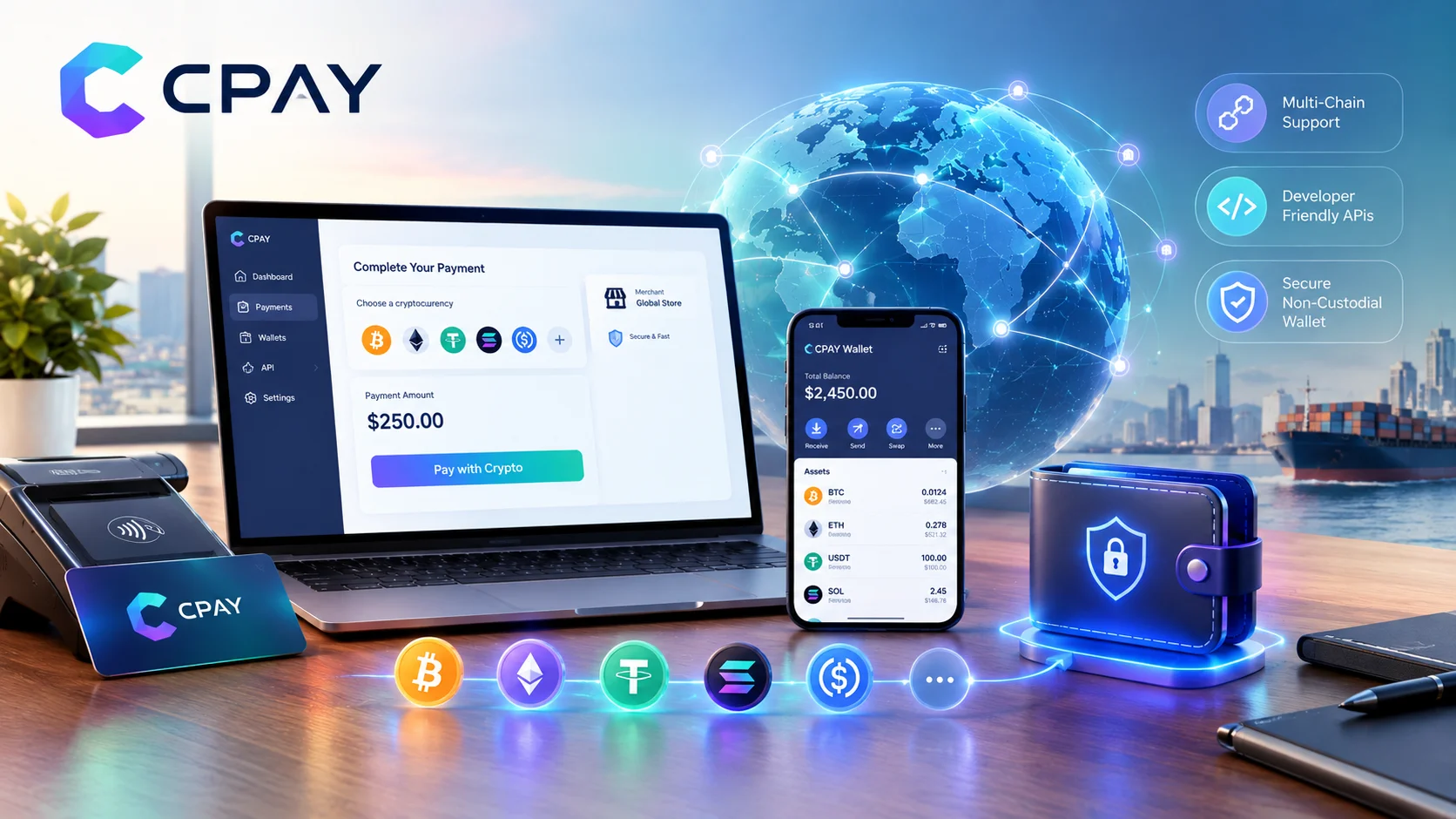
If you've landed on cpay.world, you've found a company that describes itself as crypto payment and wallet infrastructure for business. That covers several different products, so it helps to separate them. This guide explains what CPAY is, what each product does, and which businesses it is built for.
CPAY (listed as CPAY.World ltd) is a crypto payment provider founded in 2021. Its core product is a non-custodial gateway, customer payments settle straight to the merchant's wallet, with a flat 0.5% fee on incoming payments. Around that it sells wallet infrastructure, white-label gateways and wallets, KYC/AML tools and AI-agent payments. It names iGaming, forex, prop trading and eCommerce as target verticals.
What "Non-Custodial" Means Here
CPAY says it never holds, freezes or routes customer funds through its own balance sheet. When a customer pays through a CPAY checkout, the on-chain payment goes to the merchant's wallet. CPAY monitors the chain, verifies confirmations and fires a webhook, but it doesn't sit between payer and payee.
That differs from a traditional merchant account, where a provider collects the money, holds it through a settlement cycle and may keep a rolling reserve. With no custody step, there is no balance for the provider to hold back. The trade-off is that you manage your own wallets, conversion to fiat and tax records.
The Five Products
1. Crypto payment infrastructure: The gateway itself. Merchants integrate through a hosted checkout, REST API, iFrame or WooCommerce plugin, with real-time webhooks and optional auto-swap into USDT or USDC. CPAY lists 100+ assets across 8 live networks: Ethereum, Tron, Base, Polygon, BNB Chain, Solana, Arbitrum and Bitcoin.
2. Crypto wallet infrastructure: Wallets that a business can embed in its own app, custodial or non-custodial, on web, iOS and Android, with a wallet-as-a-service SDK. This is aimed at platforms that want to offer their users a wallet.
3. Agentic payments: Newer and more experimental. CPAY describes an AI copilot in the dashboard, an MCP server for connecting language models, controlled wallets for AI agents with spending limits, and x402-style machine-to-machine stablecoin payments.
4. White label: A gateway and a wallet that run under the customer's own brand: their domain, logo and colours, with CPAY running the technology. This is the product that lets another payment provider or broker launch a crypto payment service without building one.
5. KYC and AML: Automated identity verification, transaction monitoring (KYT), sanctions screening and Travel Rule tooling. CPAY positions this for crypto processors, exchanges and white-label deployments, and lists AMLbot among its compliance partners.
Pricing
CPAY states a flat 0.5% on incoming payments through checkouts, with no setup fee and no monthly minimum. Outgoing transfers cost only network gas. Auto-swap pricing reflects the market spread, and volume-based pricing is offered to high-volume merchants on request. It also advertises cashback and referral programmes.
A flat rate is easy to model, but check the auto-swap spread and gas costs, because those can matter more than 0.5% on small payments.
Who It's Built For
CPAY's use-case pages and white-label copy target iGaming and online casinos, forex brokers, prop trading firms, eCommerce, SaaS and subscription billing. Several of those are classic high-risk payment categories that mainstream merchant providers often decline. A non-custodial crypto rail avoids the card-network chargeback model that drives those declines.
Other use cases on the site are mass crypto payouts (affiliate rewards, payroll, prize distribution via CSV or batch API) and stablecoin subscription billing with webhook-driven renewals.
Reading the Numbers Carefully
CPAY reports 50+ global clients and 100K+ active users, and says it was founded in 2021. Its transaction figure is inconsistent, though. The homepage says 4M+ transactions processed, while the About page says 200M+. These are company-reported numbers, they differ by roughly fifty times, and none are independently audited that we could find. Ask which is current and how it is counted.
The site also says it undergoes regular independent security audits but doesn't name the auditor. The company name appears as "CPAY.World ltd" with no jurisdiction or registration number on the pages we reviewed.
What to Ask Before You Integrate
- Which legal entity and jurisdiction am I contracting with?
- Who performed the independent audits, and can I see the reports?
- How is KYC/AML handled for my own customers, and who is responsible for compliance?
- What is the auto-swap spread in practice?
- What happens to a payment if there is a webhook or confirmation failure?
Final Take
CPAY is a broad crypto payment provider whose core idea, non-custodial settlement at a flat 0.5%, is clear and easy to evaluate. The wallet, white-label and compliance products make it more of a platform than a single gateway. Before relying on it, confirm the legal entity, the audit evidence and which transaction figure is accurate.
FAQ
Is CPAY a payment gateway or a wallet? Both, plus more. It sells a crypto payment gateway, wallet infrastructure, white-label versions of each, KYC/AML tools and AI-agent payment rails.
How much does CPAY charge? A flat 0.5% on incoming checkout payments with no setup fee or monthly minimum, plus network gas on outgoing transfers and a market spread on auto-swaps.
Does CPAY hold my money? It says not. Payments settle directly to the merchant's wallet, so there is no balance held and no rolling reserve.
Can high-risk businesses use CPAY? It names iGaming, betting, forex and prop trading among its target verticals. Confirm compliance expectations for your jurisdiction and business directly.
Which blockchains does CPAY support? Eight networks are listed as live: Ethereum, Tron, Base, Polygon, BNB Chain, Solana, Arbitrum and Bitcoin, with 100+ assets.
Related reading: see TheFinRate's guides to crypto payment processing for merchants and high-risk merchant accounts.
Comments
No comments yet. Be the first to share your thoughts.
Leave a comment