
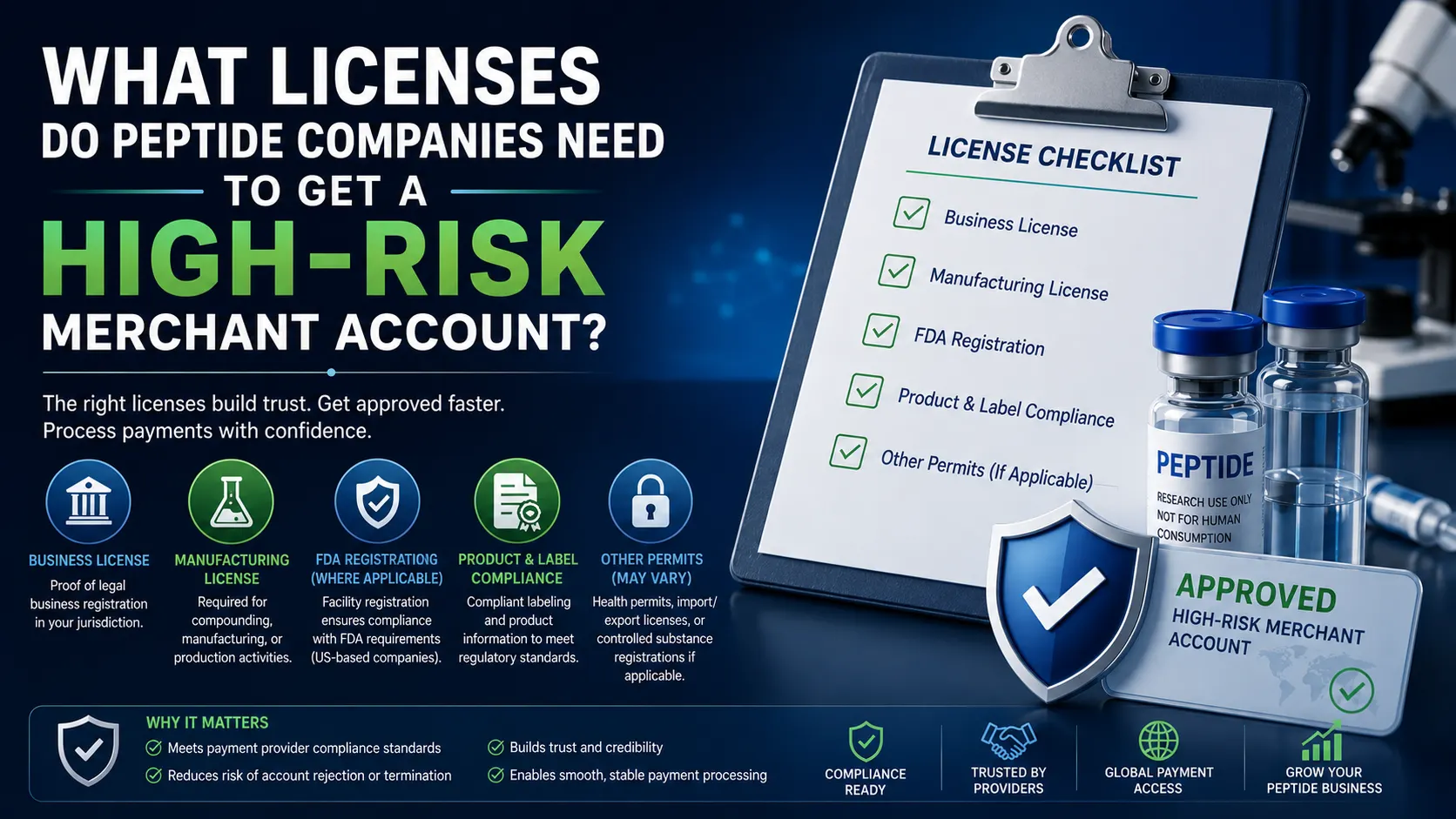
A payment underwriter reviewing a peptide business application isn’t just checking whether the company exists. They’re checking whether the business can legally sell what it’s selling, and that question has a genuinely complicated answer that depends on the peptide, the intended use, the state, and the business model itself.
This guide breaks down the actual licensing landscape peptide companies operate in, and exactly how that licensing picture connects to getting approved for a high-risk merchant account. This is general regulatory information, not legal advice, peptide licensing requirements vary significantly by state and country and change frequently, so verifying specifics with a licensed attorney and your state pharmacy board before making business decisions is essential.
Why Licensing Matters So Much for Payment Approval Specifically
Payment underwriters aren’t regulatory bodies, but they behave like risk-averse ones. An underwriter reviewing a peptide application isn’t trying to independently verify FDA compliance, they’re looking for evidence that the business has already done that verification itself, because a business that can’t demonstrate compliance represents a liability the processor doesn’t want to carry.
This is why licensing documentation does double duty for peptide companies: it’s the actual legal requirement for operating the business, and separately, it’s the evidence a high-risk payment gateway underwriter needs to approve the merchant account in the first place. Missing or unclear documentation doesn’t just create legal risk, it directly translates into payment processing rejection.
The Federal Framework: Understanding What You’re Actually Selling
Research Use Only (RUO) Peptides
Most direct-to-consumer peptide retailers operate under the research-use-only exemption, selling peptides explicitly for laboratory research rather than human consumption. This exemption generally avoids drug manufacturer and pharmacy licensing requirements, but it comes with a strict condition: the exemption only holds if the business genuinely markets and sells the product for research use, not human use, in practice and not just in a disclaimer.
- Improper labeling or marketing language that implies human use, even indirectly, through blog content, customer testimonials, or dosage-style language, can eliminate the RUO exemption entirely
- Peptide APIs labeled “research use only” cannot legally be incorporated into products intended for human use, regardless of how the finished product is marketed
- Enforcement to date has focused primarily on sellers rather than individual purchasers, but that enforcement gap doesn’t eliminate the underlying compliance requirement for the business
Section 503A and 503B: The Compounding Framework
Businesses that compound peptides, rather than sell them as-is for research purposes, fall under a meaningfully different and more heavily regulated framework:
- Section 503A, governs traditional compounding pharmacies: licensed pharmacists operating within state-licensed pharmacies, or licensed physicians, compounding medications strictly pursuant to a valid, patient-specific prescription
- Section 503B, governs outsourcing facilities, which can compound bulk drugs without patient-specific prescriptions but must comply with current Good Manufacturing Practice (cGMP) requirements, a substantially higher regulatory bar
- The legality of compounding a specific peptide under Section 503A depends on a strict, hierarchical three-part test tied to the FDA’s bulk drug substances list
Category 1 vs. Category 2: Why This Distinction Changed the Landscape
The FDA maintains a list of bulk drug substances, including peptides, that may legally be compounded:
- Category 1 peptides have sufficient safety and efficacy data to be compounded under Section 503A
- Category 2 peptides lack that supporting evidence and cannot legally be compounded for human use
In 2024, the FDA moved several popular research peptides onto the Category 2 list, effectively ending legal compounding for those specific substances, a shift that materially changed which peptides compounding pharmacies could legally offer, and one that continues to evolve. The FDA’s Pharmacy Compounding Advisory Committee met again in July 2026 to evaluate additional peptide substances for potential Category 1 or 2 classification, though those recommendations apply specifically to 503A compounding pharmacies and don’t automatically extend to 503B outsourcing facilities, which operate under separate requirements entirely.
The practical takeaway: if your business model involves compounding rather than selling RUO products as-is, the specific peptide’s Category 1 or 2 status is not a minor technical detail, it directly determines whether your business can legally offer that product at all, and that status can change as FDA review continues.
State-Level Licensing Requirements
Federal framework aside, most peptide businesses involved in anything beyond straightforward RUO retail face additional state-level licensing requirements, and these vary significantly by state:
- Drug manufacturer licensing: most states require separate state-level licensing for drug manufacturers, even for businesses already registered federally
- Wholesale drug distributor licensing: required in most states for businesses distributing pharmaceutical products, including many peptide wholesalers
- Pharmacy licensing: required for any business compounding peptides, tied directly to the state pharmacy board rather than a federal registration alone
Specific state requirements diverge meaningfully:
- Florida mandates registration for drug manufacturers and wholesale distributors handling peptides
- New York requires facility inspection and compliance documentation as part of its licensing process
- Texas and California impose their own additional state-level licensing and registration requirements for peptide manufacturers, distributors, and compounding pharmacies, separate from federal registration
Because this landscape varies so much by state and continues to shift, verifying current requirements directly with your specific state’s pharmacy board, rather than assuming national uniformity, is essential before finalizing a business model or applying for payment processing.
When Licensing Isn’t Required (And When That Exemption Breaks)
Research-use-only peptide sellers may genuinely avoid drug manufacturer, wholesale distributor, and pharmacy licensing requirements, but only if the products are marketed strictly for laboratory use and not for human or animal consumption, consistently and verifiably across the business.
This exemption breaks down in predictable, specific ways:
- Product descriptions or marketing content that references dosing, effects, or outcomes associated with human use
- Customer-facing content (blog posts, FAQs, social media) that implies or encourages human use, even if the product page itself carries a research-only disclaimer
- Packaging or labeling inconsistent with the research-use-only positioning claimed elsewhere
- A business model built around retail-style presentation (loyalty programs, subscription “dosing” schedules) that doesn’t match a genuine research-buyer customer base
Underwriters reviewing high-risk merchant applications specifically look for this kind of inconsistency, because it’s exactly the pattern that turns a legally compliant RUO business into one operating outside its claimed exemption.
LegitScript Certification: Not Legally Required, Increasingly Non-Negotiable for Payments
This is one of the more misunderstood parts of the peptide licensing conversation: LegitScript certification is not a government-mandated license. It’s an independent, third-party compliance verification service, but it has become close to a baseline expectation among acquiring banks for peptide merchant account approval specifically, even though it carries no legal force on its own.
- LegitScript certification demonstrates independent compliance verification to a payment processing underwriter, functioning as a trust signal in a category where trust is otherwise hard for a processor to verify quickly
- Certification can meaningfully improve approval odds, reduce reserve requirements, and in some cases lower processing rates, since it shifts part of the compliance verification burden off the processor’s own underwriting team
- LegitScript has published specific guidance addressing peptides, generally classifying research peptides marketed for human use as not eligible for certification, meaning certification itself functions as a filter that reinforces proper RUO positioning rather than a workaround for it
For a peptide business genuinely operating within a compliant RUO model, LegitScript certification is increasingly worth pursuing proactively rather than only after a mainstream processor rejection makes the gap obvious.
Connecting Licensing to Payment Underwriting: What to Actually Prepare
Regardless of business model, here’s the documentation package that maps most directly to high-risk merchant account underwriting:
For RUO Retail Sellers
- Business registration and incorporation documents
- Certificates of analysis (COAs) demonstrating product purity and sourcing
- Consistent research-use-only labeling across website, packaging, and all marketing content
- LegitScript certification, or documented progress toward it
- A clear refund and dispute resolution policy
For Compounding Pharmacies (503A)
- State pharmacy license
- Documentation confirming the specific peptides compounded are on the Category 1 bulk substances list, not Category 2
- Evidence of patient-specific prescription requirements built into the business process
- State-specific compliance documentation (facility inspection records, registration confirmations) as required by the operating state
For Manufacturers and Wholesale Distributors
- State drug manufacturer and/or wholesale distributor licensing
- FDA registration documentation
- Evidence that API sourcing comes from FDA-registered suppliers
- Facility compliance documentation, including cGMP evidence for 503B-adjacent operations
For International Sellers
- Equivalent local regulatory registration in each operating jurisdiction, since licensing frameworks outside the U.S. differ substantially and require separate verification
- Documentation supporting cross-border payments compliance, since international payment providers may apply additional scrutiny to regulatory documentation from unfamiliar jurisdictions
Decision Framework: What Your Business Actually Needs
If you’re launching a direct-to-consumer RUO peptide business:
- Confirm your labeling, marketing, and website content consistently and genuinely supports research-use-only positioning before applying for any merchant account
- Pursue LegitScript certification proactively rather than waiting for a rejection to reveal the gap
- Consult a licensed attorney familiar with your specific state’s requirements, since RUO exemptions can still intersect with state-level rules in ways general guidance won’t fully capture
If you’re operating or launching a compounding pharmacy:
- Verify the Category 1/2 status of every peptide you compound directly against the current FDA bulk substances list, since this determines legality independent of any state pharmacy license
- Confirm state pharmacy licensing is current and matches your specific compounding activity
- Monitor FDA Pharmacy Compounding Advisory Committee developments closely, since Category classifications continue to evolve
If you’re a manufacturer or wholesale distributor:
- Confirm state-specific manufacturer and distributor licensing requirements directly with each state you operate in or ship into, since requirements vary meaningfully (Florida, New York, Texas, and California each impose distinct rules)
- Ensure API sourcing documentation from FDA-registered suppliers is complete and readily available for underwriting review
If you’re selling internationally:
- Verify local licensing equivalents in each target market before assuming U.S.-based compliance transfers automatically
- Work with payment providers experienced in cross-border high-risk categories, since regulatory documentation review often takes longer for less familiar jurisdictions
Common Mistakes That Undermine Both Compliance and Payment Approval
- Assuming RUO labeling alone is sufficient: the exemption depends on consistent practice across the entire business, not a single disclaimer on the checkout page
- Not verifying Category 1 vs. Category 2 status before compounding: this single detail can determine whether an entire product line is legally sellable
- Treating LegitScript certification as optional when applying to specialized high-risk processors: while not legally mandated, skipping it increasingly closes off approval paths that would otherwise be available
- Assuming federal registration alone satisfies state requirements: most states impose independent licensing obligations regardless of federal status
- Failing to update licensing and compliance documentation as FDA and state rules evolve: this is an actively moving regulatory landscape, not a one-time compliance checkbox
Looking Ahead: Where Peptide Licensing Is Heading in 2026
The regulatory picture for peptides has been anything but static, and the trend suggests continued evolution rather than settling. The FDA’s ongoing Pharmacy Compounding Advisory Committee review process, state-level licensing expansion in markets like Florida and New York, and payment processors’ growing reliance on third-party verification like LegitScript all point toward a landscape where documentation rigor, not workarounds, is becoming the actual competitive advantage.
For compliant sellers specifically, several sources tracking this space note that clearer regulation, paradoxically, tends to make payment processing easier over time, reduced ambiguity is exactly what makes underwriters and acquiring banks more comfortable extending approval, compared to operating in a genuinely undefined gray zone.
Conclusion
There’s no single license that unlocks payment processing for a peptide business, because there’s no single peptide business model, what you need depends entirely on whether you’re selling RUO products as-is, compounding under 503A, manufacturing at scale, or distributing wholesale. What’s consistent across all of them is this: the documentation that satisfies a payment underwriter is, in nearly every case, the same documentation that satisfies the underlying legal requirement. Businesses that treat licensing and compliance as core infrastructure, not paperwork to assemble reactively after a rejection, are the ones building payment relationships that actually last.
This article provides general regulatory information current as of 2026 and should not be treated as legal advice. Peptide licensing requirements vary by state and country and continue to evolve; consult a licensed attorney and your relevant state pharmacy board before making compliance or business-structure decisions.
Frequently Asked Questions
Q: Do I need a pharmacy license to sell research-use-only peptides?
A: Generally no, if the products are genuinely and consistently marketed for laboratory research rather than human use. This exemption depends on consistent practice across labeling, marketing, and business model, not a single disclaimer, and it’s worth confirming with a licensed attorney given how enforcement has evolved.
Q: What’s the difference between Category 1 and Category 2 peptides?
A: Category 1 peptides have sufficient FDA-reviewed safety and efficacy data to be legally compounded under Section 503A. Category 2 peptides lack that data and cannot legally be compounded for human use, a distinction that directly determines whether a compounding pharmacy can legally offer a specific peptide.
Q: Is LegitScript certification legally required to sell peptides?
A: No, it’s not a government mandate. It’s an independent compliance verification service that has become a near-baseline expectation among payment processors and acquiring banks specifically, meaningfully improving merchant account approval odds even though it carries no legal force on its own.
Q: Does federal FDA registration eliminate the need for state licensing?
A: No. Most states require separate state-level licensing for drug manufacturers, wholesale distributors, and compounding pharmacies, regardless of federal registration status, and specific requirements vary meaningfully between states like Florida, New York, Texas, and California.
Q: What happens if a peptide business claims RUO status but its marketing suggests human use?
A: This inconsistency can eliminate the research-use-only exemption entirely, creating both regulatory exposure and a direct red flag for payment underwriters reviewing the application, it’s one of the most common reasons otherwise well-documented peptide businesses get declined.
Q: Do international peptide sellers need different licensing than U.S.-based companies?
A: Yes. Licensing frameworks outside the U.S. differ substantially by country, and U.S.-based compliance doesn’t automatically transfer. International sellers should verify local regulatory equivalents in each operating jurisdiction separately.
Comments
No comments yet. Be the first to share your thoughts.
Leave a comment