
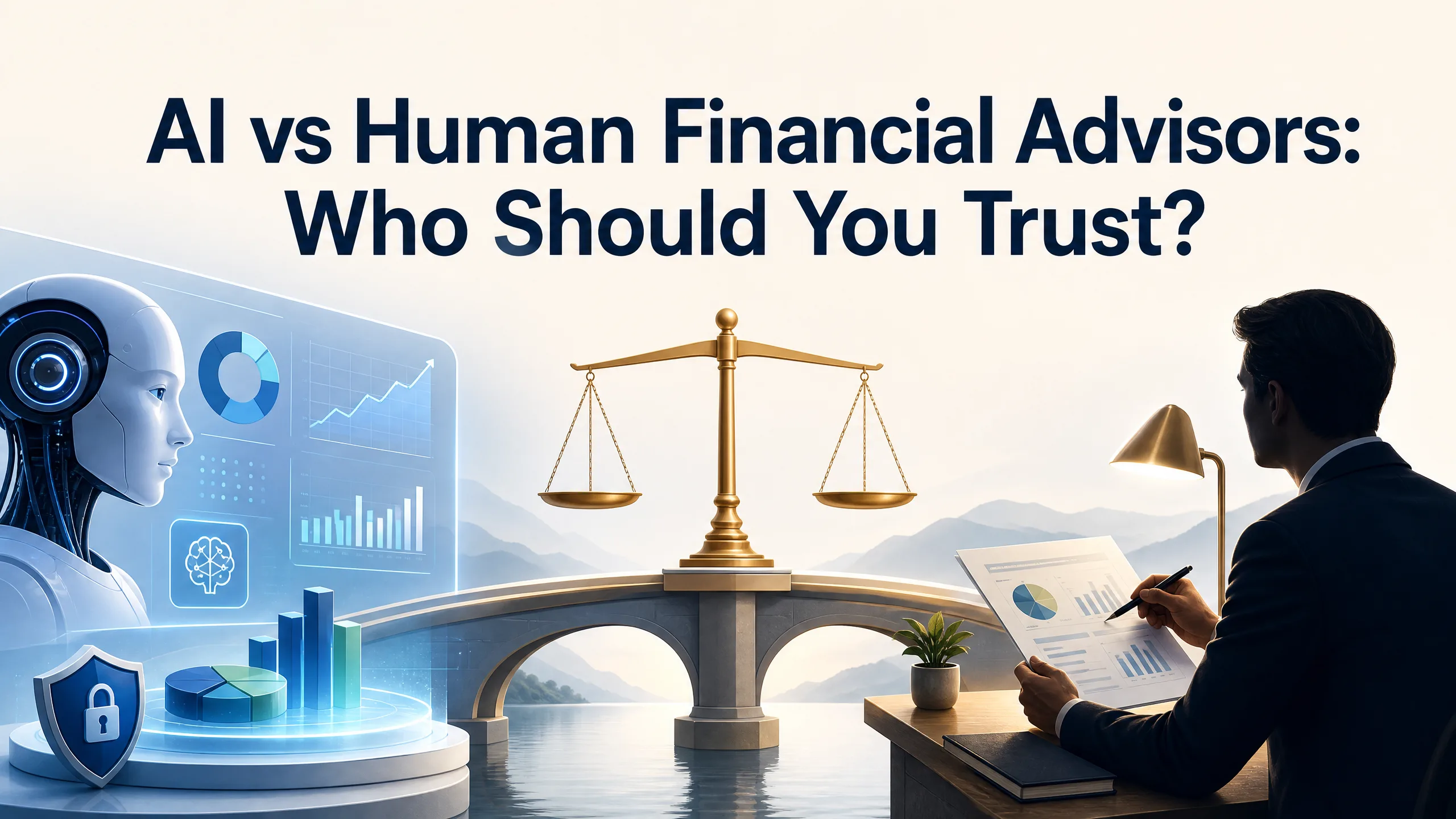
Here’s a finding from recent behavioral research that genuinely surprised me, and I think it should surprise you too: when researchers put people in front of both an algorithmic advisor and a human advisor, participants initially trusted the AI more, a well-documented effect researchers call “algorithmic appreciation.” Then the AI made one mistake, and trust collapsed harder and faster than it does with a human who makes the same error. That single data point tells you almost everything about how this comparison actually plays out in real life, and it’s a lot more interesting than a simple “AI good” or “AI bad” answer.
Neither AI nor human advisors win this outright, they fail differently and succeed differently. AI is faster, cheaper, always available, and increasingly good at the computational side of financial planning. Humans bring judgment, accountability, and the kind of contextual empathy AI still can’t replicate. Trust research shows people initially favor AI’s consistency, but that trust is fragile, a single AI error can tank confidence sharply, while human trust erodes more gradually and recovers more predictably. In my experience, the honest framework isn’t “which one should I trust”, it’s “which specific decisions does each one earn my trust for.”
Why “Which One Is Better” Is Actually the Wrong Question
I get asked this constantly, and I always redirect it, because the research genuinely doesn’t support a clean winner. AI excels at consistency and computation. It doesn’t excel at empathy or judgment, and pretending otherwise sets people up to trust it in exactly the situations where it’s weakest. The more useful question isn’t “AI or human”, it’s “what am I actually deciding, and which kind of intelligence does that decision need.”
Where AI Genuinely Outperforms
Speed, Availability, and Consistency
AI doesn’t get tired, doesn’t have a bad day, and doesn’t need a scheduled appointment three weeks out to answer a question you have right now. It can explain investment concepts, summarize your portfolio, and answer financial questions instantly, availability a human advisor structurally can’t match at scale.
Continuous Monitoring vs. Periodic Check-Ins
This is a bigger deal than people realize. Human advisor reviews often happen quarterly or annually. AI can watch your accounts continuously, catching a problem or opportunity in real time rather than at the next scheduled meeting. For anything where timing matters, rebalancing, tax-loss harvesting, catching an unusual transaction, that continuous presence is a genuine structural advantage.
Cost and Accessibility at Scale
Robo-advisors and AI-powered platforms now manage over $1.8 trillion in assets in the US alone, up sharply from just a year earlier, precisely because they make sophisticated financial planning accessible to people who could never justify, or afford, a traditional advisor’s fees. Tax-loss harvesting, multi-goal optimization, and portfolio rebalancing that used to be exclusive to wealthy clients with dedicated advisors are now available to anyone with a modest account balance.
Forecasting That Can Rival Human Analysts
This one might genuinely surprise you: some recent research suggests AI recommendations land closer to actual market benchmarks than human analyst forecasts do in certain contexts, and may even outperform human analysts in specific forecasting tasks. I don’t think this means AI should run unsupervised, but it does mean dismissing AI’s analytical capability as inherently inferior to a human’s isn’t supported by the current evidence.
Where Humans Still Clearly Win
Judgment in Genuinely Ambiguous Situations
AI handles the math extremely well. Humans provide meaning and judgment, the part of financial planning that involves understanding what actually matters to you as a person, not just what’s mathematically optimal. A financial decision that’s technically correct but completely wrong for someone’s actual life circumstances is a failure mode AI is still prone to in ways an experienced human advisor usually isn’t.
Accountability When Something Goes Wrong
This is the one I think matters most, honestly. A human advisor operating as a fiduciary has legal and professional accountability if their advice genuinely harms you. That accountability shapes behavior in ways that matter, even if it’s imperfect, not every advisor operates as a fiduciary, and incentive structures genuinely vary, so this isn’t automatic. But the accountability structure exists in a way that’s still evolving for AI systems.
Trust Recovery After a Mistake
This is where that opening research finding gets really interesting. When an AI advisor makes an error, trust drops sharply and fast. When a human advisor makes a comparable error, the decline is more gradual, and crucially, trust in humans recovers more predictably after a clear explanation of what went wrong. Interestingly, the same research found that clear post-error explanations help repair trust in AI too, sometimes even beyond the original baseline, but the system has to be built to actually explain itself, not just apologize generically, and a lot of consumer AI tools currently aren’t.
The Honest Middle Ground: Human-in-the-Loop
Here’s the finding I think deserves the most attention, because it cuts through the false binary entirely: giving a human the final say on AI-generated advice doesn’t diminish the quality of that advice. Human-AI collaboration performed on par with AI-only models in recent studies, meaning the combination isn’t a compromise that drags down AI’s strengths. It’s a genuinely viable structure that captures AI’s computational consistency while keeping human judgment as a check on the decisions that actually matter.
I think this is the model worth actually adopting, rather than picking a side: let AI handle the continuous monitoring, the computation, the pattern recognition, and the instant answers to routine questions. Keep a human in the loop, whether that’s a licensed advisor or simply your own careful judgment, for anything with real consequences, ambiguity, or emotional weight behind the decision.
A Warning Worth Taking Seriously: Algorithm Aversion Has a Cost Too
It’s worth naming the opposite failure mode too, because I see it almost as often as blind AI trust. Algorithm aversion, reflexively distrusting AI output even when it’s accurate, can actually reduce the probability of a good outcome, especially on important decisions where the AI’s analysis was genuinely sound. Dismissing AI purely on principle isn’t automatically the safer choice. The goal isn’t maximum skepticism of AI or maximum trust in AI, it’s calibrated trust, matched to what the specific tool has actually earned through its track record and its transparency about its own reasoning.
What This Means If You’re Running a Business, Not Just Managing Personal Finances
The same framework applies directly to business financial decisions, and I’d argue the stakes are often higher. Use AI for continuous cash flow monitoring, transaction pattern analysis, and instant answers to routine questions about your payment processing or merchant services setup. Keep a human, an accountant, a trusted advisor, or your own considered judgment, in the loop for decisions with real consequences: choosing a payment provider, structuring a major deal, or making a call that affects your company’s financial stability for years, not weeks.
My Honest Verdict
I don’t think “who should you trust” has a single right answer, and I’d be skeptical of anyone who tells you it does. The research consistently shows AI and humans fail differently and succeed differently, AI wins on speed, consistency, and availability; humans win on judgment, accountability, and how trust recovers after something goes wrong. The smartest approach I’ve seen actually work isn’t choosing a side. It’s using each one for what it’s genuinely good at, and staying honest with yourself about which category your current decision actually falls into.
What I’d Actually Tell My Younger Self About This Trade-off
If I could give one piece of practical advice to someone in their twenties navigating this decision for the first time, it wouldn’t be about which specific tool or advisor to pick. It would be this: pay close attention to how a financial tool, AI or human, behaves the first time it’s wrong about something involving your money. Not whether it’s ever wrong, because everything eventually is. What actually predicts whether it’s worth continuing to trust is whether it explains the error clearly, adjusts, and earns that trust back, or whether it deflects, stays vague, or just repeats the same confident tone as if nothing happened.
That single behavior, how something handles being wrong, tells you more about whether it deserves your long-term trust than any amount of impressive performance when things are going smoothly. A human advisor who owns a mistake and walks you through exactly what went wrong is doing the accountability work that makes the relationship worth keeping. An AI tool that offers a genuine, specific explanation rather than a generic non-answer is doing the same thing in a different form. The ones, human or AI, that get defensive or vague when questioned are the ones I’d actually be most cautious about continuing to rely on, regardless of how polished or confident they sounded before that moment.
Frequently Asked Questions
Is AI actually more accurate than human financial advisors?
In some forecasting contexts, yes, certain AI models have landed closer to market benchmarks than human analyst predictions. But accuracy in forecasting isn’t the same as good judgment for your specific life situation.
Why does trust in AI drop so fast after one mistake?
Research shows people initially favor AI’s perceived consistency, which makes a single error feel like a bigger violation of expectations, causing trust to decline more sharply than it typically does after a comparable human error.
Can combining AI and human advice actually work well?
Yes, and it’s arguably the best-supported approach. Studies show human-AI collaboration performs on par with AI-only models, meaning you don’t sacrifice quality by keeping a human in the loop.
Are all AI financial advisors regulated the same way as human ones?
No. Some platforms are built to operate within fiduciary and regulatory frameworks, while generic AI chatbots generally are not, so it’s worth checking specifically before relying on either.
Is it smarter to just distrust AI advice by default?
Not necessarily. Algorithm aversion, reflexively distrusting accurate AI output, can actually lead to worse outcomes on decisions where the AI’s analysis was genuinely sound.
Should a business owner trust AI or a human accountant for financial decisions?
Both, for different tasks. AI is well-suited to continuous monitoring and routine analysis; a human remains valuable for decisions with real consequences and ambiguity, like choosing a payment provider or structuring a major deal.
Comments
No comments yet. Be the first to share your thoughts.
Leave a comment