
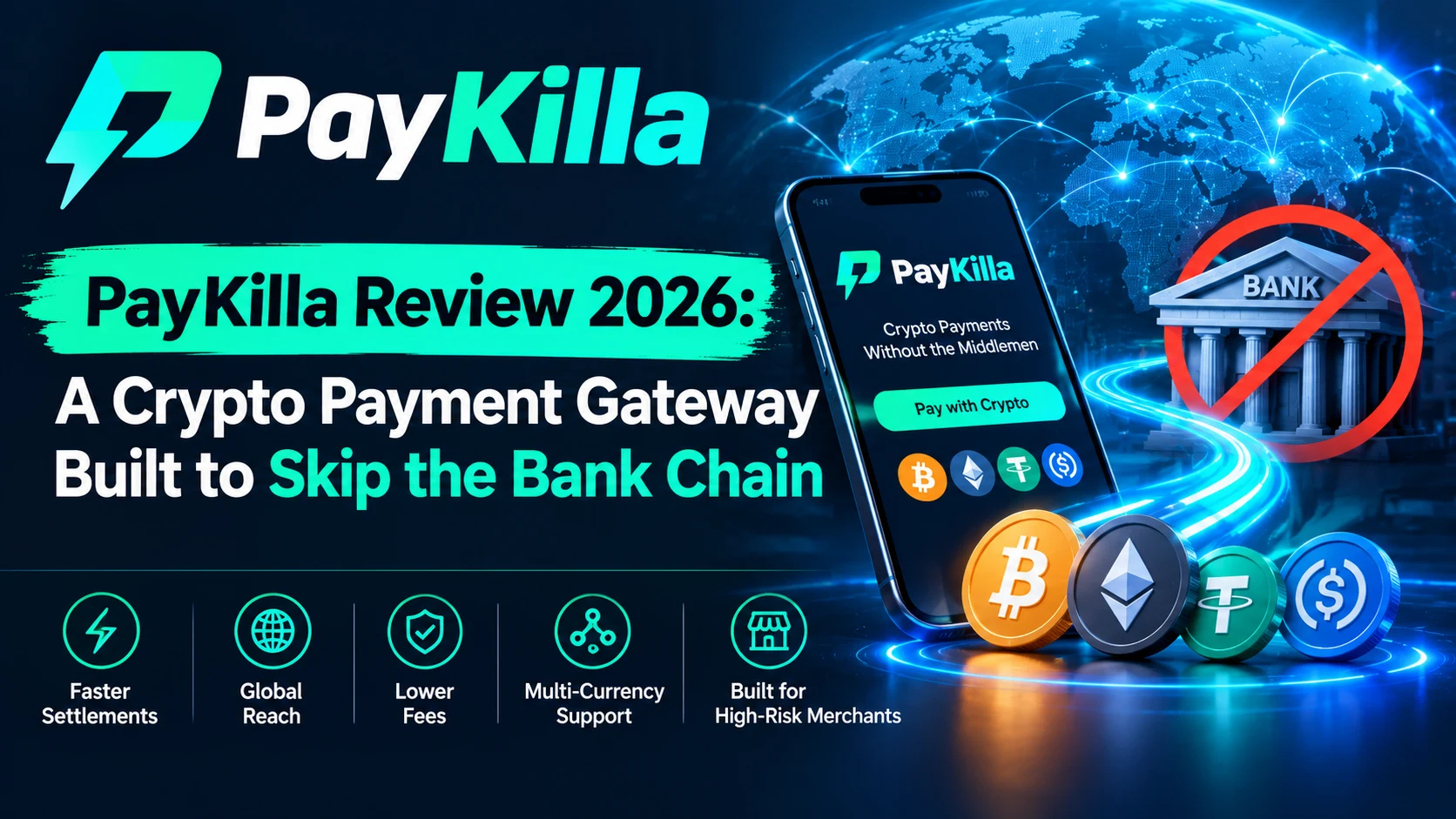
A standard cross-border wire can take two to five business days and lose 3% to 7% of its value to fees and FX markups along the way. PayKilla’s entire pitch is built around eliminating that chain, settling directly on blockchain rails instead of routing through correspondent banks.
PayKilla is a crypto payment gateway offering instant settlement, fees starting from 0.5%, no rolling reserve, and no FX markup, aimed at businesses losing time and margin to traditional cross-border banking. This sits inside one of the fastest-growing corners of payment processing right now, the global crypto payment gateway market was valued at roughly $2.7-3.8 billion in 2026 and is projected to grow at 18-22% annually through the early 2030s, with stablecoins now accounting for an estimated 82% of crypto payment gateway transaction volume. The decision that matters isn’t “crypto or not”, it’s whether your business can operate on a model where settlement happens entirely in crypto, with no default fiat bank withdrawal.
Why This Category Exists: The Real Cost of Correspondent Banking
Every international wire transfer that isn’t between two accounts at the same bank typically passes through a chain of correspondent banks, each adding its own cut-off times, compliance checks, and fees. This is why a “simple” cross-border payment can take days and quietly lose several percentage points of value before it ever reaches the recipient, costs that rarely show up as a single line item, which is exactly why they’re easy to underestimate.
Crypto-based settlement bypasses that chain entirely. A payment made in a stablecoin settles on-chain in minutes rather than days, without needing a banking relationship in every country a business operates in. That’s the specific, structural problem PayKilla and similar merchant payment platforms are built to solve, not a marginal fee reduction, but the removal of an entire intermediary layer.
What PayKilla Actually Offers
PayKilla positions itself as crypto payment infrastructure built around a full ecosystem rather than a single checkout button, a crypto gateway accepting payments via API, widget, or invoice link, on-chain analytics for monitoring wallet behavior and flagging risk signals, crypto payroll for paying distributed teams, and wallet-as-a-service for businesses that want their own managed wallet infrastructure. It targets gaming and digital goods, financial services, e-commerce, technology and software, real estate, and travel and hospitality.
On pricing, PayKilla states fees starting from 0.5%, configured per merchant, with instant settlement, no withdrawal fee, and support for 50-plus coins. Two structural details are worth calling out because they differ meaningfully from traditional card processing, there’s no rolling reserve held against future disputes, since funds settle directly rather than being withheld against future chargebacks, and rates are locked at the moment a payment is confirmed, so a merchant isn’t exposed to price movement between when a customer pays and when funds arrive.
The Structural Trade-Off Worth Understanding
Here’s the detail that matters most for deciding whether this kind of payment solution actually fits a given business, settlement happens in crypto, primarily stablecoins, not fiat. There’s no default bank withdrawal, a merchant holds a stablecoin balance rather than dollars landing in a checking account, though custom integrations for fiat withdrawal can reportedly be arranged on request.
For a business already comfortable holding stablecoin balances, paying suppliers or contractors abroad, running a Web3-adjacent product, or simply comfortable treating USDT/USDC as a cash equivalent, this isn’t a limitation at all. For a traditional retailer expecting dollars in a bank account by Friday, it’s a meaningful operational shift that needs to be planned for, not an incidental detail to discover after integration.
Real 2026 Numbers Behind This Category
The growth trajectory here is well-documented across multiple independent market research sources, and it’s worth grounding any evaluation of a specific provider in the broader numbers:
- The global crypto payment gateway market was estimated between $2.7 billion and $3.8 billion in 2026 depending on methodology, with consistent projections of 18-22% annual growth through 2030-2035.
- Stablecoins made up an estimated 82% of crypto payment gateway transaction volume in 2026, up sharply as merchants and platforms favor price-stable settlement over volatile assets like Bitcoin or Ethereum.
- B2B stablecoin payments specifically grew an estimated 733% year over year, reaching roughly $226 billion, about 60% of total global stablecoin payment volume.
- Cross-border remittances still cost 6.49% on average globally as of early 2025, more than double the G20’s 3% target, while stablecoin-based transfers run an estimated 40% cheaper once total costs are counted.
- 78% of Fortune 500 companies were exploring or piloting crypto payments as of 2025, concentrated specifically on international B2B transfers, the exact use case PayKilla targets.
These aren’t projections about a hypothetical future they describe a payment processing shift that’s already measurably underway in cross-border B2B specifically.
AML and Compliance: What to Verify
PayKilla states every transaction is screened through a third-party blockchain AML analytics platform before funds are credited, and describes itself as a regulated payment provider that doesn’t serve sanctioned jurisdictions or restricted business categories. For any crypto-native payment provider, this is the specific claim worth verifying directly rather than taking as a given, ask which AML screening provider is actually used, whether screening happens pre- or post-settlement, and what documentation is available for your own compliance records.
Who This Fits
Businesses already operating with cross-border corridors where correspondent banking friction is a real, felt cost, marketplaces paying international sellers, platforms paying global contractors and creators, B2B companies settling with overseas suppliers, are the clearest fit for this kind of payment solution. The absence of a rolling reserve is also specifically attractive to merchants who’ve experienced reserve-related cash-flow friction with a traditional high-risk payment processor.
It’s a poor fit for businesses that need fiat settlement by default, that operate in jurisdictions with restrictive crypto regulation, or that aren’t prepared to hold or manage a stablecoin balance as part of normal operations.
Questions to Ask Before Committing
- What exactly happens if you need to convert your balance to fiat, is it a standard feature or a custom request?
- Which specific AML screening provider is used, and what compliance documentation does it produce?
- How is the “fee from 0.5%” actually structured for your specific volume and vertical, get a real quote, not the headline number.
- What’s the actual settlement time in practice, not just the marketing claim of “instant”?
Final Take
PayKilla sits inside a genuinely fast-growing segment of payment processing, backed by real, current 2026 industry data showing B2B crypto and stablecoin settlement scaling quickly, particularly for cross-border use cases. The core trade-off is structural, not a hidden flaw, this is a crypto-native merchant payment platform, and it fits businesses already comfortable operating that way far better than those expecting a drop-in replacement for a traditional fiat gateway.
FAQ
Does PayKilla settle in fiat currency?
No, by default. Settlement happens in crypto, primarily stablecoins. Fiat bank withdrawal isn’t part of the standard flow, though it may be available as a custom integration.
Why don’t crypto payment gateways hold a rolling reserve?
Because chargebacks work differently in crypto settlement than in card processing, funds settle directly rather than being held back against a future dispute risk, which is a structural difference from traditional high-risk payment processing.
How big is the crypto payment gateway market in 2026?
Estimates range from roughly $2.7 to $3.8 billion in 2026, with consistent projections of 18-22% annual growth through the early 2030s across independent market research firms.
Are stablecoins actually cheaper than a bank wire for cross-border payments?
Industry data suggests stablecoin transfers run roughly 40% cheaper than traditional cross-border channels once all fees are counted, against an average global remittance cost of 6.49%.
Related reading: see TheFinRate’s guides to crypto payment processing for merchants and understanding rolling reserves.
Comments
No comments yet. Be the first to share your thoughts.
Leave a comment