
In Singapore, almost every payment gateway claims to be secure, compliant and “MAS regulated.” Some are. Some are borrowing a licence number from a parent company, a partner or a different country. This guide shows you how to verify a provider yourself in about ten minutes, and what the result does and does not tell you.
Get the provider’s legal entity name, search for it in the MAS Financial Institutions Directory and confirm the licence type and the specific payment services it covers. Check that the entity matches the one on your contract. A licence does not guarantee good service, fair pricing or approval for your business, so ask about safeguarding as well.
Why the Licence Matters
Singapore regulates payment services under the Payment Services Act. The Act covers seven regulated services, and merchant acquisition, which is accepting card payments on behalf of merchants, is one of them. Others include account issuance, domestic and cross-border money transfer, e-money issuance and digital payment token services.
A licence means the Monetary Authority of Singapore (MAS) has vetted the firm and supervises it. It does not mean MAS endorses the product, and it does not mean your money is guaranteed.
Does Every Payment Gateway Need a MAS Licence?
Not necessarily, and this is where merchants get confused.
- Software-only gateways: A gateway that only passes payment data between your checkout and an acquirer may not need its own licence. The regulated activity sits with whoever acquires the card transactions or handles the money.
- Providers that hold or move funds: If the provider collects customer payments, settles them to you or issues e-money, it generally needs authorisation for those services.
- Banks: Licensed banks, which are regulated separately from payment institutions, appear on the MAS directory as banks, not as payment institutions.
The practical question is not “is the brand licensed?” but “which licensed entity actually processes and settles my money?” Always ask.
The Three Licence Types
MAS issues three classes of licence for payment businesses:
- Money-changing licence: For firms that only change currency.
- Standard payment institution (SPI) licence: For payment businesses below the volume thresholds.
- Major payment institution (MPI) licence: For businesses above the thresholds, or those that want to operate without being subject to them.
The thresholds are about scale, not about which services are allowed. In summary:
- A monthly transaction value of S$3 million for any one payment service, or S$6 million across two or more, moves a firm into MPI territory.
- A daily e-money float above S$5 million also requires an MPI licence.
- Base capital requirements are higher for MPIs than for SPIs.
Major payment institutions face stricter ongoing requirements, including rules on safeguarding customer money, for example through trust accounts or guarantees. Ask any provider you use how it safeguards funds, because the details vary.
Step by Step: How to Check a Provider
- Find the legal entity name: Look in the terms and conditions, the footer or your contract. A brand name is not enough.
- Note the registration details: The company’s registration number and address should match what the provider tells you.
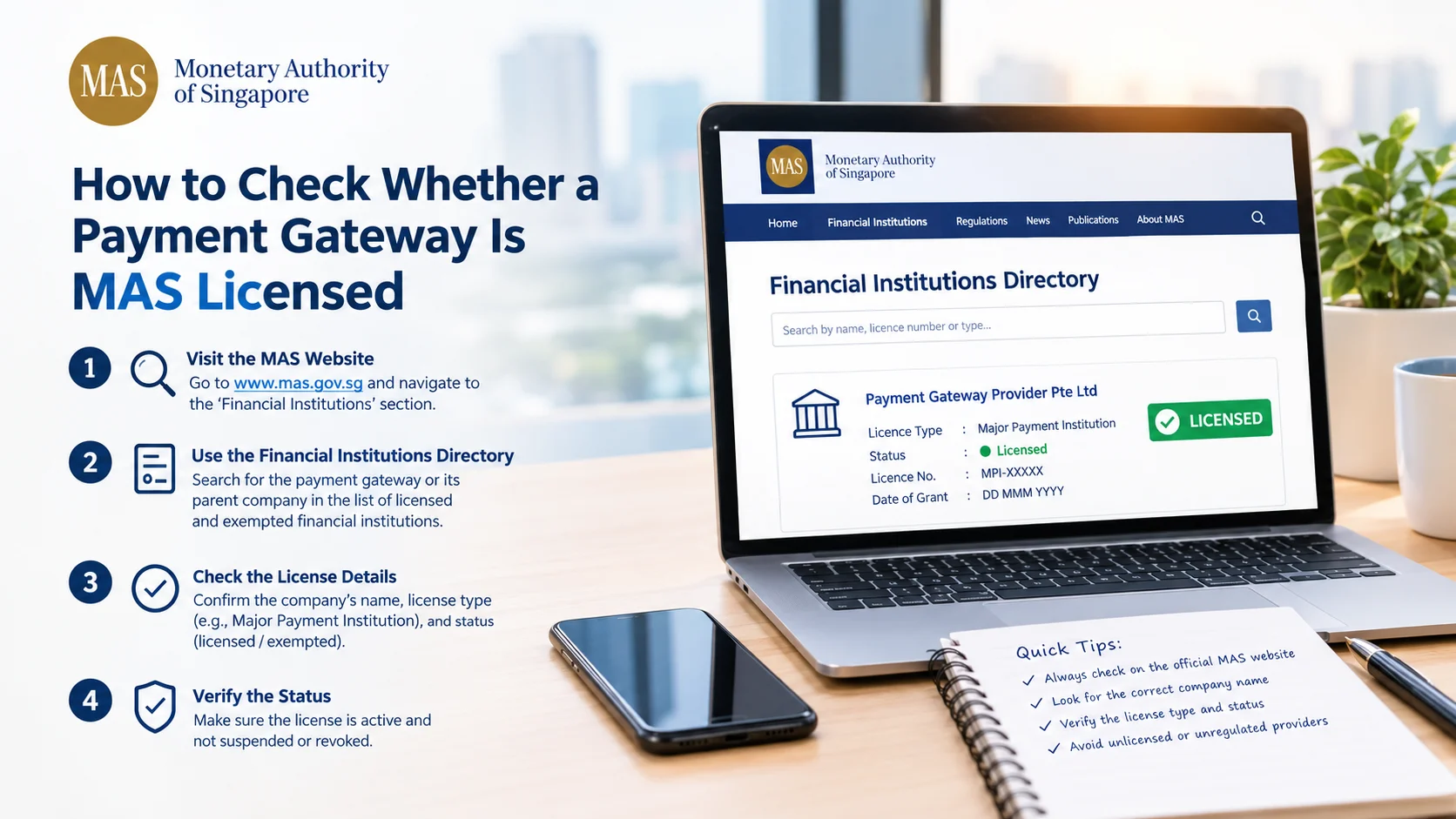
- Search the MAS Financial Institutions Directory: Use the legal entity name, not the brand. The directory lists firms licensed under the Payment Services Act.
- Confirm the licence type: Is it an SPI or an MPI? That tells you about its scale and obligations.
- Check the services covered: Look for the specific activity that matches what you are buying, such as merchant acquisition.
- Confirm the entity matches your contract: The licensed company must be the one that contracts with you or handles your funds.
- Check group structure: Many global brands operate through a Singapore subsidiary. Make sure it is the licensed subsidiary that serves you.
- Look for warnings: MAS also publishes information about unauthorised entities, so search its website for the firm’s name.
- Ask for details in writing: Request the licence number, the safeguarding arrangement and the banking partners.
What to Ask the Provider
These questions take a few minutes and reveal a lot:
- Which legal entity will I contract with?
- What is the licence number, and what services does it cover?
- Which entity actually acquires card transactions and settles funds to me?
- How are merchant funds safeguarded, and where are they held?
- Are payouts made from a Singapore account?
- What happens to my balance if the provider is wound up?
A reputable payment provider answers these directly.
Red Flags
- A badge with no number: A logo or “licensed” graphic that does not give a licence number.
- Brand name only: No legal entity is named anywhere.
- A foreign licence presented as local: A licence from another country is not a MAS licence.
- “MAS approved” wording: MAS licenses and regulates firms. Claims that it approves or endorses a product deserve scepticism.
- Mismatched entities: The company in the directory is not the one on your contract.
- No clear address or contacts: Especially an offshore address only.
- Pressure and promises: Instant approval, no checks or guaranteed acceptance.
- Refusal to share details: A licence number should not be a secret.
What a Licence Does Not Tell You
A licence is a minimum check, not a recommendation. It does not tell you about:
- Pricing and fees: Compare these separately.
- Payout speed and reserves: Ask about both.
- Support quality: Test it before launch.
- Approval for your business: Providers decide who they accept regardless of their licence.
- Coverage for specific activities: A firm may be licensed for some services but not others. Digital payment token services, for example, need their own authorisation.
A Note for High-Risk Merchants
If you are a high-risk merchant, the licence check matters even more. Sectors such as crypto, forex and gaming face tighter rules in Singapore, and mainstream gateways often decline them.
That pushes some businesses toward providers that offer high-risk payment services with thinner track records. Verify the licence first, make sure it covers the activities you need, and be wary of anyone who promises approval before looking at your business. Being licensed does not guarantee that a provider will accept you, and it does not guarantee that your payments will not be held.
If You Are a Foreign Business Selling Into Singapore
US and UK businesses often use a Singapore entity of a global provider. Check that entity in the directory, not just the parent company’s licence at home. Also ask whether local methods such as PayNow require a Singapore entity or bank account, since eligibility can differ by provider.
Quick Checklist
- Get the legal entity name and registration details.
- Search the MAS Financial Institutions Directory by entity name.
- Confirm the licence type and the services covered.
- Match the licensed entity to your contract.
- Search MAS warnings for the firm’s name.
- Ask about safeguarding, banking partners and payout accounts.
- Compare pricing, payouts and support separately.
- Revisit the check once a year, and whenever the provider changes.
Frequently Asked Questions
What is the MAS Financial Institutions Directory?
It is the list MAS publishes of the financial institutions it licenses or regulates. You search it by name to confirm whether a firm holds a licence and what kind.
Is a licence number enough?
No. Confirm it in the directory, check that it belongs to the entity on your contract and check which services it covers.
Does MAS license every payment gateway?
Not every one. It depends on what the gateway does. Regulation attaches to activities such as merchant acquisition or holding funds, so ask which licensed entity performs them.
Can a licensed provider still be a poor choice?
Yes. A licence tells you about regulation, not about fees, service or fit. Compare providers on cost, payouts and support too.
What if a gateway is not licensed but uses a licensed partner?
That can be acceptable, since the regulated service may sit with the partner. Ask which entity processes and settles your money, and verify that entity.
The Verdict
Checking a licence takes minutes and removes a whole category of risk. Search the entity, match it to your contract and ask about safeguarding before you send any volume.
Then compare pricing and service, because the licence is only the starting point. To see how providers stack up, read our independent guide to the best payment gateways in Singapore, and browse the TheFinRate payment gateways directory.
Comments
No comments yet. Be the first to share your thoughts.
Leave a comment