
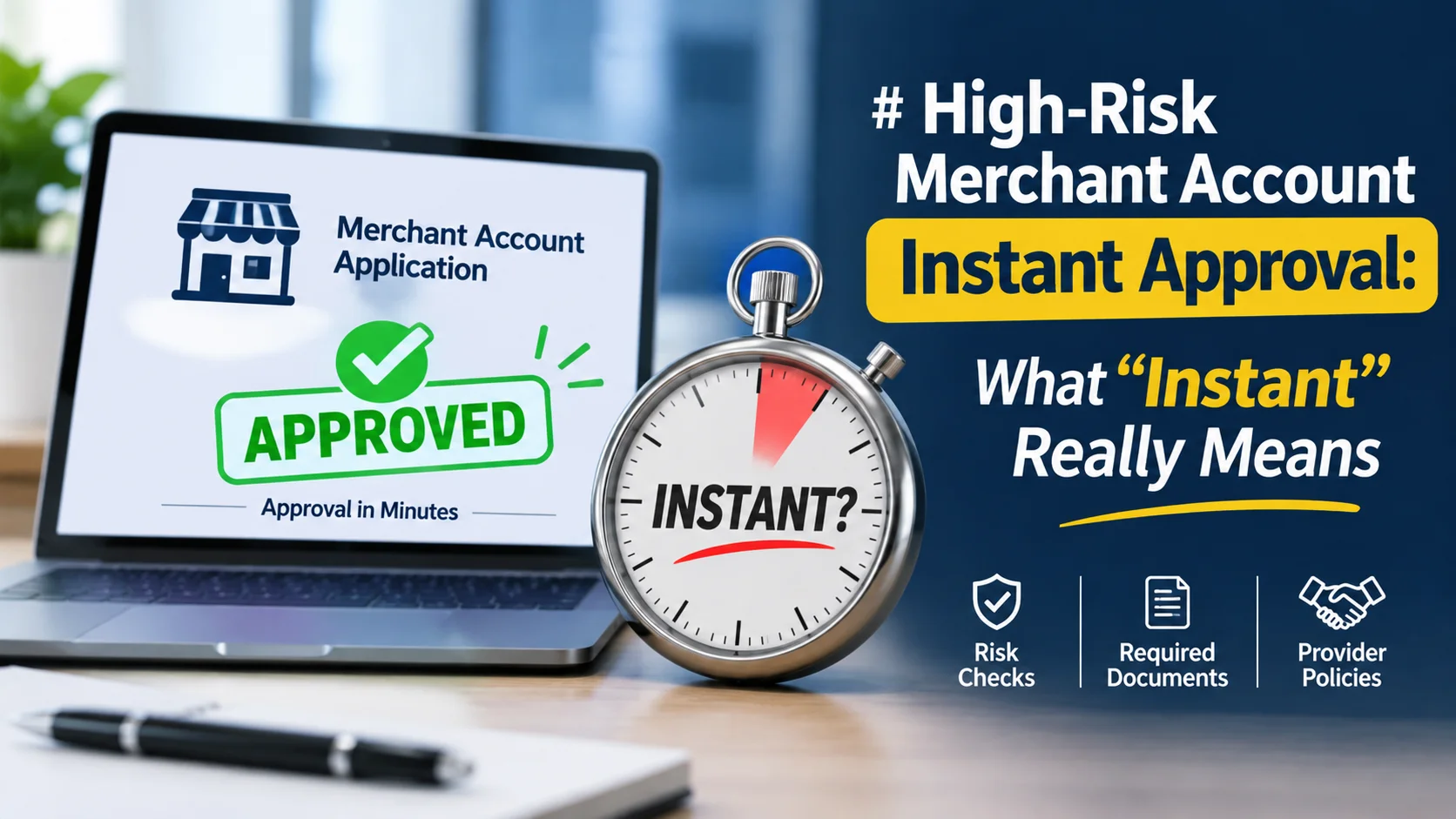
"Instant approval" sounds perfect when you need to start taking card payments. For high-risk businesses it is rarely the full story. Underwriting still happens, and the acquiring bank still makes the final call. This guide explains what instant approval usually means, how long approval really takes, and how to move faster without signing a bad deal.
What "instant approval" usually means
The phrase is used in several different ways. Knowing which one a provider means saves you a lot of frustration.
- Instant response: you submit a form and get an automatic email or quote straight away. Nobody has reviewed your business yet.
- Pre-approval: a quick, preliminary answer based on basic details. It is not a final decision.
- Fast decision: a real underwriting decision within a day or two, once you send a complete set of documents.
- Live account in minutes: this is mostly seen with low-risk businesses or with payment facilitator style accounts, not with a dedicated high-risk merchant account.
The main obstacle is underwriting. For a high-risk application, the underwriter checks fraud potential, chargeback risk and regulatory issues, and that takes more questions and more paperwork than a standard account. Some providers say openly that a true instant approval is not realistic for high-risk merchants and offer a quick pre-approval instead.
How long does approval really take?
Published timelines vary. Some providers promise a decision within 24 to 48 hours. Others say 1 to 3 business days. Another says a decision can come in as little as two business days when everything is supplied.
Guides that break the process into stages show a longer picture. Review takes several business days, then approval, then account activation. Added together, a realistic window runs from a couple of business days to about two or three weeks, depending on your industry and how complete your documents are.
| Stage | What happens | Often-cited time (varies) |
|---|---|---|
| Application | Form and documents submitted | Same day if documents are ready |
| Underwriting review | Risk, documents and website checked | About 1 to 10 business days |
| Approval or conditions | Decision, sometimes with extra requests | 1 to 2 business days |
| Activation | Gateway set up and test payments | 1 to 3 business days |
These ranges come from provider and underwriting pages and are not guarantees. Always ask a provider for its own timeline in writing.
What slows approval down
Most delays are caused by the application, not by the bank. The common reasons are:
- An incomplete application, or documents sent in small pieces
- A website that is unfinished or missing refund, shipping, terms and privacy policies
- A vague description of the business and how customers are billed
- No processing history. New merchants can still apply, but a missing history makes the application weaker.
- Unclear ownership or company structure
- Industries where claims matter (such as supplements) and no ads or landing pages provided for review
A finished website and a clear billing model description usually move faster than a form that is filled in quickly and left half-complete.
How to speed it up: a document checklist
Have these ready before you apply. Requirements differ by provider and acquiring bank, so treat this as a starting list.
- Business formation documents and any licences your industry needs
- Photo ID for the owners
- Business bank statements (often 3 to 6 months)
- Processing statements (often 3 months, if you have processed cards before)
- A voided cheque or bank letter
- A live website with clear refund, shipping, terms and privacy policies
- Marketing samples, ads and landing pages if your claims are sensitive
Then follow four habits:
- Send everything in one go.
- Answer underwriter questions the same day.
- Pick a provider that already works in your industry.
- Describe your billing model in plain words, including trials, subscriptions and refunds.
Red flags in "guaranteed instant approval" offers
Speed is attractive, which is why it gets used as a sales hook. Be careful if a provider:
- Guarantees approval before seeing your documents
- Asks for an upfront fee before reviewing your application
- Will not say who the acquiring bank or processor is
- Keeps pricing and reserve terms hidden until after underwriting
- Pushes a long contract with heavy early termination fees
- Pressures you to sign quickly
Before you commit, ask these questions in writing: What is the reserve and how long is it held? What are the chargeback fees? How fast do payouts settle? What happens if I want to leave? Who is the acquirer?
Faster routes and their trade-offs
Payment facilitator or aggregator style accounts can often onboard a business faster than a dedicated merchant account. The trade-off is usually lower processing limits, reserves, and a higher chance of holds or termination if your volume or chargebacks jump.
A dedicated high-risk merchant account takes longer to set up, but it often gives more stable terms once you are live. If you start with a quick option, plan to move to a more stable setup as your volume grows. Treat a pre-approval as a first step only, because it is not a binding offer.
After approval: how to keep the account
Approval is only the start. Providers watch your numbers closely, especially in the first months.
- Keep chargebacks and refunds low, and respond to disputes on time.
- Process in line with the volumes and ticket sizes you declared.
- Keep your website, policies and billing descriptor consistent.
- Tell your provider before a big launch or a new product line.
These habits protect you from sudden holds, reserve changes and account closures.
Compare providers before you apply
Choose on terms, not on the speed of the first reply. Compare reserves, fees, chargeback rules, settlement times, industries served and contract length side by side. You can browse and compare high-risk payment providers in the TheFinRate directory.
Frequently asked questions
Can a high-risk merchant get same-day approval? Sometimes you get a preliminary answer the same day. A full approval is rarely that fast, because underwriting needs to review your documents.
Why is high-risk approval slower than a standard account? The underwriter looks at more risk factors, such as chargebacks, fraud and regulation, and asks for more documents.
Is pre-approval a guarantee? No. It is a first indication based on limited information, and the final decision comes after full underwriting.
Do I need processing history to apply? Not always. New merchants can apply, but they need stronger documents, a complete website and a clear business plan.
This article is general information, not legal or financial advice. Terms and timelines differ by provider, acquiring bank and country, so confirm details with the provider before you apply.
Comments
No comments yet. Be the first to share your thoughts.
Leave a comment