
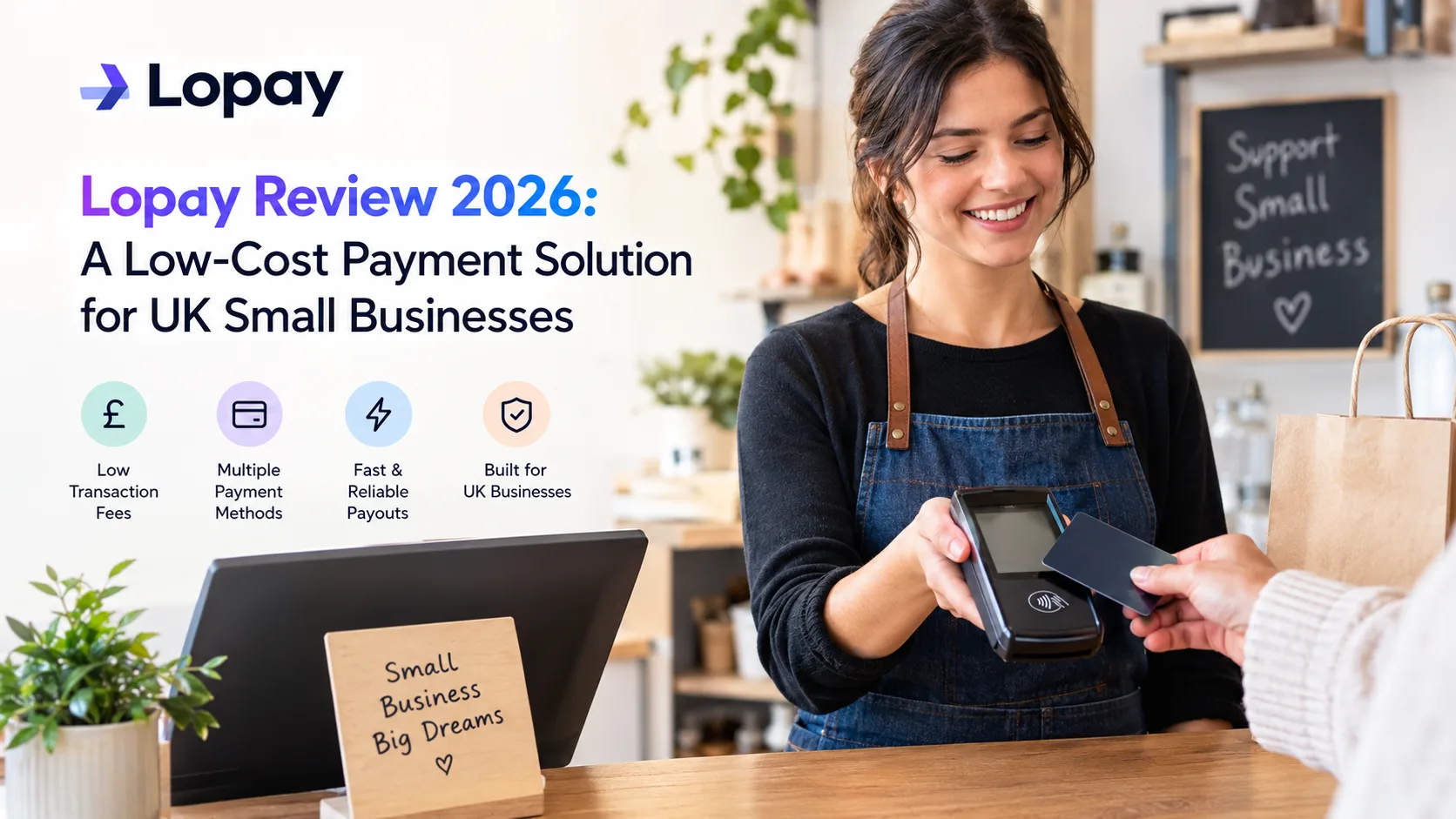
A sole trader taking card payments on the go doesn’t need enterprise payment infrastructure, they need low fees, fast access to their money, and a setup that doesn’t require a contract or a sales call. Lopay was built specifically around that gap in the UK small business market.
Lopay is a UK payment app and point-of-sale solution offering card processing from 0.79%, tap-to-pay via smartphone, a free POS system, and a rewards card that can offset fees to 0%. It’s built on Stripe Payments UK Limited’s FCA-authorised infrastructure rather than its own banking license, which matters for how you should evaluate its trustworthiness. With UK card machine and payment app fees historically running 1.5% to 2.75% at incumbents like SumUp, Zettle, and Square, a sub-1% starting rate is a genuine, verifiable differentiator, not just a marketing claim.
The Problem Lopay Is Solving
Most small UK businesses, sole traders, mobile services, salons, taxi operators, have historically paid between 1.5% and 2.75% per transaction to take card payments through established apps and card readers, often with hardware costs and contract terms layered on top. For a business running thin margins on high transaction volume, that fee difference compounds into real money every single month, not a rounding error.
Lopay’s entire positioning is built around undercutting that default, a merchant payment app advertising itself explicitly as costing “less than half the price of SumUp, Zettle & Square,” with fees starting at 0.79% on its Essential account, no upfront fee, no contract, and no minimum term.
What Lopay Actually Offers
The core product is a payment app that turns a smartphone into a contactless card reader via Tap to Pay, no extra hardware required, alongside a Bluetooth card reader (£35 plus postage) and a WiFi-enabled touchscreen Business Terminal for a monthly rental fee. Supported card types span Visa, Mastercard, American Express, UnionPay, Diners Club, JCB, and Discover, plus Apple Pay and Google Pay.
Beyond basic payment acceptance, Lopay bundles a full point-of-sale system, team management tools, an appointments feature, a loyalty program, and, notably, an Expense & Rewards card that gives instant access to earned funds and actively reduces future transaction fees the more it’s used for business spending. Payout options are flexible, instant, next-day, or weekly, decided by the merchant rather than fixed by the platform.
Why the Stripe Relationship Matters More Than It Looks
This is the detail worth understanding before evaluating any payment provider in this space, and it’s disclosed directly in Lopay’s own footer, “Lopay (LOPAY LTD – 13384279) works with the payments platform Stripe Payments UK Limited that provides payments and e-money services under its UK FCA authorisation.”
In practical terms, Lopay is the merchant-facing brand, app, and customer experience layer; Stripe Payments UK Limited is the actual regulated entity moving and safeguarding funds under its FCA authorisation. This is a completely standard and legitimate structure in UK fintech, it’s the same basic model used by many payment apps, but it’s worth knowing because it tells you where to look if you ever need to verify the regulatory backbone behind your merchant payment provider. A real, named company number (13384279) and a real, named regulated partner is a materially stronger transparency position than many smaller payment apps offer.
The Fee Math, Worked Through
Headline rates only tell part of the story, so it’s worth being concrete. On Lopay’s Essential account at 0.79%, a business processing £10,000 a month in card payments pays roughly £79 in Lopay fees, before the Rewards card offset is even applied. At a more typical incumbent rate of 1.75%, the same volume costs around £175. That’s roughly £1,150 a year in the difference alone for a modest-volume business, before accounting for any hardware or contract costs an incumbent might add on top.
The Expense & Rewards card mechanic adds a second layer, spend £100 through the card on business expenses, and the next £100 of customer transactions processed carries 0% fees. For a business that already runs its expense spending through one card, this effectively compounds the discount further, though it’s worth treating as a genuine perk to optimize around rather than assuming it eliminates fees entirely by default.
2026 Context: Why Low-Cost Payment Apps Are Gaining Ground
The broader UK small-business payment market has shifted meaningfully toward app-based, contract-free payment solutions over the past several years, driven by two converging trends, smartphone-based Tap to Pay removing the need for dedicated hardware at all, and increasing price sensitivity among small merchants comparing effective rates more carefully than they did when card machines were the only option. A payment provider that can combine Stripe-grade regulatory backing with a genuinely lower headline rate is positioned exactly where SMB demand has been moving.
What to Compare Before Switching
- Actual effective rate at your volume: not just the headline percentage, factor in any hardware costs or rental fees for your preferred payment method.
- Payout speed options: confirm whether instant payout carries any additional fee versus next-day or weekly.
- Regulatory transparency: any payment provider should be able to name its underlying regulated partner, the way Lopay names Stripe Payments UK Limited directly.
- Contract terms: Lopay’s no-contract, no-minimum-term structure is a genuine point of comparison against providers that lock merchants into 12-18 month agreements.
- Review volume and consistency: check current Trustpilot, App Store, and Google Play ratings directly, since this is exactly the kind of claim (“highest rated”) that should be verified rather than taken at face value.
Who Lopay Fits
Sole traders, mobile and on-the-go businesses (taxi and transport, mobile services), salons and spas, and vet and pet service providers, the exact verticals Lopay explicitly targets, are a strong fit for a low-fee, contract-free, smartphone-first payment solution. Businesses that value simplicity and fast access to funds over a large enterprise feature set will find the core pitch directly relevant.
It’s a less obvious fit for businesses needing complex multi-location reporting, international payment acceptance beyond the UK and US markets Lopay currently serves, or deep accounting-software integrations beyond what a small business POS typically requires.
Final Take
Lopay represents a genuinely verifiable, lower-cost alternative in a UK payment processing market where incumbents have charged a meaningful premium for years. The Stripe Payments UK Limited relationship gives it real regulatory substance rather than just a marketing claim, and the fee structure, especially combined with the Rewards card offset, produces a real, calculable savings for the right kind of small business. The sensible next step for any merchant comparing providers is running the actual math on their own transaction volume against their current rate, rather than comparing headline percentages alone.
FAQ
Is Lopay a bank or regulated financial institution itself?
No. Lopay operates as the merchant-facing app and brand, while Stripe Payments UK Limited, a separately regulated, FCA-authorised entity, provides the underlying payment and e-money services.
How does Lopay’s pricing compare to SumUp, Zettle, and Square?
Lopay advertises fees starting at 0.79%, which it states is less than half the typical rate charged by these established competitors, several of which have historically charged between 1.5% and 2.75% per transaction.
Do I need to buy hardware to use Lopay?
No. Lopay supports Tap to Pay directly through a compatible smartphone with no additional hardware, alongside optional Bluetooth card reader and business terminal hardware for merchants who prefer a dedicated device.
Is there a contract or minimum term with Lopay?
No. Lopay states no contract, no minimum term, and no upfront fee for the core app, which is a meaningful difference from payment providers that require 12-18 month agreements.
Comments
No comments yet. Be the first to share your thoughts.
Leave a comment