
Selling software, courses or digital downloads to customers in several countries sounds simple until the tax questions start. Is Stripe enough, or do you need a Merchant of Record to take the paperwork off your plate? The two models solve different problems, and the wrong choice costs you either money or sleep. Here is how to decide with real numbers.
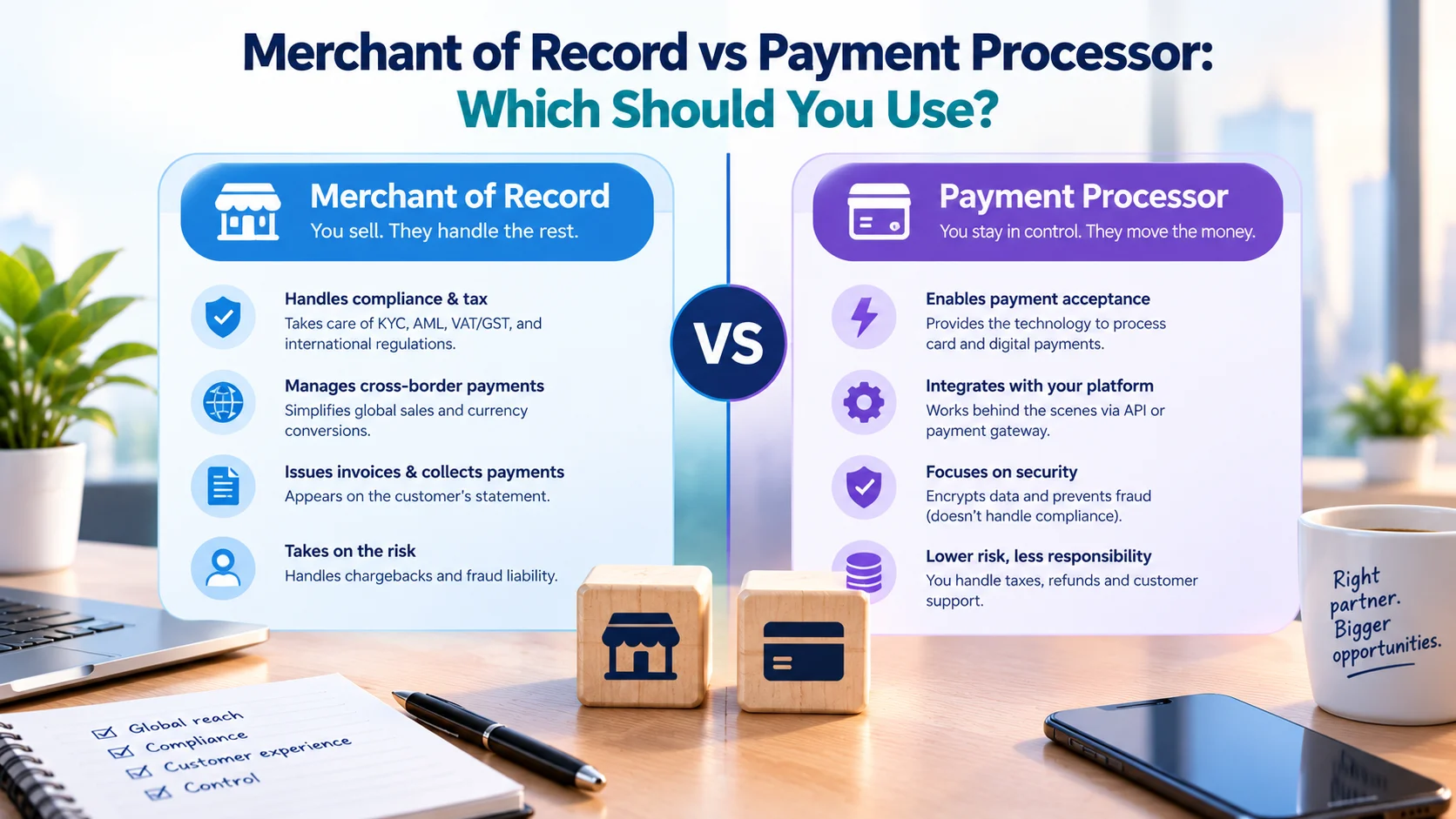
With a payment processor, you are the seller, so tax, chargebacks and compliance are yours to handle. With a Merchant of Record (MoR), the provider becomes the seller and carries most of that load, for a higher fee. Processors usually win on cost when you sell in a few markets. An MoR usually wins when you sell digital products worldwide and do not want to register for tax in every country.
The One Difference That Matters: Who Is the Seller?
Most of the confusion goes away once you ask one question: who is legally selling to the customer?
With a payment processor such as Stripe, PayPal or Adyen, the answer is you. The customer buys from your business, the processor moves the money, and you are the merchant of record in the legal sense. Your payment gateway and processor are tools, not the seller.
With a Merchant of Record such as Paddle or Lemon Squeezy, the answer flips. The MoR resells your product to the customer, collects the payment and pays you what is left after tax and fees. Because it is the legal seller, it carries the tax and compliance duties that would normally be yours.
Both are a type of payment provider. The difference is not features. It is legal responsibility.
What You Own With a Payment Processor
Choosing a processor keeps you in control, and it keeps the paperwork with you. In practice that means:
- Tax registration and filing: You work out where you owe sales tax, VAT or GST, register, collect it and file returns.
- Chargebacks: You gather evidence and answer disputes. In the US, Stripe’s published dispute fee is $15 per case, win or lose, according to third-party comparisons.
- Compliance: Hosted checkout reduces your PCI burden, but you still carry it.
- Invoices and refunds: Your name goes on every receipt.
Tax tools such as Stripe Tax can calculate what to charge and, in some cases, help with filing. They cost extra, and you remain responsible if something goes wrong.
What a Merchant of Record Takes Off Your Plate
An MoR bundles a lot into one fee:
- Tax collection and remittance in the countries it supports.
- Dispute handling. The MoR deals with chargebacks because it is the seller on the transaction.
- Compliance and fraud screening across the whole merchant payment flow.
- Local payment methods and currencies, often without extra setup.
You still own your product, your customer support, your refund policy and your own income tax. The MoR does not file your company’s tax return.
What It Costs: The Numbers
Here are the published headline rates for the main options. They change often, and much of what you will read online is written by vendors, so check each provider’s own pricing page.
| Option | Published pricing | Who handles sales tax |
|---|---|---|
| Stripe (US cards) | 2.9% + 30¢ | You |
| Paddle | 5% + 50¢ | The MoR |
| Lemon Squeezy | 5% + 50¢, with extras in some cases | The MoR |
| FastSpring | Custom, reported at roughly 5% to 8% | The MoR |
| Gumroad | Reported at 10% + 50¢ | The MoR |
Now a hypothetical SaaS business: 500 sales a month at $40 each, or $20,000 in monthly revenue.
- Stripe at 2.9% + 30¢: $1.46 per sale, so $730 a month (3.65%).
- An MoR at 5% + 50¢: $2.50 per sale, so $1,250 a month (6.25%).
The gap is $520 a month, or $6,240 a year. That sounds like a lot until you price your side of the ledger: tax software, an accountant who understands multi-country filings, and the hours you spend on them. If that adds up to more than the gap, the MoR is cheaper in practice.
Read the small print on both sides. International cards, currency conversion and add-on tax tools can push a processor setup higher, while some MoRs add surcharges in edge cases.
Tax by Market: US, UK and Singapore
United States
There is no single federal sales tax. Since the Wayfair ruling, most states with a sales tax expect remote sellers to collect once they pass an economic nexus threshold, commonly around $100,000 in sales or 200 transactions, though rules differ by state. Whether software and digital goods are taxable also varies, and a growing number of states tax SaaS.
United Kingdom
Overseas businesses selling digital services to UK consumers generally need to register for UK VAT from the first sale, with no turnover threshold. The standard rate is 20%, and registered businesses file through HMRC’s Making Tax Digital system. Business-to-business sales can follow different rules, so confirm with HMRC or an adviser.
Singapore
Singapore charges 9% GST, and overseas digital service providers fall under IRAS’s overseas vendor registration regime once they cross its thresholds. Check IRAS for the current rules.
Sell to all three and you are juggling three systems with different portals and deadlines. That is the scenario where an MoR earns its fee.
Chargebacks and Risk
With a processor, disputes are your problem. A rising dispute ratio can bring reserves, holds or a terminated account, so you need clear descriptors, simple refund terms and fast support.
An MoR takes over the dispute process, but it does not erase the risk. If your refund rate climbs, the MoR can pause payouts or end the relationship under its own terms.
There is one more catch. Most MoRs keep lists of restricted categories. If you are a high-risk merchant, such as adult content, gambling, some supplements or crypto, an MoR will usually say no. You would need a specialist high-risk payment provider instead, and you stay the seller, with tax and compliance on you.
When a Payment Processor Is the Better Fit
- You sell mostly in one country, or in a handful of tax jurisdictions.
- Your margins are thin and a 5% fee would hurt.
- You sell B2B, and customers expect invoices in your company’s name.
- You want full control over checkout, pricing, discounts and branding.
- You already have finance help for tax filings.
When a Merchant of Record Is the Better Fit
- You are a small team selling digital products or SaaS to consumers worldwide.
- You do not want to register for tax in dozens of places.
- You want one provider to handle disputes, tax and payment processing compliance.
- You are launching fast and would rather pay more than hire for compliance.
Trade-Offs People Forget
- Payout timing: Some MoRs pay on a set schedule, and Lemon Squeezy has been described as paying twice a month. Check it against your cash flow.
- Customer experience: Card statements and receipts may show the MoR’s name rather than yours.
- Less control: Checkout design, pricing rules and invoicing are usually more limited.
- Switching cost: Moving subscribers between providers is hard, so choose with the next three years in mind.
- Their rules apply: You operate under the MoR’s acceptable use terms and risk reviews.
A Simple Way to Decide
- Where do your customers live? One or two markets point to a processor. Many markets point to an MoR.
- What do you sell? Digital goods suit an MoR. Physical goods and high-risk products usually need a processor-style setup.
- Who will handle tax? If nobody on your team can, factor in a bookkeeper or the MoR’s fee.
- What is your margin? Run the break-even sum above with your own numbers.
- How much control do you need? The more you want, the more a processor fits.
Stuck between the two? Many small teams start with an MoR while revenue is low, then revisit once volume justifies in-house compliance.
Frequently Asked Questions
Is Stripe a Merchant of Record?
No. Stripe is a payment processor, so you remain the seller of record. Stripe Tax can help with calculations, but responsibility stays with you.
Can I use both?
Yes. Some businesses run an MoR for global digital sales and a processor for local or B2B sales. Keep the reporting tidy.
Does an MoR pay my income tax?
No. It handles transaction taxes such as VAT, GST and sales tax. Your own business income tax is still yours.
Are MoRs suitable for physical goods?
They are built mainly for digital products. Physical goods bring shipping, customs and different tax rules, so confirm what the provider supports.
Can I switch later?
Yes, but plan it. Migrating subscribers and stored payment details takes time, so ask providers about export options before you sign.
The Verdict
Neither model is better in general. A payment processor is cheaper and gives you control, as long as you can handle the tax work. An MoR costs more but buys you simplicity, especially when you sell digital products across borders.
Run the break-even sum, check your target markets’ tax rules, and pick the setup you can live with for three years. When you are ready to compare, browse the TheFinRate merchant account providers directory.
Comments
No comments yet. Be the first to share your thoughts.
Leave a comment