
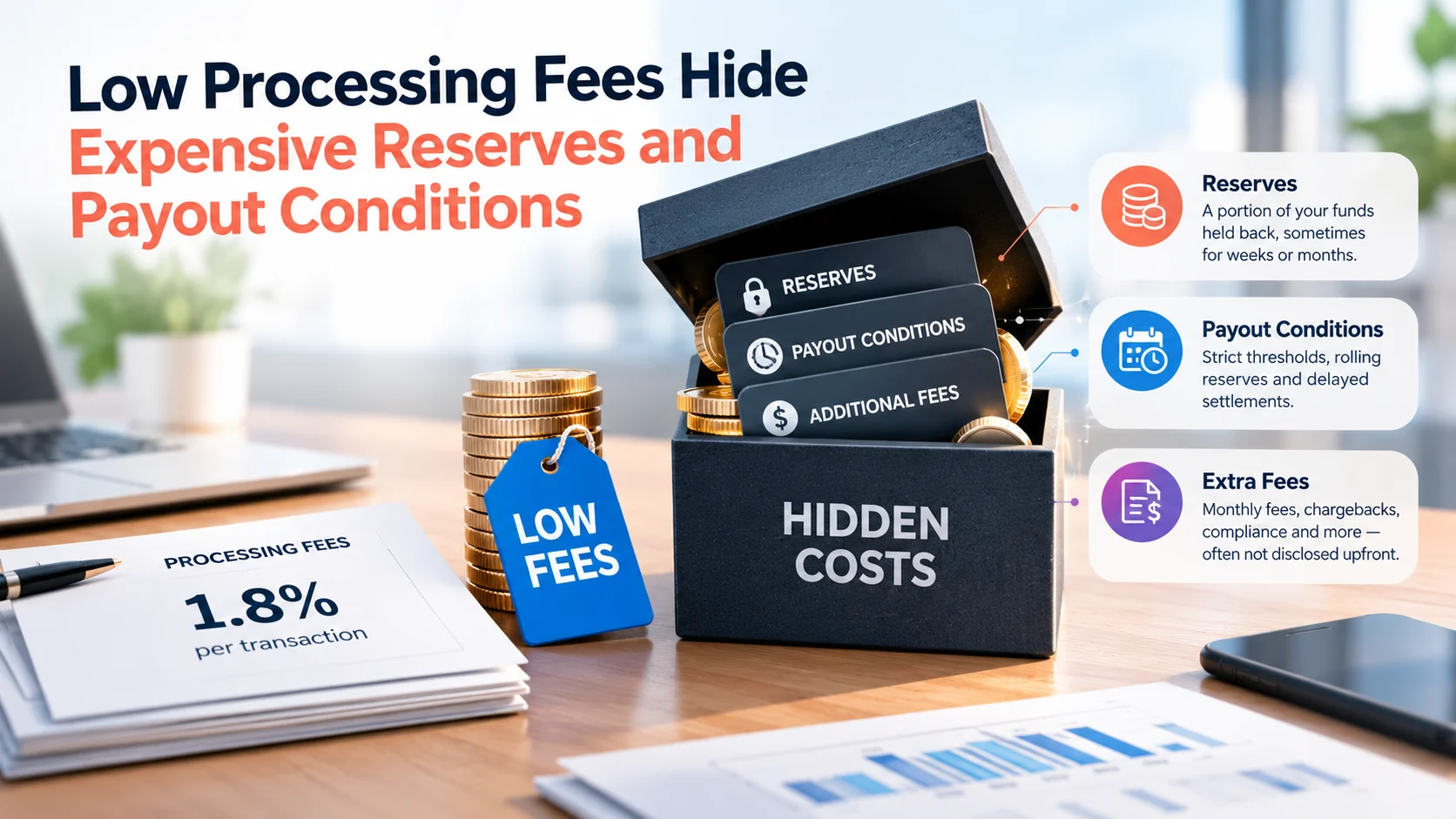
A quote of 1.6% sounds far better than 2.2%. Then the contract arrives, and a tenth of every sale is held back for six months while your first payout waits a week. At that point, the cheaper offer may no longer be cheaper at all.
A headline rate is only one of four costs, the fees, the cash held back, the time before you are paid, and the price of leaving. Convert each quote into a single effective cost, include the reserve and the payout delay, and negotiate the terms before you sign. A low rate with vague hold rights is a risk, not a bargain.
The Price Stack: Four Costs Behind Every Quote
Most merchants compare one number. Payment providers earn and protect money in four places, and a good comparison covers all of them.
- Fees: the percentage, the fixed amount per transaction, and every monthly or event charge
- Cash held: reserves that sit with the provider instead of in your bank
- Payout timing: how long each sale takes to reach you
- Exit terms: what happens to your money and data if the relationship ends
A quote can win on the first line and lose badly on the other three.
Step 1: Turn the Headline Rate Into an Effective Rate
The effective rate is total processing fees divided by total card volume, and it is the single figure that lets you compare providers fairly. An advertised markup typically leaves out interchange, network assessments, monthly charges, per-event fees and equipment rental.
The difference is not small. One analysis puts advertised rates near 2.9% and typical effective rates between 3.2% and 4.5%. Chargeback fees alone can run from $15 to $100 each, and fees on refunded sales are often not returned.
To calculate your own, add every fee on last month’s payment processing statement and divide by total card sales. Do this before you request quotes, so you have a real baseline.
Step 2: Put a Price on the Reserve
A reserve is cash the provider keeps to cover future chargebacks and refunds. The logic is simple. Customers can file chargebacks for up to 120 days, so providers hold funds while that window is open.
The Three Common Structures
- Rolling reserve: a percentage of each day’s sales is held and released gradually as older amounts reach the end of the holding period.
- Upfront reserve: you fund a lump sum before processing begins.
- Capped reserve: a percentage is held until a fixed maximum is reached.
One consultancy adds a warning worth remembering: capped reserves are often not released back to the merchant over time. Always ask how and when money comes back.
How Big Is Typical?
Rolling reserves commonly withhold 5% to 10% of each transaction for 90 to 180 days. One source maps risk tiers from 0% to 5% for new low-risk merchants up to 15% to 20% for very high-risk ones.
Two details matter. Reserves are normally imposed from day one. And the held money usually sits in a non-interest-bearing account, so it earns nothing for you.
A Worked Example
The numbers below are illustrative. Assume a UK merchant with £80,000 in monthly card sales across 1,600 transactions, all with the same payout speed.
| Offer A | Offer B | Offer C | |
|---|---|---|---|
| Headline price | 2.2% + 20p | 1.6% + 10p | 1.8% + 10p |
| Reserve | None | 10% rolling, 180 days | £20,000 upfront |
| Monthly fees | £2,080 | £1,440 | £1,600 |
| Cash held at steady state | £0 | £48,000 | £20,000 |
| Effective cost at 12% cost of cash | 2.60% | 2.40% | 2.25% |
| Effective cost at 25% cost of cash | 2.60% | 3.05% | 2.52% |
At a 12% cost of cash, both low-fee offers still beat Offer A. At 25%, Offer B flips and becomes the most expensive. That is the lesson, the reserve matters most to businesses with tight cash.
A shortcut helps. Divide Offer B’s yearly fee saving (£7,680) by the cash held (£48,000). The answer is 16%. If your real cost of cash is above 16%, Offer B loses.
The Ramp-Up Most Quotes Skip
A rolling reserve builds over time. With Offer B, about £8,000 is withheld each month until the balance reaches roughly £48,000 around month six. A new business can look fine in month one and feel squeezed by month four. Put the ramp into your cash-flow forecast before you commit.
Step 3: Read the Payout Conditions
Reserves get the attention. Payout rules cause the surprises.
- Initial funding delay: New merchants may face a 3 to 7 business day delay while the account is reviewed. Another provider sets a seven-business-day delay on the first payout.
- Minimum balances: One gateway sets a $35 minimum, so small balances roll into the next payment payout.
- Refund holdbacks: The same provider keeps a refund reserve of at least $100.
- Card-specific delays: American Express settles more slowly, which can push some providers to a seven-business-day payout delay.
Compare those terms with normal timing. Card funds generally reach the merchant’s bank within about 1.5 to 2 business days.
What a Delay Costs
On £80,000 of monthly sales, a seven-day payout delay ties up about £18,700 at any moment. At a 12% cost of cash, that is roughly £187 a month, or 0.23% of volume, before any reserve applies.
A 30-Minute Comparison Method
You do not need special software. A simple spreadsheet is enough.
- List each offer in a column with its rate, fixed fee and every monthly charge.
- Add rows for reserve type, percentage, holding period and cap.
- Calculate cash held at steady state, percentage times monthly sales times months of hold.
- Multiply the held cash by your real cost of cash, then divide by twelve.
- Add that monthly figure to the fees and divide by monthly sales.
- Add the cost of any payout delay in the same way.
Run each offer twice, once at a low cost of cash and once at a high one. If the ranking changes, the reserve is your deciding factor.
Step 4: Check the Exit
Many merchants read the entry terms and skip the exit. After an account closes, unreleased reserves are typically held for about 180 more days. Ask what happens to your funds, your stored card tokens and your reporting data if you leave.
If your payment gateway holds customer tokens, find out whether you can export them. Without that, switching providers can mean asking every customer to re-enter their details.
When a Reserve Is Reasonable
Not every reserve is a trap. Some are a fair price of access for a new or higher-risk business.
| Situation | Reasonable response |
|---|---|
| Established business, low disputes | Negotiate for no reserve or a small cap |
| New business with limited history | Accept a modest reserve with a step-down clause |
| High refund or chargeback history | Accept a capped reserve with a written release schedule |
| Large open-ended reserve plus a very low rate | Treat as a red flag and request a full contract review |
A Real-World Scenario
Picture a US online store with $60,000 in monthly sales. Its owner switches providers to save 0.5% on rates, which is $300 a month, and accepts a 10% rolling reserve over 180 days without running the numbers.
Six months later, about $36,000 of the store’s money sits with the new provider. The owner is borrowing against a credit line at roughly 20% to cover stock, which costs about $600 a month on that held amount. The rate saving of $300 has turned into a net loss of $300.
Nothing was hidden in the contract. The cost was simply never priced. One page of arithmetic before signing would have shown it.
Warning Signs in a Low-Fee Offer
- The quote does not mention a reserve, but the contract allows one later
- The provider can change reserve or payout terms at its discretion
- No release schedule, review date or step-down language
- Holds that can be applied to the account with no stated triggers
- Pricing that only appears after you upload documents
Two or more of these is enough reason to ask for the full agreement before you go further.
How to Negotiate Better Terms
Reserve terms are rarely fixed. Come with a request, not a complaint.
- Ask for a step-down: Look for clauses that reduce the reserve automatically after clean processing.
- Ask for a cap: A maximum balance beats an open-ended percentage.
- Ask for a shorter hold: Move from 180 days toward 90 where your history supports it.
- Ask for notice: Require written warning before any change.
- Ask for release triggers: Tie them to a measurable result, such as a chargeback ratio below an agreed line.
A simple opener works well: “We would like to accept the reserve, but we need a written release schedule and a review after six months of clean processing.”
Questions to Ask Before You Sign
- What reserve type, percentage and holding period apply to my business?
- Can the reserve increase later, and what would trigger it?
- When is my first payout, and how often do I get paid after that?
- Are there minimum payout amounts or separate refund reserves?
- What happens to my funds and tokens if you close my account?
- How much notice do you give before changing any term?
- Who is the acquiring bank behind my account?
Quick US and UK Checks
- UK: Confirm the provider is authorised or registered on the Financial Conduct Authority register, and ask which entity holds your funds.
- US: Ask for the acquiring or sponsor bank by name, and confirm whether you are on a direct merchant account or a sub-merchant arrangement.
- Both: Ask whether the integration with your payment gateway affects payout timing.
Mistakes That Make Cheap Offers Costly
- Comparing headline rates instead of effective cost
- Ignoring how quickly a rolling reserve builds
- Not asking whether reserves can change after approval
- Overlooking the first-payout delay
- Skipping the post-termination hold
- Placing all merchant payment volume with one provider
FAQ
Is a reserve always a bad sign?
No. It is often the price of access for newer or higher-risk businesses. The problem is a reserve that is large, open-ended or unclear.
Can a reserve be removed?
Often it can be reviewed after a stretch of clean processing. Ask for that right in writing.
Do reserves earn interest?
Usually not, since they typically sit in a non-interest-bearing account.
Which is better, rolling or upfront?
It depends on cash flow. Rolling spreads the burden but can hold more in total. Upfront is predictable but needs cash on day one.
The Bottom Line
Price an offer by what you can spend and when, not by the figure on the sales page. Convert every quote into an effective cost, include the reserve and the payout delay, and negotiate the terms in writing.
Before you choose, compare payment providers and their reserve and payout terms in the TheFinRate directory.
Comments
No comments yet. Be the first to share your thoughts.
Leave a comment