
You filled out the forms, uploaded your documents and waited. Then came the decline, often with a vague reason or none at all. This guide decodes the most common rejection causes, shows you how to audit your application like an underwriter, and gives you a clear plan to choose the right payment provider next time.
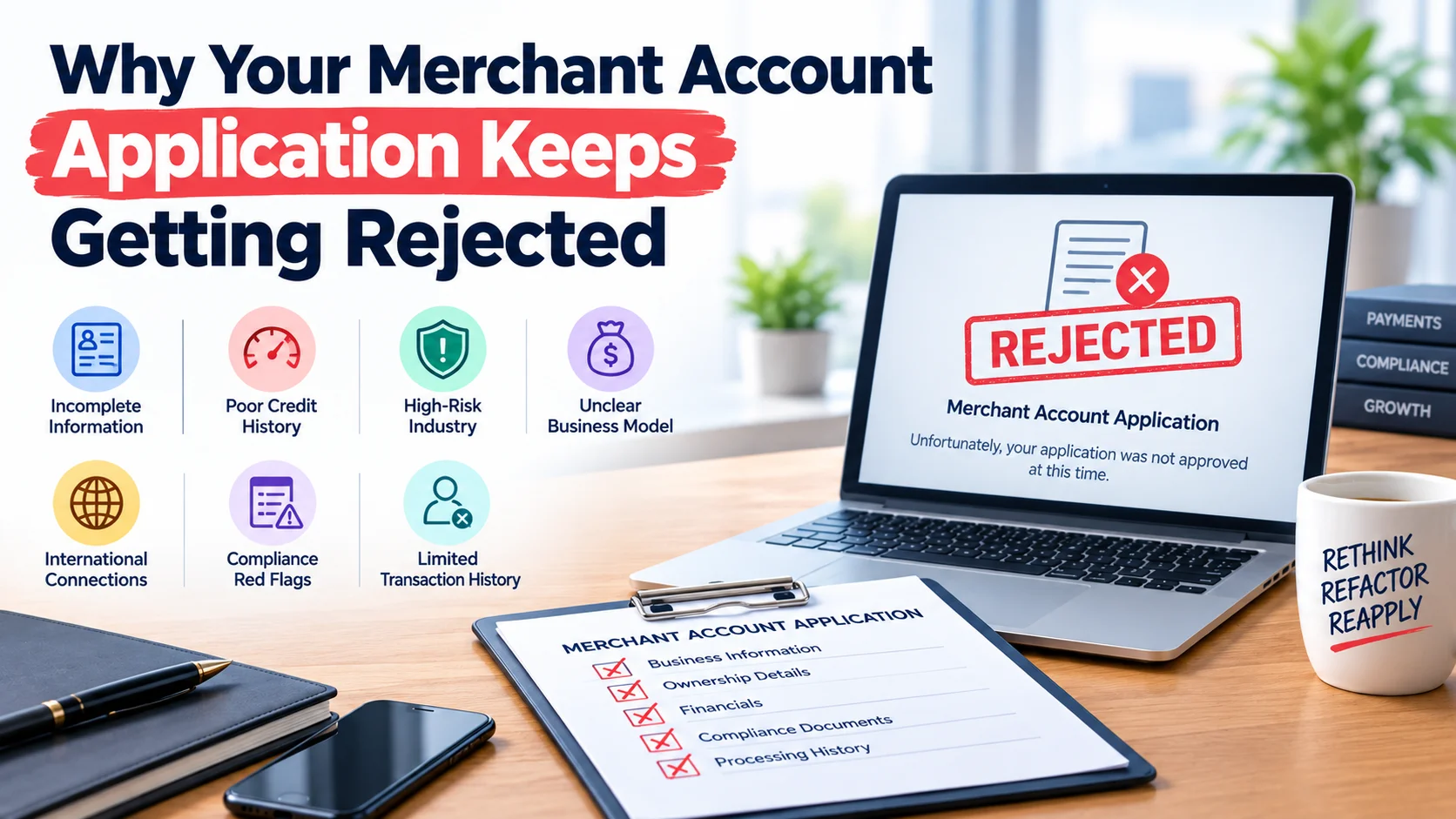
Rejections usually come from a handful of fixable issues, such as credit, website gaps, unrealistic numbers or a risky category. Find your likely cause before you resubmit. Then match your profile to the right type of provider, because the wrong door gets declined again. Reapply with a clean, consistent pack, not a copy of the last one.
Rejection Is Rarely Random
Every new application goes through bank underwriting. The bank reviews the business, its owners and its expected activity before agreeing to take on the risk. If something looks thin, inconsistent or risky, the file is declined.
Why You Rarely Get a Clear Reason
Many providers keep decline notices vague. One provider says openly that it cannot explain the specific reason in your case, and only lists common causes. That is why you need to work backward from the likely suspects.
The Eight Most Common Decline Reasons (and the Fix for Each)
1. Credit Problems and Tax Liens
Poor personal credit history is described as the most common reason processors deny applications. Tax liens against you or the business are another red flag.
The fix: Consider adding a signer, such as a business partner, who has stronger credit. Resolve open liens before you apply again.
2. Unresolved Balances With a Previous Provider
Money you still owe a former processor is a warning sign for new underwriters.
The fix: Settle the balance and keep written proof of payment.
3. A MATCH Listing
MATCH is a shared record that alerts providers before they open an account for a listed merchant. Names associated with the business or the terminated account can appear too, not only the company name.
The fix: Entries last five years, and a PCI-related listing can be challenged once you are compliant. Some acquiring banks will still consider listed merchants, but expect extra documents.
4. Unrealistic Volume or Ticket Size
Providers want honest, realistic processing numbers, and both unusually high and unusually low figures draw questions. One provider notes that a very high average ticket, such as $600, can raise a red flag.
The fix: Base your estimates on real sales data or a documented pipeline, and be ready to explain outliers.
5. Website and Policy Gaps
Your website is part of the application. Clear refund policies, terms and conditions, and accurate product descriptions are treated as non-negotiable in many industries. Products that do not match their stated description or price can also trigger a decline.
The fix: Publish the policies, show real contact details and make every listing accurate before you reapply.
6. Inconsistent or Incomplete Information
Your business name should match your bank account, website and state registration. Missing or incorrect details are another listed cause of decline.
The fix: Line up every document so names, addresses and ownership agree.
7. A Category Underwriters Distrust
Nutraceuticals, firearms, adult content, travel, credit repair, CBD, subscription boxes and online gaming are among the categories that often struggle. Supplements, drop-shipping, ticketing and high-ticket electronics are also seeing more rejections or routing to high-risk processors.
The fix: Apply to providers that actually underwrite your category.
8. Chargeback History
A prior chargeback ratio above 1% follows you through card-network databases.
The fix: Show recent data trending down, plus the changes that caused it.
Why 2026 Is a Harder Year to Get Approved
Acquirers are more selective than they were. Visa’s VAMP excessive-merchant threshold dropped to 1.5% on April 1, 2026. Some acquirers hold merchants to internal limits as low as 1%.
Banks that carry more risk per account want cleaner files. That means small gaps that once passed can now sink an application.
Three Typical Rejection Stories
These are composite examples, not real cases, but they mirror common patterns.
The mismatched store: A home-decor seller applies with a live site, yet the legal name on the application differs from the trading name on the checkout. The bank cannot connect the two and declines. The fix takes a day: align the names and add a registration certificate.
The optimistic estimate: A subscription box startup projects ten times its real volume to look established. Underwriters question the number, ask for proof and decline when none exists. A smaller, documented forecast would have passed.
The old balance: A founder with a clean new business is declined because of an unpaid fee with a previous processor. After paying it and holding the receipt, the next application is approved.
The common thread is simple. None of these merchants was a bad risk. Each one handed the underwriter a reason to say no.
Run an Underwriter-Style Audit Before You Reapply
Open your last application and check each line as if you were the bank.
- Do your legal name, trading name and bank account match everywhere?
- Is your website live, professional and free of placeholder text?
- Are refund, shipping and privacy policies easy to find?
- Do your product pages match what you declared you sell?
- Do your volume and ticket numbers agree with your documents?
- Are credit reports and tax records free of errors and open liens?
- Is the payment gateway on your checkout the one you named in the application?
Fix every item before you send a new file. Even one mismatch can trigger another decline.
How to Find Your Real Reason
Ask the provider in writing which category the decline falls into, such as credit, category, documents or database results. You may not get a full answer, but any hint helps.
You cannot search the MATCH database yourself, so most merchants learn about a listing when an application is declined. If you suspect one, ask a specialist provider to screen you.
Pick the Right Door
Many rejections happen because a good business applies to the wrong type of provider.
| Your profile | Best fit | Why |
|---|---|---|
| Very small or brand-new, low volume | Payment service provider | Fastest start for very small or new businesses |
| Steady volume, standard category, clean history | Traditional merchant account | Stability and a named acquiring bank |
| Restricted category, chargeback history or MATCH listing | Specialist high-risk payment provider | Built to underwrite your risk |
Very small or new businesses usually start fastest with a payment service provider, while a traditional merchant account tends to suit larger volumes.
What High-Risk Really Costs
A typical high-risk rate is around 2.95% plus 25 cents, compared with roughly 2.6% plus 10 cents for a standard account. Expect longer applications, setup fees and funds that can take up to a week to arrive.
That premium buys approval and stability. For many merchants, stable high-risk payment processing costs less than another round of declines and lost sales.
A 30-Day Plan to Reapply
Week 1: Diagnose: Pull your credit reports, review tax records, list every previous account and check chargeback data. Write down the three most likely decline causes.
Week 2: Fix: Resolve liens and balances, correct your website, publish policies and align every name and address.
Week 3: Build the pack: Prepare the documents underwriters ask for.
- Company registration and ownership details
- Government ID for all owners
- Business and personal bank statements
- Prior processing statements, if any
- Supplier invoices or proof of inventory
- Fulfillment and refund process summary
- Marketing materials and a certificate of good standing, which underwriters sometimes request.
Week 4: Submit: Send the file to two or three providers that match your profile.
When You Can Reapply
Timing varies. One provider lets merchants reapply six months after a decline. Others have no fixed wait. Ask each provider before you send another file.
What Underwriters Check Beyond Your Documents
Do not assume the file is the whole story. It is not unusual for underwriters to look into a business’s reputation. Expect them to search your name, your domain and your reviews.
- Clean up public complaints you can legitimately resolve
- Make sure your social profiles and contact details match the application
- Remove outdated or misleading claims from your site
A consistent public footprint tells the reviewer the business is real and stable.
A Short Explanation Letter You Can Adapt
Underwriters like context. A brief cover note helps.
We were previously declined by [provider] in [month]. Since then we have [resolved the tax lien / published refund and shipping policies / reduced our chargeback ratio from X% to Y%]. Our expected volume is [amount] per month with an average ticket of [amount], based on [source of numbers]. Supporting documents are attached.
Keep it factual and short. Do not argue with the previous decision.
Questions to Ask a Provider Before You Apply
Save yourself a wasted application. Ask these first:
- Which categories do you underwrite, and which do you decline?
- Is there a minimum monthly volume or ticket size?
- Do you accept merchants with a prior termination?
- What reserve or setup fees should I expect?
- Which payment gateway integrations do you support?
- How long does underwriting usually take?
A direct answer to each saves weeks. A vague answer is useful information too.
What to Do While You Wait for a New Approval
Declined does not mean frozen. You can often keep selling while you fix the file.
- Use a payment service provider as a temporary front door if your category allows it
- Send invoices or payment links for early orders
- Offer bank transfer to customers who prefer it
- Take pre-orders and charge once the new payment gateway is live
Be honest about what you sell with every provider you use. Hiding your real category from a temporary provider only creates a termination story you will need to explain later.
Treat the waiting period as prep time. Track daily sales, log customer complaints and note your refund rate. A few weeks of clean data makes your next application stronger.
Mistakes That Get You Declined Again
- Understating volume to look safer, then exceeding it
- Hiding a past termination
- Choosing the wrong business category on the form
- Applying to many providers with different versions of the same story
- Using a placeholder website
- Changing your business model right after approval
- Sending a merchant payment flow that does not match the checkout you described
FAQ
Does a decline mean I am banned from card processing?
No. Credit issues, website gaps, missing documents and chargeback patterns are mostly addressable.
Can I get a merchant account with bad credit?
Sometimes. Adding a stronger co-signer or applying to specialist providers can help, though pricing may be higher.
Should I use a payment service provider instead?
For a new or low-volume business, often yes. But those providers can also close accounts, so plan a backup.
How many providers should I apply to at once?
Two or three matched providers is usually enough. More than that tends to dilute your attention to each file.
The Bottom Line
A rejection is information, not a verdict. Find the likely cause, fix the real problem and apply to a provider built for your profile. The merchants who get approved are rarely the ones with perfect histories. They are the ones with consistent, honest files.
Comments
No comments yet. Be the first to share your thoughts.
Leave a comment