
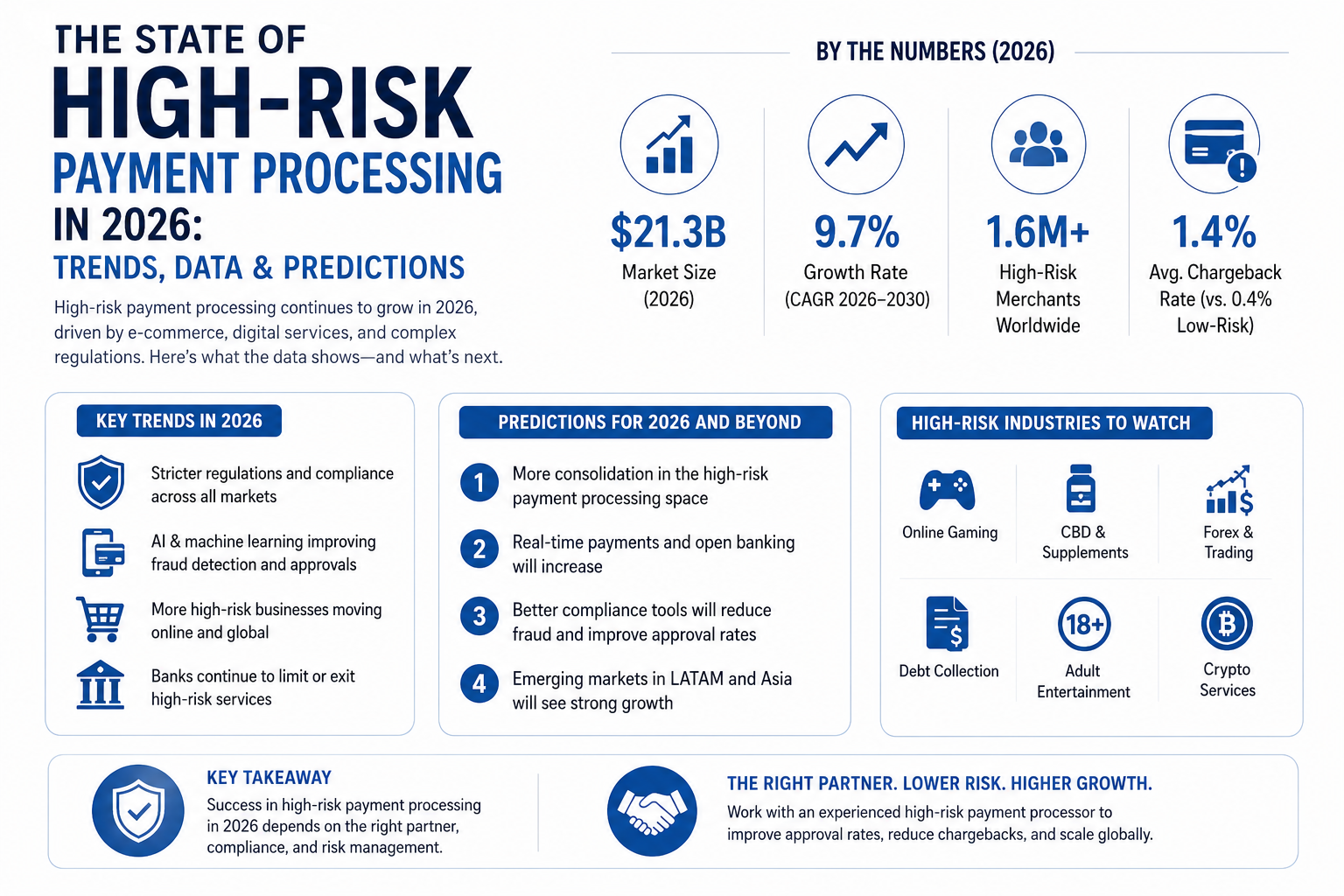
2026 in Review: The Year the Rules Changed
For high-risk merchants, 2025 was not a year of incremental change. It was a year of structural reconfiguration, one that rewrote the rules of dispute management, compliance, fraud prevention, and payment infrastructure in ways that will compound through 2026 and beyond.
With AI-driven fraud detection, local payment rails, and emerging regulations redefining the landscape, 2025 turned out to be a pivotal year for high-risk merchants, whether in iGaming, adult entertainment, nutraceuticals, or the CBD sector.
Three events defined the year:
Visa’s VAMP program went live and went into enforcement: Launched in April 2025, the Visa Acquirer Monitoring Program consolidated all fraud and dispute monitoring into a single ratio, and began enforcing financial penalties in October 2025. The entire dispute management infrastructure that high-risk merchants had built under the previous VFMP and VDMP frameworks became obsolete overnight.
Chargeback volumes hit record levels: The global chargeback total of 238 million in 2025 is projected to increase 41% to 337 million by 2026, putting additional pressure on high-risk merchants who already operate with structurally elevated dispute rates.
Institutional de-risking intensified: Tier-1 acquiring banks and payment facilitators continued their systematic exit from high-risk verticals, not due to individual merchant failures, but as a portfolio-level risk response to tightening card network thresholds and regulatory pressure.
The merchants who navigated 2025 successfully were the ones who treated these structural shifts as infrastructure problems requiring infrastructure solutions, not temporary inconveniences to be managed reactively.
Market Size & Growth: The Numbers Behind the Industry
The high-risk payment processing sector is not a niche corner of the payments industry, it is a large and rapidly expanding market driven by the growth of regulated eCommerce, digital health, subscription SaaS, and global fintech.
The Market in Numbers (2025–2026)
The high-risk payment processing market will grow from $63.46 billion in 2025 to $214.8 billion by 2033 at a 13.5% CAGR. This growth rate, nearly double the broader payment processing market’s expansion, reflects the rapid migration of regulated industries from cash and check-based payment models to card-based and digital payment infrastructure.
The payment processor market overall is expected to reach $63.87 billion in 2025 and grow at a CAGR of 11.59% to reach $110.53 billion by 2030.
Total transaction value in the digital payments market alone is projected to reach $24.07 trillion in 2025, and 75% of worldwide adults now use some form of digital payment method.
High-risk merchants pay 4–8% processing fees versus the 1.3–2.7% paid by standard retail merchants, a premium that represents the combined cost of elevated chargeback management, specialized underwriting, rolling reserves, and fraud prevention infrastructure. For a $214.8 billion market by 2033, this fee gap represents the scale of the economic opportunity in specialized high-risk payment processing.
High-risk eCommerce industries face unique challenges that would paralyze standard retail operations, yet the global eCommerce market exceeded $7 trillion in 2025. The growth of that broader market directly expands the high-risk segment, as more regulated-industry businesses move online and require specialized payment processing infrastructure to operate.
The Fraud Crisis: Data Every High-Risk Merchant Must Know
Fraud is the defining financial pressure on every high-risk merchant account relationship. The 2025 data tells a story of accelerating scale, and of fraud patterns that are evolving faster than most merchants’ defenses.
The Numbers (2025–2026)
Chargeback fraud will create $28.1 billion in merchant losses by 2026, separate from the broader $48 billion fraud total. This represents losses specifically from the dispute process rather than fraud detection and prevention. The dual burden of preventing fraud and fighting chargebacks demands integrated solutions.
Both third-party fraud and first-party “friendly fraud” account for 80% of all chargebacks. This statistic explains why payment processors classify certain industries as high-risk: elevated chargeback rates directly correlate with fraud exposure.
The stricter standards for VAMP create a notable vulnerability for merchants experiencing friendly fraud chargebacks which, according to Visa’s own data, make up roughly 75% of all disputes. Specifically, when a cardholder disputes a legitimate charge by claiming it was due to third-party fraud, that single incident now adds two black marks against a merchant’s record under VAMP.
When merchants actively dispute chargebacks, they win approximately 45% of cases with proper evidence and documentation. This success rate makes representment worthwhile despite the labor costs involved. Automated evidence gathering and submission systems improve win rates while reducing manual effort.
The Friendly Fraud Acceleration
Friendly fraud, where a legitimate cardholder disputes a valid transaction, has become the dominant fraud vector for high-risk merchants in 2025. Under the VAMP framework, friendly fraud is particularly costly: the TC40 fraud alert and the TC15 dispute from the same transaction both count against the merchant’s VAMP ratio. A fraud alert (TC40) and a chargeback (TC15) from the same transaction both count against your ratio. One disputed transaction can generate two events, hitting your ratio twice, creating the potential for fines on a single disputed transaction from two separate penalty events.
This double-counting mechanism makes friendly fraud prevention not just a financial priority but a compliance survival requirement in 2026.
VAMP: The Biggest Regulatory Shift in a Decade
No single development shaped high-risk payment processing in 2025 more significantly than Visa’s Acquirer Monitoring Program. Understanding VAMP in precise technical detail is no longer optional for any merchant with significant Visa card-not-present volume.
What VAMP Is
Visa’s VAMP replaced its legacy fraud and dispute monitoring programs in April 2025, combining both TC40 fraud reports and TC15 chargebacks into a single ratio.
The core program metric is a single, count-based ratio: VAMP Ratio = Count of [Fraud (TC40) + Disputes (TC15)] ÷ Count of Settled Transactions (TC05).
The Evolving Threshold Timeline
April 1, 2025: VAMP launch and start of advisory period. June 1, 2025: New thresholds and minimum event counts take effect. September 30, 2025: Advisory period ends. October 1, 2025: Enforcement begins; Visa penalties possible. April 1, 2026: Stricter merchant thresholds (1.5%) go live in U.S., Canada, and EU.
As of April 1, 2026, the threshold is now 1.5% across the U.S., Canada, EU, and APAC — a 32% reduction in your margin for error overnight.
The Acquirer Pressure Cascade
Visa set acquirer “Above Standard” at 0.50% and “Excessive” at 0.70% for portfolio-level VAMP ratios. Acquirers exceeding those limits face fines per affected transaction across their entire portfolio. This creates a strong financial incentive for acquirers to proactively restrict or offboard merchants whose individual ratios threaten portfolio compliance.
Merchants should expect acquirers across the board to charge higher fees for excessive chargebacks, enforce stricter underwriting rules prior to onboarding, and be quicker to terminate accounts that pose a risk to their VAMP ratio.
What to Do Now
One of the most effective ways to keep your VAMP ratio low is to leverage Compelling Evidence 3.0, Visa’s enhanced data-sharing framework. Fraud reports resolved through preventative tools or Compelling Evidence 3.0 do not count toward your VAMP ratio.
If you resolve a dispute before it becomes a formal chargeback, it is removed from the VAMP calculation. To avoid the Enumeration Ratio penalty, which hits if 20% of your traffic is bot-testing, ensure you have CAPTCHA on your payment page and velocity checks limiting how many times one IP can attempt payment per minute.
AI-Powered Fraud Detection Goes From Edge to Standard
Gone are the days when risk management relied solely on static rules and manual reviews. In 2025, AI and machine learning are revolutionizing fraud detection for high-risk businesses. Modern fraud engines now identify patterns across millions of transactions in real time, spotting chargebacks, transaction laundering, or synthetic identities before they cause harm.
For high-risk merchant account holders, this shift has three practical dimensions:
Behavioral biometrics at the payment layer: AI systems now analyze keystroke dynamics, mouse movement patterns, and device interaction behaviors to differentiate legitimate customers from automated fraud bots and synthetic identities, without adding any visible friction to the checkout experience. For high-risk merchants with subscription billing, this technology is particularly valuable in detecting account takeover attacks during the rebilling cycle.
Real-time transaction laundering detection: Transaction laundering, where a high-risk merchant processes transactions on behalf of an undisclosed higher-risk business, has become more sophisticated and more prevalent. AI-powered monitoring systems can now detect laundering patterns that static rule sets miss entirely, protecting both processors and compliant merchants from association with fraudulent activity.
Synthetic identity fraud prevention: Synthetic identities, built from combinations of real and fabricated information, are increasingly used to open fraudulent accounts in high-risk service categories. AI systems that can identify synthetic identity signals at onboarding are becoming standard infrastructure for any specialized high-risk payment processor serving the subscription, lending, or digital health spaces.
Not only does blockchain have the power to reduce fraud across the financial services industry but it can also boost transaction speeds, explaining why it is being rapidly adopted within the payment processing industry. Blockchain within the banking, financial services, and insurance market is expected to reach $22.46 billion by 2026, with a compound growth rate of 73.8%.
Payment Orchestration Becomes Non-Negotiable
In 2023, payment orchestration was a sophisticated option for high-volume merchants. In 2025, it became a baseline requirement for any high-risk business operating at scale. The convergence of VAMP pressure, institutional de-risking, and tightening approval rates across traditional acquiring relationships made single-processor dependency too dangerous to sustain.
The world of high-risk payment processing is evolving faster than ever. Whether you’re in iGaming, adult entertainment, nutraceuticals, or the CBD sector, understanding these high-risk payment processing trends can help you stay compliant, improve transaction success rates, and protect your revenue from fraud.
Payment orchestration platforms, which sit above individual processors and manage routing, cascading, retry logic, and reporting across a merchant’s entire processor stack, saw significant adoption growth in 2025 across three high-risk categories:
Subscription merchants: The combination of involuntary churn from failed recurring charges and VAMP pressure from dispute accumulation made multi-processor cascading with intelligent retry logic a revenue and compliance necessity.
iGaming operators: Geographic routing optimization across multiple regional acquiring relationships improved approval rates by 3–8 percentage points in markets where single-processor arrangements produced structurally high decline rates.
Cross-border fintech: Currency optimization, local payment rail integration, and multi-jurisdiction compliance management became practical only with orchestration platforms that could manage routing logic across 10+ processor relationships simultaneously.
The merchants who built orchestration infrastructure in 2025 entered 2026 with materially better approval rates, lower effective chargeback ratios, and more resilient processing architectures than those who continued to rely on single-processor arrangements.
Stablecoins & Crypto Enter the Mainstream Processing Stack
One of the most disruptive high-risk payment processing trends this year is the use of stablecoins for cross-border transactions. Major players like Visa have begun experimenting with stablecoins to simplify global settlements.
For high-risk merchants, particularly those operating in markets where traditional card acquiring is severely constrained, stablecoins and cryptocurrency payment rails moved from experimental alternatives to operational infrastructure in 2025.
Three developments accelerated this shift:
LATAM adoption: In markets like Brazil, Argentina, Mexico, and Colombia, currency volatility, limited local acquiring infrastructure, and cross-border banking restrictions made stablecoin-denominated payments a practical solution for merchants who could not secure reliable card processing relationships. Crypto payment processors like NOWPayments reported significant growth in LATAM merchant adoption through 2025.
Regulatory clarity in the UK and EU: Progressive regulatory frameworks, including the UK’s Payment Services Regulation 2 and the EU’s MiCA regulation, created clearer operating rules for crypto payment processors, reducing the regulatory uncertainty that had previously deterred mainstream adoption.
Chargeback elimination: Unlike card payments, cryptocurrency transactions are irreversible, eliminating chargeback exposure entirely for merchants who can successfully migrate willing customers to crypto payment rails. For high-risk merchants in categories with structurally high dispute rates, this irreversibility is a transformative operational characteristic.
The limitation remains customer adoption. Crypto payment rails are viable primarily for merchants whose customer base already uses digital assets. For most consumer-facing high-risk businesses in regulated markets, crypto functions as a supplementary rail rather than a primary payment method, but its role in the payment stack is growing.
Institutional De-Risking Accelerates
One of the most consequential, and least reported, trends in high-risk payment processing in 2025 was the continued acceleration of institutional de-risking by Tier-1 acquiring banks and large payment facilitators.
In 2025, compliance is not a checkbox, it’s an infrastructure layer. Businesses that integrate compliance proactively are not only safer but also more likely to attract trustworthy acquiring relationships.
The VAMP framework’s acquirer-level thresholds (0.5% “Above Standard,” 0.7% “Excessive”) created direct financial incentive for acquiring banks to manage their merchant portfolios more aggressively. This creates a strong financial incentive for acquirers to proactively restrict or offboard merchants whose individual ratios threaten portfolio compliance. You may not hear about this pressure directly. The first signal could be tighter processing restrictions, account reserves, or a settlement pause.
The practical consequence: high-risk merchants who had maintained stable relationships with mainstream acquiring banks through 2023–2024 found those relationships under review in 2025. Merchants should expect acquirers across the board to charge higher fees for excessive chargebacks, enforce stricter underwriting rules prior to onboarding, and be quicker to terminate accounts that pose a risk to their VAMP ratio.
The merchants who responded most effectively to this trend were those who had already built multi-processor redundancy, so that an acquirer exit affected one MID rather than their entire processing capability.
Compliance Becomes a Competitive Advantage
A counterintuitive trend emerged clearly in 2025: for high-risk merchants, compliance investment is generating competitive returns, not just cost avoidance.
The U.S. and EU have both introduced stricter guidelines around risk-based authentication and audit trails. In 2025, compliance is not a checkbox, it’s an infrastructure layer. Businesses that integrate compliance proactively are not only safer but also more likely to attract trustworthy acquiring relationships.
Three compliance investments produced the clearest competitive returns in 2025:
PCI DSS v4.0.1 full implementation: Merchants who completed the transition to PCI DSS v4.0.1, with script integrity controls, expanded MFA, and automated log review, before the March 2025 enforcement deadline demonstrated compliance maturity that directly influenced acquiring bank underwriting decisions. The merchants who were still operating under v3.2.1 assumptions faced both compliance risk and reduced access to premium acquiring relationships.
Compelling Evidence 3.0 deployment: CE3.0, Visa’s enhanced data-sharing framework for dispute defense, became one of the highest-ROI compliance investments of 2025. All disputes resolved through pre-dispute solutions, contingent on the timing of the data extract, are excluded from VAMP ratio calculations. Merchants with CE3.0 infrastructure in place effectively removed a category of friendly fraud disputes from their VAMP ratio, a direct competitive advantage in acquiring bank relationships.
LegitScript certification in digital health: Telemedicine and digital health operators who obtained LegitScript certification gained access to a significantly wider range of acquiring bank relationships than uncertified competitors, and faced shorter approval timelines and better initial reserve terms. Compliance investment directly translated into market access advantage.
Local Payment Rails Reshape Global High-Risk Routing
From CBD retailers battling state-by-state regulations to subscription businesses managing 238 million annual chargebacks, merchants in regulated verticals require specialized infrastructure to survive. Increasingly, that infrastructure includes local payment rails rather than exclusively card-based processing.
The 2025 expansion of local instant payment systems, PIX in Brazil, UPI in India, FPS in the UK, and various LATAM equivalents, created new routing options for high-risk merchants whose card approval rates were structurally constrained by issuer-level restrictions on their MCC.
The approval rate advantage: Local payment rails bypass card network underwriting entirely. A merchant whose credit card approval rate is 65% due to issuer-level blocking on a high-risk MCC may achieve 95%+ approval on a local bank transfer rail where the transaction is processed as a peer-to-peer bank payment rather than a card authorization.
The chargeback elimination benefit: Most local instant payment rails are bank-transfer-based, which means the chargeback mechanism that generates VAMP ratio exposure does not apply. For merchants with structurally high dispute rates, routing willing customers to local payment rails removes those transactions from card network dispute monitoring entirely.
The currency and settlement advantage: Settlement in local currency through domestic payment rails eliminates the FX conversion costs and cross-border routing fees that traditional card acquiring imposes on international transactions, a meaningful cost reduction for high-risk merchants with significant international customer bases.
Predictions for 2026: What’s Coming Next
Based on the data, regulatory trajectory, and technology trends of 2026, the following developments are predictable with high confidence for 2026 and beyond:
VAMP Threshold Tightening Will Trigger a Wave of Processor Exits
As of April 1, 2026, the threshold is now 1.5% across the U.S., Canada, EU, and APAC, a 32% reduction in your margin for error overnight. Merchants who have not yet brought their VAMP ratios into compliance will face accelerating acquirer exits and account terminations through H1 2026. The merchants best positioned to survive this wave are those who implemented CE3.0, pre-dispute alert services, and multi-MID redundancy in 2025.
AI Fraud Will Outpace AI Fraud Detection in Specific Verticals
The same AI capabilities that high-risk processors are deploying for fraud detection are being weaponized by fraudsters for synthetic identity creation, behavioral mimicry, and automated carding attacks. In verticals with high average transaction values, iGaming, travel, luxury goods, AI-powered fraud attacks will become more targeted and more difficult to distinguish from legitimate transaction patterns. The merchants who invest in behavioral biometrics and device intelligence in 2026 will maintain the fraud prevention advantage; those who rely on static rule sets will not.
Crypto Payment Rails Will Become Standard for LATAM High-Risk Merchants
The combination of BRL, MXN, and COP currency volatility, tightening card issuer restrictions on high-risk MCCs, and expanding crypto regulatory clarity across LATAM will accelerate crypto payment rail adoption for high-risk merchants in the region. By end of 2026, crypto-enabled checkout will be a standard offering for the majority of LATAM-focused high-risk processors.
Payment Orchestration Will Consolidate Around a Small Number of Dominant Platforms
The proliferation of payment orchestration platforms in 2024–2025 will give way to consolidation as merchants gravitate toward platforms with the deepest high-risk processor integrations, most advanced routing logic, and most comprehensive compliance tooling. The platforms that have built direct relationships with high-risk acquiring banks, rather than simply aggregating gateway connections, will capture the majority of the enterprise high-risk merchant market.
Compliance as a Moat Will Become an Explicit Strategy
The merchants who treated compliance investment as a cost center in 2024 and watched competitors gain acquiring bank access, better reserve terms, and faster underwriting approvals will recognize compliance as a strategic function in 2026. Dedicated payment compliance teams, proactive regulator engagement, and formal compliance documentation programs will shift from exceptional practice to standard operating procedure for high-risk merchants above $1 million in monthly processing volume.
What This Means for Your Business Right Now
The trends and data of 2025 translate directly into operational priorities for high-risk merchants in 2026. Here is the action framework:
Immediate (Within 30 Days)
- Calculate your VAMP ratio: Pull your last three monthly processing statements and calculate (TC40 + TC15) ÷ total Visa CNP transactions. If you are above 1.0%, you need an immediate intervention plan.
- Deploy CE3.0: Compelling Evidence 3.0 is the most effective single tool for removing friendly fraud disputes from your VAMP ratio. If you have not implemented it, start the process with your processor immediately.
- Audit your enumeration controls: If you do not have CAPTCHA and IP velocity controls on your payment page, you are exposed to the VAMP enumeration ratio penalty. Implement both within 30 days.
Near-Term (Within 90 Days)
- Evaluate payment orchestration: If you are processing more than $50,000/month across multiple geographies with a single-processor arrangement, begin evaluating orchestration platforms. The approval rate and VAMP ratio benefits are significant enough to justify the integration investment.
- Build your secondary MID: Apply for a secondary high-risk merchant account with an independent acquiring bank while your primary account is stable. Do not wait until your primary account is under review.
- Implement pre-dispute alerts: Verifi and Ethoca alert services intercept disputes before they become formal chargebacks and before they enter your VAMP ratio. If you are not using both, you are leaving your most effective dispute management tool unused.
Strategic (Within 12 Months)
- Invest in local payment rail integration: If you have significant international volume in LATAM, UK, or APAC, local payment rail integration improves approval rates and removes those transactions from card network dispute exposure.
- Build your compliance documentation program: PCI DSS v4.0.1 certification, CE3.0 deployment, industry-specific licensing, and documented fraud prevention protocols are the evidence package that drives rate reductions and reserve releases in every acquiring bank review.
FAQs
Q: What is the single most important change in high-risk payment processing in 2026? Visa’s VAMP program is the most consequential regulatory change. By consolidating fraud reports (TC40) and chargebacks (TC15) into a single ratio, and beginning enforcement with financial penalties in October 2025, VAMP fundamentally changed the dispute management calculus for every merchant with significant Visa card-not-present volume. The April 2026 threshold reduction to 1.5% for the U.S., Canada, EU, and APAC has made VAMP compliance the most urgent operational priority for high-risk merchants in 2026.
Q: How does the VAMP ratio differ from a traditional chargeback ratio? A traditional chargeback ratio measures chargebacks as a percentage of transaction count or volume. The VAMP ratio combines both TC40 fraud reports and TC15 disputes, including non-fraud disputes, divided by total settled transactions. Because a single friendly fraud incident can generate both a TC40 and a TC15, one disputed transaction can count twice against your VAMP ratio. This double-counting mechanism makes the VAMP ratio materially harder to manage than a traditional chargeback ratio.
Q: Is the high-risk payment processing market growing or contracting? Growing significantly. The high-risk payment processing market will grow from $63.46 billion in 2025 to $214.8 billion by 2033 at a 13.5% CAGR. Growth is driven by the continued migration of regulated industries to digital payment channels, the expansion of global eCommerce into high-risk verticals, and the increasing specialization of payment infrastructure required to serve these industries compliantly. The market is simultaneously growing in size and concentrating, with specialist processors capturing share from generic high-risk providers that cannot keep pace with VAMP compliance requirements and AI-powered fraud management demands.
Q: How can a high-risk merchant protect themselves from institutional de-risking? The most effective protection is multi-processor redundancy, maintaining two or more active high-risk merchant account relationships with independent acquiring banks. When one acquirer exits a vertical due to portfolio-level VAMP pressure, your secondary MID continues processing uninterrupted. Building this redundancy before a de-risking event, not in response to one, is the key operational decision.
Q: What role will cryptocurrency play in high-risk payment processing in 2026? Cryptocurrency and stablecoin payment rails will become increasingly significant for high-risk merchants in LATAM, and for merchants in categories where card issuer restrictions on their MCC produce structurally low approval rates. For most consumer-facing high-risk merchants in developed markets, crypto will remain a supplementary rail rather than a primary payment method, but the subset of merchants for whom crypto eliminates chargeback exposure entirely will grow substantially through 2026.
The Bottom Line: 2025 Reset the Standard 2026 Is the Test
The state of high-risk payment processing in 2025 was defined by a single overarching theme: the gap between merchants with purpose-built payment infrastructure and those still operating reactive, single-processor arrangements widened decisively.
VAMP enforcement, accelerating chargeback volumes, AI-driven fraud, institutional de-risking, and the emergence of local payment rails all rewarded the same underlying approach: treating payment processing as a strategic function rather than an operational commodity. The merchants who built multi-processor redundancy, deployed AI-powered fraud tools, implemented CE3.0, and invested in payment orchestration entered 2026 with stronger acquiring relationships, lower effective chargeback ratios, and more resilient processing infrastructure than those who did not.
For any high-risk merchant account holder reading this in 2026: the patterns are clear, the thresholds are tightening, and the window for proactive infrastructure investment is the present. The merchants who act on these trends now will be the ones with stable, growing processing relationships 12 months from now.
Comments
No comments yet. Be the first to share your thoughts.
Leave a comment