
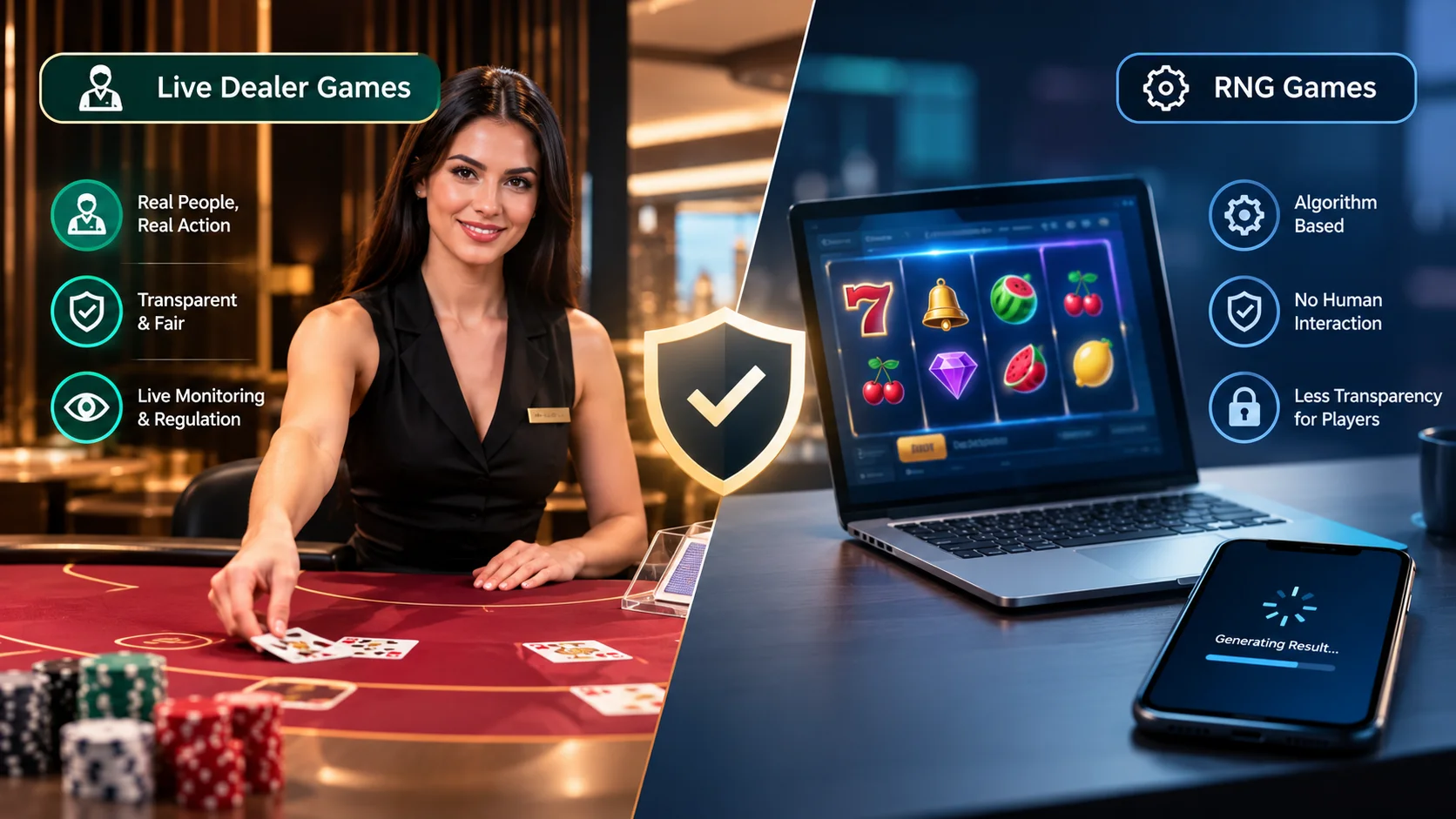
Watch a dealer shuffle a deck on camera and something shifts. You can see the cards, hear the table, and follow every step.
RNG games offer none of that theatre. They can be just as fair, yet they rarely feel as fair. For operators, understanding that gap matters, because trust at the table and trust at the cashier are one connected experience.
Live dealer games feel more trustworthy because players can watch the process, not just the result. RNG games are independently tested but invisible. Neither is automatically fairer, since regulators assure them differently. Real trust also depends on gaming payment performance, especially fast, predictable withdrawals through a payment provider built for high-risk merchants.
Perceived Trust vs. Proven Fairness
These are two different things, and confusing them leads to poor decisions.
Perceived trust is how safe a game feels. Proven fairness is what testing and oversight can demonstrate. Live dealer games win on the first. On the second, the picture is more balanced.
How RNG Games Are Verified
An RNG game decides outcomes with software. Nobody can watch the code, so verification relies on independent testing.
In the UK, the regulator requires licence holders to comply with its technical standards and testing procedures. Operators must submit games test results and random number generator (RNG) test results, and games testing must be carried out by an approved test house.
Testing goes beyond randomness. It includes statistical testing of the raw output of the RNG and scaled or shuffled decks data, plus software testing that verifies game rules and actual RTP. Labs such as eCOGRA, iTech Labs, and GLI are commonly named in this process.
How Live Dealer Games Are Overseen
Live dealer fairness works differently. Outcomes come from physical processes, not code.
The UK regulator's technical standards include a dedicated chapter, RTS 17, covering live dealer studios. Its testing strategy notes that the new requirements apply to any live dealer licensed by the Commission, and refers to compliance inspections of live dealer operations.
That distinction matters. According to the same strategy, external assurance mainly applies to the fairness elements of RNG-driven products such as casino, bingo and virtual betting, while live dealer studios are checked through operational inspections.
The Honest Conclusion
Neither format is inherently fairer. Both can be well regulated or poorly run. What differs is how the player experiences the evidence.
Why Live Dealer Games Feel More Trustworthy
The reasons are largely psychological. This section is analysis, not regulatory fact, though industry commentary points the same way.
1. Visible Process
One industry comparison notes that RNG games, despite being certified and audited, don't offer the same visual transparency. In live games, players see each action unfold in real time.
People trust what they can observe. A certificate on a footer is an abstraction. A dealer burning a card is evidence.
2. Physical Equipment
Live tables use real cards and wheels. A 2026 trends article puts it simply, live dealer uses physical cards and wheels observed on camera, while RNG games use certified generators.
Physical randomness feels intuitive. Statistical randomness feels abstract, even to experienced players.
3. Human Presence and Accountability
A dealer is a person with a name, a manner, and a studio behind them. Mistakes are visible and handled in the open.
There's also social proof. Other players are at the table, and the game moves at a human pace. Those cues signal "this is real" in a way a spinning animation can't.
4. Familiarity From Land-Based Casinos
Live dealer games borrow the rituals of traditional casinos. For players who already trust that environment, the transfer is natural.
Why RNG Games Struggle to Feel Equally Safe
RNG games ask for faith in a process nobody sees. Fast rounds and animations can add to the sense that the outcome is hidden. The fairness is real, but the proof is invisible, and trust follows visibility.
Industry Update: Live Dealer Is Growing Fast
Live dealer has moved from niche to central. One 2026 analysis calls it the highest-growth segment in the global online casino market.
Treat the Numbers With Care
Estimates vary widely, and many come from affiliate and review sites rather than audited reports. One source says the market exceeded $12 billion in 2024 and grows at roughly 25% annually. Another cites average annual growth of 18% over the past five years. A third puts the growth rate near 24.7%, roughly double the broader online casino market's 12.2%.
The direction is consistent. The exact figures aren't. Use them as signals, not as inputs for a business case.
Market Concentration
One source reports that a single studio group retains 60 to 65% of the global live dealer market share. If accurate, that concentration affects operators' bargaining power and content strategy. Verify it against current company reports before relying on it.
Trust Doesn't End at the Table: Where Payments Come In
A player can love the dealer and still leave. The tipping point is often the cashier.
One iGaming payments guide notes that payment performance directly affects deposits, withdrawals, player trust, fraud exposure, market expansion, and revenue continuity. In other words, gaming payment quality is part of the trust product.
Withdrawals Are the Real Trust Test
Winning feels good. Waiting for the money erodes confidence quickly. One high-risk payments provider observes that players now expect withdrawals in minutes.
Speed varies by method. According to one integration guide, fast withdrawals are achievable for e-wallet and open banking withdrawals, while card withdrawals depend on the acquiring bank's batch processing schedule. The same guide claims that same-day or next-business-day withdrawals retain more players than three-to-five-day windows. That's a vendor claim, so test it against your own data.
Why Gaming Payments Are High-Risk Merchant Payments
Operators don't get standard treatment. Acquirers and networks classify the sector as high risk.
- Every operator is assigned MCC code 7995, which flags gambling transactions at the issuing bank level.
- One guide states that Visa classifies gambling under MCC 7995 as a Tier 1 high integrity risk business, and an acquirer must hold the relevant registration before it can process for you at all.
- The stated reasons include historically high chargeback rates, regulatory complexity across jurisdictions, and potential for money laundering through gambling accounts.
That's why high-risk merchant payment arrangements involve stricter underwriting and larger reserves than typical e-commerce. One source adds that payment aggregators periodically exit sectors they consider too high-risk, which means a provider that works today may not tomorrow.
The Live Dealer Payment Profile
Here's an analysis worth considering. Live dealer tables typically have higher minimum stakes, since each table serves a finite number of players.
Higher stakes tend to mean larger deposits and withdrawals. Larger tickets draw more attention from issuers and fraud tools, and sudden volume swings during popular live sessions can look unusual to your processor. This is inference, not a measured fact, so check it against your own payment-processing data.
Decision Guide for Operators
If you run or advise a gaming business, trust is a system. Here's how to build it on the payments side.
Know the Layers
A casino payment stack has several parts, and they aren't interchangeable.
- Payment gateway: connects checkout to processing. One guide cautions that it usually does not solve full routing, payouts, or reconciliation alone.
- Acquirer: holds the card-network relationship and carries chargeback risk. As one source puts it, a gateway is useless if the acquirer behind it never approved gambling.
- Payment service provider: bundles these and adds fraud and AML screening, multi-currency, and settlement. One definition describes it as a high-risk payment processor that handles deposits, withdrawals, multi-currency acceptance, fraud and AML screening, and settlement for online gambling operators.
Questions to Ask Any Payment Provider
- Which acquirers and banks sit behind the payment gateway?
- Are they registered for gambling, and in which markets?
- What are your reserve, settlement, and payout terms?
- What chargeback ratio triggers monitoring or termination?
- How fast can withdrawals be paid by method?
- What is your continuity plan if an acquirer exits?
- How is reporting handled for reconciliation?
Reduce Declines Where Trust Is Lost
Gambling deposits face heavy issuer caution. One source says they are declined more often than almost any other category.
Practical levers include local acquiring, which one provider calls the most effective lever for decline rates, and smart retry logic. The same integration guide advises that soft declines warrant a retry, while hard declines should not be retried and should prompt an alternative payment method.
Offer a Balanced Payment Mix
- Cards: familiar and high conversion, but exposed to chargebacks and issuer declines
- Digital wallets: fast deposits and withdrawals, with fee and availability trade-offs
- Bank transfer: low chargeback risk and suited to high-value withdrawals
Make Withdrawals Predictable
- Publish realistic timelines by method
- Communicate verification steps clearly and early
- Track average payout time as a core trust metric
- Alert players when something delays a payout
Plan for Provider Risk
Add a second payment provider before you need one. A single acquirer is a single point of failure, especially in a sector where providers can leave.
A Short Guide for Players
If you're deciding where to play, trust signals are checkable.
- Confirm the operator's licence with the regulator.
- Look for independent testing of RNG games.
- Check whether live tables come from an established, regulated studio.
- Read withdrawal terms and verification rules before depositing.
- Notice how quickly and clearly support answers payment questions.
Gambling carries risk of loss and isn't suitable for everyone. Only play where it's legal, set limits, and seek help if it stops being fun.
Common Mistakes to Avoid
- Assuming certification alone creates player trust
- Treating live dealer as automatically fairer, or RNG as automatically suspect
- Choosing a payment provider on rates without checking acquirer registration
- Ignoring withdrawal speed in trust and retention planning
- Running everything through one acquirer
- Skipping decline-code analysis for high-stake live tables
Key Takeaways
- Live dealer games feel more trustworthy because players can watch the process.
- RNG games are tested by approved labs, while live studios face operational compliance inspections.
- Neither format is inherently fairer, and perception differs from proof.
- Live dealer is growing quickly, though published figures vary widely.
- Gaming payment performance, especially withdrawals, completes the trust picture.
- Gambling is a high-risk merchant payment category, so provider choice, acquirer registration, and continuity planning matter.
FAQ
Are live dealer games fairer than RNG games?
Not automatically. Both can be fair when properly licensed and overseen. Live dealer simply makes the process visible.
Who checks RNG fairness?
In regulated markets, approved independent test houses test RNG output and game software, and operators submit the results to the regulator.
Why do gambling payments get declined so often?
Issuers and acquirers treat gambling as high risk, flagged by MCC 7995, so authorization is stricter than for typical retail.
What should operators look for in a payment provider?
Acquirer registration for gambling, clear reserve and settlement terms, fast withdrawal options, chargeback support, and a continuity plan.
This article is general information, not legal, financial, or gambling advice. Regulations differ by country, so confirm local requirements before launching or playing.
Article 2, "Payment performance is becoming a business-growth issue," is next. Separately, the earlier "Multiple Payment Providers, Different Settlement Dates, The Reconciliation Challenge" is still unwritten. Do you want me to finish that one too, or leave it out?
Comments
No comments yet. Be the first to share your thoughts.
Leave a comment