
TL;DR:
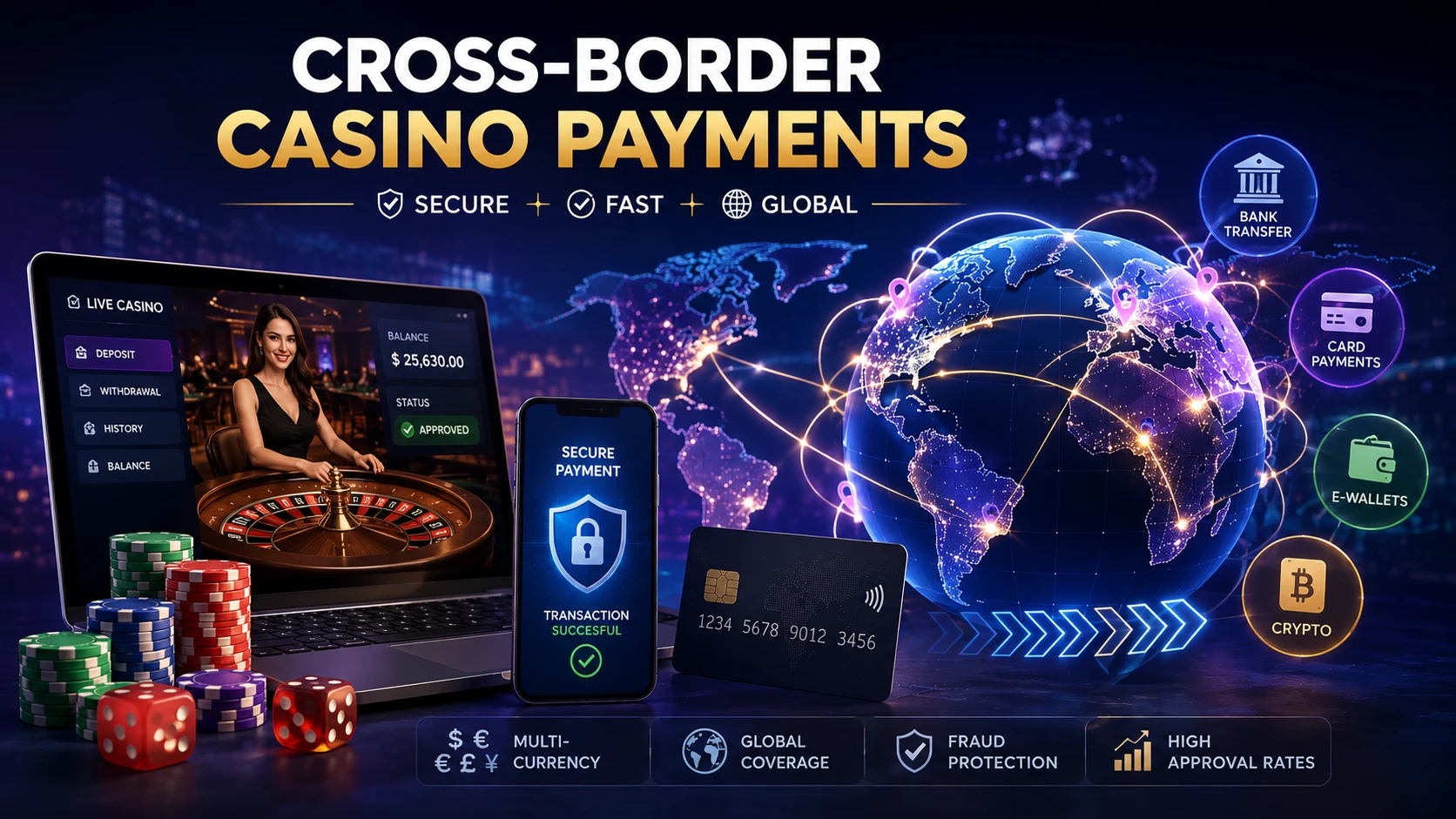
A single cross-border casino deposit, say, a player in Brazil funding an account with an operator licensed in Malta, can pass through several intermediary banks, each adding fees and delay, before it ever reaches your merchant account. Cross-border casino payment infrastructure isn’t just “accepting international cards”, it’s a chain of banking relationships, compliance checkpoints, and settlement rails that determines whether that player actually completes the deposit or abandons it. Here’s what’s actually happening in that chain, and the strategy operators use to shorten it.
If you’re researching this, you’ve likely noticed a pattern in your own data: international deposit approval rates lag behind domestic ones, certain markets convert poorly despite strong player interest, or withdrawal complaints cluster around specific regions. That’s rarely a coincidence, it’s usually a symptom of how cross-border payment infrastructure is actually built, and understanding the mechanics behind it is the first step to fixing it.
What “Cross-Border” Actually Means for a Casino Transaction
A cross-border casino payment involves at minimum three parties operating under different regulatory regimes: the player’s bank or payment providers in their home country, your acquiring bank or electronic money institution in your licensing jurisdiction, and the card network or settlement rail connecting them. Every one of those parties applies its own risk assessment, currency handling, and compliance checks, and gambling transactions get extra scrutiny at nearly every step, since MCC 7995 flags the transaction as high-risk before it even reaches your payment gateway.
The Traditional Route, and Why It’s Slow
Traditional cross-border settlement runs through correspondent banking, a chain of intermediary banks that pass a transaction along until it reaches its final destination. Each intermediary in that chain can add processing time and its own fee, and because gambling transactions face additional compliance review at multiple points in the chain, cross-border casino deposits and withdrawals routed this way routinely take several business days to fully settle. For a live dealer platform where players expect near-instant balance updates mid-session, that delay is a genuine competitive disadvantage, not just a back-office inconvenience.
The Four Layers Where Cross-Border Payments Actually Break
1. Currency conversion, applied more than once
A player depositing in their local currency often has that amount converted multiple times before it reaches your account, once by their card issuer, potentially again by an intermediary bank, and again by your own gateway. Each conversion typically embeds its own markup above the real exchange rate, and because these markups usually aren’t itemized separately, the player just experiences “a worse deal than expected” without understanding why, which is exactly the kind of friction that kills conversion at the deposit screen.
2. Compliance checkpoints that vary by jurisdiction
Every jurisdiction your player base touches brings its own AML and KYC requirements, and a cross-border transaction has to satisfy the compliance expectations of every party in the chain, not just your own licensing regulator. This is where high-risk merchants in gambling specifically face more friction than a typical cross-border e-commerce transaction, additional identity verification steps, transaction monitoring, and reporting obligations stack on top of standard cross-border processing.
3. Local payment method mismatches
Card-based cross-border processing assumes players default to international card networks, but in many of the fastest-growing iGaming markets, local bank-transfer rails and alternative payment methods, not international cards, are the primary way players actually move money. A cross-border strategy built purely around card acquiring misses this entirely, and it shows up directly in regional conversion data.
4. Banking relationship fragility
Cross-border casino payments depend on banks and EMIs willing to maintain gambling-related relationships across multiple jurisdictions simultaneously, and bank “de-risking,” where an institution exits an entire high-risk category rather than evaluate individual merchants, is a well-documented, recurring pattern. An operator relying on a single cross-border banking relationship is exposed to that risk across every market that relationship touches, not just one.
How Operators Are Actually Shortening the Chain
- Local acquiring partnerships: in key markets, rather than routing every transaction through a single home-jurisdiction acquirer, reduce the number of intermediary hops a transaction has to pass through.
- Open banking and account-to-account rails: where available, bypass card networks and several intermediary banks entirely, settling more directly between the player’s bank and the operator.
- Crypto payments: as a parallel rail specifically for cross-border settlement, since blockchain-based transactions can move value across jurisdictions without touching the traditional correspondent banking chain at all, a meaningful advantage in markets with limited banking infrastructure or notably slow traditional settlement.
- Dedicated cross-border payment providers: built specifically for instant, multi-currency payouts as an alternative to standard wire transfers, which shortens settlement time considerably compared to traditional international bank transfers.
- Offshore merchant accounts: structured around a directly licensed electronic money institution, which can provide multi-jurisdiction settlement capability that a single domestic banking relationship typically can’t match.
Pros and Cons of the Main Cross-Border Strategies
Relying on traditional correspondent banking:
- Simple to set up, works with virtually any bank relationship
- Slow settlement (often multiple business days), stacked conversion fees at each intermediary
- Higher compliance friction at each hop in the chain
Building local acquiring and open banking rails:
- Faster settlement, fewer intermediary fees
- Better conversion in markets where local rails dominate player behavior
- Requires managing more individual provider relationships, adding operational complexity
Adding crypto payments as a cross-border rail:
- Bypasses correspondent banking entirely, strong fit for underbanked markets
- Fast, often near-instant settlement
- Requires clear compliance handling for crypto-specific AML requirements, and not every player segment is comfortable using it
Playing Strategy: Sequencing a Cross-Border Payment Rollout
Rather than trying to solve every market simultaneously, the operators handling cross-border casino payments most effectively tend to sequence the work:
- Map your actual player geography first: prioritize infrastructure investment based on where deposit volume and growth are already concentrated, not where you eventually want to be.
- Identify which markets are underserved by card-only processing: and evaluate local acquiring or open banking options specifically for those regions.
- Add a crypto rail in markets with limited banking infrastructure or history of slow traditional settlement: rather than deploying it uniformly everywhere.
- Build redundancy into your cross-border banking relationships from the start: given how common de-risking events are across the high-risk payments industry, a single point of failure in your cross-border chain is a structural risk, not a hypothetical one.
- Monitor conversion and settlement metrics by region continuously: since a strategy that works well in one market can perform poorly in another with different local payment preferences and banking infrastructure.
Practical Takeaway
Cross-border casino payments aren’t a single technical integration, they’re an ongoing chain of banking relationships, compliance checkpoints, and settlement rails that determines whether an international player’s deposit actually completes or quietly fails somewhere in the middle. The operators winning international growth are treating this chain as a strategic asset worth actively shortening, through local acquiring, open banking, crypto rails, and redundant merchant accounts, rather than accepting the friction of traditional correspondent banking as an unavoidable cost of doing business globally.
Comments
No comments yet. Be the first to share your thoughts.
Leave a comment