
TL;DR:
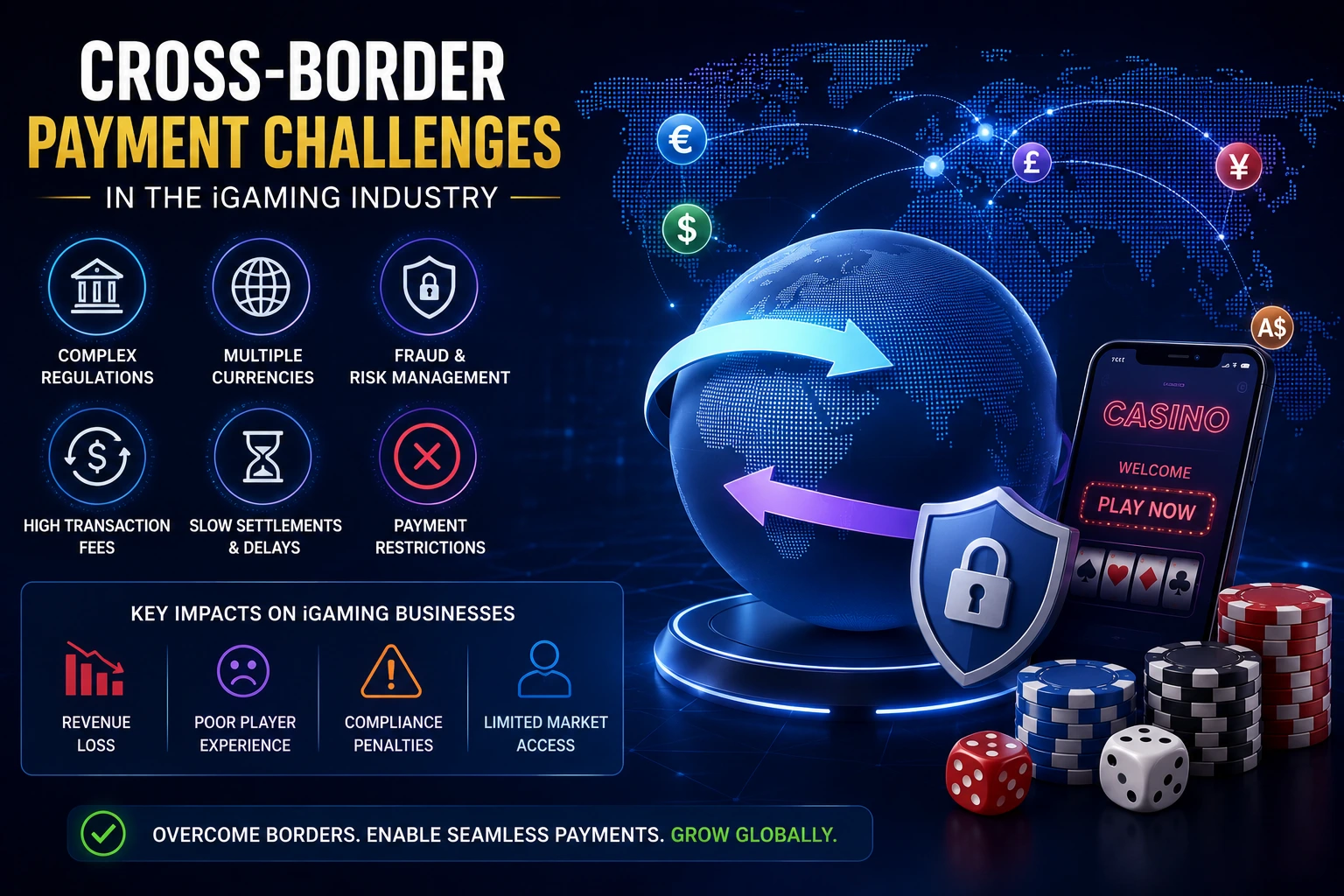
iGaming’s cross-border payment problems aren’t random, they follow a predictable shape: MCC 7995 declines at the bank level, fragmented local payment method expectations, hidden FX markups, a newly tightened Visa chargeback threshold, multi-day settlement that erodes player trust, and multiplying compliance obligations with every new market. Each has a specific, tested fix. If you’re expanding an iGaming operation internationally in 2026, this is the strategic checklist worth working through before your next market launch, not after.
If you’re searching for this specifically, you’re probably not asking “what is cross-border payments”, you’re troubleshooting something concrete: deposits failing in a new market, chargebacks climbing faster than growth, or a finance team that can’t explain where FX margin keeps disappearing. That’s the practical starting point for this article. Below is a breakdown of the six problems actually driving most of that friction, and the strategy operators are using to fix each one.
Why iGaming’s Cross-Border Payments Break Differently Than Standard E-Commerce
Three structural factors separate iGaming payment infrastructure from a typical e-commerce expansion. First, every operator is classified under merchant category code MCC 7995, which flags gambling transactions at the issuing-bank level, many banks decline these automatically regardless of local licensing status. Second, currency and local payment method fragmentation is unusually deep in gaming specifically, because deposit behavior is tied closely to trust and instant gratification, a slow or unfamiliar checkout doesn’t just delay a sale, it often kills it outright. Third, the fraud profile skews heavily toward disputes rather than stolen-card fraud, since “friendly fraud”, players disputing legitimate gambling losses, is a structural feature of the vertical, not an edge case. Together, these three factors mean a payment gateway built for general online payments rarely holds up once an iGaming operator scales across borders.
Local Payment Method Gaps Are Losing Players Before They Deposit
A player in Brazil who can’t find Pix, or a player in the Netherlands who doesn’t see iDEAL at checkout, doesn’t troubleshoot, they leave. Cross-border payments in iGaming aren’t primarily about moving money internationally; they’re about matching each market’s dominant local payment wallets and bank-transfer methods, which shift dramatically by region and directly determine conversion at the deposit screen.
Strategy: Build market-by-market payment method coverage rather than a single global checkout. This typically means layering local payment providers on top of your primary card-acquiring relationship, prioritized by where your player acquisition spend is actually concentrated, rather than trying to cover every method everywhere at once.
FX Costs Are Quietly Eating Your Margin
Traditional correspondent banking still embeds significant markups directly into exchange rates, on top of separate transaction fees, and that lack of pricing transparency makes it genuinely difficult for finance teams to forecast or control cross-border costs at scale. For an operator processing digital payments across a dozen currencies, an unmanaged FX markup compounds quietly across every transaction and is often only noticed once a full reconciliation cycle exposes the gap.
Strategy: Move toward providers offering transparent, disclosed FX rates rather than embedded markups, and centralize currency conversion reporting so finance can see true landed cost per market, not just gross deposit volume.
Visa’s Tightened Chargeback Threshold Just Raised the Stakes
This is the most time-sensitive item on this list. As of April 2026, Visa lowered its VAMP “excessive” merchant threshold from 2.2% to 1.5% for merchants across the US, Canada, the EU, and Asia-Pacific. Cross that threshold and operators face per-event fines and risk losing Visa acquiring access outright. Friendly fraud remains the single largest chargeback driver in iGaming specifically, which makes this a structural, ongoing risk rather than a one-time compliance checkbox.
Strategy: Real-time chargeback-ratio monitoring, not monthly reporting. Pair that with merchant services providers who actively flag rising dispute rates before they become a threshold breach, and build a dispute-response process (evidence collection, pre-dispute alerts) specifically tuned to gambling’s friendly-fraud pattern rather than generic e-commerce fraud tooling.
Multi-Day Settlement Erodes Player Trust Fast
Slow settlement isn’t just an operational inconvenience in iGaming, it directly damages retention. When multiple banks and currencies are involved in a cross-border transaction, settlement can still take several business days, and every day of delay is a day a player might move to a competitor offering faster payouts. This matters more in gaming than almost any other vertical, since payout speed is a direct, visible part of the product experience players compare between operators.
Strategy: Prioritize payment processing rails built for real-time or near-real-time settlement, open-banking rails like Trustly in Europe, or purpose-built crypto settlement for global player bases, specifically for withdrawal flows, even if your deposit rail runs on traditional card acquiring.
Compliance Complexity Multiplies With Every New Market
Every new jurisdiction brings its own AML expectations, KYC standards, and regulatory reporting obligations, and running that compliance layer separately for each market is where internal teams get stretched thinnest as expansion accelerates. This is also where a mismatch between your licensing jurisdiction and your actual target markets becomes expensive, payment providers factor jurisdiction-market fit directly into their own risk underwriting, so an operator licensed in a lower-tier jurisdiction may find fewer PSPs willing to support expansion into stricter markets.
Strategy: Sequence market entry deliberately, matching your licensing roadmap to your payments roadmap rather than treating them as separate workstreams. Operators expanding fastest in 2026 tend to centralize compliance operations (shared KYC/AML infrastructure) even while localizing the player-facing payment experience market by market.
Single-Processor Dependency Creates a Single Point of Failure
An underappreciated risk: relying on one processor or one banking relationship for cross-border volume means one bank’s risk-policy change, one processor’s sudden de-risking decision, or one regulatory shift can take down your entire cashier overnight, a real, recurring pattern across the high-risk payments industry generally, not a hypothetical.
Strategy: Multi-rail, multi-acquirer infrastructure by design, not as an emergency fallback. Spreading volume across several payment gateways and maintaining at least one offshore merchant account relationship as redundancy gives operators room to reroute volume quickly if any single relationship changes, rather than scrambling to onboard a replacement processor mid-crisis.
Putting the Strategy Together: A Practical Sequencing Approach
Rather than treating these six problems as a checklist to solve simultaneously, most operators succeeding at international expansion in 2026 sequence them roughly like this:
- Confirm licensing-to-market fit first: a mismatch here limits every downstream payment option.
- Establish a multi-acquirer base layer: before scaling volume in any single market, so redundancy is built in from day one.
- Layer local payment methods market-by-market: prioritized by actual player acquisition spend rather than trying to cover every method globally at once.
- Build real-time chargeback monitoring: before volume grows enough to make a Visa VAMP breach a real risk, not after.
- Optimize withdrawal speed specifically: as a retention lever, even if deposit-side infrastructure stays more conservative.
- Centralize FX and compliance reporting: so finance and compliance teams have accurate, real-time visibility rather than reconstructing costs after the fact.
Pros and Cons of This Multi-Rail Strategy vs. a Single-Processor Approach
Multi-rail, market-localized approach:
- Redundancy against sudden processor terminations or bank de-risking decisions
- Meaningfully better local conversion through matched payment methods per market
- Faster payouts where it matters most for player retention
- Higher integration and reconciliation complexity, requiring stronger internal payments operations
Single-processor, single-currency approach:
- Simpler to operate and report on
- Single point of failure, one bank policy change can freeze your entire payment flow
- Rarely covers the local payment methods your international player base actually expects
- Slower to adapt to regulatory changes like Visa’s tightened chargeback threshold
Practical Takeaway
If your cross-border expansion strategy doesn’t yet address local payment method coverage, transparent FX reporting, and active chargeback-ratio monitoring against Visa’s newly tightened threshold, treat those as immediate priorities rather than future optimizations. The operators pulling ahead in international iGaming expansion this year aren’t the ones with the flashiest single high-risk payment gateway relationship, they’re the ones treating cross-border payments as core strategic infrastructure, built with redundancy and market-specific localization from the start, rather than backend plumbing bolted on after a launch reveals the gaps.
Comments
No comments yet. Be the first to share your thoughts.
Leave a comment