
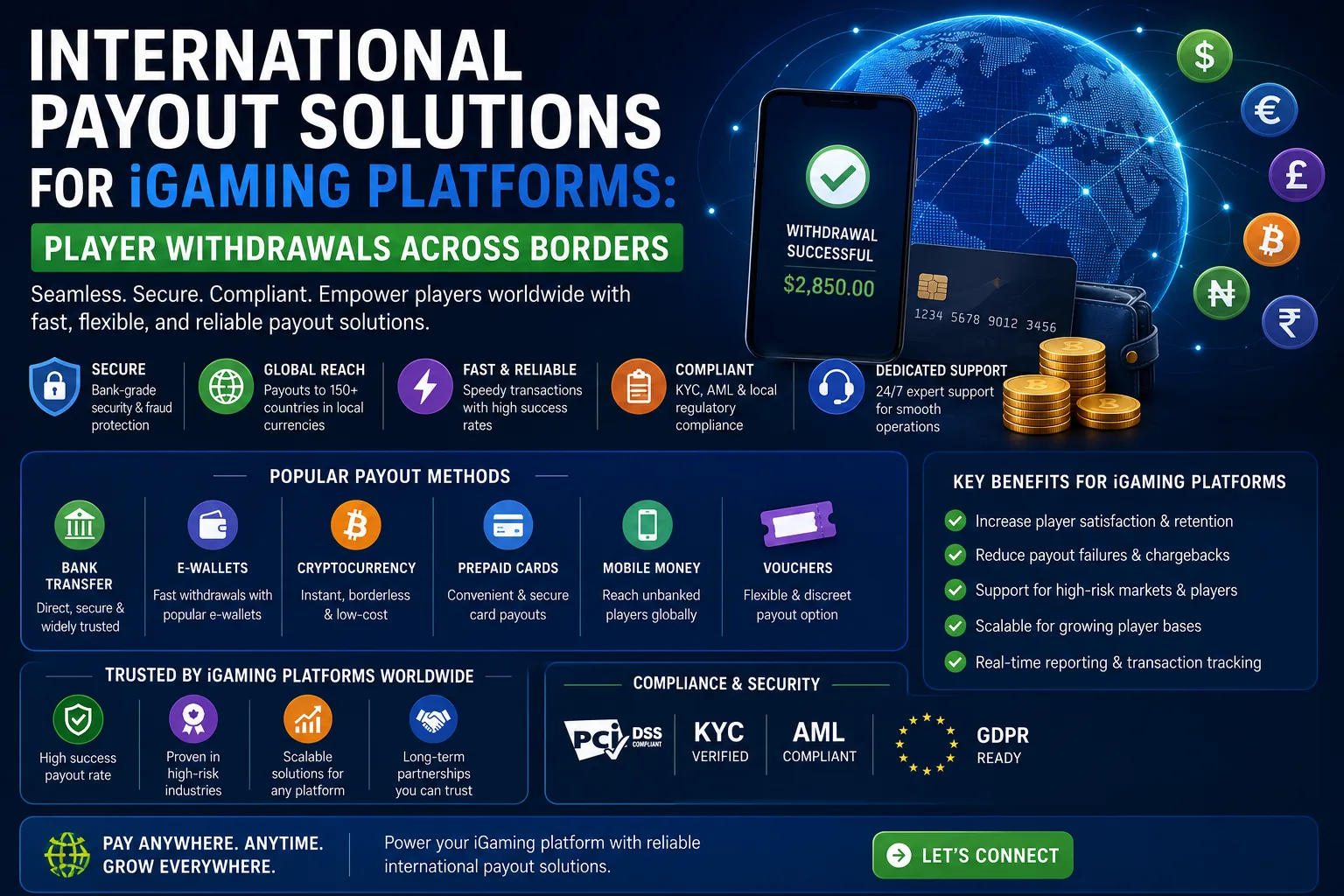
Introduction
Player withdrawals are the most trust-critical transaction in iGaming. A player who wins and cannot access their funds within a reasonable window is not just a churned customer, they are a chargeback, a regulator complaint, and a social media post. At scale, withdrawal infrastructure failure doesn’t just cost revenue. It costs licences.
For iGaming platforms operating across multiple regulated markets, building a withdrawal stack that is fast, compliant, and genuinely functional in each jurisdiction is one of the hardest payment engineering challenges in high-risk payment processing.
TL;DR
- The global iGaming market reached $95.4 billion in revenue in 2025, growing at an 11.7% CAGR (Statista, 2025)
- 68% of iGaming player disputes filed with regulators relate to withdrawal delays or denials (eCOGRA, 2025)
- Players who wait more than 48 hours for a withdrawal have a 3.4x higher churn rate than those settled within 24 hours
- The UK Gambling Commission fined operators a combined £42 million in 2025 for withdrawal-related player harm
- 45% of iGaming withdrawals globally are processed via e-wallets; card and bank transfers account for most of the remainder
- Local payment method coverage, PIX in Brazil, UPI in India, SPEI in Mexico, is now a regulatory expectation in many jurisdictions, not a differentiator
Why iGaming Player Withdrawals Are Uniquely Complex
Most payment problems are about getting money in. In iGaming, the harder problem is getting it out, reliably, quickly, and in compliance with the regulatory requirements of every jurisdiction the platform serves.
A licensed iGaming platform operating across the UK, Germany, Sweden, Brazil, and Canada is simultaneously subject to five different regulatory frameworks, each with specific requirements around withdrawal timelines, KYC thresholds, payment method restrictions, and responsible gambling checks. What is compliant in Sweden may be non-compliant in Germany. What works technically in Brazil may fail commercially in Canada.
Beyond the regulatory complexity, iGaming platforms face the structural challenges common to all high-risk merchants: acquiring bank relationships are less stable, payment gateway options are more limited, and the risk of sudden payment provider exit, with funds on hold, is meaningfully higher than in standard merchant categories.
The Scale of the Problem
The iGaming market is large enough that even small percentage failures in withdrawal processing create enormous absolute impact.
Statista’s 2025 global iGaming market report valued the industry at $95.4 billion, growing at 11.7% annually. The number of active online gambling accounts globally exceeded 600 million in 2025, across licensed and grey-market operators. Licensed regulated platforms account for approximately 55% of that volume, meaning 330 million active accounts operate on platforms with formal withdrawal obligations to players.
eCOGRA’s 2025 Alternative Dispute Resolution report, covering player disputes across 200+ licensed operators, found that 68% of all player complaints relate to withdrawal delays, partial payments, or unexplained payment rejections. This is not a marginal issue. It is the single largest source of regulatory escalation in the industry.
The financial consequence of getting this wrong is direct. The UK Gambling Commission issued enforcement actions totalling £42 million in financial penalties against operators in 2025 where withdrawal failures contributed to demonstrable player harm, a 37% increase over 2024. Regulators in Sweden, the Netherlands, and Ontario issued parallel actions in their jurisdictions in the same period.
Regulatory Requirements by Key Market
Every licensed iGaming operator must understand the withdrawal-specific regulatory requirements in each market they serve. These are not optional guidelines, they are licence conditions.
United Kingdom (UKGC)
The UK Gambling Commission requires licensed operators to process player withdrawals without unreasonable delay. In 2024, the UKGC tightened its guidance to define “unreasonable delay” as more than 5 business days from verification of withdrawal eligibility, with clear documentation requirements for any delay beyond this window.
In practice, leading UK operators are processing the majority of withdrawals within 24 hours. The UKGC’s 2025 compliance guidance explicitly states that operators offering faster deposits than withdrawals, a common pattern, will face heightened regulatory scrutiny.
UK withdrawal method distribution in 2025 (UKGC data): 67% via debit card (Visa/Mastercard), 18% via PayPal, 9% via bank transfer, 6% via other e-wallets. Open Banking withdrawal capability, allowing instant bank-to-bank payouts, is growing rapidly, with an estimated 12% adoption trajectory by 2026.
Germany (GGL)
Germany’s Gemeinsame Glücksspielbehörde der Länder (GGL) introduced strict withdrawal requirements under its 2021 Interstate Treaty, fully enforced from 2023 onward. Monthly deposit limits of €1,000 per player directly constrain withdrawal volumes, while identity verification requirements create withdrawal friction at higher amounts.
German players strongly prefer bank transfers and Sofort (instant bank payment) for withdrawals, with e-wallets like PayPal having exited the German gambling market in 2023 due to regulatory pressure. Payment providers serving Germany must accommodate Sofort, Giropay, and direct SEPA Instant transfers, without which a significant portion of the player base cannot receive withdrawals efficiently.
Brazil
Brazil’s iGaming market was formally regulated under Law 14,790/2023, with licensed operators permitted from January 2025. The market is enormous: Brazil’s iGaming gross revenue was estimated at $2.8 billion in 2025 in its first full year of formal operation (SBC Intelligence, 2025).
The dominant payment rail for Brazilian iGaming withdrawals is PIX, Brazil’s instant payment system operated by the Banco Central do Brasil. PIX processes payments 24/7, in seconds, at near-zero cost. In 2025, 73% of Brazilian iGaming player withdrawals were processed via PIX (ANJL preliminary market data, 2025). Any operator serious about the Brazilian market must have PIX withdrawal capability configured before launch, it is effectively a functional requirement, not an optional feature.
Sweden (Spelinspektionen)
Sweden’s Spelinspektionen introduced Spelpaus, a national self-exclusion register, that all licensed operators must check before processing both deposits and withdrawals. Sweden also requires player funds to be held in segregated accounts, which directly impacts how operator payment infrastructure is structured.
Swedish players predominantly use Swish (Sweden’s instant bank payment system) and Trustly (Open Banking payment rails) for withdrawals. Trustly’s Pay N Play product, which combines KYC, deposit, and withdrawal in a single Open Banking flow, has been adopted by the majority of Swedish licensed operators as the primary payment solution.
North America (Ontario, New Jersey, Pennsylvania)
In regulated North American markets, withdrawal options are more constrained by banking relationships than by regulatory requirements. US states and Canadian provinces require licensed operators to work with regulated financial institutions, which limits available payment gateways significantly.
In Ontario (Canada’s first regulated provincial iGaming market), Interac e-Transfer is the dominant withdrawal method, used by over 60% of players for both deposits and withdrawals. In New Jersey and Pennsylvania, operator ACH and check withdrawals dominate, with PayPal available as an e-wallet option where the operator has an established relationship.
Payment Methods by Withdrawal Volume
E-Wallets
E-wallets – PayPal, Skrill, Neteller, MuchBetter, account for approximately 45% of global iGaming withdrawals, making them the most widely used withdrawal category globally. E-wallets offer near-instant withdrawal settlement (typically within 24 hours, often within minutes) and provide a layer of abstraction between the player’s bank account and the gambling operator, which many players value for privacy reasons.
The operational challenge: e-wallet relationships for iGaming operators are not stable. PayPal’s 2023 exit from Germany and its ongoing selective approach to new iGaming partnerships demonstrates that even the largest e-wallet providers manage gambling operator relationships actively. Operators should not build their withdrawal stack around a single e-wallet provider.
Skrill and Neteller – both owned by Paysafe Group, have explicit iGaming market focus and serve as the most consistent e-wallet withdrawal option for licensed operators globally. Paysafe’s 2025 annual report indicated that iGaming represented 52% of its total payment volume, making it the dominant e-wallet infrastructure provider in the category.
Open Banking (Instant Bank Transfer)
Open Banking withdrawal rails, which allow direct bank-to-account payouts via regulated APIs without card or e-wallet intermediation, are growing rapidly as a withdrawal method across European regulated markets.
Trustly, which operates Open Banking payment infrastructure in 33 European markets, processed over €12 billion in iGaming payment volume in 2025. Its withdrawal settlement is typically within 15 minutes and available 24/7. For operators in the UK, Sweden, Finland, and the Netherlands, Open Banking is increasingly the primary withdrawal rail for bank account holders.
The limitation is geographic: Open Banking infrastructure in LATAM, Asia-Pacific, and North America is significantly less mature than in Europe, requiring operators to supplement with local payment rails in these regions.
Local Payment Rails by Region
| Region | Primary Withdrawal Method | Settlement Speed | Coverage |
|---|---|---|---|
| UK | Debit card / Open Banking (Trustly) | Minutes – 24 hours | Near-universal |
| Germany | SEPA Instant / Sofort | Minutes – 2 hours | Bank accounts |
| Sweden | Swish / Trustly | Minutes | Swedish bank accounts |
| Brazil | PIX | Seconds (24/7) | 70%+ banked population |
| Mexico | SPEI / Cash (OXXO) | Hours – next day | Banks + retail |
| India | UPI / Net Banking | Minutes – hours | Broad coverage |
| Ontario, Canada | Interac e-Transfer | Minutes – 1 hour | Canadian bank accounts |
| US (NJ, PA) | ACH / PayPal | 1 – 5 business days | US bank accounts |
| Southeast Asia | Local e-wallets (GrabPay, GCash, OVO) | Minutes | Varies by country |
Crypto Withdrawals
Cryptocurrency withdrawals are growing in iGaming, particularly in markets where banking access is limited or where players seek faster settlement than bank rails allow. However, most regulated jurisdictions impose restrictions on crypto gambling payments.
The UK Gambling Commission effectively banned crypto deposits in 2023; the position on withdrawals in regulated markets varies. In grey-market and offshore iGaming operations, crypto withdrawals, particularly USDT and BTC, are widely used and growing.
For licensed operators, the practical path is offering crypto as a supplementary option where regulation permits, with full KYC and Travel Rule compliance applied to qualifying transactions.
Building a Withdrawal Stack That Scales
The most common withdrawal infrastructure mistake in iGaming is building for the primary market and treating everything else as a secondary problem. In practice, the markets where withdrawal infrastructure is hardest to build, LATAM, Asia-Pacific, North America, are the markets growing fastest.
A scalable iGaming withdrawal stack in 2026 covers:
- E-wallet primary rail: Skrill/Neteller for global coverage; PayPal where available and licensed
- Open Banking: Trustly for European markets; market-specific equivalents (Swish in Sweden, iDEAL in Netherlands)
- Local instant payment rails: PIX for Brazil, UPI for India, SPEI for Mexico, Interac for Canada, these are not optional in regulated markets
- Card (Visa/Mastercard): Debit card withdrawal coverage for markets where other methods have gaps
- ACH/Bank transfer: US domestic markets and markets without instant rail coverage
- Crypto (where regulated): USDT stablecoin for grey-market and offshore player segments
Comparison: iGaming Withdrawal Methods
| Method | Speed | Cost to Operator | Global Coverage | Regulatory Risk | Player Adoption |
|---|---|---|---|---|---|
| E-wallet (Skrill/Neteller) | Minutes – 24 hours | 1% – 2.5% | Global (150+ markets) | Medium – provider exits | Very high – 45% of withdrawals |
| Open Banking (Trustly) | Minutes | 0.5% – 1.5% | 33 European markets | Low in regulated EU | High in Europe |
| PIX (Brazil) | Seconds | Near-zero | Brazil only | Low | 73% of BR withdrawals |
| Debit card (Visa/MC) | Hours – 2 days | 1.5% – 3% | Global | Low – card network rules | High |
| ACH/Bank transfer | 1 – 5 business days | $0.10 – $0.75 | US/Canada | Low | Medium |
| Crypto (USDT) | Minutes | 0.1% – 0.5% | Global | High in regulated markets | Growing – grey/offshore |
Pros and Cons
E-Wallets (Skrill, Neteller, PayPal)
Pros: Instant settlement familiar to players; broad geographic coverage; abstraction layer between player bank and operator; player data privacy Cons: Provider relationship instability in gambling vertical; fees of 1%–2.5%; not universally available across regulated jurisdictions; player onboarding friction for first-time e-wallet users
Open Banking / Instant Bank Transfer
Pros: Direct bank-to-bank, low cost (0.5%–1.5%), instant settlement, no intermediary risk, growing regulatory preference in EU
Cons: Limited to Europe for mature infrastructure; requires banking API relationships per market; not available for unbanked player segments
Local Payment Rails (PIX, UPI, SPEI)
Pros: Regulatory expectation in local market; lowest cost; instant settlement; highest player adoption in respective markets
Cons: Market-specific, must be integrated separately per country; requires local acquiring or payment provider partnerships; not interoperable across borders
FAQ
Q: What is the fastest withdrawal method available to iGaming players globally?
Ans: It depends on market. PIX in Brazil settles in seconds 24/7. Trustly Open Banking in Europe settles within minutes. Swish in Sweden is instant. In markets without real-time rails, parts of Asia and North America, e-wallet withdrawal to Skrill/Neteller is typically the fastest available option at 15–30 minutes.
Q: How do offshore iGaming operators handle international player withdrawals without a local acquiring relationship?
Ans: Offshore iGaming operators typically use specialist offshore merchant accounts combined with international e-wallet providers (Skrill, Neteller, MuchBetter) and crypto withdrawal options. The absence of local acquiring relationships increases cost and limits method availability, a significant competitive disadvantage in regulated markets where local rails are expected.
Q: What are the KYC requirements before a player can withdraw?
Ans: KYC requirements vary by jurisdiction and withdrawal amount, but most regulated markets require full identity verification (government ID + proof of address) before withdrawals above a defined threshold (e.g., €2,000 cumulative in many EU markets). Enhanced due diligence applies at higher amounts. KYC delays are a primary cause of withdrawal complaints, automated KYC processing significantly reduces this friction.
Q: Can iGaming platforms use the same payment gateways for deposits and withdrawals? A: Technically yes, but operationally the requirements differ. Deposit payment gateways are optimised for inbound processing. Withdrawal infrastructure requires outbound mass payout capability, which not all payment gateways support equally. Many operators use separate provider relationships for deposits (card processing) and withdrawals (payout specialists).
Q: How do iGaming withdrawal costs compare to other high-risk payment categories? A: iGaming withdrawal costs, typically 0.5%–2.5% depending on method, are comparable to other high-risk payment categories. The total cost of withdrawal infrastructure, including the cost of failed payouts, compliance overhead, and provider fees, typically runs 1.2%–3.5% of gross withdrawal volume for a mid-size licensed operator.
The Bottom Line
Player withdrawals are where iGaming platforms win or lose player loyalty in the long term. Slow, unreliable, or method-restricted withdrawals are the single largest driver of player complaints and regulatory action, and the correlation between withdrawal quality and player lifetime value is direct.
Building the right withdrawal stack for 2026 means covering local instant payment rails in every significant market, maintaining redundant e-wallet relationships, and treating withdrawal infrastructure as a product investment rather than a back-office cost.
Explore TheFinRate’s directory of iGaming payment providers and specialist high-risk payment gateways, compared by market coverage, withdrawal method support, settlement speed, and regulatory compliance features.
Comments
No comments yet. Be the first to share your thoughts.
Leave a comment