
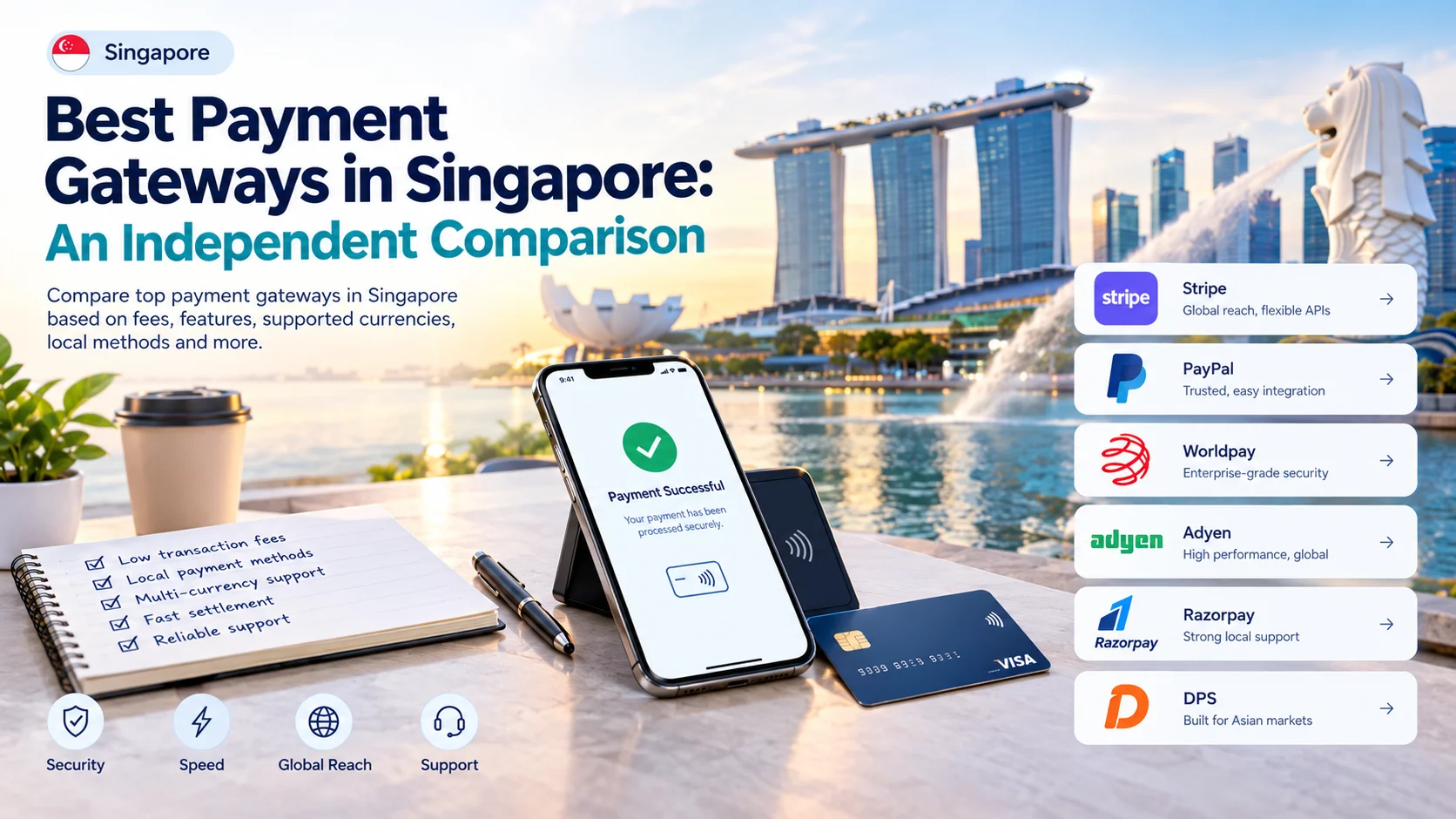
Search for a payment gateway in Singapore and you will find plenty of “best of” lists, many written by the providers themselves. That makes it hard to tell useful advice from a sales pitch. This guide takes a neutral view. It covers what Singapore shoppers expect, how to check a provider is licensed, what the fees look like and how to match a gateway to your business.
Pick a gateway that supports PayNow, cards and the wallets your customers use, holds the right MAS licence and publishes its fees. PayNow is far cheaper than cards, so push it at checkout. Stripe and HitPay are popular options, but fees, payout speed and eligibility differ, so run the numbers on your own sales before you commit.
What Singapore Shoppers Expect at Checkout
Singapore buyers are used to paying their way. If your checkout lacks their preferred method, some will simply leave.
The usual mix includes:
- PayNow: Bank-to-bank transfers by QR code, very popular for both online and in-person sales.
- Cards: Visa, Mastercard and American Express, plus Apple Pay and Google Pay.
- Local wallets: GrabPay and ShopeePay are the most commonly cited.
- Buy now, pay later: Providers such as Atome appear in many local checkouts.
- Visitor wallets: Alipay and WeChat Pay matter if you serve tourists.
The right mix depends on who buys from you. A neighbourhood café and an online electronics shop will not need the same list.
Five Things to Compare
Before looking at brand names, decide what matters most to your business:
- Payment methods: Does it cover the methods your customers actually use?
- Total cost: Look at percentage fees, fixed fees, dispute fees and currency conversion.
- Payout speed: How quickly does money reach your bank account?
- Licensing and safeguarding: Is the provider properly authorised, and how does it protect your funds?
- Integrations and support: Does it work with your store, accounting software and team?
Check the Licence First
This step takes five minutes and many businesses skip it.
Singapore regulates payment services under the Payment Services Act. Merchant acquisition, which is the service of accepting card payments on behalf of merchants, is one of the regulated activities. Providers hold either a standard or a major payment institution licence.
You can check any provider on the MAS Financial Institutions Directory. Search for the legal entity name, then look at the licence type and the activities it covers. Large global providers usually operate through a Singapore entity, so check that entity, not the brand name.
A major payment institution has to safeguard customer money, for example through a trust account or a guarantee. Even so, read the provider’s safeguarding notice. One licensed provider’s own disclosure says customers may face delays if its safeguarding bank fails. A licence also does not make a provider a bank.
Fees Compared
The figures below are published or widely reported rates. Third-party sources do not always agree, especially on PayNow, so confirm everything on each provider’s own pricing page.
| Item | Stripe (reported) | HitPay (published) | PayPal (reported) |
|---|---|---|---|
| Domestic card, online | 3.4% + S$0.50 | 2.8% + S$0.50 | 3.9% + S$0.50 |
| PayNow, online | 1.3% | 0.65% + S$0.30 from S$100, or 0.9% (min S$0.20) below | Not supported, per reports |
| GrabPay | 3.3% | See provider | Not supported, per reports |
| Alipay and WeChat Pay | 2.2% + S$0.35 | See provider | See provider |
| Monthly fee | None | None | None |
| Dispute fee | S$15 | See provider | See provider |
Stripe also adds about 0.5% for international cards and about 2% for currency conversion, according to third-party reports.
What It Costs in Practice
Here is a hypothetical shop with S$10,000 in monthly sales across 200 orders of S$50 each. These examples use the rates above and are for illustration only.
If every customer pays by card:
- Stripe: S$2.20 per order, so S$440 a month (4.4%).
- HitPay: S$1.90 per order, so S$380 a month (3.8%).
- PayPal: S$2.45 per order, so S$490 a month (4.9%).
If half the orders use PayNow and half use cards:
- Stripe: S$285 a month (2.85%).
- HitPay: S$235 a month (2.35%).
Two lessons stand out. First, the S$0.50 fixed fee makes small baskets expensive, because a S$50 order pays 4.4% before anything else. Second, the share of customers using PayNow moves your cost more than the choice of gateway. Make PayNow easy to find at checkout.
Payout Speed and Cash Flow
Payout timing can matter as much as fees, especially for small shops.
HitPay says non-card balances are paid out the next calendar day. Comparison sites report longer timelines for Stripe, in the range of a few business days, and new accounts are often slower at first. Treat these as starting points and ask each provider about reserves, weekends and holidays.
Also check which bank receives the funds, and whether the payout arrives as one lump or in batches.
Which Gateway Fits Which Business
- Developer-led startups and global sellers: Stripe or an enterprise-grade gateway such as Adyen offers deep tools and cards across many markets.
- Local retail, cafés and social sellers: A provider built around PayNow QR and local wallets may fit better, and HitPay is one example.
- Cross-border sellers needing multi-currency accounts: Airwallex-style providers focus on holding and converting foreign currency.
- NETS debit customers: eNETS is a homegrown option that is reported to be low cost for domestic debit, so ask for current pricing.
- High-volume merchants: At higher card volumes, interchange-plus pricing can work out lower than a flat rate, so request a custom quote.
Selling Into Singapore From the US or UK
If you are a foreign business, local acceptance is not always straightforward.
- Check eligibility: Some local methods, including PayNow, may depend on having a Singapore entity or bank account. Ask the provider directly.
- Watch conversion costs: Settling in your home currency can add a conversion fee on every sale.
- Consider local acquiring: Processing locally can help with acceptance rates and customer trust.
- Mind the tax: Singapore charges 9% GST, and overseas digital sellers may need to register under IRAS rules.
A Note for High-Risk Merchants
Mainstream gateways are cautious about crypto, forex, gambling and some other sectors, and Singapore’s regulators take these seriously. If you are a high-risk merchant, expect more underwriting and more questions.
A specialist high-risk payment provider is usually the way forward. Verify its licence first, read the contract carefully, and be sceptical of anyone promising instant approval or no reserves. A provider that cannot show a valid licence is not worth the risk.
Checklist Before You Sign
- Look up the provider’s Singapore entity on the MAS directory.
- Confirm it supports PayNow and the wallets your customers use.
- Add up the full cost per transaction, including fixed fees and dispute fees.
- Ask when funds reach your bank, and whether reserves apply.
- Check for setup fees, monthly minimums and contract lengths.
- Test the integration with your store or POS before launch.
- Ask how the provider handles chargebacks and fraud.
- Confirm how long approval takes for a business like yours.
Frequently Asked Questions
What is the cheapest way to accept payments in Singapore?
PayNow is usually the cheapest method, with reported rates far below card fees. Encourage it at checkout, and keep cards for customers who prefer them.
Do I need a licence to accept payments?
No. The provider needs the right licence, not you. You may still need to register your own business and meet tax rules.
Can a foreign company use a Singapore payment gateway?
Often yes for cards, but local methods can have extra conditions. Ask whether your provider supports your business structure.
How long does approval take?
Some providers advertise approval in one to three business days. Expect longer for complex or high-risk businesses.
Is a flat rate better than interchange-plus?
Flat rates are simpler for small sellers. At higher volumes, interchange-plus pricing can cost less, so compare on your own numbers.
The Verdict
There is no single best payment gateway in Singapore. The right choice depends on your customers, your order size and how you want to be paid. Start with the licence check, then compare total cost on a realistic month of sales.
Make PayNow easy to use, keep an eye on fixed fees, and ask hard questions about payouts. To compare options, browse the TheFinRate payment gateways directory.
Comments
No comments yet. Be the first to share your thoughts.
Leave a comment