
TL;DR
- Payment processing moves a transaction through three core stages, authorization, clearing, and settlement, typically completing in under three seconds for the customer, though funds may take 1-14 days to reach the merchant’s bank.
- Global card networks processed an estimated 3.4 trillion transactions in 2026, with average authorization response time around 1.2 seconds.
- The global decline rate sits at roughly 9.8%, but high-risk merchants see decline rates nearly double that, at 18.4%, driven by stricter fraud screening on elevated-risk MCCs.
- High-risk payment processors face new 2026 compliance requirements under Visa’s VAMP and Mastercard’s CE3.0 programs, both of which tie directly into the clearing and dispute stages of the transaction lifecycle.
- Settlement speed varies sharply by account type, 2 days for standard merchant accounts versus up to 10 days for newly onboarded high-risk merchant accounts.
What Is Payment Processing?
Payment processing is the sequence of steps that moves money from a customer’s bank to a merchant’s bank account every time a card or digital payment is made. It’s easy to think of a payment as instant, the customer taps, the screen says “approved,” the transaction is done. In reality, that approval is only the first of three distinct stages: authorization, clearing, and settlement. Each involves different parties, the merchant, the payment gateway, the acquiring bank, the card network, and the issuing bank, and each happens on a different timeline.
Understanding this flow matters for any business accepting online payments, because problems at any stage, a high decline rate, delayed settlement, an unexpected chargeback, usually trace back to a specific point in this chain. This guide walks through the full journey from card to bank, with the 2026 data and high-risk processing context every merchant should know.
The Three Stages of Payment Processing
Stage 1: Authorization
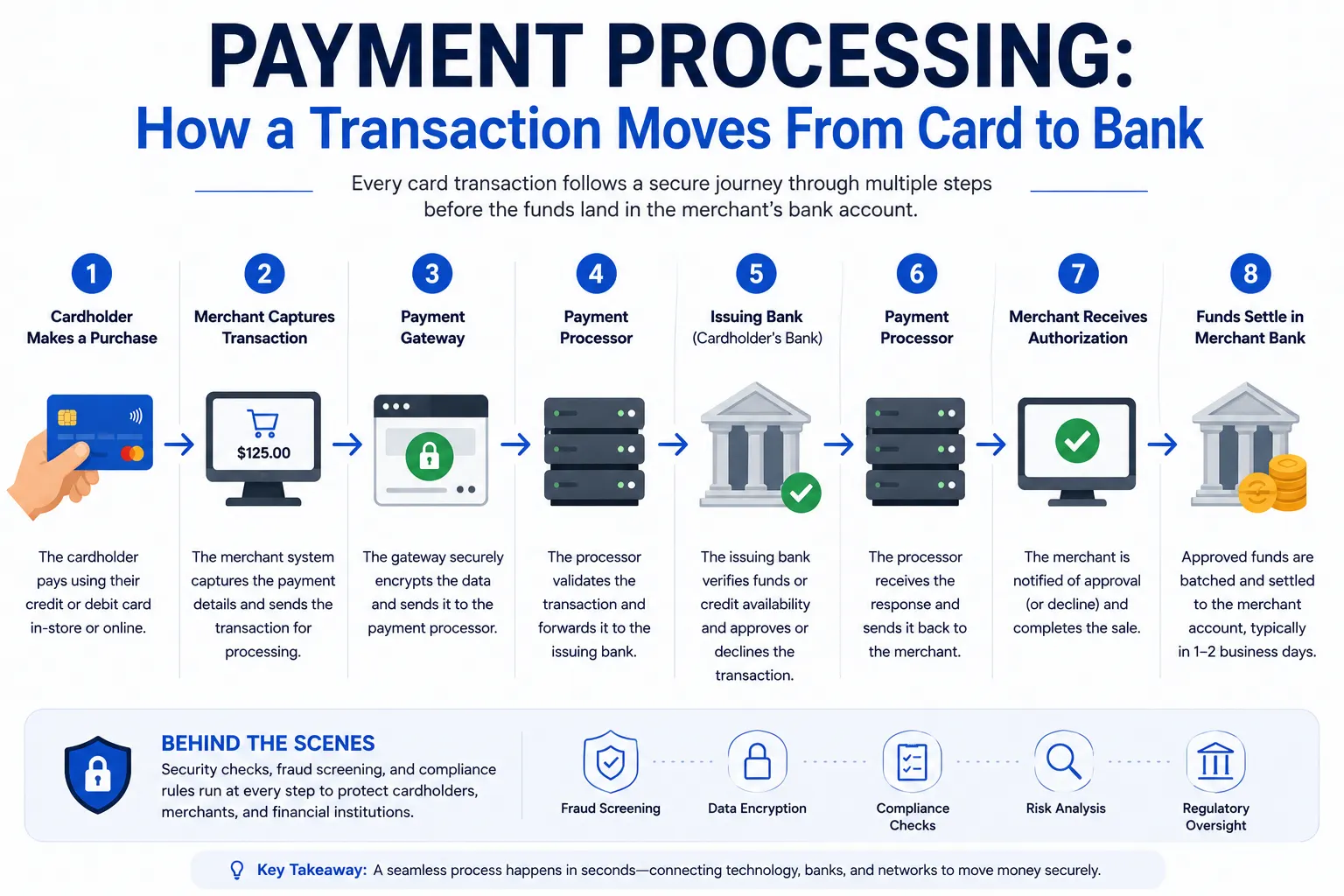
Authorization is the real-time check that determines whether a transaction is approved or declined. It happens in the few seconds between a customer submitting payment and seeing a confirmation screen, the diagram above shows the full path this request travels.
What happens during authorization:
- The merchant’s payment gateway encrypts the card or wallet data and tokenizes it for PCI DSS compliance.
- The gateway sends the authorization request to the acquiring bank (the merchant’s bank), which forwards it to the relevant card network, Visa, Mastercard, or a regional equivalent.
- The card network routes the request to the issuing bank (the customer’s bank), which checks available funds, fraud signals, and, increasingly in 2026, 3DS2 authentication status.
- The issuer sends back an approval or decline code, which travels back through the same chain to the merchant’s checkout screen.
This entire round trip averages 1.2 seconds globally in 2026, though cross-border transactions and high-risk category transactions, which trigger additional fraud screening, can take noticeably longer, sometimes 3-5 seconds.
Stage 2: Clearing
Authorization confirms a transaction can happen; clearing is what actually exchanges the transaction details between banks so the money can move. Approved transactions aren’t transferred individually, they’re collected throughout the day and submitted in a daily batch.
The clearing process:
- At the end of the business day (or on a schedule set by the merchant’s payment processor), all approved transactions are batched together.
- The batch is submitted to the acquiring bank, which forwards transaction details through the card network to each respective issuing bank.
- The card network calculates interchange fees, assessment fees, and net amounts owed between the issuing and acquiring banks.
- Each issuing bank confirms the transaction details and commits to transferring funds.
Clearing is also the stage where chargebacks and disputes eventually re-enter the system, a transaction that clears today can still be reversed weeks or months later if the cardholder disputes it, which is why chargeback ratio monitoring (covered below) is tied directly to this stage of the lifecycle.
Stage 3: Settlement
Settlement is the final movement of funds, from the issuing bank, through the card network, into the acquiring bank, and finally into the merchant’s account.
Settlement timelines vary significantly by account type:
- PayFac platforms (Stripe, Square, PayPal) typically settle in 2 business days for established merchants.
- Standard dedicated merchant accounts also settle around 2 business days once a processing history is established.
- Cross-border transactions take longer, typically 4 days, due to currency conversion and correspondent banking steps.
- Newly onboarded high-risk merchant accounts often see settlement delayed to 7-10 days, as acquirers hold funds longer during the initial risk-monitoring period.
- Established high-risk accounts with a clean six-month processing history typically see settlement timelines improve to around 6 days.
Once funds settle, they appear in the merchant’s bank account, completing the journey from card swipe to available cash, though for high-risk merchants a portion of each settlement may be withheld as a rolling reserve rather than paid out immediately, discussed further below.
Why Transactions Get Declined: 2026 Data
A meaningful share of payment processing friction happens before clearing ever begins, at the authorization stage, where transactions get declined. Globally, the decline rate across all card-not-present transactions sits at roughly 9.8% in 2026. For high-risk merchants, that rate nearly doubles to 18.4%, reflecting the additional fraud screening layered onto elevated-risk MCCs.
The leading cause of declines remains insufficient funds, accounting for roughly 31% of all declines, a customer-side issue merchants can do little about directly. Suspected fraud is the second-largest cause at 24%, followed by expired or invalid card details at 19%. A notable and growing category is 3DS authentication failure, now responsible for 14% of declines as more issuers enforce Strong Customer Authentication under evolving 2026 regulatory requirements in the EU and UK. The remaining 12% spans miscellaneous issuer-side declines.
For merchants, the practical takeaway is that authorization optimization, retry logic, intelligent routing across multiple acquirers, and dynamic 3DS exemption requests, has become a measurable revenue lever, not just a technical nicety.
Payment Providers and Gateways: Where They Fit in the Flow
It’s worth clarifying how the major players in payment processing map onto this three-stage journey, since the terminology often gets blurred in vendor marketing.
- Payment gateways: sit at the very start of the authorization stage, they’re the technology layer that encrypts and transmits the transaction request from checkout to acquiring bank.
- Payment providers: is a broader term covering any company offering payment processing services, this includes gateways, processors, and merchant account providers, often bundled together.
- Acquiring banks: hold the merchant account and are the institution actually responsible for clearing and settlement on the merchant’s behalf.
- Card networks: (Visa, Mastercard, regional networks like RuPay or UnionPay) operate the rails that connect acquiring and issuing banks during clearing.
- Issuing banks: are the customer’s bank, the institution that approves or declines authorization and ultimately releases funds during clearing.
Digital payments increasingly route through an additional layer here too: payment wallets like Apple Pay, Google Pay, and regional wallets such as Alipay or PIX sit between the customer and the gateway, tokenizing card credentials before the authorization request is even sent, which is part of why wallet transactions tend to show modestly higher authorization rates than manually entered card details.
High-Risk Payment Processing: 2026 Industry Update
High-risk merchants, operating in iGaming, adult content, forex, nutraceuticals, MLM, subscription billing, and similar elevated-risk categories, experience the standard three-stage payment processing flow with meaningfully different terms and added compliance obligations at nearly every step.
Authorization Differences for High-Risk Merchants
High-risk transactions are subject to more intensive fraud screening at the authorization stage, velocity checks, BIN analysis, and behavioral scoring run before a transaction is even forwarded to the issuer. This is the direct cause of the elevated 18.4% decline rate noted above. A well-configured high-risk payment gateway mitigates this with dedicated fraud tooling tuned for the merchant’s specific vertical, rather than applying generic e-commerce fraud rules that over-flag legitimate high-risk transactions.
Clearing-Stage Compliance: VAMP and CE3.0 in 2026
The clearing stage is where chargeback ratios are tracked, and 2026 has brought the most significant regulatory tightening in years for high-risk merchants:
- Visa’s VAMP (Visa Acquirer Monitoring Program): sets a non-fraud/non-dispute chargeback threshold of 0.5% for elevated-risk MCCs, down from 0.9% under the previous framework. Breaching it triggers remediation fees of $10-$50 per excess chargeback.
- Mastercard’s CE3.0 (Chargeback Excellence Program): applies a three-tier penalty structure: Tier 1 (1.5%+ chargeback ratio) triggers $1,000-$5,000 monthly fines; Tier 2 (2.0%+) escalates to $5,000-$25,000; Tier 3 (3.0%+) requires the acquirer to terminate the merchant relationship entirely.
Both programs effectively extend payment processing compliance beyond the transaction itself into ongoing dispute monitoring, meaning high-risk merchants now need real-time chargeback ratio tracking and pre-dispute alert tools (Ethoca, Verifi/CDRN) integrated directly into their processing stack, not bolted on after the fact.
Settlement Differences: Rolling Reserves
The settlement stage is where high-risk processing diverges most visibly from standard processing. Rather than receiving the full settled amount, high-risk merchants typically have 5-10% of gross volume withheld as a rolling reserve, held for 90-180 days as a buffer against future chargebacks, and released on a rolling basis as each reserve period expires. This doesn’t change the underlying processing flow, but it materially affects cash flow planning for any high-risk business.
Offshore Merchants and Cross-Border Processing Nuances
Many high-risk businesses route processing through offshore merchants, acquiring relationships based outside their home jurisdiction, often in the EU, UK, or Caribbean, where underwriting standards for elevated-risk verticals are more accommodating. Offshore processing follows the same authorization-clearing-settlement structure, but typically adds 1-2 extra days to clearing due to correspondent banking relationships, and may introduce additional currency conversion steps if settlement occurs in a currency different from the merchant’s home currency. Offshore merchant accounts can offer valuable risk-tolerance advantages, but the added cross-border complexity and longer dispute resolution timelines are real trade-offs worth weighing against a domestic high-risk option.
Pros and Cons: Understanding the Payment Processing Chain
Advantages of the modern three-stage system:
- Authorization happens in roughly a second, giving customers a near-instant checkout experience
- Batched clearing reduces transaction-by-transaction overhead and network load
- The separation of authorization and settlement allows fraud screening to happen without blocking checkout speed
- Standardized card network rails make global digital payments interoperable across borders and currencies
Disadvantages and friction points:
- Settlement delay (1-14 days depending on account type) creates real cash flow timing challenges, especially for high-risk and new merchants
- Authorization declines (9.8% globally, 18.4% for high-risk) represent real lost revenue, much of it preventable with better routing and fraud tuning
- Chargebacks can unwind a transaction weeks or months after clearing, creating ongoing financial uncertainty
- High-risk merchants face compounding friction at every stage, stricter authorization screening, compliance-driven clearing monitoring, and reserve-encumbered settlement
Optimizing Your Payment Processing Stack: Practical Steps
- Reduce false declines: by ensuring your gateway supports dynamic 3DS2 exemption routing rather than forcing every transaction through full authentication.
- Use intelligent multi-acquirer routing: if your volume justifies it, routing the same transaction type through the acquirer with the best historical authorization rate for that card BIN can lift approval rates by several percentage points.
- Integrate pre-chargeback alerts: (Ethoca, Verifi) directly into your clearing-stage monitoring, especially if you’re in a high-risk MCC subject to VAMP or CE3.0 thresholds.
- Negotiate settlement and reserve terms upfront:, particularly for high-risk merchant accounts, reserve percentage and release cadence are usually negotiable within a band.
- Monitor decline reason codes:, not just overall decline rate, insufficient funds, fraud flags, and 3DS failures each call for a different remediation strategy.
Frequently Asked Questions
What are the three stages of payment processing?
The three core stages are authorization (real-time approval or decline of a transaction), clearing (batching and routing transaction details between banks), and settlement (the actual transfer of funds into the merchant’s account).
How long does payment processing take?
Authorization typically completes in about 1.2 seconds. Clearing happens in daily batches. Settlement, funds actually reaching the merchant’s bank account, takes anywhere from 2 days for established standard accounts to 7-10 days for newly onboarded high-risk merchant accounts.
What is the difference between a payment gateway and a payment processor?
A payment gateway encrypts and transmits transaction data at the start of the authorization stage. A payment processor (often used interchangeably with payment provider) manages the broader flow, including clearing and settlement, between the merchant’s acquiring bank and the customer’s issuing bank.
Why was my payment declined?
The most common reasons are insufficient funds (31% of declines globally), suspected fraud (24%), expired or invalid card details (19%), and 3DS authentication failure (14%). High-risk merchants see meaningfully higher decline rates due to additional fraud screening applied to elevated-risk transaction categories.
What is a rolling reserve in payment processing?
A rolling reserve is a percentage of a high-risk merchant’s settled funds, typically 5-10%, withheld by the acquiring bank for 90-180 days as a buffer against future chargebacks, released on a rolling basis as each holding period expires.
How do VAMP and CE3.0 affect payment processing for high-risk merchants?
Both programs monitor chargeback ratios at the clearing stage. Visa’s VAMP sets a 0.5% threshold for elevated-risk MCCs, with remediation fees for breaches. Mastercard’s CE3.0 applies escalating fines starting at a 1.5% chargeback ratio, with mandatory account termination required at 3.0%. Both require high-risk merchants to integrate real-time monitoring and pre-dispute alert tools into their processing stack.
What is a high-risk payment gateway and how does it differ from a standard one?
A high-risk payment gateway is built specifically for elevated-risk industries, it includes more advanced fraud screening tuned to the merchant’s vertical, supports higher chargeback tolerance, and integrates compliance tooling for programs like VAMP and CE3.0. Standard gateways typically decline or later terminate high-risk merchants once their transaction patterns are profiled.
Do digital wallets process payments differently than cards?
Payment wallets follow the same three-stage authorization, clearing, and settlement flow, but tokenize card credentials before the transaction reaches the gateway, which can modestly improve authorization rates compared to manually entered card numbers.
Comments
No comments yet. Be the first to share your thoughts.
Leave a comment