
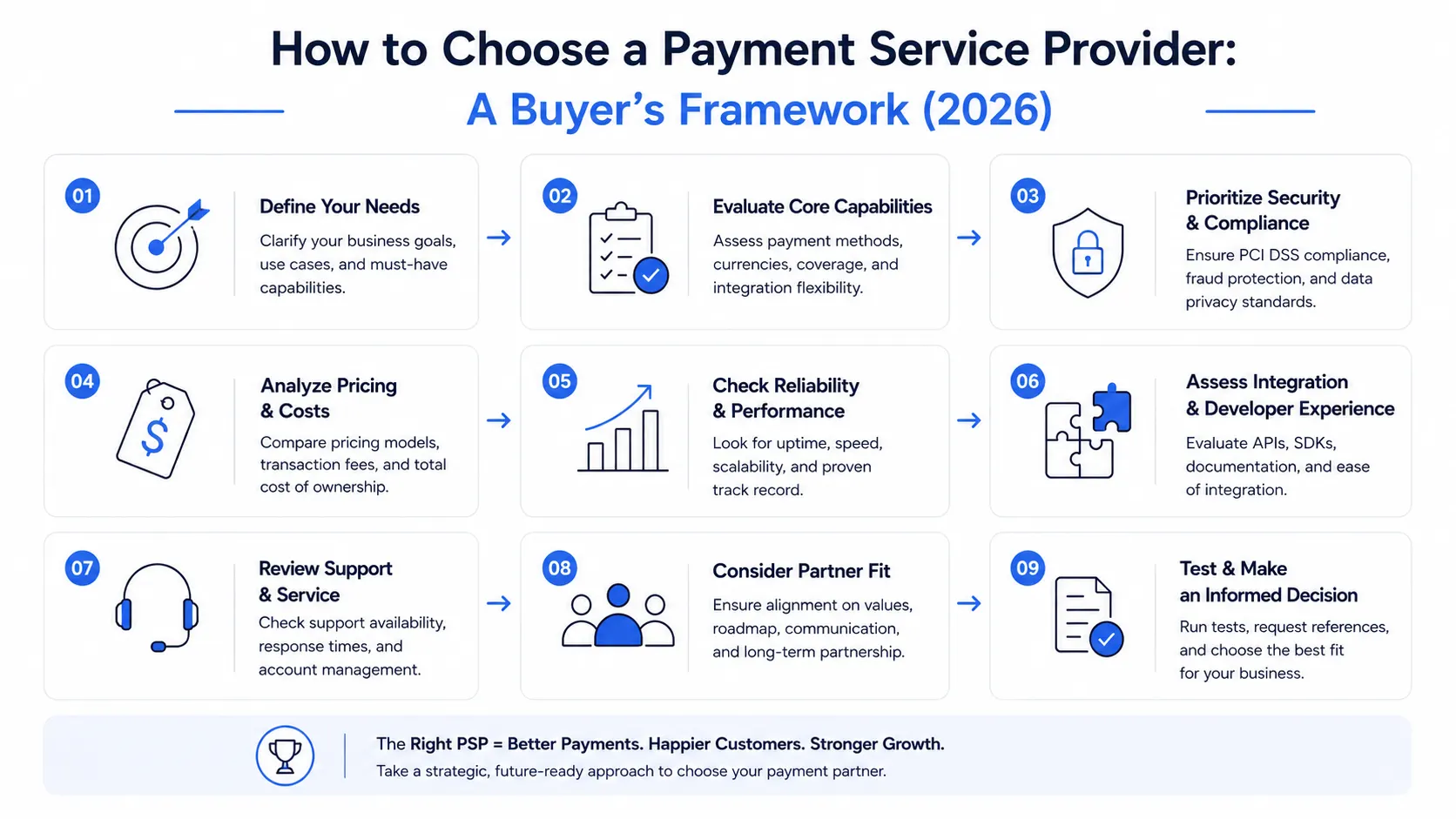
TL;DR
- Choosing the wrong payment service provider costs the average SME merchant $18,400 in switching costs, lost revenue during migration, and reintegration development time (Merchant Payments Coalition, 2025).
- The average merchant re-evaluates their PSP every 2.4 years, most triggered by rising fees, poor authorization rates, or compliance gaps.
- High fees (41%) and poor authorization rates (34%) are the two most cited reasons merchants switch providers, according to a 2026 industry survey of 1,200 merchants.
- Matching the right PSP to your business type, standard vs. high-risk, can improve authorization rates by 6-11 percentage points and reduce false declines by up to 22%.
- In 2026, Visa VAMP and Mastercard CE3.0 compliance requirements have made chargeback management tooling a mandatory evaluation criterion, not an optional add-on.
Why PSP Selection Is a Strategic Decision, Not a Vendor Choice
Picking a payment service provider is one of the highest-leverage commercial decisions a growing merchant makes. The wrong provider doesn’t just cost you on transaction fees, it costs you on every declined card, every abandoned checkout, and every chargeback dispute you don’t have the tools to fight. The right provider silently compounds your revenue by improving authorization rates, reducing fraud losses, and keeping your merchant account open.
In 2026, the decision is more complex than ever. The global payment processing market has fragmented into specialist verticals: standard e-commerce providers, cross-border payment specialists, high-risk merchant services, and crypto-native gateways, each with different underwriting standards, fee models, and compliance tooling. This guide gives you a structured framework to evaluate the options systematically.
Define Your Merchant Profile Before You Contact Anyone
Most merchants go straight to comparing providers without first documenting their own profile. This leads to underwriting surprises, mismatched contracts, and late-stage rejection. Define these five dimensions first.
Transaction volume and ticket size: Monthly volume determines your pricing tier. Merchants processing under $50K/month are best served by flat-rate or blended pricing models. Merchants above $150K/month should negotiate interchange-plus pricing, which typically reduces effective processing costs by 0.3–0.7 percentage points. Enterprise merchants above $1M/month should pursue custom direct acquirer relationships.
Industry classification (MCC): Your Merchant Category Code determines underwriting eligibility across all major payment providers. MCCs in the 5900-7999 range covering travel, entertainment, and subscription services face elevated scrutiny. MCCs associated with adult content, iGaming, forex, nutraceuticals, CBD, MLM, and firearms are classified as high-risk by most acquiring banks and standard payment providers. If your MCC falls in any of these categories, you need a specialist high-risk payment gateway from day one, attempting to onboard with a standard PayFac will result in account termination, often without notice.
Geographic footprint: Do more than 20% of your transactions originate outside your home market? If so, cross-border payment capability is a tier-one criterion. Map your top five customer markets and identify the local payment methods that dominate each, PIX in Brazil, iDEAL in the Netherlands, UPI in India, SADAD in Saudi Arabia. A provider that only supports Visa and Mastercard is structurally incompatible with international growth.
Chargeback history: Your current chargeback ratio is the single most important underwriting signal a new acquirer evaluates. If your ratio is above 0.75%, expect stricter terms or rejection. If it’s above 1.0%, your options narrow to specialist high-risk providers with dedicated dispute management tooling. Pull your last 6 months of chargeback data before any provider conversation.
Technical integration requirements: Hosted payment pages offer the lowest PCI scope but the least UX control. API-direct integrations give full checkout ownership but require a dedicated development resource and carry higher PCI compliance obligations. Embedded SDKs (e.g., Stripe Elements, Braintree Drop-in) offer a middle ground. Know which you need before evaluating providers.
Understand the PSP Landscape in 2026
The payment service provider market has consolidated at the top and fragmented at the specialist level. Understanding provider types helps narrow the evaluation field quickly.
PayFac / Aggregator Platforms
Stripe, Square, Shopify Payments, and PayPal operate as payment facilitators, they aggregate merchants under a single master merchant account. Onboarding is fast (often instant), pricing is transparent (flat-rate or blended), and integrations are polished. The trade-off: no dedicated merchant account, which means account stability is lower. PayFacs terminate accounts algorithmically when fraud or chargeback patterns shift. They are not suitable for high-risk merchants, high-volume merchants above $500K/month, or merchants needing custom reserve terms.
Full-Stack Acquirers
Adyen, Worldpay, and Checkout.com operate as licensed acquirers with direct card network relationships. They offer interchange-plus pricing, dedicated account management, and the highest authorization rate optimization, but require a formal underwriting process, minimum volume commitments, and longer implementation timelines. Best suited for mid-market and enterprise merchants ($500K+/month).
High-Risk Specialist Providers
A distinct tier of acquiring banks and ISOs specialize in elevated-risk merchant categories. These providers accept iGaming, adult, forex, nutraceuticals, and subscription billing merchants that standard acquirers decline. They charge higher rates (1.5-3.5%), require rolling reserves, and impose stricter contractual terms, but they offer account stability, dedicated chargeback dispute support, and multi-currency routing options that standard PSPs cannot match. Examples include Durango Merchant Services, PayKings, eMerchantBroker, and several EU/offshore acquiring banks.
Cross-Border Payment Specialists
Nuvei, dLocal, and Rapyd have built platforms specifically for cross-border payment processing, with deep local payment method coverage across LATAM, Southeast Asia, Africa, and the Middle East. If international volume is central to your business model, these providers offer materially better conversion rates and lower FX costs than generalist PSPs attempting to extend into emerging markets.
The Six Evaluation Criteria Every Merchant Must Score
Use this framework to score each shortlisted provider on a 1-10 scale across six dimensions. The relative weighting differs by merchant type, standard vs. high-risk vs. cross-border.
1. Fee Structure and Total Cost of Acceptance
Processing fees are visible, but the total cost of acceptance (TCA) includes interchange passthrough, assessment fees, monthly gateway fees, chargeback fees, rolling reserves, setup costs, and PCI compliance fees. Always request a full merchant statement simulation from providers before signing.
For standard merchants, processing rates on interchange-plus pricing run 0.5%-1.8%, with per-transaction fees of $0.10-$0.30, monthly gateway fees between $0 and $25, and chargeback fees of $15-$25 per dispute. Cross-border surcharges add 1.0%-1.5% on top of base rates, and no rolling reserve applies. High-risk merchants face materially higher costs across every component: processing rates of 1.5%-3.5%, per-transaction fees of $0.25-$0.55, monthly gateway fees of $30-$99, chargeback fees of $35-$100 per dispute, and a rolling reserve of 5%-10% of gross volume held for 90-180 days. Cross-border surcharges on high-risk accounts run 1.5%-2.5%.
Benchmark question to ask providers: “What was the average effective rate for merchants in my MCC and volume tier over the last 12 months?” This cuts through headline rate promises.
2. Authorization Rate Performance
Authorization rate, the percentage of attempted transactions that result in a successful approval, is the most directly revenue-linked metric in payment processing. A 2% difference in auth rate on $1M/month GMV translates to $20,000 in recovered or lost revenue. Industry benchmarks for 2026 by channel:
- Card-present (POS): 98.2% average
- E-commerce, domestic card: 87-92% average
- E-commerce, cross-border: 72-84% average
- High-risk e-commerce: 65-80% average
Ask providers for their published authorization rate data by MCC and market. Providers with direct acquiring licenses and intelligent routing between multiple acquiring banks (Adyen, Checkout.com) consistently outperform aggregators by 4-8 percentage points on complex or international transactions.
3. Compliance Tooling: VAMP, CE3.0, and 3DS2
In 2026, compliance tooling has become a mandatory PSP evaluation criterion following Visa’s VAMP launch and Mastercard’s CE3.0 program. Both programs impose progressive penalties on merchants breaching chargeback thresholds, 0.5% for elevated MCCs under VAMP, tiered fines starting at $1,000/month under CE3.0 Tier 1.
Your PSP must provide:
- Real-time chargeback ratio monitoring with threshold alerts before you breach program limits
- Automated pre-chargeback alerts (Ethoca, Verifi/CDRN) that allow you to refund before a dispute escalates
- 3DS2 authentication support with dynamic exemption routing to maximize frictionless transactions
- Detailed decline reason codes with actionable remediation data
Providers that cannot demonstrate these capabilities in a live demo are not compliant-infrastructure providers, they are basic transaction routers. In 2026, this distinction matters significantly to your bottom line.
4. Fraud Prevention and Risk Management
Payment fraud losses globally reached $48 billion in 2025 (Nilson Report, 2025), with card-not-present fraud accounting for 73% of total fraud volume. Evaluate providers on three fraud capability tiers:
Tier 1 – Minimum viable (all merchants): BIN/velocity checks, AVS and CVV matching, device fingerprinting, IP geolocation screening.
Tier 2 – Standard e-commerce: Machine learning fraud scoring, 3DS2 challenge optimization, chargeback reason code analysis, negative database integration.
Tier 3 – High-risk and subscription merchants: Behavioral analytics, multi-account detection, affiliate fraud screening, real-time transaction monitoring with rules-based block/review/allow logic, dedicated fraud analyst access.
If you are processing subscription billing, digital goods, or any high-risk category, Tier 3 capabilities are not optional, they are the difference between operating within VAMP thresholds and facing merchant account termination.
5. Settlement Speed and Cash Flow Terms
Settlement timing directly impacts merchant working capital. Standard settlement terms in 2026:
- T+1 (next business day): available from most full-stack acquirers for established merchants
- T+2: standard across PayFac platforms
- T+3 to T+7: common for new merchants, cross-border transactions, and high-risk accounts
- T+7 to T+14: standard for high-risk merchants in initial underwriting period; renegotiable after 6-12 months of clean processing history
Rolling reserves, where 5-10% of gross volume is held for 90-180 days, are a near-universal feature of high-risk merchant accounts. Negotiate the reserve percentage and release schedule into the contract before signing. A 5% reserve releasing on a 90-day rolling basis is materially better than an 8% reserve on a 180-day cycle.
6. Support Infrastructure and Account Stability
For standard merchants: Evaluate tiered support response times. PayFac platforms provide email/chat support only, resolution times for account issues average 2-5 business days. Full-stack acquirers typically assign a named account manager at $50K+/month volume.
For high-risk merchants: Dedicated support is not a premium, it is a survival requirement. When your account is flagged for a chargeback spike or a compliance review, the difference between a 24-hour resolution and a 5-day hold can mean five figures in frozen settlement funds. Confirm named account management, escalation paths, and guaranteed response SLAs before signing. A PSP that cannot commit to a 4-hour escalation response for compliance events is not a high-risk PSP, it is a standard PSP that accepts high-risk merchants.
Contract Red Flags That Cost Merchants Money
These are the six most consequential contract terms that merchants miss during PSP evaluation.
1. Unilateral reserve increases: Clauses allowing the provider to increase the rolling reserve percentage or hold period at their discretion, without notice. Negotiate a fixed reserve ceiling into the contract or require 30 days’ written notice before any reserve change.
2. Termination without cause: Most PayFac agreements allow termination without cause on 30 days’ notice. For high-volume merchants, this is catastrophic. Full-stack acquirer contracts typically require material breach for termination; negotiate this explicitly.
3. MATCH list liability: If a provider terminates your account for excessive chargebacks and reports you to the MATCH (Member Alert to Control High-Risk) list, you will be unable to obtain merchant accounts with Visa/Mastercard-connected acquirers for 5 years. Understand your contractual exposure to MATCH listing before signing.
4. Volume minimums with penalties: Contracts that impose monthly volume minimums with shortfall penalties effectively lock you into the provider. Common in enterprise acquirer contracts, ensure penalties are proportionate and waivable for genuine volume disruption.
5. Opaque interchange passthrough: Some providers quote interchange-plus pricing but cap or manipulate the passthrough in favor of higher-margin card types. Request a 90-day statement from a comparable merchant in your MCC to verify actual interchange passthrough accuracy.
6. Exclusivity or right-of-first-refusal clauses: Some contracts restrict your ability to add a second PSP or competitor routing. For merchants above $300K/month, multi-PSP routing (sending different transaction types to different providers) is a meaningful optimization, ensure your contract does not foreclose this.
The 2026 High-Risk PSP Checklist
If your merchant profile falls into any high-risk category, standard PSP evaluation criteria are necessary but not sufficient. Run this additional checklist before signing with any high-risk payment gateway provider.
- Does the provider hold their own acquiring license, or are they an ISO/aggregator reselling another acquirer’s BIN? Direct acquirers offer greater account stability.
- What is their chargeback tolerance threshold before triggering an account review? Confirm in writing.
- Do they offer multi-currency settlement and local acquiring in your target markets?
- What is the rolling reserve structure, percentage, hold period, and release cadence?
- Do they have pre-chargeback alert integration (Ethoca/Verifi) built into the platform?
- What VAMP and CE3.0 monitoring tools do they provide, and at what alert threshold?
- Can they provide three references from merchants in the same MCC who have processed with them for 12+ months?
- Is there a dedicated compliance officer assigned to high-risk accounts?
PSP Comparison by Merchant Type: Summary Matrix
SME e-commerce merchants in low-risk categories are best served by PayFac platforms like Stripe or Square, flat-rate pricing, instant onboarding, and clean integrations outweigh the lack of a dedicated account at lower volumes. Avoid complex enterprise contracts until monthly volume justifies the overhead.
Mid-market e-commerce businesses above $150K/month should move to a full-stack acquirer like Adyen or Checkout.com. The priority criteria here are authorization rate performance, interchange-plus pricing transparency, and named account management. PayFac platforms are unsuitable at this tier, algorithmic account management creates unacceptable stability risk at scale.
High-risk merchants in iGaming, adult content, or forex have no viable path through standard PSPs, which will terminate accounts once transaction patterns are profiled. A specialist high-risk acquirer with VAMP/CE3.0 monitoring tools, dedicated chargeback support, and negotiated rolling reserve terms is the only appropriate option.
Cross-border and international merchants should prioritize cross-border specialists such as Nuvei, dLocal, or Rapyd, which offer deep local payment method coverage, competitive FX rates, and local acquiring in target markets. Generic PSPs with limited alternative payment method support will cause significant conversion losses in LATAM, Southeast Asia, and the Middle East.
Subscription billing merchants require a provider with tokenized recurring billing infrastructure, dunning management tools, and experience with MCC5968 compliance. Flat-rate PayFac pricing is unfavorable for repeat transactions, the per-transaction cost accumulates quickly on high-frequency billing cycles.
Crypto-native businesses need a dedicated crypto PSP such as BTCPay Server or Coinbase Commerce, with stablecoin settlement capability, FATF Travel Rule compliance, and blockchain-level reconciliation tooling. Fiat-only PSPs cannot support this infrastructure regardless of their marketing claims.
Frequently Asked Questions
What is a payment service provider?
A payment service provider (PSP) is a company that enables merchants to accept payments by connecting them to payment networks, acquiring banks, and payment methods. Modern PSPs typically bundle gateway technology, fraud screening, and settlement services into a single platform.
What is the difference between a PSP and a payment gateway?
A payment gateway is a specific technology layer that encrypts and routes transaction data. A PSP is a broader category it, the gateway, plus acquiring relationships, merchant account management, fraud tooling, and settlement. Some PSPs operate their own gateways; others use third-party gateway technology.
How do I know if I need a high-risk PSP?
If your business operates in iGaming, adult content, forex, CBD, nutraceuticals, MLM, subscription billing, firearms, or debt collection, you need a specialist high-risk PSP. Standard providers and PayFac platforms will either reject your application outright or terminate your account once your transaction patterns are profiled.
What is interchange-plus pricing?
Interchange-plus (IC+) pricing passes through the exact interchange fee charged by the card network, plus a fixed markup for the acquirer. It is more transparent and typically 0.3-0.7% cheaper than blended flat-rate pricing at volumes above $50K/month.
What is a rolling reserve in PSP contracts?
A rolling reserve is a percentage (typically 5-10%) of a high-risk merchant’s gross processing volume held by the acquirer for 90-180 days as a buffer against future chargebacks or fraud losses. Funds are released on a rolling basis as the reserve period for each batch expires.
How does VAMP affect my PSP choice in 2026?
Visa’s VAMP program monitors chargeback ratios at the merchant level. For elevated-risk MCCs, the threshold is 0.5%. Merchants who breach VAMP face remediation fees of $10-$50 per excess chargeback and risk account termination. Your PSP must provide real-time VAMP monitoring and pre-chargeback alert integration, if they cannot, you are flying blind on your most critical compliance metric.
What should I look for in a cross-border payment PSP?
Multi-currency settlement accounts, native local payment method (LPM) support in your target markets, competitive FX rates (ideally within 0.5% of mid-market), local acquiring capability to avoid cross-border interchange surcharges, and PSD2/SCA compliance tooling for European markets.
How many PSPs should I use?
Most merchants above $300K/month benefit from a primary PSP and a backup routing partner. Multi-PSP routing allows you to direct different transaction types (e.g., high-risk cards to one acquirer, domestic debit to another) for improved authorization rates. Ensure your primary contract does not include exclusivity clauses before adding a second provider.
Comments
No comments yet. Be the first to share your thoughts.
Leave a comment