
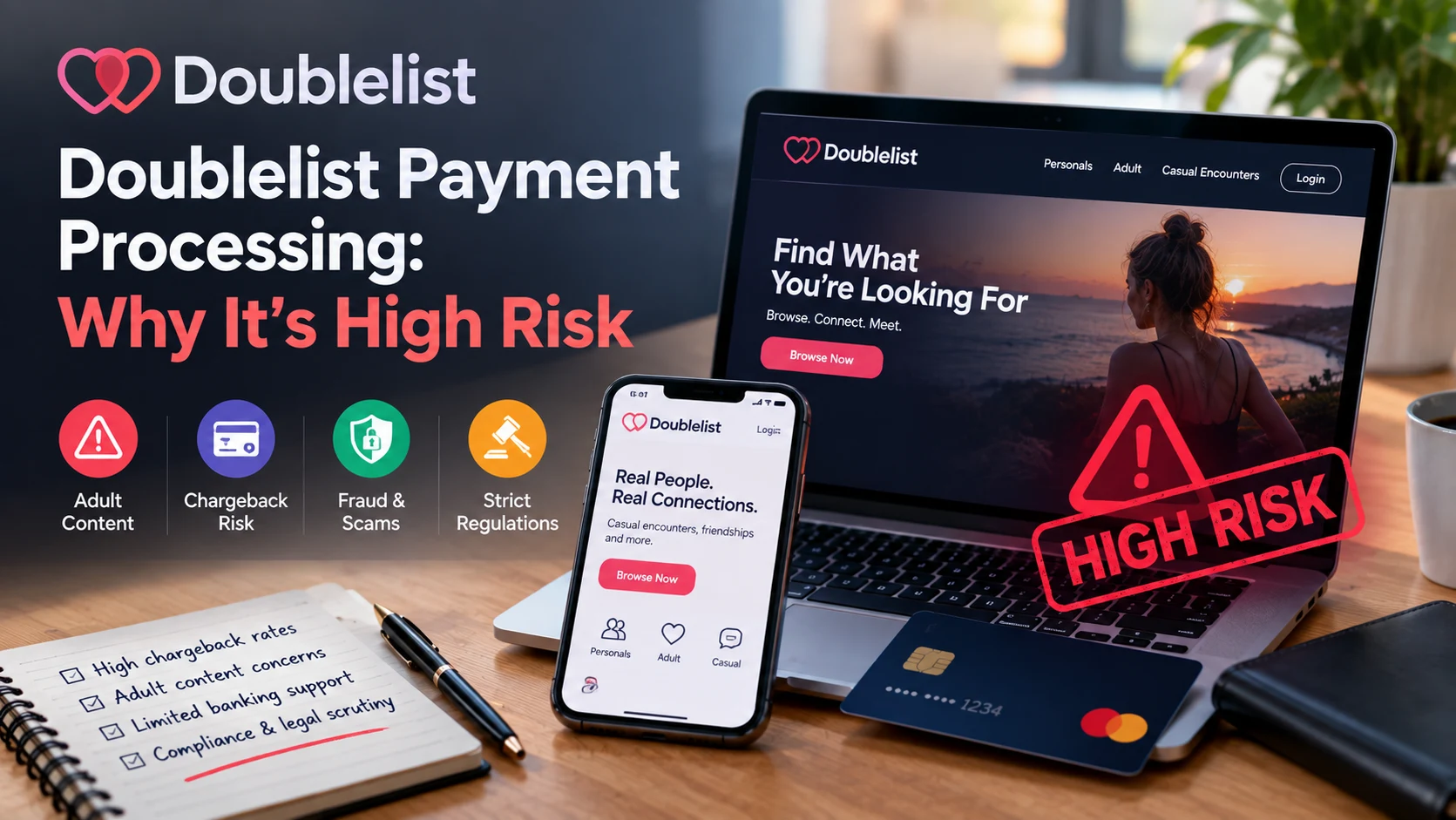
Adult classifieds sit in an uncomfortable corner of the internet economy. Users want simple, discreet ads. Banks and card networks want proof that nothing illegal is happening on the platform. That gap is why payment processing for a site like Doublelist is harder than for almost any other online business.
This guide explains why the category is flagged, what a payment provider actually checks, and how an operator can make a sound decision.
Adult classifieds are treated as high-risk because of legal exposure after FOSTA-SESTA, strict Visa and Mastercard rules on adult content, and chargeback-prone billing. Approval depends on strong age verification, moderation, and clean billing. A platform that cannot show those controls will struggle to keep a high-risk merchant payment account.
Understanding the Problem
What Doublelist is, and why it exists
Doublelist launched in early 2018 as a personals-focused classifieds site, right after Craigslist closed its personals section. According to review coverage, it operates under the business name Helpful Things, LLC, and was reportedly acquired by a company called Adly in 2022.
Its format is deliberately old-school: post an ad, browse by city, message directly. Accounts are free, and public descriptions mention a freemium model with paid extras. That mix of anonymous posting and paid features is exactly what makes adult payment processing complicated.
The FOSTA-SESTA effect
Craigslist shut down its personals section in March 2018 because of FOSTA-SESTA, a US law that placed legal responsibility for certain user-posted content on the platform itself rather than only on the individual poster.
For a payment provider, that shift matters. If a classifieds site can be held liable for what users post, then the bank processing its payments can be drawn into that liability chain. Providers respond the way risk teams always do, by pricing in the risk, tightening controls, or declining the account.
Doublelist’s own terms are reported to prohibit sex work, escorting, and any advertising of transactions. That policy is the right foundation. But a policy on paper is not the same as enforcement, and processors ask for evidence of the second.
Why “adult” almost always means “high risk”
Mainstream processors commonly prohibit adult content outright because of reputational risk. That pushes adult merchants toward specialist high-risk acquiring relationships.
Three factors drive the label:
- Legal exposure: user-generated content can include illegal material, and the platform is responsible for controlling it.
- Card network scrutiny: Visa and Mastercard both impose extra rules on adult merchants.
- Chargebacks: discreet purchases lead to disputes when a customer does not recognize a charge or regrets a purchase.
Adult payment providers exist because these merchants need a partner who understands all three.
What a Payment Provider Actually Evaluates
Card network rules
In October 2021, Mastercard tightened its requirements for adult content merchants. The rules focus on verifying the identity and age of content providers, keeping written consent on record, pre-screening content, and offering a working complaint and takedown process. Acquirers can also require monthly reports on flagged content and complaints.
Visa runs a parallel structure through its Integrity Risk Program, which replaced an older brand protection program in 2023 and sets similar expectations around age verification, consent, and takedown handling.
These rules are written mainly with adult content in mind, but the principle carries over to classifieds: the more user-generated adult material a platform hosts, the more proof of control an acquirer will request.
The chargeback problem
Chargebacks are the most measurable risk in adult payment. Card schemes commonly monitor merchants whose chargeback ratio climbs above roughly 1%, and penalties can include fines and, eventually, account termination. Reporting on newer Visa monitoring rules also points to a dispute threshold of about 1.5% from April 2026, which puts extra pressure on adult merchants.
Classifieds add a wrinkle. Because premium features, boosted ads, or subscriptions are often bought on impulse and privately, “I don’t recognize this charge” is a common dispute reason. Clear billing descriptors matter here. Schemes expect the statement text to identify the service plainly, and vague descriptors are treated as a red flag.
Classification and monitoring
Adult merchants must be classified correctly under the right merchant category code. Misclassification is a fast route to fines. Mastercard’s monitoring program was also revised in early 2026, meaning acquirers are watching merchants more closely over time, not only at onboarding.
What high-risk underwriting typically looks like
Expect a more detailed application than a standard merchant account. Providers commonly review:
| What they review | Why it matters |
|---|---|
| Business ownership and licensing | Confirms who is accountable |
| Age and identity verification process | Core requirement under card network rules |
| Moderation and takedown workflow | Shows control over user-generated content |
| Chargeback history and fraud tools | Predicts dispute risk |
| Billing descriptors and refund policy | Reduces “unrecognized charge” disputes |
Approved high-risk merchants often face higher processing costs and may be asked to hold rolling reserves. That is the price of the extra risk, not a sign the provider is treating you unfairly.
Making the Decision
Step 1: Separate the product from the risk
The most important decision an adult classified operator makes is what exactly customers pay for. Charging for software features such as ad boosts, ad-free browsing, or messaging tools is a very different proposition from anything resembling payment tied to an offline service.
Be direct about the limit here: no legitimate payment provider will support a platform that allows advertising of sex-for-pay transactions, and none should. Platforms that enforce a strict no-transactions policy have a defensible position. Those that do not will not get, or keep, processing.
Step 2: Build the compliance file before you apply
Approval is faster when the operator arrives prepared. Before contacting a payment provider, assemble:
- A written content policy and a documented moderation process
- Age and identity verification steps for account holders
- A takedown and complaint workflow that actually gets used
- A refund and cancellation policy that is easy to find
- Plain billing descriptors that match your brand
Step 3: Choose a provider built for adult payment processing
A generalist processor will often reject adult merchants or, worse, approve them and terminate later. That leaves the business scrambling and can add account-freeze risk at the worst moment.
When comparing providers, look for:
- Genuine adult experience: ask which adult platforms they currently support.
- Named sponsor banks: transparent acquiring relationships are a good sign.
- Chargeback tooling: dispute alerts, 3-D Secure, and fraud screening.
- Clear terms on reserves and fees: no surprises in the contract.
- Backup routing: a second acquiring route reduces single-provider dependence.
Step 4: Watch for red flags
Walk away from any payment provider that guarantees approval without reviewing your business, refuses to name its banking partners, asks for large upfront fees with vague promises, or is unwilling to explain reserve terms. Real underwriting asks questions. If nobody is asking, nobody is really checking, and the account will be fragile.
Quick FAQs
Why can’t a classifieds site just use a mainstream processor? Most mainstream processors restrict adult content categories, and card network rules require monitoring that generalist providers rarely offer.
Does free posting make payment processing easier? Not necessarily. Free posting reduces card exposure, but any paid features still require a merchant account, and the platform’s content risk still applies.
What is the biggest cause of account termination? Excessive chargebacks and poor content control are the most common triggers, followed by misclassification.
The Bottom Line
Doublelist’s story shows how a legal change reshaped an entire category. FOSTA-SESTA raised the stakes for classifieds platforms, and card network rules raised them again for anyone taking payments in adult content. The result is a category where adult payment processing is possible, but only for operators who can prove control, verified users, active moderation, clean billing, and low disputes.
For any business in this space, the best strategy is not finding the loosest payment provider. It is building the kind of compliance record that makes a high-risk merchant payment relationship durable.
Sources & Further Reading: Mastercard’s October 2021 adult content requirements and 2026 industry commentary on the Merchant Monitoring Program; Visa Integrity Risk Program guidance via acquirer publications; public reviews and coverage of Doublelist’s launch and ownership; industry guides on adult chargeback thresholds and VAMP.
Comments
No comments yet. Be the first to share your thoughts.
Leave a comment