
TL;DR:
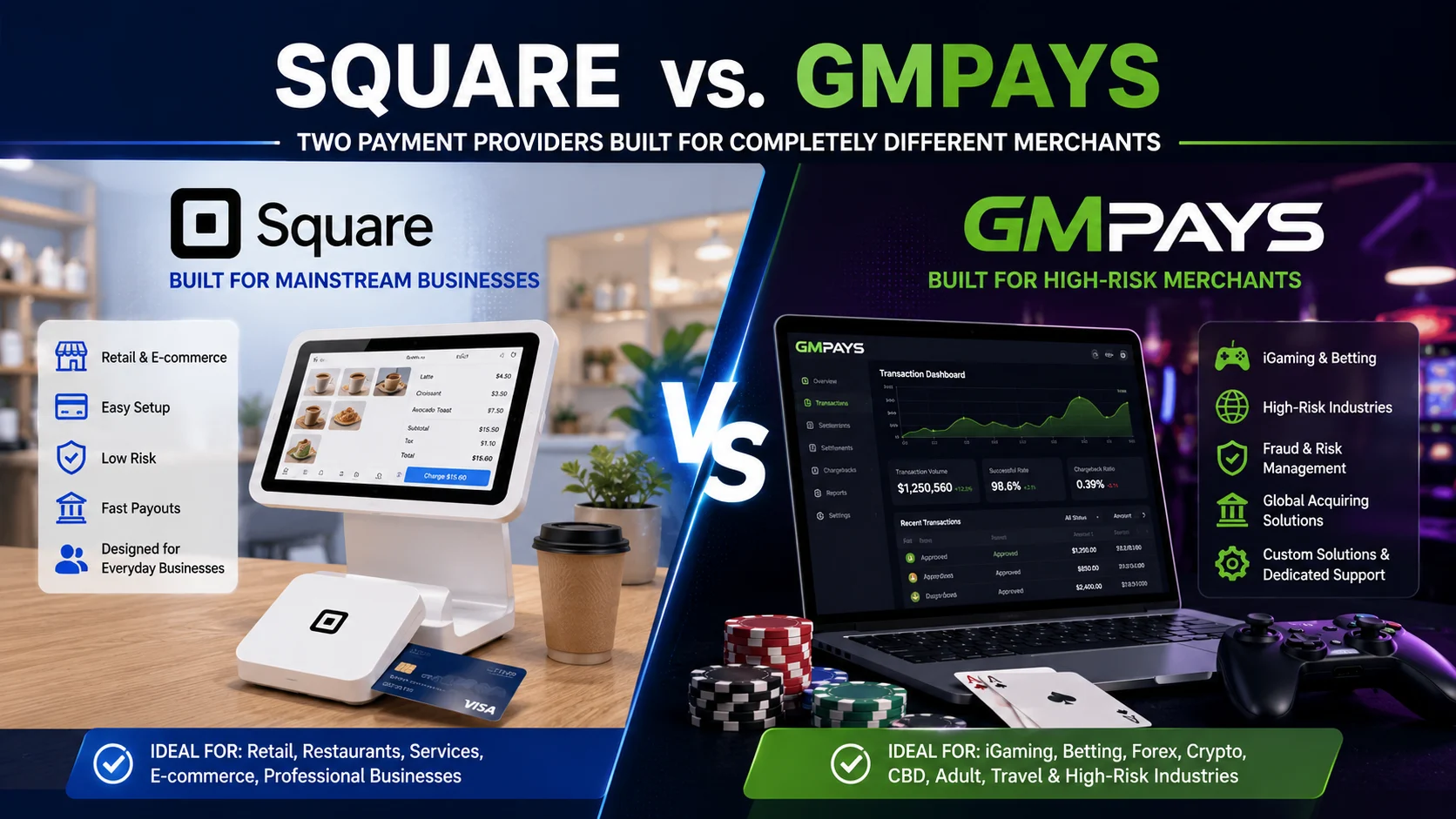
Square is one of the most widely used merchant services platforms in the US, built for low-risk retail, restaurants, and service businesses. GMPays is a Czech-licensed electronic money institution built specifically for gaming and other high-risk verticals, categories Square’s own policy explicitly excludes. This isn’t really a “which one wins” comparison. It’s a category-fit question, and getting it wrong costs merchants real time and money either way.
If you searched for this comparison, you’re probably trying to answer a version of one specific question: “will this processor actually accept my business, or will I get approved and then shut down six months in?” That’s the right question to ask, and it’s also the one that makes “Square vs. GMPays” a strange head-to-head in practice, because for most merchants, only one of these two was ever going to say yes in the first place.
What Square Actually Is
Square is one of the most recognizable payment processing platforms for small and mid-sized US businesses, known for transparent flat-rate pricing, fast onboarding, and integrated POS hardware and software. It works extremely well for retail stores, restaurants, and service businesses with predictable sales volume and low chargeback risk.
The detail that matters most for this comparison is Square’s own restricted-business policy: Square explicitly prohibits or restricts a long list of high-risk categories, including online gambling, sports betting, cryptocurrency businesses, adult content, and CBD, among others. This isn’t a gray area or an inconsistently enforced rule, it’s stated policy, and Square will reject applications or shut down active accounts once restricted activity is detected. For gaming and gambling businesses specifically, Square is not a realistic payment gateway option at all, regardless of how well-run or compliant the business is in its own jurisdiction.
What GMPays Actually Is
GMPays operates under Mercurius Partners s.r.o., licensed by the Czech National Bank as a small-scale electronic money institution since 2017, a directly verifiable license, with the Czech National Bank named in GMPays’ own terms as the supervisory authority merchants can escalate to. Unlike Square, GMPays is built specifically around the merchant categories mainstream processors decline: gaming, digital goods, and other high-risk online payments verticals, with particular traction among international gaming platforms.
The public picture here is genuinely mixed, and worth stating plainly rather than smoothing over. Independent domain-reputation scans show no malware or phishing flags associated with GMPays. At the same time, a recurring cluster of user reviews, concentrated among end-users of one specific gaming platform, describe withdrawal delays, repeated verification requests, and fee complaints. These are unverified, user-submitted accounts rather than regulatory findings, and shouldn’t be read as evidence of licensing problems, but they’re a real operational-friction signal worth factoring into a decision, alongside GMPays’ otherwise verifiable licensing status.
The Core Comparison: Why “Regulated vs. Reckless” Misses the Actual Story
1. These aren’t competitors – they’re built for non-overlapping merchant categories
The honest framing here isn’t “which provider is more trustworthy.” Square doesn’t compete for gaming merchants because its own policy excludes them entirely. GMPays doesn’t compete for Square’s core retail/restaurant customer base because that’s not its specialization. A framing that pits them as “regulated vs. reckless” implies they’re fighting over the same customers and one is cutting corners to win, the reality is closer to two providers serving entirely different risk categories, each shaped by the regulatory reality of the merchants they actually serve.
2. Both are regulated – differently, and for different reasons
Square operates as a payment facilitator under US regulatory frameworks, aggregating merchants under its own master account with card-network oversight. GMPays operates as a directly licensed EMI under EU regulation, with its own named regulator. Describing GMPays as unregulated would be inaccurate, it holds a real, checkable license. What differs is what kind of regulatory structure backs each provider, and that difference exists specifically because they’re licensed to serve different risk categories, not because one skipped compliance and the other didn’t.
3. The real risk differential is category-based, not company-based
Industry data on high-risk merchant accounts is worth internalizing here: gambling merchants experience chargeback rates 2-4x higher than average e-commerce, and high-risk accounts generally cost 2-5x more in processing fees with 5-20% rolling reserves held for 90-180 days, regardless of which specific provider handles them. That elevated cost and friction isn’t a GMPays-specific issue; it’s the structural reality of the gaming vertical itself, which is precisely why mainstream providers like Square exclude it rather than price it in.
4. Merchants who apply to the wrong category waste real time
A genuine, practical pain point shows up constantly in high-risk merchant guidance: businesses spend weeks applying to mainstream payment providers like Square, get initially approved, then have their account frozen once restricted activity is detected, losing processing continuity and often facing held funds during the transition. The fix isn’t finding a “better” mainstream processor; it’s applying to a provider built for your actual risk category from the start.
Use Cases: Which Provider Actually Fits Your Business
Choose Square if:
- You run retail, restaurant, or service-business sales with predictable, low-chargeback volume
- You want fast onboarding (often same-day) without a lengthy underwriting process
- You need integrated POS hardware and software alongside payment processing
- Your business isn’t in a restricted category under Square’s own published policy
Choose a provider like GMPays if:
- You operate a gaming platform or another vertical mainstream processors explicitly exclude
- You need a directly licensed EU electronic money institution rather than an offshore intermediary
- You’re serving an international player base needing multi-currency digital payments support
- You’ve verified current licensing status directly and are comfortable with the elevated cost structure inherent to high-risk processing generally
Pros and Cons
Square
- Fast, simple onboarding; transparent flat-rate pricing
- Strong POS and software ecosystem for retail/restaurant operations
- Will reject or terminate accounts in restricted categories, including gambling, without exception
- Not a viable long-term option for any high-risk vertical, no matter how compliant
GMPays
- Directly licensed EMI with a named, checkable EU regulator
- Built specifically for gaming and other high-risk verticals mainstream processors decline
- Recurring (unverified) user complaints about withdrawal speed and verification friction
- Higher fees and reserve requirements, though this reflects the high-risk category generally, not GMPays specifically
Industry Best Practice: Match the Provider to the Category First
The best practice here isn’t choosing based on brand recognition or which company markets itself more confidently, it’s identifying your merchant category accurately before applying anywhere. If you’re in a low-risk, predictable-volume business, mainstream providers like Square genuinely offer better pricing and faster onboarding than any high-risk-focused payment gateway would. If you’re in gaming, gambling, adult, CBD, or another explicitly restricted category, applying to Square at all is a wasted cycle, go directly to a provider built for that risk profile, and treat licensing verification (checking the regulator directly, not just the marketing page) as a non-negotiable first step regardless of which provider you choose.
Practical Takeaway
Don’t ask “which of these is the better company”, ask “which merchant category am I actually in, and which provider is built for it.” For most low-risk US retail and service businesses, Square’s fast onboarding and transparent pricing make it a reasonable default. For gaming and other high-risk verticals, GMPays’ EU licensing structure is worth evaluating directly, but pair that evaluation with independent verification of current licensing status and a clear-eyed look at the withdrawal-friction complaints in public reviews, rather than relying on marketing claims from either side.
Comments
No comments yet. Be the first to share your thoughts.
Leave a comment