
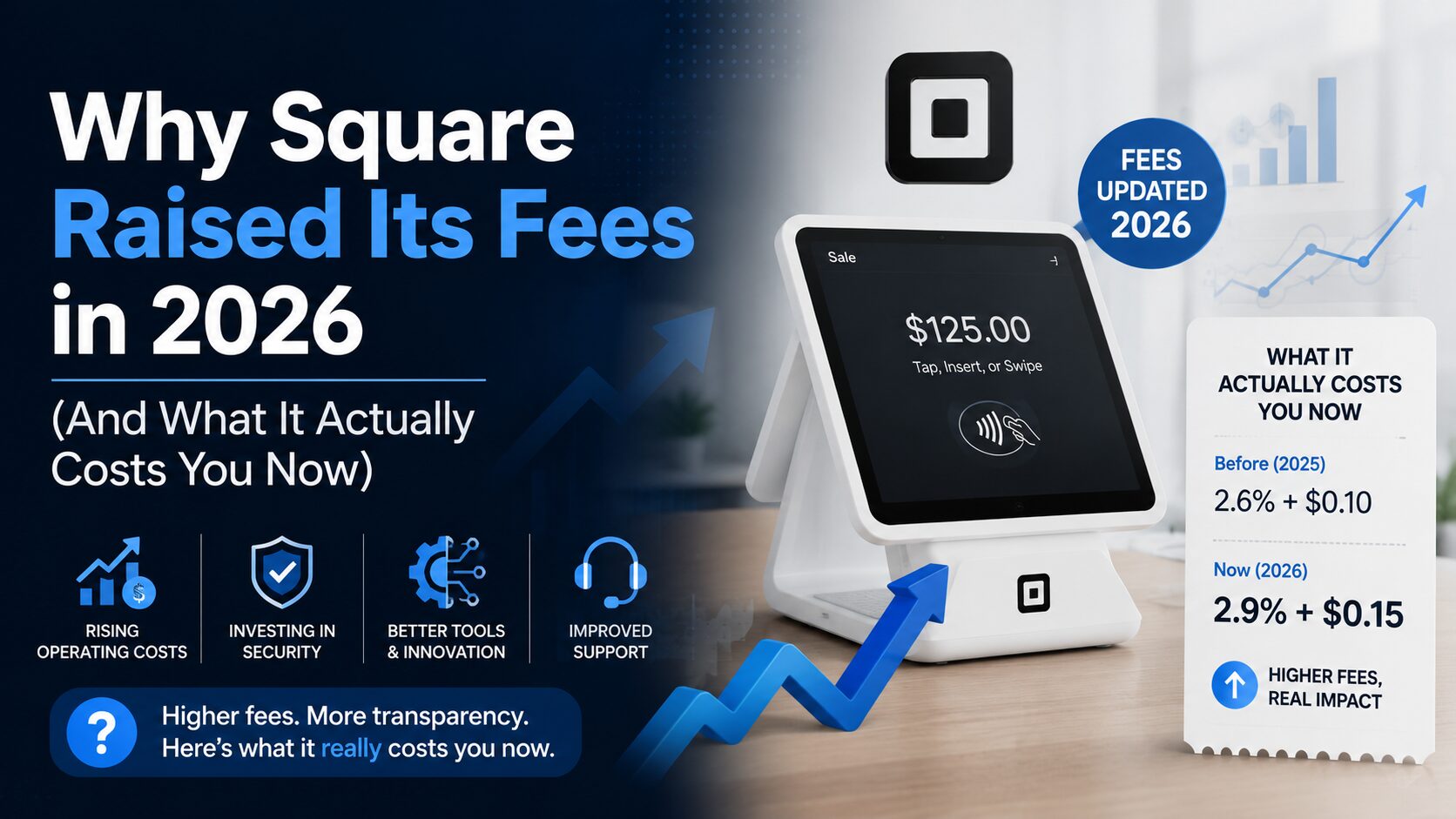
If your Square statement looks a little higher than it used to, you’re not imagining it. Square implemented its biggest pricing overhaul since launch in late 2025, followed by another online rate increase effective January 13, 2026, and a lot of merchants are only now noticing the difference in their monthly totals.
TL;DR:
Square’s online processing rate on its Free plan jumped from 2.9% + 30¢ to 3.3% + 30¢ as of January 13, 2026, a 14% increase, with in-person rates also ticking up from 2.6% + 10¢ to 2.6% + 15¢. The changes reflect Square’s shift toward tiered subscription plans (Free, Plus, Premium) where paid tiers unlock lower processing rates. For low-to-mid volume merchants the increase is modest in dollar terms; for growing businesses processing meaningful online volume, it’s a real signal that flat-rate merchant services stop being the cheapest option well before most people switch.
What Changed: Square’s 2026 Pricing Overhaul
Square restructured its entire pricing model in October 2025, consolidating what used to be different rates for different business types, retail, restaurants, appointments, into three unified subscription tiers: Free, Plus ($49/month), and Premium ($149/month). That alone was a meaningful shift, since some service-based businesses that previously paid $29/month for a comparable tier saw their subscription cost jump, even before touching transaction rates.
Then, effective January 13, 2026, Square raised its online processing rates specifically. The Free plan’s online rate moved from 2.9% + 30¢ to 3.3% + 30¢, and the discounted online rate on Plus and Premium plans moved from 2.6% + 30¢ to 2.9% + 30¢. In-person rates on the Free plan also increased earlier, from 2.6% + 10¢ to 2.6% + 15¢, a smaller nickel-per-transaction bump, but one that compounds at volume.
The New Rates, Broken Down
Here’s what merchants are actually paying under Square’s current published pricing:
- Square Free ($0/month): 2.6% + 15¢ in-person, 3.3% + 30¢ online, 2.9% + 30¢ for online API payments, 3.5% + 15¢ for manually keyed or card-on-file payments
- Square Plus ($49/month per location): 2.5% + 15¢ in-person, 2.9% + 30¢ online
- Square Premium ($149/month per location): 2.4% + 15¢ in-person, 2.9% + 30¢ online (online rate matches Plus)
- ACH via invoice: 1% with a $1 minimum
- Instant/same-day transfers: 1.95% per transfer, up from previous rates; standard next-business-day transfers remain free
- Custom pricing is available for merchants processing more than $250,000 per year
The pattern is clear: online payments took the biggest hit in this round of increases, while in-person rates moved more modestly. That’s a meaningful detail for merchants whose sales mix leans digital.
Why Square Raised Prices Now
Square isn’t alone in adjusting pricing, the broader payment processing industry has been absorbing rising interchange costs, increased fraud and chargeback exposure, and tightening card network rules throughout 2026. But the shift also reflects something more specific to Square’s business model: flat-rate, bundled pricing was always going to face pressure as transaction volumes and fraud risk climbed, since Square absorbs pricing risk that interchange-plus processors pass through more directly.
The tiered subscription structure is also a deliberate nudge. By keeping the Free plan’s rates high while discounting Plus and Premium, Square is effectively pricing merchants toward paid tiers as their volume grows, a strategy that only pays off for the merchant once monthly processing volume clears a specific breakeven point.
What This Actually Costs You: Real Numbers
For a business processing $10,000/month online on the Free plan, the January 2026 increase adds roughly $40/month in extra fees, about $480/year. For higher-volume merchants, the gap widens considerably. A business processing $20,000/month in card sales can expect to pay somewhere in the $660-$740/month range on the Free plan, compared to roughly $629/month combining subscription and processing costs on Premium, and potentially $380-$450/month with an interchange-plus merchant account instead of Square’s bundled pricing entirely.
That comparison is the real story here. It’s not that Square’s rates are unreasonable in isolation, it’s that flat-rate pricing, convenient as it is, increasingly costs more than a dedicated merchant account with interchange-plus pricing once volume passes a certain threshold. Many merchants report saving 20–40% on processing costs by switching structures at that point.
Square’s 2026 Rates at a Glance
| Plan | Monthly Cost | In-Person Rate | Online Rate | Manually Keyed |
|---|---|---|---|---|
| Square Free | $0 | 2.6% + 15¢ | 3.3% + 30¢ | 3.5% + 15¢ |
| Square Plus | $49/location | 2.5% + 15¢ | 2.9% + 30¢ | 3.5% + 15¢ |
| Square Premium | $149/location | 2.4% + 15¢ | 2.9% + 30¢ | 3.5% + 15¢ |
Custom pricing is available for merchants processing more than $250,000 annually, typically negotiated directly with Square’s sales team rather than published publicly.
The Bigger Structural Issue: Flat-Rate Pricing at Scale
Square’s appeal has always been simplicity, no contracts, no monthly minimums on the Free plan, fast setup. That trade-off made sense for small, low-volume merchants who valued predictability over marginal savings. But the underlying economics of flat-rate payment processing were never built to be the cheapest option at scale; they’re built to be the easiest to understand.
As Square’s rates climb and its subscription tiers proliferate, that gap between “simple” and “cheapest” widens. Merchants who started on Square for convenience and have since grown into meaningful monthly volume are increasingly the ones for whom a dedicated merchant account, with transparent interchange-plus pricing through a specialized payment provider, starts to make clear financial sense.
When Square Still Makes Sense
Square isn’t wrong for everyone, even after this increase.
- Very low-volume or seasonal businesses: benefit from paying nothing when there’s no revenue, since the Free plan carries no monthly minimum
- Businesses that need fast, all-in-one setup: POS hardware, online payments, and invoicing bundled together, still get real value from Square’s integrated ecosystem
- Merchants without dedicated finance or ops resources: may reasonably prioritize simplicity over the modest savings a specialized merchant account might offer at lower volumes
When It’s Time to Look at Alternatives
The math shifts clearly once volume grows:
- Once monthly processing volume consistently exceeds roughly $15,000-$20,000, it’s worth running the numbers on an interchange-plus merchant account against Square’s Plus or Premium tiers
- Businesses doing meaningful online payments specifically should weigh the January 2026 rate hike heavily, since that’s where the increase landed hardest
- Merchants planning to scale significantly in the next 12 months should evaluate payment providers now, since switching processors gets more disruptive the larger a business gets
Cross-Border Payments and International Sellers
Square’s pricing structure is built primarily around domestic US transactions, and merchants expanding into cross-border payments should factor that into any cost comparison. Dedicated payment gateways and payment providers built specifically for international settlement often offer more competitive multi-currency handling than a flat-rate domestic processor retrofitted for occasional international sales. For merchants with a genuinely global customer base, this is frequently a bigger cost factor than the domestic rate increase itself.
Why Travel and Booking Businesses Feel This More
Travel and booking companies are particularly exposed to Square’s 2026 online rate increase, for a few structural reasons specific to the vertical.
- High average order values amplify percentage-based fees: A 0.4-percentage-point increase on a $50 purchase is negligible; on a $2,000 vacation booking, it’s a meaningfully larger dollar amount.
- Online payments dominate the travel booking funnel: meaning this vertical absorbs the full brunt of Square’s steepest rate increase rather than the smaller in-person bump.
- International customers add cross-border complexity: that flat-rate domestic processors aren’t built to handle efficiently, compounding the cost gap beyond the headline rate increase.
- Advance bookings with long fulfillment windows: mean travel merchants process meaningful transaction volume well before revenue is fully realized, making processing cost efficiency more important to cash flow than in most retail categories.
Travel businesses currently on Square should specifically model their online transaction costs under the new rates and compare them against dedicated travel-focused payment providers or interchange-plus merchant accounts, given how directly this vertical is affected.
High-Risk Merchants and Square
Square’s standard pricing generally isn’t available to businesses in high-risk categories in the first place, Square’s underwriting excludes many high-risk verticals outright, pushing those merchants toward a dedicated high-risk payment gateway regardless of Square’s rate changes. For merchants who do qualify for standard Square processing but operate in gray-area categories, it’s worth confirming current standing directly, since risk classifications and platform policies can shift independently of the pricing changes covered here.
What To Do Next
Rather than reacting only to sticker shock, run the actual math for your business:
- Pull your last three months of Square statements and calculate your effective rate under the new pricing
- Compare that total cost, subscription plus processing, against at least one interchange-plus quote from a competing payment provider
- Weigh convenience against savings honestly; Square’s simplicity has real value, but only you know what it’s worth at your specific volume
- Revisit this comparison periodically, since payment processing pricing across the industry has shown a clear trend of change throughout 2026
Frequently Asked Questions
When did Square’s fee increase take effect?
The online processing rate increase took effect January 13, 2026, following a broader pricing overhaul in October 2025 that introduced Square’s current Free, Plus, and Premium subscription tiers.
How much did Square’s online rates actually increase?
On the Free plan, online processing went from 2.9% + 30¢ to 3.3% + 30¢, a 14% increase. On Plus and Premium plans, the online rate moved from 2.6% + 30¢ to 2.9% + 30¢.
Did Square’s in-person rates also increase?
Yes, though more modestly. The Free plan’s in-person rate moved from 2.6% + 10¢ to 2.6% + 15¢, an extra nickel per transaction that adds up at higher volume.
Is it worth paying for Square Plus or Premium after the increase?
It depends entirely on volume. The monthly subscription fee only pays for itself once your processing volume is high enough that the lower per-transaction rate saves more than the plan costs, run the specific math for your business rather than assuming either direction.
When should a merchant switch away from Square entirely?
Once monthly processing volume consistently exceeds roughly $15,000-$20,000, it’s generally worth comparing Square’s total cost against an interchange-plus merchant account, where savings of 20-40% are commonly reported at that volume level.
Comments
No comments yet. Be the first to share your thoughts.
Leave a comment