
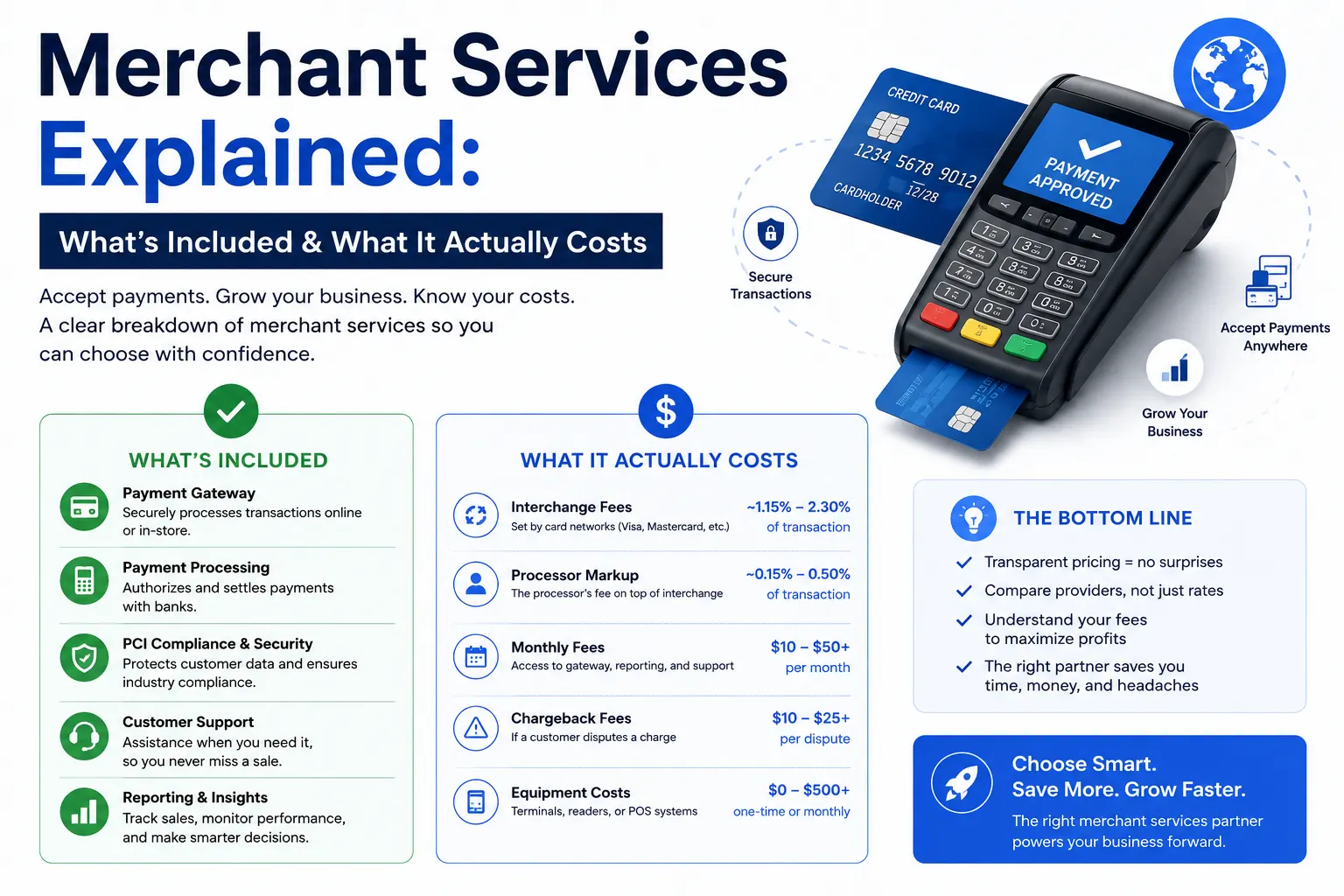
Ask five business owners what merchant services actually cost them, and you’ll likely get five different answers, and most of them will be wrong, because the real cost hides across a dozen line items most merchants never fully unpack. Understanding what’s actually included, and what each fee is paying for, is the first step to negotiating a fairer deal and avoiding the padded charges that quietly inflate processing costs every month.
TL;DR
Merchant services cover far more than just card processing, they include the payment gateway, fraud and security tools, PCI compliance support, reporting, and customer support that sit behind every transaction a business accepts. The total cost combines interchange fees set by card networks, assessment fees paid to Visa and Mastercard, and a markup charged by your processor, typically landing between 1.5% and 3.5% per transaction depending on pricing model and business type. In 2026, new network-level fees targeting high-risk merchants and continued PCI DSS 4.0.1 enforcement are reshaping what “standard” merchant services pricing looks like. Travel companies face a distinct version of this cost structure, since their high-risk classification often means higher rates, rolling reserves, and a narrower set of providers willing to work with them at all.
What Merchant Services Actually Includes
The term “merchant services” gets used loosely, but it refers to the full bundle of tools and infrastructure a business needs to accept online payments, digital payments, and card transactions. A complete merchant services package typically includes:
- Payment processing: the core infrastructure that authorizes, captures, and settles transactions across card networks
- Payment gateway access: for online or e-commerce businesses, the technology layer that securely transmits transaction data between your website and the processor
- Merchant account setup: the account that holds processed funds before they settle into your business bank account
- PCI compliance support: tools and documentation helping your business meet Payment Card Industry Data Security Standards
- Fraud prevention and security tools: including tokenization, address verification, and 3D Secure authentication
- Reporting and reconciliation dashboards: visibility into transaction volume, fees, and settlement timing
- Customer and technical support: assistance with disputes, chargebacks, and account issues
Depending on the provider, merchant services may also bundle point-of-sale hardware, virtual terminals, and support for payment wallets like Apple Pay and Google Pay alongside standard card acceptance.
Breaking Down What Merchant Services Actually Cost
The biggest source of confusion around merchant services pricing is that costs flow from three separate parties, each charging their own fee:
1. Interchange Fees
Interchange is the largest component of processing cost and goes directly to the card-issuing bank. It’s set by the card networks based on factors like merchant category code, card type, and whether the transaction is card-present or card-not-present. Interchange rates are non-negotiable, they’re set by Visa, Mastercard, and other networks regardless of which processor you use.
2. Assessment Fees
Assessment fees go to the card network itself (Visa, Mastercard, Amex, Discover) to cover network maintenance and operation. These are typically a small percentage of transaction value and, like interchange, aren’t negotiable through your processor.
3. Processor Markup
This is the fee your payment providers actually control, and it’s where pricing models diverge significantly:
- Flat-rate pricing: combines interchange, assessment, and markup into one advertised rate (e.g., 2.6% + $0.10), offering simplicity at the cost of paying more on lower-interchange transactions
- Interchange-plus pricing: charges a consistent, transparent markup on top of the actual interchange rate (e.g., interchange + 0.30% + $0.10), generally the most cost-effective model for established businesses
- Tiered pricing: groups transactions into “qualified,” “mid-qualified,” and “non-qualified” buckets, a model that frequently pushes more transactions into higher-cost tiers than merchants expect
For most businesses in 2026, the effective cost of card acceptance lands somewhere between 1.5% and 3.5% of transaction value, though high-risk merchants routinely see higher effective rates once every fee is accounted for.
Pricing Models Compared
| Model | How It Works | Best For |
|---|---|---|
| Flat-rate | Single advertised rate combining all fees | Low-volume or new businesses wanting simplicity |
| Interchange-plus | Transparent markup added to actual interchange rate | Established businesses seeking cost transparency |
| Tiered | Transactions grouped into qualified/mid-qualified/non-qualified buckets | Rarely the best option; often obscures true cost |
Fees Beyond the Headline Rate
Merchant statements are notorious for line items that never get questioned. Common additional charges include:
- Monthly account or minimum fees: often $0-$25 for standard accounts, though high-risk businesses may see $50-$100
- PCI compliance fees: typically $5-$15/month for validated compliance; anything charging $79+ monthly deserves scrutiny
- Gateway fees: $10-$25/month for online payment gateway access, with red flags around $40+ or large one-time “setup” charges
- Statement fees: usually $5-$15/month
- Chargeback fees: charged per dispute regardless of outcome, typically $15-$25
- Early termination fees: can run into the hundreds of dollars for contracts cancelled before term
Auditing a merchant statement line by line is one of the most reliable ways to catch fees that have crept in without a clear justification.
What’s Changing in 2026
A few developments are actively reshaping merchant services costs this year:
- Mastercard’s Specialty Merchant fee overhaul: A new registration fee structure targeting high-risk merchant categories introduced a $1,000 annual per-merchant registration fee and a $50,000 annual high-risk acquirer license fee, alongside new per-transaction and volume-based fees rolling out through June 2026. These costs are largely passed through to high-risk merchant accounts by acquirers absorbing the acquirer-level license cost.
- PCI DSS 4.0.1 enforcement: Stronger authentication requirements and stricter dispute documentation standards are pushing merchants to upgrade security controls, with non-compliance increasingly tied to direct financial penalties.
- Network tokenization adoption: Tokenization and improved address verification are reducing fraud and chargebacks industry-wide, which is gradually lowering the total cost of acceptance for merchants with strong fraud controls.
- Interchange rates continuing to climb: The average combined credit card interchange rate has trended upward for over a decade, meaning the baseline cost embedded in every transaction keeps rising regardless of processor choice.
Why High-Risk Businesses Pay More
Card networks assign every business a Merchant Category Code, and that code directly influences interchange and fee structure. Industries flagged as high-risk, including travel, financial services, and hospitality, face materially different economics than standard retail merchants:
- Higher processing rates: reflecting elevated chargeback and fraud exposure
- Rolling reserves: where a percentage of revenue is held back for a set period as a buffer against disputes
- Narrower provider options: since many mainstream processors decline high-risk categories outright
- Additional registration and monitoring fees: as seen in the 2026 network-level changes targeting specialty merchant categories
Working with a genuine high-risk merchant provider, one that specializes in these categories rather than treating them as an edge case, typically means clearer fee disclosure and fewer surprises than trying to force a high-risk business through a standard merchant services agreement.
Merchant Services Pain Points for Travel Companies
Travel companies sit squarely in the high-risk category, and that classification shapes nearly every part of their merchant services relationship:
- Approval is harder to secure: Delayed service delivery, customers pay months before the trip happens, makes many standard processors reluctant to approve travel merchants at all, pushing businesses toward specialized high-risk payment gateway providers.
- Effective rates run higher: Between elevated interchange categorization and processor risk premiums, travel businesses often pay noticeably more per transaction than low-risk retail merchants.
- Rolling reserves affect cash flow: Funds held back against future disputes can strain a travel company’s ability to pay suppliers, especially during peak booking season when volume is highest.
- Chargeback fees compound quickly: Cancellations and itinerary changes drive dispute volume in travel more than almost any other vertical, and per-dispute fees add up fast at scale.
- Cross-border settlement adds complexity: Travel companies serving international customers need merchant services that handle cross-border payments and multi-currency settlement cleanly, not as an afterthought bolted onto a domestic account.
For travel businesses, the right approach usually means partnering directly with a provider experienced in high-risk merchant accounts rather than assuming a generalist processor will scale with the business as volume grows.
How to Evaluate a Merchant Services Provider
- Request a full, itemized fee schedule before signing, including all recurring and per-transaction charges, not just the headline rate
- Ask specifically about your business’s Merchant Category Code and how it affects your interchange tier
- Clarify reserve requirements upfront if your business falls into a high-risk category
- Compare interchange-plus pricing against flat-rate and tiered models based on your actual transaction mix
- Confirm PCI DSS 4.0.1 compliance support is included, not billed as a separate ongoing charge
Final Thoughts
Merchant services are more than a processing fee, they’re the full infrastructure layer connecting merchant accounts, payment processing, fraud protection, and compliance into one system. Understanding the real cost structure, from interchange through processor markup to the smaller recurring fees that add up over a year, puts businesses in a much stronger position to negotiate and budget accurately. For high-risk categories like travel, that understanding matters even more, since 2026’s network-level fee changes and stricter compliance requirements are making transparent, specialized providers increasingly valuable over generalist processors stretched beyond their risk appetite.
FAQs
What’s included in a typical merchant services package?
Payment processing, gateway access, PCI compliance support, fraud prevention tools, reporting dashboards, and customer support for disputes and chargebacks.
How much do merchant services typically cost?
Most businesses pay between 1.5% and 3.5% of transaction value, combining interchange, assessment fees, and processor markup, though high-risk businesses often see higher effective rates.
Are interchange fees negotiable?
No. Interchange and assessment fees are set by card networks and apply regardless of which processor a business uses. Only the processor’s markup is negotiable.
Why do high-risk businesses pay more for merchant services?
Elevated chargeback and fraud exposure in categories like travel leads to higher processing rates, rolling reserves, and additional registration fees from card networks.
What pricing model is best for most businesses?
Interchange-plus pricing is generally the most transparent and cost-effective for established businesses, since it clearly separates the non-negotiable interchange rate from the processor’s actual markup.
What should travel companies look for in a merchant services provider?
A provider genuinely experienced with high-risk merchant accounts, transparent reserve terms, and solid cross-border payment and multi-currency support.
How can businesses reduce their merchant services costs?
Audit statements regularly for unexplained fees, negotiate processor markup rather than interchange, and ensure fraud prevention tools like tokenization are in place to reduce chargeback-related costs.
Comments
No comments yet. Be the first to share your thoughts.
Leave a comment