
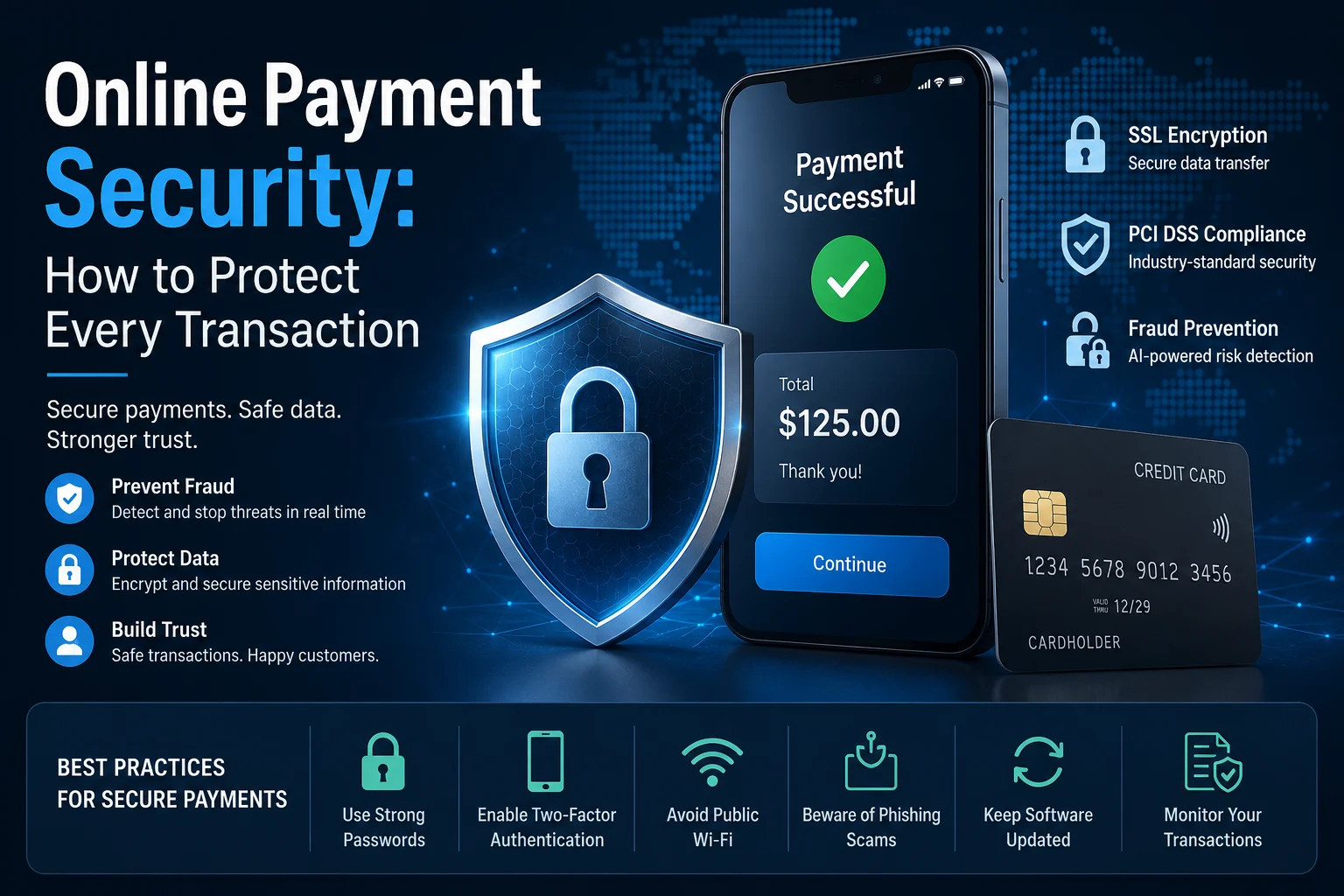
Online payment fraud is no longer a fringe risk, it is a primary operating cost for every merchant processing digital payments in 2026. Global e-commerce fraud losses now sit at approximately $48 billion annually, and research from Research And Markets projects that figure to double to $100 billion by 2029. Whether you operate a standard merchant account or route transactions through a high-risk payment gateway, securing every payment is non-negotiable.
TL;DR
- Global e-commerce fraud losses reached ~$48B in 2026, projected to hit $100B by 2029
- PCI DSS v4.0.1 is the only active standard, all 64 requirements are now mandatory with no grace period
- The dominant threats are card-not-present fraud ($28B), Magecart e-skimming (23M+ transactions compromised), and synthetic identity fraud ($35B+)
- Tokenization, 3DS2, P2PE, and AI-driven fraud scoring are the four security pillars every payment gateway needs
- High-risk merchants face chargeback and fraud exposure 2-4× higher than standard e-commerce averages
The State of Payment Security in 2026
The numbers reflect a payment ecosystem under sustained attack. Annual global e-commerce fraud losses stand at approximately $48 billion, with card-not-present (CNP) fraud contributing $28 billion of that total. For every $1 lost to fraud, U.S. merchants absorb an average of $4.61 in total costs, chargebacks, operational recovery, lost goods, and customer attrition.
What has shifted between 2024 and 2026 is the sophistication of the attack surface:
- 79% of organisations: globally reported being targeted by payment fraud attacks
- Magecart e-skimming: campaigns compromised over 23 million online transactions in 2025, with 10,500 active attack kits documented by Recorded Future
- Synthetic identity fraud: now accounts for $35 billion in losses, with over 80% of new account fraud in Q1 2025 linked to synthetic identities
- AI-generated phishing: powers 82.6% of phishing emails, significantly increasing the success rate of social engineering across digital payments
AI-driven fraud detection systems have responded, achieving 95% average accuracy globally. But the attack surface is expanding faster than any single defensive tool can close, particularly for merchants processing cross-border payments and operating high-risk merchant accounts.
The Biggest Threats to Online Payments Today
Card-Not-Present (CNP) Fraud
CNP fraud is the dominant threat across all online payment processing. Without a physical card, chip, or PIN to verify, every e-commerce checkout, payment wallet transaction, or API-initiated payment relies on data-point verification alone. Fraudsters exploit stolen card data purchased from dark web marketplaces.
Card-not-present fraud losses hit $28 billion globally in 2025. Payment providers running weak velocity controls or lacking 3DS2 implementation are the most exposed. This is the single most important threat vector for any merchant account operating in e-commerce.
Magecart / E-Skimming Attacks
E-skimming works like a digital card skimmer hidden inside your checkout page. Attackers inject malicious JavaScript into merchant payment pages and silently capture card numbers, expiry dates, and CVVs before they ever reach the payment gateway.
Recorded Future documented 10,500 active Magecart campaigns in 2025, compromising over 23 million transactions. These attacks directly target client-side scripts on payment pages, which is precisely why PCI DSS v4.0.1 Requirements 6.4.3 and 11.6.1 (script inventory and tamper detection) became mandatory in March 2025.
Account Takeover (ATO) Fraud
ATO attacks are growing sharply on platforms that store payment wallet credentials or saved card details within merchant accounts. Using credential stuffing, automated login attempts powered by stolen username and password combinations, fraudsters hijack accounts and initiate unauthorised payments.
Across digital payment ecosystems, ATO-driven disputes have made it increasingly difficult for merchants to separate genuine chargebacks from deliberate fraud exploitation. Platforms with high-value stored balances, such as digital wallets and subscription services, are priority targets.
Chargebacks and Friendly Fraud
Chargebacks are projected to cost merchants $28.1 billion in 2026. Of all chargebacks raised, 70% stem from friendly fraud, a legitimate customer disputing a valid transaction, either deliberately or through genuine confusion. Subscription merchant accounts face chargeback rates three times higher than the average.
For merchants operating on high-risk merchant accounts, elevated chargeback ratios above 1% can trigger Visa and Mastercard monitoring programmes, carrying escalating monthly fees and the risk of account termination.
PCI DSS v4.0.1: The Non-Negotiable Standard in 2026
PCI DSS v4.0.1 is the only active compliance standard for any business that handles cardholder data. The transition window is closed and the grace period has ended.
All 64 new and updated requirements, including 51 previously listed as “future-dated best practices”, became mandatory on March 31, 2025. Every assessment conducted in 2026 is evaluated against the full v4.0.1 standard. Non-compliance carries monthly fines reaching $100,000, and IBM places the average breach cost at $6.08 million.
The two highest-impact changes for e-commerce merchants are:
- Requirement 6.4.3: A complete inventory of every JavaScript running on your payment page is required, with formal authorisation and integrity verification records for each script.
- Requirement 11.6.1: Automated detection of unauthorised changes to HTTP security headers and payment page content is now mandatory, with alerting on any deviation.
Beyond script management, v4.0.1 mandates universal multi-factor authentication (MFA) across all access to the cardholder data environment (CDE), not just administrative logins. Automated, real-time log reviews replace manual spot checks as the required standard.
| Security Area | Pre-2025 Requirement | 2026 Requirement (v4.0.1) |
|---|---|---|
| MFA | Admin + remote access | All CDE access – no exceptions |
| Payment page scripts | No formal inventory | Full inventory + authorisation required |
| Log reviews | Manual acceptable | Automated real-time monitoring mandatory |
| E-skimming detection | Recommended | Mandatory (Requirements 6.4.3 + 11.6.1) |
| Password length | 7+ characters | 12+ characters |
| Non-compliance fines | Variable | Up to $100,000 per month |
The Four Security Layers Every Payment Gateway Needs
1. Tokenization
Tokenization replaces sensitive card data with a unique alphanumeric token during payment processing. The token carries no exploitable value, the actual card number never passes through the merchant’s environment after the initial capture. Tokenization dramatically reduces PCI DSS scope and is now a baseline expectation from any credible payment gateway.
Pros: Reduces PCI scope significantly; minimises breach impact; widely supported across payment providers Cons: Integration complexity varies; tokens are typically issuer or network specific and are not universally portable across processors
2. 3D Secure 2.0 (3DS2)
3DS2 is the modern authentication layer for online payments. Unlike the friction-heavy redirect of original 3DS, 3DS2 uses risk-based authentication, low-risk transactions clear silently, while high-risk patterns trigger a real-time step-up challenge. This significantly improves conversion rates compared to blanket authentication.
Critically, 3DS2 shifts chargeback liability from the merchant to the card issuer on authenticated transactions, a direct financial benefit alongside the fraud reduction.
Pros: Reduces CNP fraud liability; better user experience than 3DS1; strong fit for cross-border payment flows under PSD2 SCA Cons: Step-up challenges add friction for flagged transactions; implementation and support quality varies between payment gateway providers
3. Point-to-Point Encryption (P2PE)
P2PE encrypts card data at the exact moment of entry, whether at a terminal or inside a payment form, and maintains that encryption until the data reaches the processor’s secure decryption environment. There is no window during transit where plaintext card data exists.
For high-risk payment gateway operators and merchants with physical presence, P2PE combined with EMV chip support provides layered protection that neither alone fully achieves.
Pros: Eliminates plaintext card data in transit; simplifies PCI DSS audit scope Cons: Requires certified hardware for in-person use; less flexible for fully custom checkout builds
4. AI-Driven Fraud Detection
Machine learning models now analyse hundreds of transaction signals in milliseconds, device fingerprint, velocity patterns, geolocation delta, purchase history, and behavioural biometrics, assigning real-time risk scores per transaction. AI-driven fraud detection achieved 95% average accuracy globally in 2025, and leading payment providers embed this capability directly into their payment processing infrastructure.
Merchants running multiple fraud tools perform significantly better. The 2026 Global eCommerce Payments and Fraud Report found that merchants deploy, on average, five fraud detection tools per business. Single-tool reliance leaves exploitable gaps.
High-Risk Payment Gateways: Security in 2026
High-risk merchant accounts, covering iGaming, adult content, CBD, forex, nutraceuticals, bail bonds, and subscription businesses, operate under materially higher security pressure than standard merchants.
Key 2026 distinctions for high-risk payment processing:
- Chargeback thresholds are tighter: Visa and Mastercard monitoring programmes activate at 1% chargeback ratio, triggering monthly fees and potential account termination if unresolved.
- Rolling reserves serve as a security buffer: Most high-risk payment gateway providers hold 5–10% of settlement funds in reserve for 9-180 days to cover delayed chargebacks and fraud exposure.
- Regional fraud rates are significantly higher: LATAM-based merchants see 4.6% of e-commerce revenue lost to fraud, nearly double the North American average of 2.4%.
- Cross-border exposure is rising fast: Cross-border payment fraud grew 20% year-over-year globally, concentrated in high-risk transaction flows.
Beyond standard PCI DSS v4.0.1 compliance, high-risk merchant services providers typically require enhanced KYC at onboarding, real-time transaction monitoring, and explicit chargeback prevention tools, specifically Ethoca Alerts or Verifi CDRN under the Compelling Evidence 3.0 framework for dispute resolution.
Cross-Border Payment Security: The Growing Gap
Cross-border payments introduce a compounding security challenge. International orders face rejection rates between 4.4% in North America and 6.1% in LATAM, significantly above domestic rates, reflecting the elevated fraud risk carried by cross-border transactions.
Payment wallet fraud involving cryptocurrency rose 25% in 2025, as attackers continue to exploit smart contract and bridge vulnerabilities in digital payment infrastructure. Real-time payment rails have reduced settlement friction in cross-border merchant services, but they also reduce the window available for fraud intervention.
Merchants processing internationally should prioritise:
- Multi-currency fraud models: fraud pattern signatures differ significantly by origin country and payment method
- IP geolocation verification: against billing and shipping addresses
- BIN (Bank Identification Number) checks: to flag cards issued in mismatched geographies
- Velocity controls on international transaction attempts per account within rolling time windows
Frequently Asked Questions
What is the most common online payment security threat in 2026?
Card-not-present (CNP) fraud remains the leading threat category, responsible for $28 billion in global losses. Magecart e-skimming is the fastest-growing specific attack vector for e-commerce merchants, with 10,500 active campaigns documented in 2025.
What does PCI DSS v4.0.1 require for online merchants in 2026?
Full compliance with all 64 updated requirements, including mandatory payment page script inventory (Req. 6.4.3), automated change detection (Req. 11.6.1), and universal MFA across the cardholder data environment. Non-compliance fines can reach $100,000 per month, with average breach costs exceeding $6 million.
What security features should a high-risk payment gateway offer?
Look for tokenization, 3DS2 authentication, rolling reserve transparency, real-time chargeback alerts via Ethoca or Verifi, AI-based transaction fraud scoring, and full PCI DSS v4.0.1 Level 1 certification from the processor.
How does tokenization reduce payment fraud risk?
Tokenization replaces actual card data with an alphanumeric token during processing. Even if intercepted, the token cannot initiate a payment elsewhere, eliminating the exploitable value of stolen cardholder data and reducing PCI audit scope for the merchant.
Is 3D Secure 2.0 required for all payment gateways?
3DS2 is mandated under PSD2 Strong Customer Authentication (SCA) rules in Europe and the UK. Outside these markets it is strongly recommended as an industry standard. Merchants using 3DS2 benefit from chargeback liability shift to the card issuer on successfully authenticated transactions.
How do cross-border payments increase fraud exposure?
International transactions face higher rejection rates (up to 6.1% in LATAM), fewer shared fraud signals between issuing and acquiring banks, and greater difficulty in identity verification across jurisdictions. Fraudsters exploit these gaps, which is why cross-border payment fraud grew 20% year-over-year in 2025.
Comments
No comments yet. Be the first to share your thoughts.
Leave a comment