
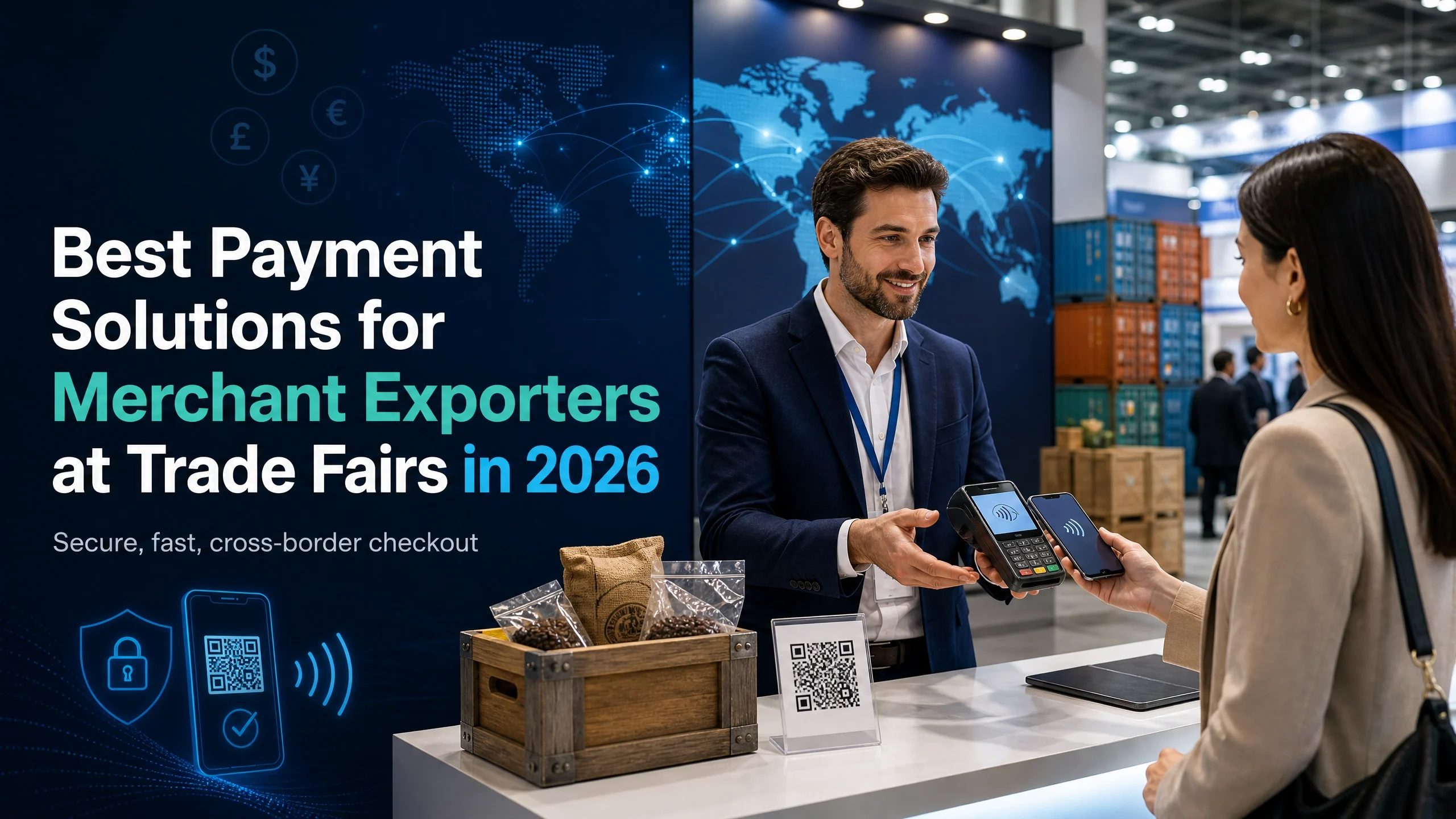
Landing a buyer’s interest at an international trade fair is only half the battle, closing the deal on the spot, in a currency and payment method they trust, is where deals actually get won or quietly lost to a competitor’s booth. This guide covers the payment infrastructure exporters need to collect deposits, take orders, and settle cross-border transactions confidently while standing on a show floor thousands of miles from home.
Exporters at trade fairs need a different payment solution than a typical retail vendor, the priority isn’t a cheap card reader, it’s collecting multi-currency deposits and B2B orders without losing money to FX markups or waiting weeks for funds to clear. Wise Business and Airwallex work well for holding and converting multiple currencies at the real exchange rate, Payoneer is strongest for receiving payments from buyers already using marketplace or freelance platforms, and a local card terminal from the host country (or a global processor like Adyen) covers in-person card and deposit collection at the booth itself. The right combination depends on your buyer mix, deal size, and how many countries you exhibit in per year.
Why Trade Fair Payments Are a Different Problem Than Retail
A retail vendor at a craft fair just needs a card reader. An exporter at an international trade fair is usually solving three problems simultaneously:
- Collecting deposits or full payment from international buyers: who want to pay in their own currency, not yours.
- Settling B2B invoices: not simple one-off retail transactions, often with partial deposits at the show and balance due on delivery.
- Managing FX exposure: so a strong deal at the show doesn’t shrink by 2–4% in hidden conversion markups by the time funds settle in your home account.
Getting this wrong doesn’t just cost money, it costs trust. A buyer who’s asked to wire funds to an unfamiliar account, or who gets hit with a surprise conversion fee, is a buyer who remembers that experience at the next show.
What Exporters Should Look for in a Payment Provider
- Multi-currency holding accounts: the ability to receive and hold USD, EUR, GBP, and other major currencies without immediate forced conversion.
- Real exchange rate transparency: a clear, published FX markup rather than a bank’s opaque spread.
- Fast settlement: same-day or next-day access to funds, not a multi-week wire delay.
- B2B-friendly invoicing and partial payment support: since export deals often involve a deposit at the show and a balance on shipment.
- In-person collection capability: a way to take a card or deposit directly at the booth, not just a bank transfer request.
- Compliance and documentation support: trade documentation, invoice matching, and multi-jurisdiction compliance matter more here than in domestic retail.
Top Payment Solutions for Merchant Exporters
1. Wise Business
Wise Business gives exporters multi-currency accounts priced at the real mid-market exchange rate, making it one of the most transparent options for holding and converting deposits collected abroad.
Pros:
- Genuinely transparent FX pricing, no hidden markup on conversion
- Multi-currency accounts let you hold buyer payments in their original currency until you’re ready to convert
- Most major-currency transfers settle within 24 hours, often same-day
Cons:
- Fewer trade-specific compliance workflows than platforms built specifically for B2B trade documentation
- Less suited to businesses needing invoice matching or complex supplier-side payment orchestration
2. Airwallex
Airwallex is built for businesses operating across many currencies at once, with local collection accounts in dozens of countries, useful for exporters who exhibit at fairs across multiple regions each year.
Pros:
- Local collection accounts in 60+ countries reduce cross-border transfer friction
- API-first design allows integration with your own order and invoicing systems
- Virtual card issuance and spend controls useful for teams traveling to multiple shows
Cons:
- More infrastructure than a small exporter attending one or two fairs a year typically needs
- Best value requires some technical setup to use fully
3. Payoneer
Payoneer is widely used by exporters who already receive payments through marketplaces or platforms, giving them a familiar receiving account that buyers may already trust.
Pros:
- Strong marketplace and platform integrations for exporters selling through multiple channels
- Local receiving accounts in major markets simplify buyer-side payment
- Widely recognized by international B2B buyers, which can reduce friction at the negotiating table
Cons:
- Less flexible for businesses needing payout orchestration or treasury-level control
- Works best for inbound payments initiated by the buyer, less so for complex multi-party settlement
4. XTransfer
XTransfer specializes in B2B trade payments with particular strength for exporters on the China-outbound side of a trading relationship, built around the compliance and documentation load that comes with export trade.
Pros:
- Purpose-built for trade documentation and exporter compliance requirements
- Strong licensing footprint including Hong Kong, mainland China, the UK, and the Netherlands
- Understands the specific paperwork buyers and customs authorities expect from export transactions
Cons:
- Most relevant for corridors touching China or Asia, less useful outside that trade lane
- Less familiar to buyers and exporters operating purely within Western markets
5. Adyen or a Local In-Country Terminal
For collecting a deposit or a full card payment directly at the booth, exporters need in-person acceptance alongside their cross-border banking setup. Adyen’s global acquiring network, or a rented local terminal from the host country, both cover this gap.
Pros:
- Enables immediate, in-person card collection at the booth, closing deals before the buyer walks away
- Adyen’s global acquiring footprint can improve authorization rates for international cards
- A local terminal avoids cross-border card acceptance issues some foreign processors run into
Cons:
- Adyen’s onboarding and integration require more setup than a small exporter may want for occasional shows
- A rented local terminal is a one-show solution, not a long-term payment processing relationship
Comparison at a Glance
| Solution | Best For | Currency Strength | In-Person Collection |
|---|---|---|---|
| Wise Business | Transparent FX, simple deposits | Strong, mid-market rate | No |
| Airwallex | Multi-country exhibitors | Very strong, 50+ currencies | Limited |
| Payoneer | Marketplace-linked exporters | Strong, major markets | No |
| XTransfer | China/Asia trade corridor | Strong for Asia trade | No |
| Adyen / local terminal | On-the-spot deposits at the booth | Depends on acquirer | Yes |
A Practical Setup for Trade Fair Exporters
Most exporters end up combining two layers rather than relying on a single provider:
- A multi-currency holding account: (Wise, Airwallex, or Payoneer) to receive deposits and balance payments from international buyers without losing money to conversion timing.
- An in-person collection method at the booth: a rented local terminal, a global acquirer like Adyen, or in some cases a QR-based mobile wallet payment familiar to buyers from that region, to capture a deposit the moment a deal closes.
This combination avoids the two most common failure modes: losing a deal because you can only accept a wire transfer that takes a week to arrive, and losing margin because every payment gets forcibly converted at a bank’s unfavorable rate.
Handling High-Risk or Restricted Trade Categories
Exporters in certain categories, defense-adjacent goods, chemicals, pharmaceuticals, or businesses trading with restricted or sanctioned regions, often get flagged as high-risk payment relationships by mainstream processors, regardless of the legitimacy of the trade itself. If your product category or trade corridor falls into this territory:
- Expect additional documentation requirements during onboarding with any payment provider.
- Budget extra time for compliance review before your first show, not during it.
- Consider a provider with strong trade-specific compliance workflows, like XTransfer or Ebury, rather than a general-purpose consumer-facing platform.
Making the Decision
- Exhibiting occasionally, want simple and transparent FX: Wise Business.
- Exhibiting across many countries each year: Airwallex.
- Buyers already pay you through marketplaces: Payoneer.
- Trading primarily with China or the broader Asia corridor: XTransfer.
- Need to collect a deposit the moment a deal closes at the booth: pair your holding account with Adyen or a rented local terminal.
Whichever combination you choose, test it before the show, not during it. Confirm your holding account can actually receive the currencies your target buyers will use, and confirm your in-person collection method works with the card networks common in your buyers’ home markets.
FAQ
What’s the best way for an exporter to collect a deposit at a trade fair?
A local in-country card terminal or a global acquirer like Adyen typically works best for immediate, in-person collection, paired with a multi-currency account like Wise or Airwallex to hold and later convert the funds.
Do exporters need a separate merchant account for every country they exhibit in?
Not necessarily. Multi-currency platforms with local collection accounts, like Airwallex, reduce the need for a separate account per country, though in-person card collection may still require a local or global acquirer.
How can exporters avoid losing money to currency conversion?
Use a provider with transparent, real exchange rate pricing, like Wise Business, and hold funds in the original currency until you’re ready to convert, rather than accepting an automatic conversion at the point of collection.
Is it safe to accept a wire transfer instead of a card at a trade fair?
Wire transfers work well for larger B2B deals but settle slower than card payments, which can be a problem if a buyer expects immediate confirmation. Combining a fast in-person collection method with wire for the balance due is a common approach.
What makes an export business “high-risk” to a payment provider?
Classification usually depends on product category (defense-adjacent goods, chemicals, pharmaceuticals) or trade corridor (sanctioned or high-scrutiny regions) rather than the legitimacy of the business itself, expect more documentation, not necessarily rejection.
Can exporters use the same payment provider for online sales and trade fair collection? Sometimes, if the provider supports both in-person and remote invoicing, but many exporters use a dedicated cross-border platform for banking and a separate terminal or acquirer specifically for the show floor.
Comments
No comments yet. Be the first to share your thoughts.
Leave a comment