
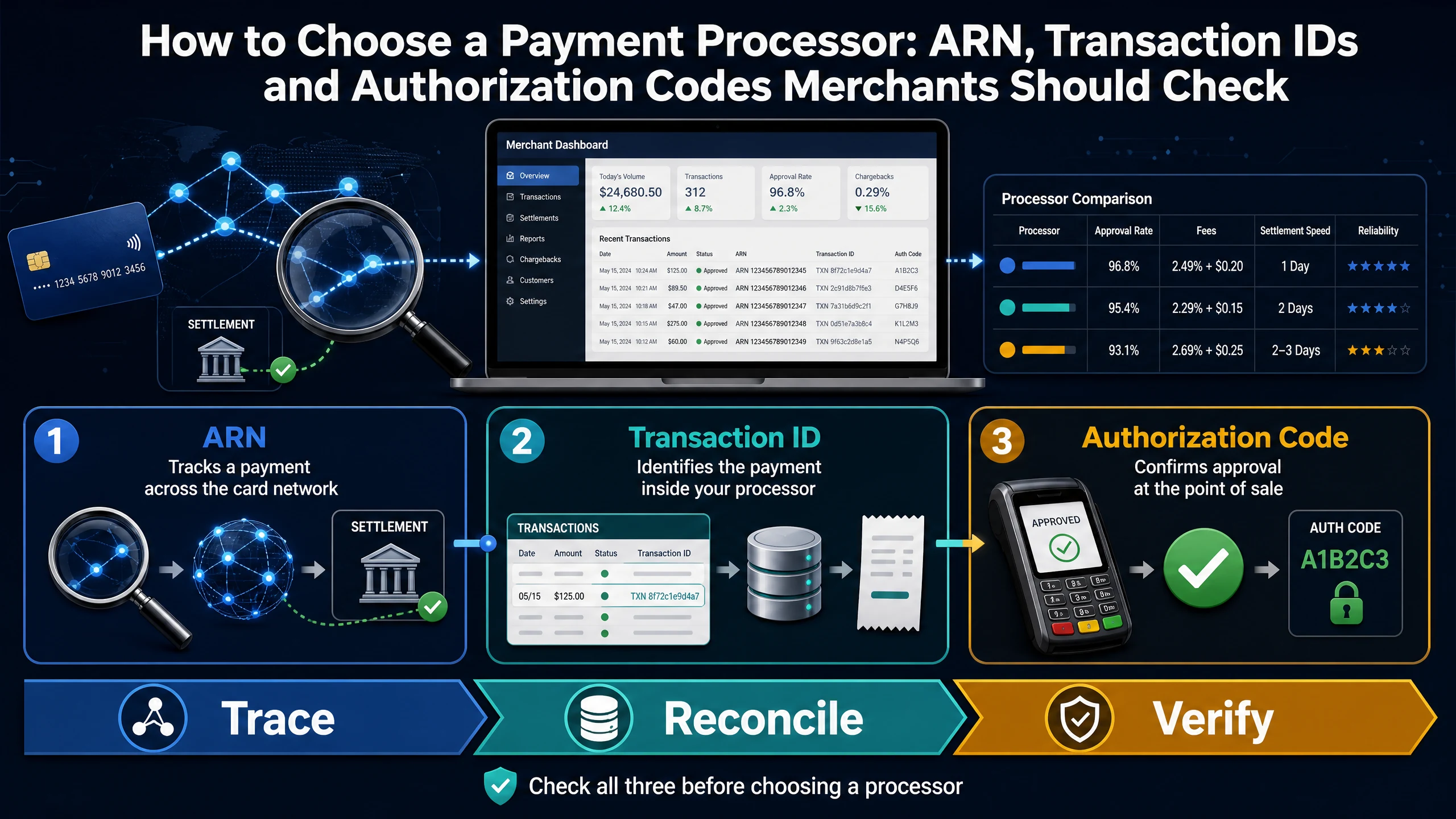
Most guides to choosing a payment processor focus on rate comparisons and contract terms, and those matter. But there’s a quieter factor that only shows up after you’ve already signed: how well a processor lets you trace a transaction when something goes wrong. A cheap rate stops looking like a deal the first time a customer disputes a refund and your dashboard can’t tell you where the money actually went.
Beyond pricing, the strongest signal of a good payment processor is how much transaction-level detail it actually surfaces, specifically the transaction ID, the authorization code, and the ARN (Acquirer Reference Number). These three identifiers are what let you resolve disputes, trace missing refunds, and respond to chargebacks with evidence instead of guesswork. Before signing with any payment provider, check whether these fields are visible in the dashboard, accessible via API, and included in settlement files, not just theoretically available if you call support.
Why Traceability Belongs in Your Processor Decision
Every card transaction generates several distinct identifiers as it moves from your checkout to the customer’s bank and back. Most merchants never think about this until a dispute forces the question, and by then, they’re stuck with whatever level of detail their payment processing provider happens to expose.
The businesses that handle disputes fastest aren’t the ones with the lowest rate. They’re the ones whose processor gives them, at a glance:
- Exactly which transaction a customer is referring to
- Confirmation that the issuing bank actually approved it
- A cross-network reference that a customer’s own bank can independently verify
Missing any one of these turns a five-minute resolution into a week of back-and-forth. This is why transaction traceability deserves the same evaluation weight as pricing when comparing providers, see our full guide to comparing merchant account providers for the broader decision framework.
The Three Identifiers Every Transaction Carries
1. Transaction ID
The transaction ID is a unique alphanumeric code your payment gateway or processor assigns the moment a payment is submitted. It’s the key that ties a single payment to everything that happens to it afterward, refunds, partial captures, and dispute records all reference back to it.
- Typically 12-20 characters, alphanumeric, with no fixed industry-standard format
- Appears on receipts, invoices, and payment confirmations
- Returned in API responses and webhooks for merchants reconciling programmatically
- Specific to the processor or gateway that generated it, a Stripe transaction ID and a Square transaction ID for the same sale look nothing alike
2. Authorization Code
The authorization code is the card issuer’s real-time confirmation that a charge was approved and funds are available. It’s generated automatically by the issuing bank the moment a transaction is authorized, merchants don’t request it separately.
- Usually five or six digits, sometimes a mix of a letter and numbers
- Appears on printed receipts, in the POS terminal response, or in merchant transaction logs
- Confirms validity in the moment but does not guarantee a transaction is free of fraud, it only confirms the bank approved it
- Essential evidence when disputing a chargeback claim that a transaction was never authorized
3. ARN (Acquirer Reference Number)
The ARN is the one identifier that travels the entire chain, merchant, acquiring bank, card network, and issuing bank, rather than staying inside a single system. We’ve covered this one in depth in our complete guide to ARN numbers in payment processing, but the short version:
- A 23-digit code generated during clearing, after authorization
- The only identifier a customer’s own bank can look up directly to confirm a refund actually arrived
- Critical for resolving “I never got my refund” disputes and strengthening chargeback responses
A Fourth Identifier Worth Knowing: Merchant ID (MID)
While not transaction-specific, your Merchant ID is worth understanding alongside these three, since it’s what identifies your business to the processor and acquiring bank in the first place. It’s permanent, assigned once when you open a merchant account, and appears on every settlement file and statement tied to your account.
What to Actually Check Before Choosing a Processor
Dashboard Visibility
Log into a demo or trial account and look specifically for the transaction ID, authorization code, and ARN on an individual transaction’s detail page, not buried in a downloadable file you’d have to request from support. Some providers only display a subset unless you explicitly ask, which becomes a problem the first time you need one under time pressure during an active dispute.
API and Webhook Access
If your business reconciles payments programmatically, confirm these fields are returned in the API response and webhook payloads, not just the human-facing dashboard. A payment solution that only shows this data in a UI is a bottleneck for any business doing volume-level reconciliation.
Settlement File Completeness
Pull a sample settlement file (most providers can show you one during a sales conversation) and check whether the ARN appears for every transaction and refund in the batch, not just a summary total. This is the file your finance team will actually use to match a payment across your books and the processor’s records.
Dispute and Chargeback Tooling
Ask specifically how the processor surfaces these identifiers in its dispute workflow. A processor that requires you to manually dig up an ARN from a separate report during an active chargeback response is adding friction exactly when speed matters most.
Support for High-Risk or Complex Transaction Types
If your business processes recurring billing, marketplace payouts, or anything the industry treats as high-risk payment activity, dispute volume is naturally higher, which makes strong transaction-level reporting even more valuable than it would be for a typical low-dispute retail business. Confirm a prospective processor’s reporting depth scales to your actual dispute rate, not just your transaction volume.
Reporting Depth by Processor Type
| Processor Type | Typical Dashboard Detail | API Access to ARN/Auth Code | Best For |
|---|---|---|---|
| Payment facilitator (Square, PayPal, Stripe) | Good, self-service | Usually yes, varies by field | Low-to-moderate dispute volume |
| Traditional merchant account (Helcim, Payment Depot) | Strong, itemized | Often yes, confirm per provider | Growing businesses wanting full visibility |
| Enterprise processor (Adyen, Worldpay) | Very strong, built for reconciliation at scale | Yes, extensive | High-volume, high-dispute businesses |
| Specialist high-risk provider | Varies significantly by provider | Confirm case-by-case | Restricted industries with elevated dispute rates |
For a deeper look at how these processor categories compare on pricing and approval requirements more broadly, see our guide to the best credit card merchant account providers.
Questions to Ask a Processor Before Signing
- Can I see the ARN for a transaction directly in the dashboard, or do I need to request it separately?
- Is the authorization code included in the transaction detail view and in API responses?
- Does your settlement file include ARNs for every line item, including refunds?
- How do you surface these identifiers specifically within your chargeback or dispute management workflow?
- Can your support team pull a missing ARN or authorization code quickly if a customer disputes a charge?
A processor that answers these clearly and specifically, rather than a general “yes, we have great reporting”, is signaling that this is a mature part of their platform, not an afterthought.
Red Flags to Watch For
- Identifiers only available on request: If getting an ARN requires a support ticket rather than a dashboard click, expect the same friction during every future dispute.
- Inconsistent identifier formats across payment methods: If cards, bank transfers, and wallets each surface transaction data differently in the same dashboard, reconciliation gets harder as your payment mix grows.
- No API access to dispute-relevant fields: This becomes a real bottleneck the moment your dispute volume outgrows manual dashboard lookups.
- Settlement files that summarize instead of itemize: A batch total without per-transaction ARNs makes it much harder to match a specific dispute to its evidence.
Making the Decision
- Low transaction volume, simple business: most mainstream payment facilitators provide adequate identifier visibility for occasional disputes.
- Growing volume, want full transparency: prioritize a traditional merchant account provider with itemized, API-accessible reporting.
- High volume or high dispute rate: an enterprise-grade processor with dedicated reconciliation and dispute tooling earns its complexity.
- Operating in a high-risk or high-chargeback vertical: treat dispute-evidence reporting as a primary evaluation criterion, not a secondary one, the businesses that need this most are exactly the ones most likely to overlook it while comparing rates.
Whichever processor you’re evaluating, ask to see a real transaction detail page and a real settlement file before signing, not just marketing copy about “robust reporting.” The gap between those two things only becomes visible during your first real dispute, which is the worst possible time to discover it.
FAQ
What’s the difference between a transaction ID and an ARN?
A transaction ID is assigned by your processor or gateway and only means something within that system. An ARN is a cross-network identifier recognized by every institution in the payment chain, the acquiring bank, the card network, and the issuing bank, making it far more useful for disputes involving the customer’s own bank.
Does an authorization code prove a transaction wasn’t fraudulent?
No. An authorization code only confirms the issuing bank approved the charge at the time it was submitted, it doesn’t guarantee the transaction is legitimate or free of later fraud claims.
Why does reporting depth matter more for high-risk businesses?
High-risk and high-chargeback verticals naturally generate more disputes, so a processor’s ability to quickly surface transaction IDs, authorization codes, and ARNs directly affects how efficiently, and how successfully, those disputes get resolved.
Should I switch payment processors just for better reporting?
Not in isolation, but reporting depth should be one of several factors, alongside pricing and approval requirements, you weigh when comparing providers, especially if disputes are already a recurring pain point.
Where can I find the ARN for a specific transaction?
Typically in your processor’s dashboard under transaction or payment event details, or by requesting it from your acquiring bank if your processor doesn’t surface it directly.
Do all payment processors provide the same level of transaction detail?
No, this varies significantly by provider and processor type. Enterprise-grade processors generally offer the deepest reporting, while some payment facilitators only surface certain identifiers on request rather than by default.
Comments
No comments yet. Be the first to share your thoughts.
Leave a comment