
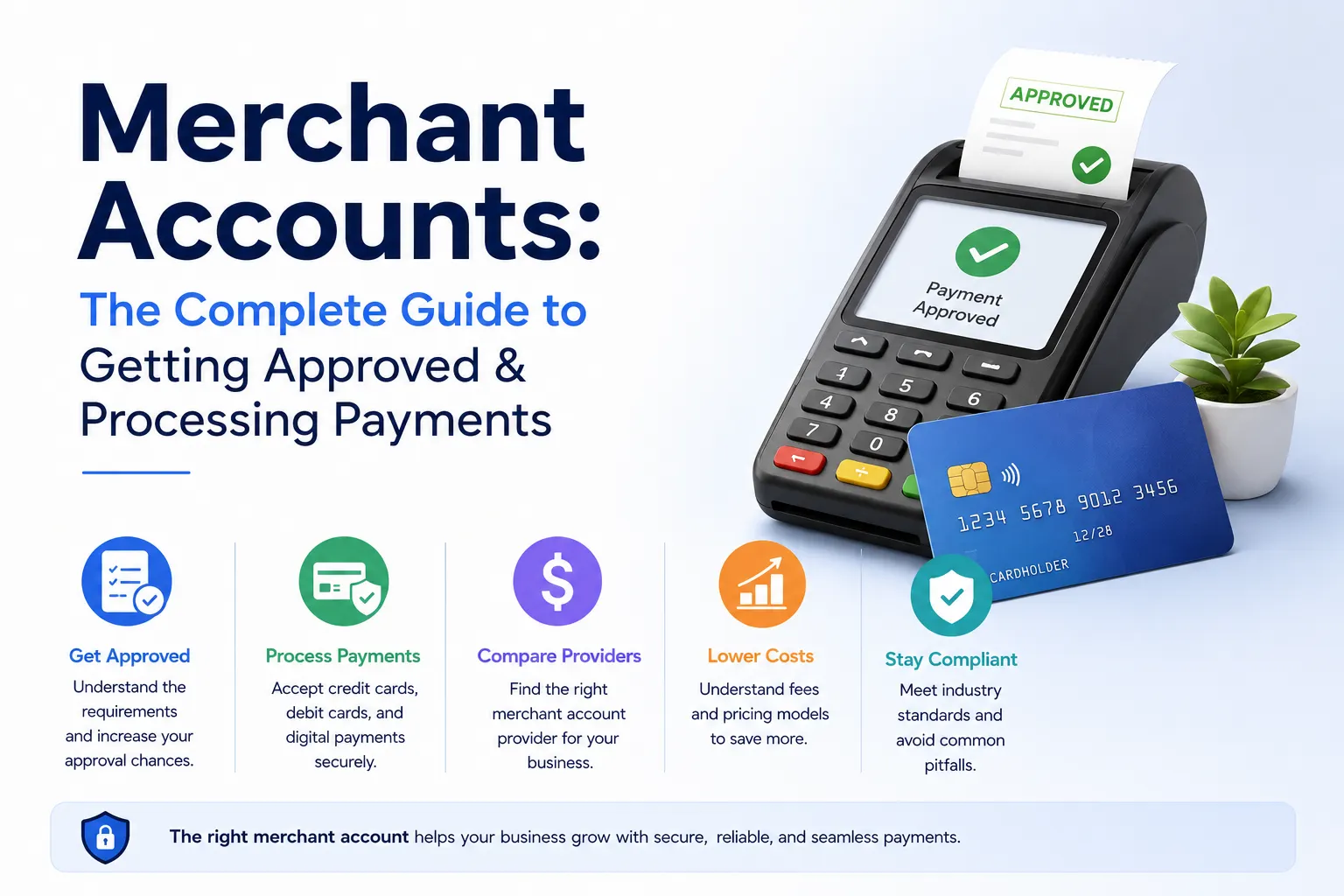
TL;DR
- A merchant account is the holding account that receives card and digital payment funds before they settle into your business bank account, distinct from the payment gateway that processes the transaction.
- There are an estimated 61.4 million active merchant accounts globally in 2026, with approval rates varying sharply by industry: 89% for retail e-commerce versus 37% for adult content businesses.
- Standard merchant account underwriting takes 3-7 days; high-risk merchant accounts take 7-21 days and often require 3-6 months of processing history before reserve terms improve.
- High-risk merchants face materially different economics: higher processing rates, rolling reserves of 5-10%, and mandatory compliance with Visa’s VAMP and Mastercard’s CE3.0 chargeback monitoring programs in 2026.
- Choosing the wrong account type, PayFac instead of a dedicated merchant account, or vice versa, is the single most common cause of mid-year payment disruption for growing merchants.
What Is a Merchant Account?
A merchant account is a specialized bank account that allows a business to accept card payments and digital payments. When a customer pays by card, the funds don’t move directly into your business checking account, they first land in the merchant account, held by an acquiring bank, where they’re checked against fraud rules and chargeback exposure before being released to you, typically within 1-7 business days.
This distinction matters more than most merchants realize. A merchant account is not the same as a payment gateway (which encrypts and routes the transaction) or a payment processor (which manages the fund transfer). Some payment providers, Stripe, Square, PayPal, bundle all three into a single product under what’s called a payment facilitator (PayFac) model, where you don’t get your own dedicated merchant account but instead operate as a sub-merchant under their master account. Others, traditional acquiring banks and ISOs, issue you a dedicated merchant account with its own underwriting, reserve terms, and contractual relationship.
Both paths lead to accepting online payments, but they differ enormously in approval speed, cost structure, and account stability, which is the central theme of this guide.
How Merchant Accounts Work: The Underwriting Process
Getting a merchant account isn’t like opening a checking account. Acquiring banks assume real financial risk every time they approve one, because they’re liable for chargebacks and fraud losses if a merchant can’t cover them. That’s why every application goes through underwriting.
The underwriting process generally follows five stages:
- Application and business verification: You submit business registration documents, beneficial ownership information, processing history (if any), and a description of your products or services.
- Industry classification (MCC assignment): The underwriter assigns a Merchant Category Code that determines your risk tier and pricing.
- Risk assessment: The underwriter evaluates your average ticket size, projected monthly volume, refund policy, delivery timelines, and, critically, your chargeback history if you’ve processed before.
- Credit and reputation check: For higher-risk applications, underwriters may run a personal or business credit check and screen against the MATCH (Member Alert to Control High-Risk) list, which flags merchants terminated for excessive chargebacks or fraud.
- Approval, terms, and reserve setting: Once approved, the acquirer sets your processing rate, any rolling reserve requirement, and settlement timeline.
Retail e-commerce and SaaS businesses see the fastest, smoothest path through this process, approval rates around 89% and 85% respectively, with underwriting completed in 3-7 days. Businesses in travel see meaningfully lower approval rates near 71%, reflecting longer fulfillment windows and higher dispute exposure. The steepest drop comes in high-risk categories: nutraceuticals and subscription billing each sit just above 55%, forex and iGaming fall to roughly 41-49%, and adult content businesses face the lowest approval rate of any category, around 37%. These businesses don’t fail underwriting because they’re illegitimate, they fail because standard acquirers price elevated chargeback risk by simply declining the application rather than adjusting terms.
Types of Merchant Accounts
PayFac / Aggregator Sub-Merchant Accounts
You operate under the provider’s master merchant account rather than holding your own. Onboarding is near-instant, often same-day. Pricing is flat-rate and transparent. The trade-off is account stability, PayFac platforms use automated risk monitoring and can freeze or terminate sub-merchant accounts algorithmically, often with limited notice or recourse. Best suited to low-risk, early-stage, and low-to-mid volume merchants.
Dedicated Merchant Accounts
A standalone account underwritten specifically for your business, issued by a bank or ISO. Underwriting takes longer and requires more documentation, but you get contractual protections, negotiable terms, and a relationship that can scale with volume. Strongly recommended once monthly volume exceeds roughly $150,000, or for any business in a higher-risk MCC.
High-Risk Merchant Accounts
A dedicated account from an acquirer that specifically underwrites elevated-risk industries, iGaming, adult content, forex, nutraceuticals, CBD, MLM, subscription billing, firearms, and debt collection. These accounts carry higher processing rates and rolling reserves, but they’re structured to remain stable through normal chargeback fluctuations that would trigger termination on a standard account.
Offshore Merchant Accounts
Issued by acquiring banks outside the merchant’s home country, often in jurisdictions with more permissive underwriting for high-risk verticals, common across parts of the EU, UK, and Caribbean. These can offer higher risk tolerance and multi-currency settlement, but merchants should weigh added compliance complexity, currency conversion costs, and longer dispute resolution timelines against a domestic high-risk option before choosing offshore.
Aggregated High-Volume / Enterprise Accounts
Custom-negotiated accounts for merchants processing above roughly $1 million per month, typically with direct acquirer relationships, interchange-plus pricing, and dedicated account management. These sit outside standard tiering and are negotiated individually.
Merchant Account Fees: What You Actually Pay in 2026
Fee structures vary by account type, but the components are consistent across the industry: a processing rate (charged as a percentage of each transaction), a per-transaction fee, monthly account fees, chargeback fees, and, for higher-risk accounts, a rolling reserve.
Standard merchant accounts in 2026 typically charge a processing rate of 0.5%-1.8% under interchange-plus pricing, a per-transaction fee of $0.10-$0.30, monthly account fees of $0-$25, and chargeback fees of $15-$25 per dispute, with no rolling reserve required. High-risk merchant accounts sit on a different cost curve entirely: processing rates of 1.5%-3.5%, per-transaction fees of $0.25-$0.55, monthly fees of $30-$99, chargeback fees of $35-$100 per dispute, and a rolling reserve of 5%-10% of gross volume held for 90-180 days as a buffer against future disputes.
Worked example – high-risk merchant processing $80,000/month, average ticket $40 (2,000 transactions):
| Cost component | Calculation | Monthly cost |
|---|---|---|
| Processing rate (2.5%) | $80,000 × 2.5% | $2,000 |
| Per-transaction fee ($0.35 × 2,000) | $0.35 × 2,000 | $700 |
| Monthly account fee | Flat | $65 |
| Rolling reserve (7%, held, not lost) | $80,000 × 7% | $5,600 held |
| Total processing cost | $2,765/month (3.5% of GMV) |
The reserve isn’t a fee, it’s held and released on a rolling 90-180 day basis, but it materially affects cash flow planning, particularly in the first six months of a new high-risk account when reserve percentages tend to be at their highest.
High-Risk Payment Processor Update: What Changed in 2026
This is the area of merchant account underwriting with the most regulatory movement over the past 18 months, and it directly affects account stability for any business in an elevated-risk category.
Visa VAMP (Visa Acquirer Monitoring Program)
Visa consolidated its legacy chargeback and fraud monitoring programs into VAMP, now fully in effect across 2026. For merchants in elevated-risk MCCs, the non-fraud/non-dispute chargeback ratio threshold is 0.5%, down from 0.9% under the prior framework. Breaching this threshold triggers remediation fees of $10-$50 per excess chargeback, escalating scrutiny from the acquirer, and ultimately the risk of account termination if the ratio isn’t brought under control within the program’s review window.
Mastercard CE3.0 (Chargeback Excellence Program)
Mastercard’s CE3.0 program applies a three-tier penalty structure based on chargeback ratio. Tier 1 (1.5%+) triggers monthly fines of $1,000-$5,000. Tier 2 (2.0%+) escalates to $5,000-$25,000 per month. Tier 3 (3.0%+) results in direct fines to the acquirer and a contractual requirement to terminate the merchant relationship, meaning the acquirer has no discretion to keep the account open past this point.
What This Means for Merchant Account Holders
These programs have shifted compliance tooling from a “nice to have” to a baseline requirement for any high-risk merchant account. Acquirers now expect merchants to demonstrate active chargeback management, pre-dispute alert integration (Ethoca, Verifi/CDRN), 3DS2 authentication with dynamic exemption routing, and real-time ratio monitoring, as a condition of approval, not just as a post-approval nice-to-have. Merchant accounts opened without this tooling in place are increasingly likely to be flagged for review within the first 90 days of processing.
Pros and Cons: Dedicated Merchant Account vs. PayFac
Dedicated merchant account – advantages:
- Contractual stability; termination typically requires material breach, not algorithmic discretion
- Negotiable processing rates, especially at volume above $150K/month
- Dedicated underwriting means account terms reflect your actual risk profile, not a generic policy
- Access to high-risk and cross-border acquiring relationships unavailable through PayFac platforms
Dedicated merchant account – disadvantages:
- Slower onboarding (3-21 days depending on risk tier)
- More documentation required upfront
- Rolling reserves common for high-risk accounts, affecting short-term cash flow
PayFac sub-merchant account – advantages:
- Fast, often same-day approval
- Simple, transparent flat-rate pricing
- Polished, low-effort technical integration
PayFac sub-merchant account – disadvantages:
- No dedicated account; subject to algorithmic risk monitoring and potential sudden freezes
- Not viable for most high-risk MCCs
- Limited negotiating power on rates regardless of volume growth
- Settlement and reserve terms can change without the contractual protections of a dedicated agreement
Cross-Border Merchant Accounts: A 2026 Consideration
Merchants expanding internationally face an additional layer of complexity. A merchant account opened in one country doesn’t automatically support optimal processing for cross-border payments, local acquiring relationships materially improve authorization rates and reduce currency conversion costs for international customers.
Key considerations for merchants with significant cross-border volume:
- Local acquiring: reduces cross-border interchange surcharges, which otherwise add 1.0-2.5% on top of standard processing rates.
- Multi-currency settlement accounts: let you receive funds in the currency your customer paid in, avoiding double conversion.
- Regional payment wallets: PIX in Brazil, UPI in India, GrabPay in Southeast Asia, require gateway-level integration but are increasingly tied to merchant account eligibility in some markets, since local regulators (e.g., RBI in India) impose data residency and licensing requirements on payment providers operating in-country.
- FATF Travel Rule and MiCA compliance: apply to merchant accounts processing crypto-linked cross-border settlement, adding documentation requirements for high-risk businesses operating in this space.
How to Get a Merchant Account Approved: Practical Checklist
- Prepare documentation before applying: business registration, beneficial ownership (25%+ owners), 3-6 months of bank statements, and prior processing statements if available.
- Know your MCC before you apply: research how your specific business model is classified, since misclassification is a common cause of later account review or termination.
- If you’ve processed before, request your chargeback ratio: from your current or most recent processor. A clean 6-month history meaningfully improves approval odds and reserve terms.
- Match your application to the right account type from the start: Applying to a standard PayFac with a high-risk business model wastes time and can create a MATCH list flag if the account is later terminated for chargebacks.
- For high-risk applicants, lead with compliance tooling: Demonstrating that you already have 3DS2, pre-dispute alerts, and fraud screening in place materially improves underwriting outcomes and can reduce initial reserve percentages.
- Negotiate reserve terms before signing: not after. Reserve percentage, hold period, and release cadence are usually negotiable within a range, ask.
Frequently Asked Questions
What is a merchant account?
A merchant account is a type of bank account that allows a business to accept and hold card and digital payments before they settle into the business’s primary bank account. It’s typically issued by an acquiring bank or a payment facilitator.
How long does it take to get a merchant account approved?
Standard merchant accounts are typically approved in 3-7 business days. High-risk merchant accounts take longer, generally 7-21 days, due to more extensive underwriting and documentation requirements.
What is the difference between a merchant account and a payment gateway?
A merchant account holds settled funds before they reach your bank account. A payment gateway is the technology that encrypts and routes the transaction data at the point of sale. You typically need both, though some providers bundle them into a single product.
Can I get a merchant account for a high-risk business?
Yes. Specialist high-risk acquirers and ISOs underwrite industries like iGaming, adult content, forex, nutraceuticals, MLM, and subscription billing. Approval rates are lower than standard categories (averaging in the 40-60% range depending on vertical) and terms include higher processing rates and rolling reserves, but dedicated high-risk accounts offer far greater stability than attempting to process through a standard PayFac.
What is a rolling reserve?
A rolling reserve is a percentage of a merchant’s gross processing volume, typically 5-10% for high-risk accounts, held by the acquirer for 90-180 days as a buffer against future chargebacks. Funds are released on a rolling basis as each reserve period expires.
What is the MATCH list and how does it affect merchant accounts?
MATCH (Member Alert to Control High-Risk Merchants) is a database maintained by Mastercard that acquiring banks check during underwriting. Merchants terminated for excessive chargebacks or fraud can be listed for 5 years, during which obtaining a new merchant account with most Visa/Mastercard-connected acquirers becomes extremely difficult.
How do Visa VAMP and Mastercard CE3.0 affect my merchant account in 2026?
Both programs monitor chargeback ratios and impose escalating penalties or termination requirements as thresholds are breached, 0.5% for VAMP in elevated-risk categories, and a three-tier fine structure starting at 1.5% under CE3.0. Merchant accounts in high-risk categories should have compliance tooling (chargeback alerts, 3DS2) in place from day one to stay within these thresholds.
Do I need a merchant account if I use Stripe or PayPal?
Not a dedicated one. Stripe and PayPal operate as payment facilitators, meaning you process as a sub-merchant under their master merchant account rather than holding your own. This is faster to set up but offers less account stability and is generally unsuitable for high-risk business models.
Comments
No comments yet. Be the first to share your thoughts.
Leave a comment