
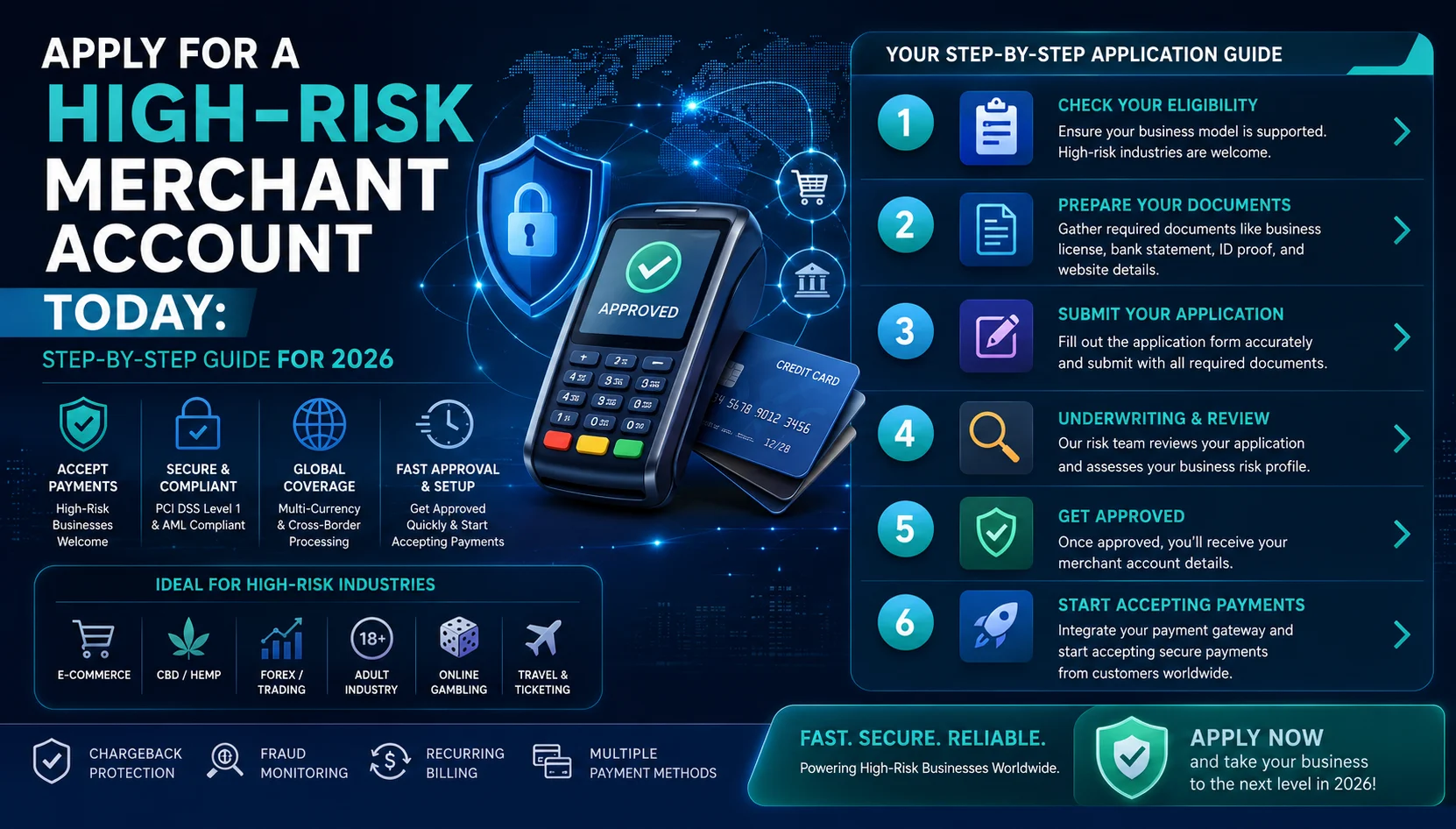
TL;DR:
Getting approved for a high-risk merchant account in 2026 is faster and more structured than ever, but only if you apply with the right documents, the right payment providers, and a clear understanding of what underwriters look for. This guide walks you through every step, with up-to-date data on fees, approval criteria, and what’s changed in the high-risk payment processing landscape this year.
Introduction
The high-risk payment processing market is one of the fastest-growing segments in global fintech. The global high-risk payments market was valued at $62.4 billion in 2025 and is projected to expand to $148.7 billion by 2034, at a CAGR of 10.1% from 2026 to 2034. Despite that growth, thousands of merchants, from iGaming operators to subscription businesses and nutraceutical sellers, still struggle to open a merchant account because they don’t know how to position their application.
This guide removes the guesswork. Whether you’re applying for your first high-risk merchant account or switching payment providers after an account termination, you’ll find a clear, current step-by-step process here.
What Is a High-Risk Merchant Account?
A high-risk merchant account is a specialized payment processing arrangement for businesses that acquiring banks consider more likely to generate chargebacks, fraud, or regulatory complications. These accounts feature structural differences including rolling reserves, extended settlement periods, and stricter contract terms, all designed to protect the processor from elevated risk exposure.
Being classified as high-risk isn’t a moral judgment. It’s a financial classification that reflects how payment processors assess the likelihood of chargebacks, fraud, or regulatory complications associated with your business, based on your industry, your product vertical, or your processing history.
Industries Commonly Classified as High-Risk
- iGaming, online gambling, and sports betting
- Adult content and entertainment
- Nutraceuticals, supplements, and CBD
- Forex trading, crypto exchanges, and financial services
- Subscription billing and continuity commerce
- Travel agencies and online ticketing
- Digital goods and software downloads
- Firearms, ammunition, and tactical gear
2026 Industry Update: What Has Changed?
The high-risk payment landscape has shifted significantly heading into 2026. Here are the key developments every merchant must understand before applying.
Faster Onboarding, Stricter Compliance
In the past, obtaining a high-risk merchant account could take weeks or even months. In 2026, onboarding processes have improved significantly due to digital verification systems, automated underwriting tools, and better risk analytics. Many providers now issue provisional approvals within 48–72 hours, though full underwriting may still take up to two weeks for high-volume accounts.
At the same time, financial authorities require payment providers to implement stronger KYC, AML, and customer authentication procedures, making a high-risk merchant account in 2026 harder to obtain due to increased scrutiny from different payment networks.
AI-Driven Fraud Prevention Is Now Standard
By 2026, more than 65% of high-risk payment processors have deployed at least one AI-driven fraud prevention module, up from approximately 38% in 2022. This means your payment gateway is actively monitoring transaction patterns in real time. Merchants who invest in their own fraud stack, 3DS2 authentication, velocity checks, device fingerprinting, are viewed more favorably during underwriting.
Chargeback Volume Continues to Climb
Chargeback volume is projected to surge 41% from 238 million to 337 million between 2023 and 2026, outpacing ecommerce growth rates. By 2026, chargeback fraud is expected to result in $28.1 billion in losses for merchants, a 40% increase from $20 billion in 2023. This is the single biggest reason underwriters are raising their documentation standards. Demonstrating a proactive chargeback management strategy in your application directly improves your approval odds.
Fee Structure: What to Expect in 2026
Understanding the cost of high-risk payment processing helps you evaluate providers and negotiate better terms.
Most high-risk businesses in 2026 end up paying an effective total processing cost between 3.5% and 7% per transaction. The exact number depends on the business model, processing history, and the level of risk perceived by the acquiring bank.
| Fee Type | Standard Merchant Account | High-Risk Merchant Account |
|---|---|---|
| Processing rate | 1.5% – 2.9% | 3.5% – 7.0% |
| Monthly fee | $10 – $25 | $25 – $100 |
| Chargeback fee | $15 – $25 | $25 – $100 |
| Rolling reserve | None | 5% – 10% (held 90–180 days) |
| Setup fee | Usually waived | $0 – $500 |
| Early termination | $0 – $200 | $200 -0 $1,000+ |
The average chargeback fee ranges from $20 to $100 depending on the payment processor and transaction risk level. The rolling reserve is typically the most misunderstood cost, it’s not a fee, but a liquidity hold. Most providers release it in full after 3–6 months of clean processing history.
Step-by-Step: How to Apply for a High-Risk Merchant Account
Step 1 – Assess Your Risk Profile
Before approaching any payment provider, understand how underwriters will classify your business. The three factors that matter most are your industry vertical, your processing history (if any), and your chargeback ratio.
A chargeback ratio below 1% is the standard threshold. Visa’s VAMP program and Mastercard’s ECM monitoring programs flag merchants who consistently exceed this. If your ratio is above 1%, address it before applying, even a 60-day period of clean processing history strengthens your file considerably.
Step 2 – Gather Your Application Documents
Incomplete applications are the most common reason for delays. Prepare these before you approach a single provider.
Standard documents required:
- Government-issued photo ID (all beneficial owners with 25%+ stake)
- Business registration certificate and articles of incorporation
- Last 3–6 months of bank statements
- Last 3–6 months of processing statements (if applicable)
- Voided business check for settlement account
- Business licence or operating permit (industry-specific)
- Website URL with compliant terms of service, privacy policy, and refund policy
- Processing volume estimates (monthly average and peak)
- Chargeback ratio history
For offshore merchants and international businesses:
- Proof of registered address in your operating jurisdiction
- Corporate structure documentation (especially for multi-entity structures)
- Certificate of Good Standing
Step 3 – Ensure Your Website Is Compliance-Ready
Payment providers and card networks review your website as part of underwriting. Non-compliant sites are rejected before the application is even read. Your site must clearly display:
- Full legal business name and contact information
- Product or service descriptions that match what you told your acquirer
- Clear refund and return policy (not buried in a footer)
- Privacy policy compliant with GDPR and applicable regional law
- Terms and conditions that cover subscription billing, auto-renewals, and cancellation rights
- Secure checkout (HTTPS, current SSL certificate)
- Transaction descriptors that match your merchant name, a major chargeback trigger when they don’t
Step 4 – Compare High-Risk Payment Providers
Not all payment gateways serve the same verticals. A provider that specializes in iGaming may not be the right fit for a CBD subscription business. Use a comparison platform like TheFinRate to filter providers by industry, geography, monthly volume, and accepted card networks.
Key criteria to evaluate:
- Which acquiring banks back the provider (jurisdiction matters for international card acceptance)
- Whether they support multi-currency settlement
- Rolling reserve terms and release schedule
- Chargeback threshold before account review is triggered
- Integration options (API, hosted payment page, shopping cart plugins)
- Support for alternative payment methods beyond Visa/Mastercard
Step 5 – Submit a Strong Application
High-risk processors usually need detailed applications, including financial records and operational policies. A well-packaged application, organized, complete, and accompanied by a brief business overview, signals operational maturity to underwriters.
Include a one-page merchant summary that covers:
- What your business sells and how
- How you acquire customers (organic, paid, affiliate)
- Your average transaction value and monthly volume
- Your existing fraud prevention and chargeback mitigation tools
- Why you’re switching providers (if applicable – be honest)
Step 6 – Negotiate Your Terms Before Signing
Once you receive an approval offer, don’t sign immediately. The initial offer is usually the provider’s standard high-risk template. Points that are often negotiable include the rolling reserve percentage, the reserve release timeline, early termination penalties, and monthly minimum volume thresholds. Merchants with clean processing history or strong financial statements have more leverage than they often realize.
Pros and Cons of High-Risk Merchant Accounts
Pros
- Access to processing: for industries that standard payment providers won’t touch
- Global payment acceptance: most high-risk accounts support multi-currency and cross-border payments
- Scalable volume limits: unlike standard accounts, high-risk accounts are built for higher average transaction values and monthly volumes
- Dedicated risk support: specialist merchant services teams familiar with your vertical
- Multi-acquirer redundancy: many high-risk providers route through multiple banks, reducing downtime risk
Cons
- Higher processing fees: 3.5% to 7% versus 1.5% to 2.9% for standard accounts
- Rolling reserves: restrict cashflow, particularly in the first 3-6 months
- Longer contract terms: with higher early termination fees
- Stricter monitoring: volume spikes or rising chargeback ratios trigger account reviews
- More documentation: required upfront and on an ongoing basis
How to Maintain Your Account After Approval
Approval is the beginning, not the destination. High-risk merchant accounts are reviewed on an ongoing basis. Protect your account by keeping your chargeback ratio below 1%, using clear and consistent transaction billing descriptors, responding to disputes within the required timeframe (typically 7-10 days), notifying your provider before major traffic spikes (promotions, product launches), and keeping your KYC documentation current.
FAQ
What is the fastest way to get approved for a high-risk merchant account?
Have all documentation ready before you apply, ensure your website is fully compliant, and choose a provider that specialises in your vertical. Pre-packaged applications with a merchant summary reduce underwriting time significantly.
Can I get a high-risk merchant account with bad credit?
Yes. Many high-risk payment providers weigh processing history and business model over personal credit scores. A higher rolling reserve may be required as a substitute security measure.
What is a rolling reserve?
A rolling reserve is a percentage of each transaction, typically 5% to 10%, held by the processor as a security buffer against chargebacks. It is released on a rolling basis (usually monthly) after an agreed-upon hold period of 90 to 180 days.
Do offshore merchant accounts offer better rates?
Offshore merchant accounts can offer more flexibility for certain industries and geographies, but they come with their own compliance requirements and may limit which card networks you can accept. Use them strategically, not by default.
How many merchant accounts should I have?
Multi-acquirer redundancy, maintaining accounts with two or more providers, is a best practice for high-risk merchants. It protects against sudden account terminations and allows volume routing for optimised approval rates.
What happens if my chargeback ratio exceeds the threshold?
Your account will likely be placed under review. If the ratio doesn’t improve within the remediation period, the processor can terminate your account and place your business on the MATCH list (Mastercard’s terminated merchant file), which significantly affects future applications.
Ready to Apply? Compare Providers on TheFinRate
Finding the right high-risk payment provider for your business model, volume, and geography is the single most important step in this process. TheFinRate’s payment provider directory lets you compare high-risk merchant account providers side by side, by vertical, region, fee structure, and supported payment methods, so you can apply with confidence.
Comments
No comments yet. Be the first to share your thoughts.
Leave a comment