
TL;DR
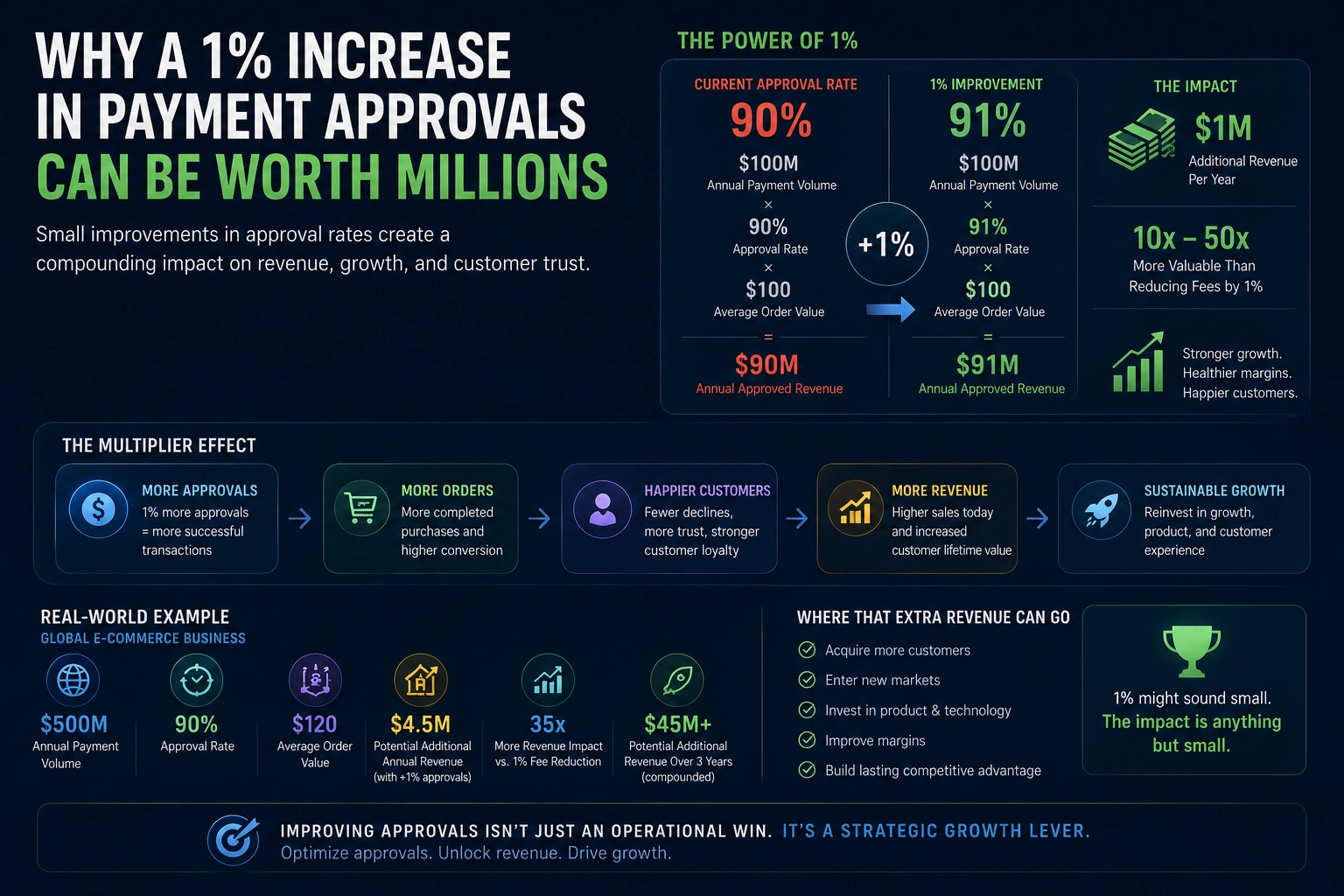
Payment approval rate, the share of authorization requests a bank actually approves, is one of the most underweighted metrics in enterprise finance. Stripe has documented large businesses capturing millions in additional annual revenue from an authorization rate lift of just 0.5%. At scale, a single percentage point isn’t a rounding error; it’s the difference between revenue that reaches your bank account and revenue that silently disappears at checkout. This guide breaks down why approval rates matter more than most fee negotiations, what’s driving declines in 2026, and how merchants, especially those running cross-border and high-risk payment gateway operations, can close the gap.
Most payment teams spend their energy negotiating processing fees down by a few basis points. Meanwhile, the approval rate sitting quietly on their dashboard, the percentage of legitimate transactions actually getting authorized, often has ten times the revenue impact and gets a fraction of the attention.
This isn’t a niche payments-team concern. For merchant services leaders and finance teams building long-term payment infrastructure, approval rate is one of the clearest signals of whether the underlying payment stack, gateways, acquirers, routing logic, is actually working for the business or quietly leaking revenue every day.
What Payment Approval Rate Actually Measures
Payment approval rate (also called authorization rate) is the percentage of submitted payment requests that an issuing bank approves, out of all attempts. It sits upstream of conversion rate and downstream of checkout traffic, meaning even a perfectly optimized funnel can leak significant revenue if the authorization step underperforms.
- A transaction can fail for dozens of reasons, spanning insufficient funds, expired cards, fraud suspicion, or technical mismatches between merchant and issuer systems
- Approval rate is distinct from conversion rate: a customer can complete checkout correctly and still be declined by their bank
- Benchmarks vary sharply by industry, region, and payment method, which is why merchants should compare against their own vertical rather than a single global number
The Real Math Behind “Just 1%”
At small transaction volumes, a percentage point of approval rate looks negligible. At enterprise volume, it compounds fast.
- Stripe has documented large businesses increasing their authorization rate by just 0.5% and capturing millions of dollars in additional revenue each year
- For high-volume platforms such as iGaming operators, even a 1-2% lift in authorization rates can equal millions in annual revenue, both from recovered transactions and higher player lifetime value
- GR4VY’s 2026 benchmarking notes that the gap between an average 92% approval rate and a best-in-class 96% rate can represent millions in revenue that costs nothing to acquire, the customer and the demand already exist
- Network tokenization alone has been shown to lift authorization rates by roughly 4.7% while cutting e-commerce fraud by about a third (Visa data)
The pattern across all of these figures is the same: approval rate improvements recover revenue from demand you already paid to acquire, which makes the return on a payments infrastructure investment unusually direct compared to marketing or acquisition spend.
Why Approval Rates Slip in 2026
False Declines Are Now a Bigger Problem Than Fraud Itself
The single biggest hidden driver of lost approval rate isn’t fraud, it’s fraud systems being too cautious. A false decline happens when a legitimate transaction from a real, funded customer gets rejected because a fraud filter misfires.
- Industry surveys find nearly half of merchants estimate up to 5% of legitimate orders are incorrectly declined as fraudulent, representing an estimated $50 billion in lost revenue industrywide (PYMNTS Intelligence, 2026)
- A separate four-market study (Oxford Economics, commissioned by Checkout.com) put direct merchant revenue lost to false declines at $50.7 billion in a single year, against global card fraud losses of roughly $33.4 billion in the same period (Nilson Report)
- Signifyd’s research finds that among loyal customers, a single false decline is followed by a 65% drop in future order volume from that customer
- Only about 64% of merchants actively track their false decline rate at all, meaning a large share of lost revenue never appears on a dashboard in the first place
Card Network Monitoring Is Pushing Issuers to Decline More, Not Less
There’s a structural asymmetry worth understanding: card networks monitor and penalize issuers and acquirers for approving too much fraud, but there’s no equivalent program pushing them to decline less. That imbalance has intensified in 2026.
- Visa’s Acquirer Monitoring Program (VAMP) tightened its merchant “Excessive” fraud-and-dispute threshold from 220 to 150 basis points on April 1, 2026, a 32% reduction in tolerance across the US, Canada, the EU, and Asia-Pacific
- Acquirers typically run their own internal buffers 30-40 basis points below Visa’s threshold, adding another layer of caution that filters down to merchant-level declines
- The combined effect: tighter network thresholds, tighter acquirer buffers, and more conservative underwriting all push toward rejecting more marginal, including legitimate, transactions
For merchants in cross-border or high-risk categories, this compounds an existing problem, since those transaction profiles already trigger more scrutiny by default.
Payment Approval Rate: What Moves the Needle
| Lever | Typical Impact | Best Suited For |
|---|---|---|
| Network tokenization | Up to +15 percentage points on tokenized cohorts | Recurring billing, stored-credential merchants |
| Smart routing / cascading | Compounding LTV impact of roughly +14.8% | Multi-provider, multi-acquirer setups |
| Intelligent retry logic | Around +11.6% LTV impact on recovered soft declines | Subscription and recurring payments |
| MCC / merchant category alignment | Several points of headroom, no engineering required | Merchants misclassified under an overly cautious MCC |
| Local acquiring for cross-border | Closes the structural gap vs. domestic approval rates | Cross-border payments, multi-region merchants |
| Fraud orchestration | Reduces false declines without raising fraud exposure | High-volume merchants managing 5+ payment integrations |
Pros and Cons of Chasing Approval Rate Optimization
Pros
- Recovers revenue from demand that’s already been acquired, with no added marketing spend
- Improvements compound: higher first-attempt approval also improves customer lifetime value and reduces support load
- Most levers (routing, tokenization, retry logic) are infrastructure changes, not policy trade-offs against fraud risk
Cons
- Requires accurate measurement first, most merchants underestimate their true false decline rate
- Some fixes (like loosening fraud rules) can increase fraud exposure if not paired with better detection, not just looser thresholds
- Cross-border approval gaps often require local acquiring relationships, which take longer to establish than a simple settings change
Why Cross-Border and High-Risk Merchants Feel This More
Cross-border transactions are declined at higher rates by default, since issuers apply extra scrutiny to unfamiliar geographies, currency mismatches, and international billing patterns, the same profile that often triggers false declines for legitimate travelers, expats, and international shoppers.
High-risk merchants face a compounding version of the same dynamic:
- Elevated MCC classifications mean transactions are scrutinized more heavily by default, independent of the individual merchant’s actual chargeback history
- Standard processors often apply blanket risk rules across an entire high-risk category rather than underwriting merchants individually
- A specialized high-risk payment gateway with multiple acquiring bank relationships can route transactions intelligently, improving approval rates without simply accepting more fraud risk
This is where payment orchestration and a properly matched high-risk merchant account earn their cost: not through lower fees, but through materially higher first-attempt approval rates on the same transaction volume.
Payment Method Mix Also Affects Approval Rates
The choice between cards, digital wallets, and payment wallets isn’t just a checkout-experience decision, it directly affects authorization outcomes. Wallets like Apple Pay and Google Pay rely on tokenized, device-authenticated credentials, which typically clear issuer risk checks more easily than manually entered card numbers. For merchants supporting online payments across multiple regions, offering a broader mix of local payment methods alongside cards tends to lift blended approval rates, since it reduces reliance on any single rail that may underperform in a specific corridor.
How to Start Closing the Approval Rate Gap
- Measure your true false decline rate: most merchants self-report a lower number than their actual transaction data shows
- Segment approval rate by corridor and card network: a single blended number hides where the real losses are concentrated
- Adopt network tokenization: for stored-credential and recurring transactions to reduce credential-related declines
- Use intelligent retry and cascading routing: across multiple acquirers rather than relying on a single processor
- Review MCC classification: an outdated or overly broad merchant category code can suppress approval rates for no fraud-related reason
- Pair fraud orchestration with approval optimization: the goal is fewer false declines, not simply looser fraud rules
Key Takeaways
- A 0.5-1% lift in payment approval rate can translate into millions of dollars in recovered annual revenue for enterprise merchants
- False declines cost merchants tens of billions of dollars annually, a figure that, by several measures, now exceeds actual fraud losses
- Visa’s 2026 VAMP threshold tightening is pushing issuers and acquirers toward more conservative approvals, making proactive approval rate management more important, not less
- Cross-border and high-risk merchants face structurally lower approval rates by default, making payment orchestration and specialized acquiring relationships a direct revenue lever
- Approval rate optimization recovers revenue from demand already acquired, making it one of the highest-ROI investments available to payment teams in 2026
Frequently Asked Questions
What is a good payment approval rate?
It depends heavily on industry and region, but many merchants benchmark against a 92-96% range for domestic card transactions, with best-in-class merchants at the top end. Cross-border and high-risk categories typically run lower by default.
What’s the difference between a false decline and a legitimate decline?
A legitimate decline stops an actual fraudulent or invalid transaction. A false decline rejects a real, funded customer’s legitimate purchase because a fraud system misjudged the risk, and it’s now estimated to cost merchants far more than fraud itself.
How does Visa’s VAMP program affect approval rates?
VAMP’s April 2026 threshold tightening pushes acquirers and issuers to decline more marginal transactions to stay within their fraud-and-dispute ratio limits, which can lower approval rates for merchants near the threshold even without a change in their own behavior.
Can improving approval rates increase fraud risk?
Not if done correctly. The goal is to reduce false declines through better data and routing, such as tokenization and fraud orchestration, rather than simply loosening fraud rules across the board.
Why do high-risk merchants see lower approval rates?
Elevated MCC classifications and blanket risk rules from standard processors often scrutinize transactions more heavily regardless of the individual merchant’s actual performance, which is why specialized high-risk payment gateway relationships tend to produce measurably better approval outcomes.
What’s the fastest way to start improving approval rate?
Start by accurately measuring your current false decline rate, most merchants underestimate it, then segment approval performance by corridor and card network to find where the losses concentrate.
Comments
No comments yet. Be the first to share your thoughts.
Leave a comment