
TL;DR
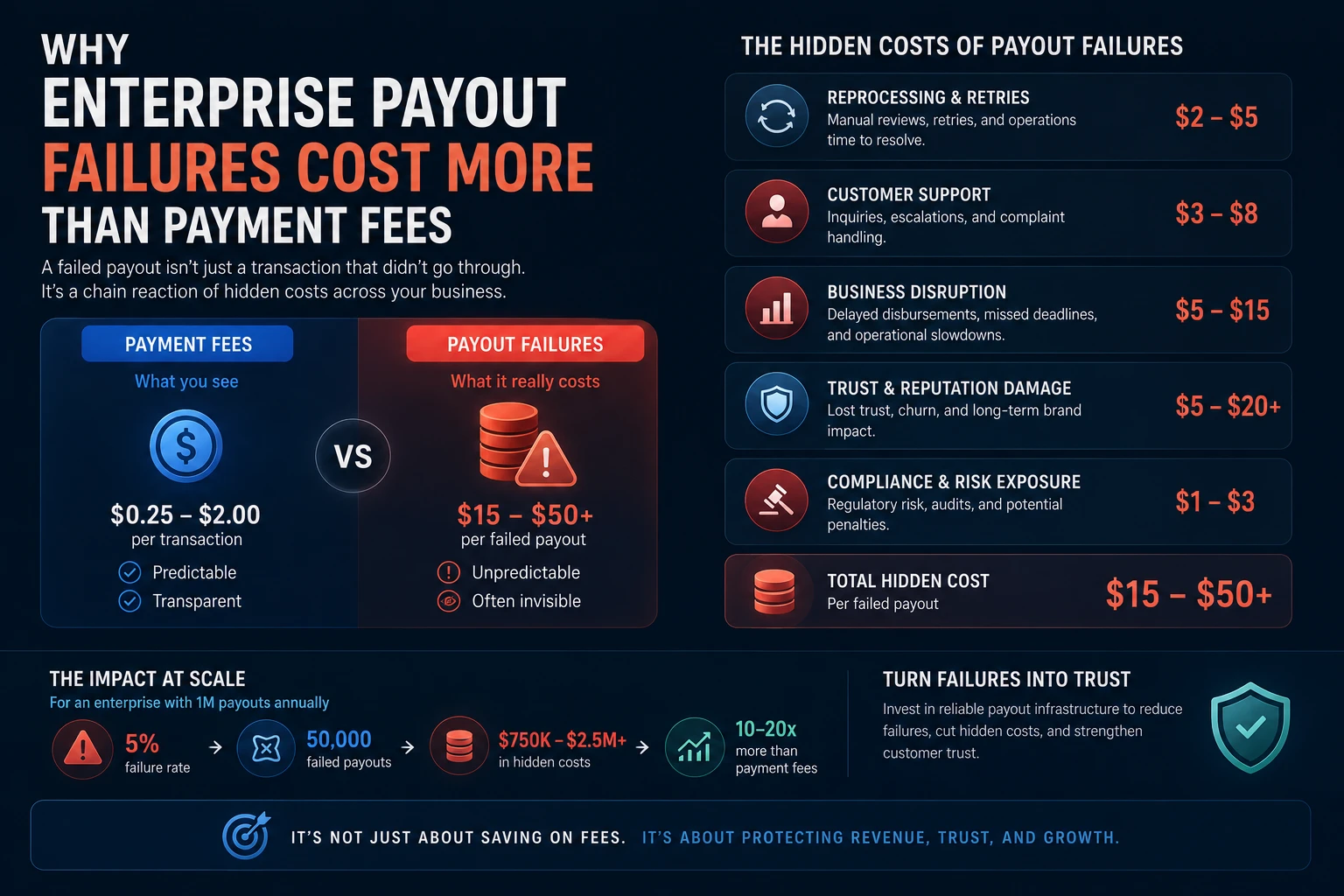
Most finance teams negotiate hard on payment fees but barely track payout failures, and that’s backward. A single failed payment can cost up to $97 to investigate and resolve, cross-border payout corridors fail at rates up to 11%, and the global economy loses over $118.5 billion a year to failed payments. Payment fees are visible and predictable. Payout failures are hidden, compounding, and far more expensive once you count staff time, customer churn, and reputational damage. This guide breaks down why payout failures deserve more attention than basis-point fee negotiations, especially for enterprises running cross-border and high-risk payment gateway operations in 2026.
Every finance and payments team obsesses over interchange rates, gateway fees, and processing percentages. It’s an easy number to benchmark and an easy line item to negotiate down. But payout failures, vendor payments that bounce, cross-border transfers that stall, marketplace payouts that never arrive, rarely get the same scrutiny, even though they cost enterprises far more per incident than the fee difference they spent months negotiating.
The Real Scoreboard: Fees vs. Failures
A 0.2% reduction in payment processing fees feels like a win. But a single failed payout can erase that saving many times over once you account for investigation time, customer service escalation, delayed cash flow, and lost trust.
- The direct cost of a failed payment averages $12.10 per transaction, covering bank fees, manual intervention, and processing corrections
- In more complex operational models, investigating a single failed payment can cost as much as $97 per item
- Banks spend roughly $360,000 annually managing failed payments; non-bank corporates spend $200,000-$220,000 annually
- Failed payments cost the global economy an estimated $118.5 billion a year in fees, labor, and lost business (LexisNexis)
Payment fees are a known, budgeted cost. Payout failures are an unbudgeted, compounding one, and that asymmetry is exactly why they deserve more attention than they typically get.
What Counts as a Payout Failure
A payout failure isn’t just a declined card. For enterprises, it covers any outbound payment that doesn’t reach its destination correctly the first time:
- B2B vendor and supplier payments: that bounce due to incorrect bank details or intermediary bank rejections
- Cross-border transfers: delayed or reversed due to currency mismatches, correspondent banking gaps, or compliance holds
- Marketplace and gig-economy payouts: rejected due to invalid payee accounts or unsupported corridors
- Payroll and contractor payments: returned due to stale account information
- Merchant settlement payouts: frozen or delayed due to reserve holds, especially for high-risk merchant accounts
Each failure type has a different root cause, but they share the same downstream cost pattern: manual investigation, delayed funds, and a damaged relationship with whoever was waiting on the money.
The Hidden Cost Stack
| Cost Category | What It Includes | 2026 Data Point |
|---|---|---|
| Direct remediation | Bank fees, manual rework, reprocessing | $12.10 average per failed transaction |
| Investigation labor | Staff time tracing and resolving a failure | Up to $97 per investigated item |
| Cross-border premium | Multi-bank tracing, FX reconciliation | Up to 11% of cross-border payments fail (PYMNTS) |
| Revenue leakage | Missed or delayed collections | 8-11% of revenue in affected industries |
| Customer/vendor attrition | Lost relationships after repeated failures | 60% of organizations report losing customers to failed payments (LexisNexis) |
| Operational drag | Reconciliation delays, staff frustration | 64% of organizations say failures affect staff workload significantly |
The pattern across every category is the same: the visible cost is small, but the compounding cost, labor, churn, reputational damage, is what actually erodes margin.
Why Cross-Border and High-Risk Payouts Fail More Often
Cross-Border Payout Failure Drivers
Cross-border payouts fail far more often than domestic ones, and the global average straight-through processing (STP) rate for cross-border account-to-account payments sits at just 26%, meaning roughly three out of four cross-border payments require some form of manual intervention before they settle cleanly.
Common failure triggers include:
- Mistyped IBANs, expired cards, or invalid account numbers
- Currency mismatches that trigger automatic holds
- Bank-specific routing quirks that go unnoticed until a payment bounces
- Correspondent banking gaps in de-risked corridors, particularly across frontier and emerging markets
- Missing or mismatched beneficiary details that fail compliance screening
For a mid-sized enterprise processing 120,000 cross-border payments a year, even a modest 2% failure rate translates into hundreds of thousands of dollars lost annually in enquiry fees and staff time alone.
High-Risk Merchant Payout Complications
High-risk merchants face an additional layer of payout friction that standard merchants rarely encounter. In 2026, high-risk merchant accounts typically carry:
- Rolling reserves: of 5-15% withheld for 90-180 days, directly restricting payout liquidity
- Extended settlement periods: of 3-7+ business days, versus 1-2 days for mainstream processors
- Elevated chargeback fees: of $25-100 per dispute, plus setup and monthly account fees
- Sudden fund freezes triggered by chargeback spikes, volume increases, or routine risk reassessments
- Termination risk: if the acquiring bank exits the merchant’s category, a scenario that can suspend payout capability entirely, regardless of the merchant’s own track record
This is why a dedicated high-risk payment gateway, one that maintains relationships with multiple acquiring banks and applies risk-based underwriting specific to the merchant’s actual behavior rather than blanket MCC-code assumptions, matters more for payout continuity than for fee savings alone.
Crypto Payments as a Payout Resilience Layer
A growing number of merchant services providers are adding crypto payments settlement as a parallel payout rail, particularly for high-risk merchants who face recurring reserve and freeze risk with traditional acquirers. In this model, the customer still pays with a standard card through a familiar online payments checkout, Visa, Mastercard, Apple Pay, Google Pay, but the merchant receives settlement in a stablecoin such as USDC or USDT, often within minutes rather than days.
The appeal for payout resilience specifically:
- Settlement bypasses the correspondent banking chain entirely, removing several of the failure points listed above
- There’s no rolling reserve, since the payment provider isn’t holding merchant funds against future chargeback risk
- It doesn’t replace subscription billing or multi-currency fiat settlement needs, so most enterprises use it alongside, not instead of, a traditional high-risk merchant account
It isn’t a fit for every merchant, but as a supplementary payout rail for volatile or de-risked corridors, it’s becoming a standard part of the 2026 payments toolkit rather than a fringe option.
2026 Update: Card Network Risk Rules Are Raising the Stakes
Card network monitoring has tightened further in 2026, and it directly affects payout reliability for merchants processing card-based transactions. Visa’s Acquirer Monitoring Program (VAMP) dropped its “Excessive Merchant” threshold from 2.2% to 1.5% on April 1, 2026, across the US, Canada, the EU, and Asia-Pacific.
What this means for payout stability:
- The VAMP ratio counts combined fraud reports and disputes against settled transactions — event volume matters, not dollar value
- Acquirers face their own tighter thresholds (0.50% “Above Standard,” 0.70% “Excessive”), which pushes them to proactively restrict merchant payouts before a formal violation occurs
- Merchants that fall outside compliance windows can see reserve increases, payout delays, or account termination with little warning
For enterprises running high-volume or cross-border card acceptance, this makes fraud and dispute management a payout continuity issue, not just a compliance checkbox.
Payment Fees vs. Payout Failures: A Direct Comparison
| Factor | Payment Fees | Payout Failures |
|---|---|---|
| Visibility | Fully visible, budgeted line item | Often untracked, scattered across departments |
| Predictability | Fixed or contractually negotiated | Variable, spikes with volume and corridor risk |
| Cost per incident | Basis points per transaction | $12-$97+ per failed transaction |
| Compounding effect | None | Customer churn, staff time, reputational damage |
| Negotiation leverage | High, a standard procurement conversation | Low, requires infrastructure and process change |
| 2026 relevance | Stable, well understood | Rising, due to VAMP, de-risking, and cross-border growth |
Building a Payout Failure Reduction Strategy
Reducing payout failures requires treating them as an infrastructure problem, not a customer service one. The most effective payment providers now build failure-prevention into onboarding rather than leaving it to post-failure recovery.
- Audit your payout corridors: map failure rates by corridor, rail, and payout method to find where the real losses are concentrated
- Validate payee details upfront: account and routing validation at onboarding prevents the majority of avoidable bounces
- Adopt multi-rail routing: pairing card, bank transfer, and digital wallet options improves resilience when one rail underperforms in a specific corridor
- Use payout orchestration: a single control layer across providers reduces the fragmentation that causes tracing delays
- Partner with a high-risk payment gateway where relevant: for merchants with elevated risk profiles, a specialized acquirer relationship prevents the sudden freezes and terminations that standard processors can trigger
- Track STP rate as a KPI: treating straight-through processing rate as seriously as processing fees exposes the real cost center
Key Takeaways
- Payout failures cost enterprises far more per incident than payment fees, once labor, delays, and churn are included
- The global average cross-border STP rate is only 26%, meaning most cross-border payouts require manual intervention
- High-risk merchants face compounding payout risk from rolling reserves, extended settlement, and sudden terminations
- Visa’s VAMP threshold drop to 1.5% in April 2026 raises the cost of unmanaged disputes for any merchant processing card payouts
- A payout failure reduction strategy, not a fee negotiation, is the higher-leverage move for enterprise payment operations in 2026
Frequently Asked Questions
What is a payout failure?
A payout failure is any outbound business payment, vendor payment, cross-border transfer, marketplace payout, or merchant settlement, that fails to reach its destination correctly on the first attempt, requiring manual investigation or reprocessing.
Why do cross-border payouts fail more often than domestic ones?
Cross-border payouts pass through more intermediaries, involve currency conversion, and face inconsistent compliance and formatting standards across countries, all of which increase the chance of a bounce or delay.
How much does a failed payment actually cost a business?
Direct remediation averages around $12.10 per failed transaction, but full investigation and resolution can cost up to $97 per item once staff time and reconciliation work are included.
Why do high-risk merchants experience more payout disruptions?
High-risk merchant accounts typically carry rolling reserves, extended settlement periods, and termination risk tied to the acquiring bank’s overall risk appetite, all of which can delay or freeze payouts independent of the merchant’s individual performance.
How does Visa’s VAMP program affect payout reliability?
VAMP monitors combined fraud and dispute ratios against settled transactions. Merchants that exceed the 1.5% threshold (as of April 2026) risk reserve increases, payout delays, or account restrictions from their acquirer.
What’s the single highest-leverage fix for reducing payout failures?
Upfront payee and account validation, since most preventable failures originate from incorrect or outdated payee data rather than processor-side issues.
Comments
No comments yet. Be the first to share your thoughts.
Leave a comment