
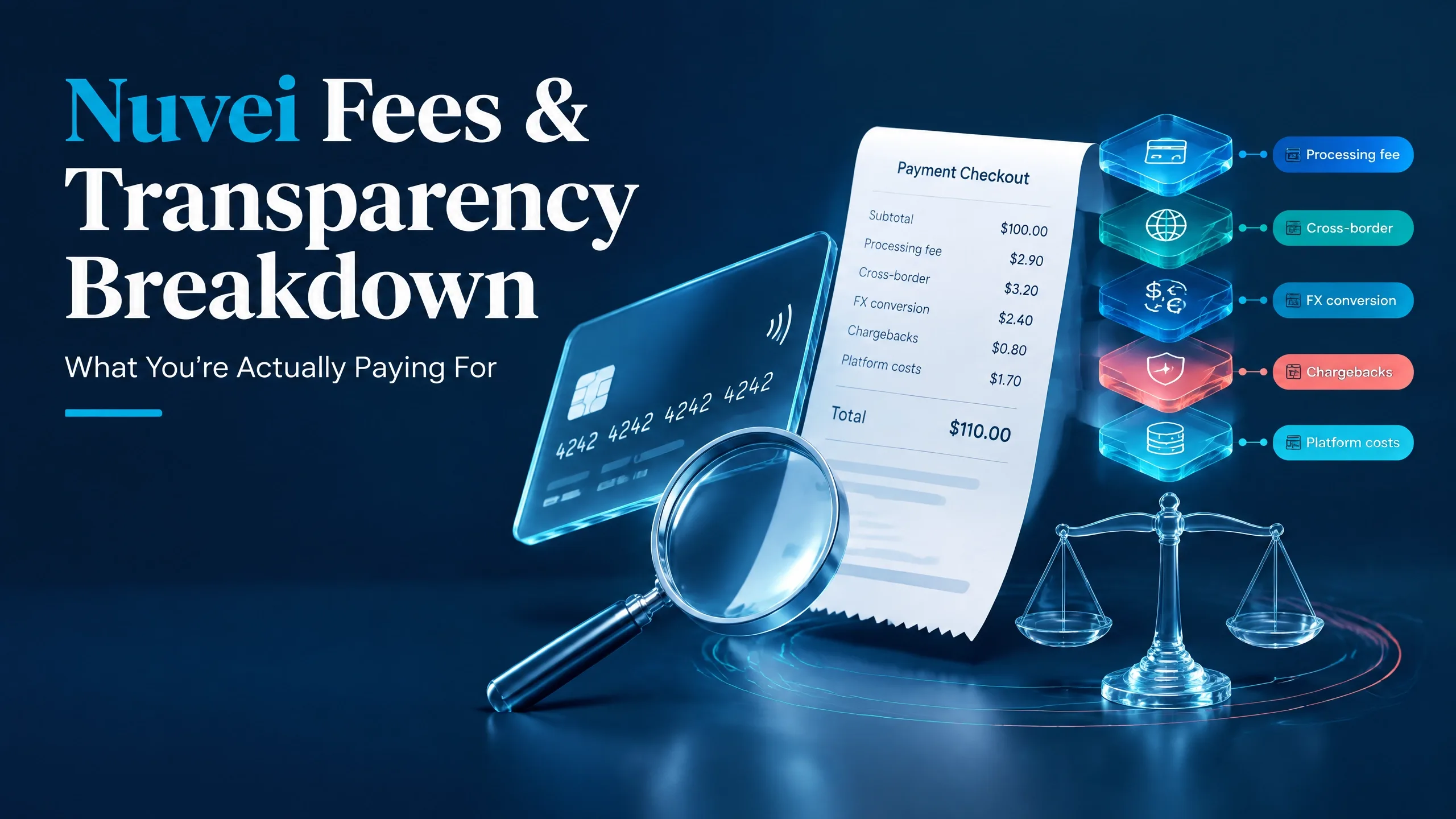
If there’s one theme that cuts across every independent data source on Nuvei, TrustPilot reviews, G2 comparisons, third-party statement audits, and merchant forums alike, it’s this: the platform itself is solid, but the fee structure is where merchants most often get surprised. That doesn’t make Nuvei unusual in the payments industry; opaque, negotiable, non-published pricing is close to the norm at the enterprise processor tier. But it does mean fee transparency deserves its own dedicated examination, separate from questions of safety, licensing, or platform reliability. This article breaks down exactly how Nuvei prices its services, where the transparency gaps actually sit, and what a merchant needs to ask for in writing before signing.
No Published Rate Card – By Design
The first thing to understand about Nuvei’s pricing is that there isn’t one publicly posted number to evaluate. Unlike flat-rate consumer-facing processors that advertise a single percentage on their homepage, Nuvei negotiates pricing on a bespoke, per-merchant basis, calibrated to transaction volume, industry risk category, and geography. Independent comparison sites confirm this directly: entry-level pricing is consistently listed as “not available” across G2, Capterra, and similar directories, and UK-focused analyses note that Nuvei publishes no fixed rate card at all, targeting instead businesses processing upward of roughly £100,000 a month.
This isn’t inherently a red flag, enterprise-grade acquirers across the industry (Adyen, Worldpay, and others) operate the same way, because genuinely custom pricing based on real risk and volume data can be fairer than a one-size-fits-all rate. But it does shift the transparency burden onto the merchant. Without a public benchmark to compare against, a prospective Nuvei merchant has no way to sanity-check a quoted rate against a published standard, which makes the specific pricing structure offered (not just the number) the most important thing to interrogate before signing.
The Three Pricing Structures Nuvei Offers – And Why They’re Not Equal
According to detailed merchant statement audits conducted by independent payment-cost consultants, Nuvei offers merchants a choice between three distinct pricing models, and the differences between them have enormous financial consequences that aren’t obvious from the sales conversation alone.
Tiered pricing: Under this model, Nuvei sorts every transaction into one of three buckets, qualified, mid-qualified, and non-qualified, with a different, escalating rate attached to each. The structural problem, independent of who the processor is, is that Nuvei itself controls the criteria that determine which bucket a transaction lands in. Third-party statement audits examining Nuvei’s own merchant pricing documentation found that a strikingly high share of ordinary transaction types, reported at around 68% of credit card categories in one detailed audit, get classified as non-qualified, the most expensive tier. Recurring subscription charges, SaaS billing, and premium reward cards are specifically flagged as categories that routinely land in this costlier bucket even when the underlying interchange cost to Nuvei isn’t actually higher.
Flat-rate pricing: Every transaction is charged the same percentage regardless of card type or category. The appeal is simplicity, merchants know exactly what they’ll pay per transaction without parsing a statement. The cost of that simplicity, per independent statement audits, is a markup that can exceed 100 basis points above what the same transaction would cost under a properly structured cost-plus arrangement. For any merchant processing meaningful volume, that spread compounds into real money over a year.
Cost-plus (interchange-plus) pricing: This is the structure independent auditors consistently recommend, and it works differently: the merchant pays the actual wholesale interchange rate set by the card networks (Visa, Mastercard, etc.), a rate Nuvei does not control, plus a clearly disclosed, fixed markup that goes to Nuvei. Because the markup is separated from the underlying interchange cost, it’s the only one of the three structures where a merchant can actually audit what they’re being charged and negotiate the markup component specifically. Even here, auditors note the markup itself may start higher than necessary and is worth negotiating down, but the structural transparency is categorically better than tiered or flat-rate.
The practical takeaway is blunt: two merchants processing identical volume through Nuvei can end up paying meaningfully different effective rates purely based on which of these three structures they were placed on, and the pricing structure is something a merchant has to actively request and negotiate, not something offered by default.
The Full Fee Stack: What Shows Up on a Nuvei Statement
Beyond the headline per-transaction rate, Nuvei’s merchant statements carry a layered set of additional fees, each individually disclosed in contract documentation but easy to lose track of collectively. Based on published fee schedules and independent statement audits, the fee categories include:
- Merchant Service Fee (MSF): the core percentage rate, structured differently depending on whether the account is blended, Interchange+, or Interchange++
- Credit and Debit Transaction Fees: fixed per-transaction charges, billed as separate line items from the percentage-based MSF
- Card-network-specific fees: separate fee lines for UnionPay, Amex, Diners Club, and Alipay transactions where Nuvei is aggregating or switching that volume on the merchant’s behalf
- Monthly Clearing Fees
- PCI Compliance Monthly Fees
- Annual Fee: (sometimes labeled an “Anniversary Fee”)
- Monthly Gateway Fee
- Monthly Statement Fee
- Tokenization Per-Transaction Fee: charged specifically when a card is registered/tokenized for future use
- Terminal-related fees: Monthly Terminal Rental, Wireless Fees, Overage Wireless Fees, and Wireless Activation/Setup Fees
- Payment Links Fee: applied to every transaction processed through Nuvei’s hosted payment link product, including declined attempts, and bundled with 3D Secure authentication costs
None of these fees are individually hidden in the sense of being undisclosed, they appear in contract documentation and fee-explainer resources. The transparency problem, based on both merchant reviews and independent audits, is more about legibility: a dozen-plus line items spread across percentage rates, fixed per-transaction charges, and recurring monthly fees is difficult for a non-specialist merchant to reconstruct into a single “true cost” figure, especially when the qualification criteria for tiered pricing sit inside Nuvei’s own internal documentation rather than a simple public table.
What the Review Data Confirms About Fee Complaints
This fee structure analysis isn’t theoretical, it lines up precisely with what shows up in the independent review data covered in our companion piece on Nuvei’s reviews and reputation. TrustPilot’s own AI-generated review summaries flag “hidden charges,” “unjustified higher deposits,” and general dissatisfaction with pricing as recurring, machine-identified themes across hundreds of reviews, not isolated anecdotes. Individual reviewers describe concrete examples: one merchant reported an unexplained $25/month charge for “specialized reports” they hadn’t requested and didn’t have access to; another described a bill roughly double what a competing Canadian processor charged for the same transaction volume; several describe contract termination fees and disputes over returned hardware. Third-party benchmarking tools that compare Nuvei against peers like Priority Technology and Fattmerchant/Stax independently flag “surprise fees and delayed settlements” and “billing disputes” as consistent TrustPilot-sourced themes specific to Nuvei, reinforcing that this is a structural pattern rather than a handful of unhappy customers.
Transparency in Context: Not an Outlier, But Not Best-in-Class Either
It’s worth grounding this in a fair comparison rather than treating Nuvei as uniquely opaque. Bespoke, negotiated pricing without a public rate card is standard practice among enterprise-tier acquirers serving large or complex merchants, Adyen, Checkout.com, and Worldpay all follow broadly similar models, and for good reason: genuine risk-based pricing requires underwriting a specific merchant’s profile rather than applying a flat public rate that either overcharges low-risk merchants or undercharges high-risk ones. Where Nuvei sits within that peer group is more nuanced. Its data security and fraud-prevention marks score well against competitors in independent benchmarking. Its fee-structure and pricing-transparency scores, by contrast, tend to land at or slightly below the category average in the same benchmarking exercises, for example, one comparative analysis against a mid-market peer scored Nuvei-class processors around 2.7 out of 5 specifically on transparent fee structure, versus stronger marks in categories like fraud prevention and data security. That gap between “strong platform, weaker pricing clarity” is the single most useful summary of Nuvei’s transparency position.
A Practical Due-Diligence Checklist Before Signing
Based on everything above, a merchant evaluating Nuvei should treat the following as non-negotiable pre-contract steps rather than nice-to-haves:
- Explicitly request Interchange-Plus (cost-plus) pricing: not tiered or flat-rate, and get the specific markup in basis points in writing.
- Ask for a complete, itemized fee schedule: covering every monthly, annual, and per-transaction charge listed above, not just the headline processing rate.
- Clarify how “qualified” vs. “non-qualified” transactions are defined: particularly if your business relies on recurring billing, subscriptions, or premium card acceptance, since these categories are specifically flagged as prone to costlier classification under tiered pricing.
- Get early-termination and hardware-return terms in writing: including exact dollar figures, given how frequently this surfaces in negative reviews.
- Confirm settlement timing SLAs: since delayed settlement is a secondary but recurring complaint theme.
- Determine whether you’re contracting directly with Nuvei or through a reseller/ISO: since independent analysis notes that ISO-mediated relationships are typically the most expensive setup, with the third party, not Nuvei directly, setting the effective rate.
- Revisit pricing periodically: since Nuvei’s cost-plus markup, like most negotiated enterprise rates, is described by auditors as having room for renegotiation over time as volume grows.
Why Statement Complexity Persists Across the Industry – and What Makes Nuvei’s Version Notable
It’s worth pausing on why this kind of fee complexity exists at all, because it isn’t arbitrary. Card-network interchange itself is genuinely complicated, Visa and Mastercard maintain hundreds of individual interchange categories based on card type, merchant category code, transaction channel, and qualification criteria that change periodically. Any acquirer sitting between a merchant and those networks has to translate that complexity into a statement the merchant can read, and translating complexity into simplicity always involves choices about what to bundle, what to itemize, and what markup to apply where. A tiered pricing model is, in a sense, an acquirer’s attempt to hide network-level complexity behind three simple buckets, which sounds merchant-friendly until you realize the acquirer, not the merchant, decides which bucket each transaction falls into. Nuvei’s fee stack is notable less because it’s uniquely complex, most large-scale acquirers have comparably long fee schedules, and more because independent audits have specifically quantified the effect of that complexity for Nuvei merchants (the 68% non-qualified figure cited above is a rare, concrete data point most processors don’t have published against them at all). That level of external scrutiny is itself a byproduct of Nuvei’s scale and public profile; smaller or less-established processors rarely attract the kind of independent statement-auditing attention that produces this level of detail.
Fee Transparency in the Context of Merchant Size
The transparency conversation also looks different depending on where a merchant sits on Nuvei’s volume spectrum. Enterprise merchants processing millions of dollars monthly typically negotiate custom cost-plus agreements directly with a dedicated account team, with markups scrutinized and benchmarked against competing bids from other acquirers as part of a formal procurement process, in that context, the pricing structure functions much closer to how it’s supposed to: transparent, negotiated, and competitively checked. Smaller merchants, particularly those onboarded through a reseller or ISO rather than a direct Nuvei sales relationship, have far less negotiating leverage and are statistically more likely to end up on tiered or flat-rate pricing by default, simply because it’s presented as the standard option rather than one of three choices to actively compare. This size-dependent experience is consistent with the sentiment-by-merchant-type pattern found in the review analysis: smaller merchants disproportionately drive the fee-complaint volume, while larger, better-resourced merchants report comparatively smoother pricing experiences. The lesson holds regardless of size, though, the burden of asking for cost-plus pricing and an itemized schedule falls on the merchant either way; Nuvei’s sales process does not appear to volunteer the more transparent option by default.
Bottom Line
Nuvei’s fee structure is not deceptive in the sense of hiding charges that never appear in a contract, every fee category discussed here exists in disclosed documentation and shows up, correctly labeled, on merchant statements. The transparency gap is one of complexity and structural asymmetry rather than concealment: three pricing models with meaningfully different cost outcomes, a fee stack with a dozen-plus separate line items, and qualification criteria for the least favorable pricing tier that sit inside Nuvei’s own internal rules rather than a public reference table. For a merchant willing to do the diligence, insisting on cost-plus pricing, demanding a full itemized fee schedule, and reading termination clauses before signing, Nuvei’s costs become predictable and competitive. For a merchant who accepts the first quote offered without asking which pricing structure it uses, the fee-transparency complaints that dominate independent reviews become considerably more likely to apply to them too. The platform’s technology and security are not where the risk sits; the commercial terms are, and they reward merchants who negotiate actively rather than passively.
Comments
No comments yet. Be the first to share your thoughts.
Leave a comment