
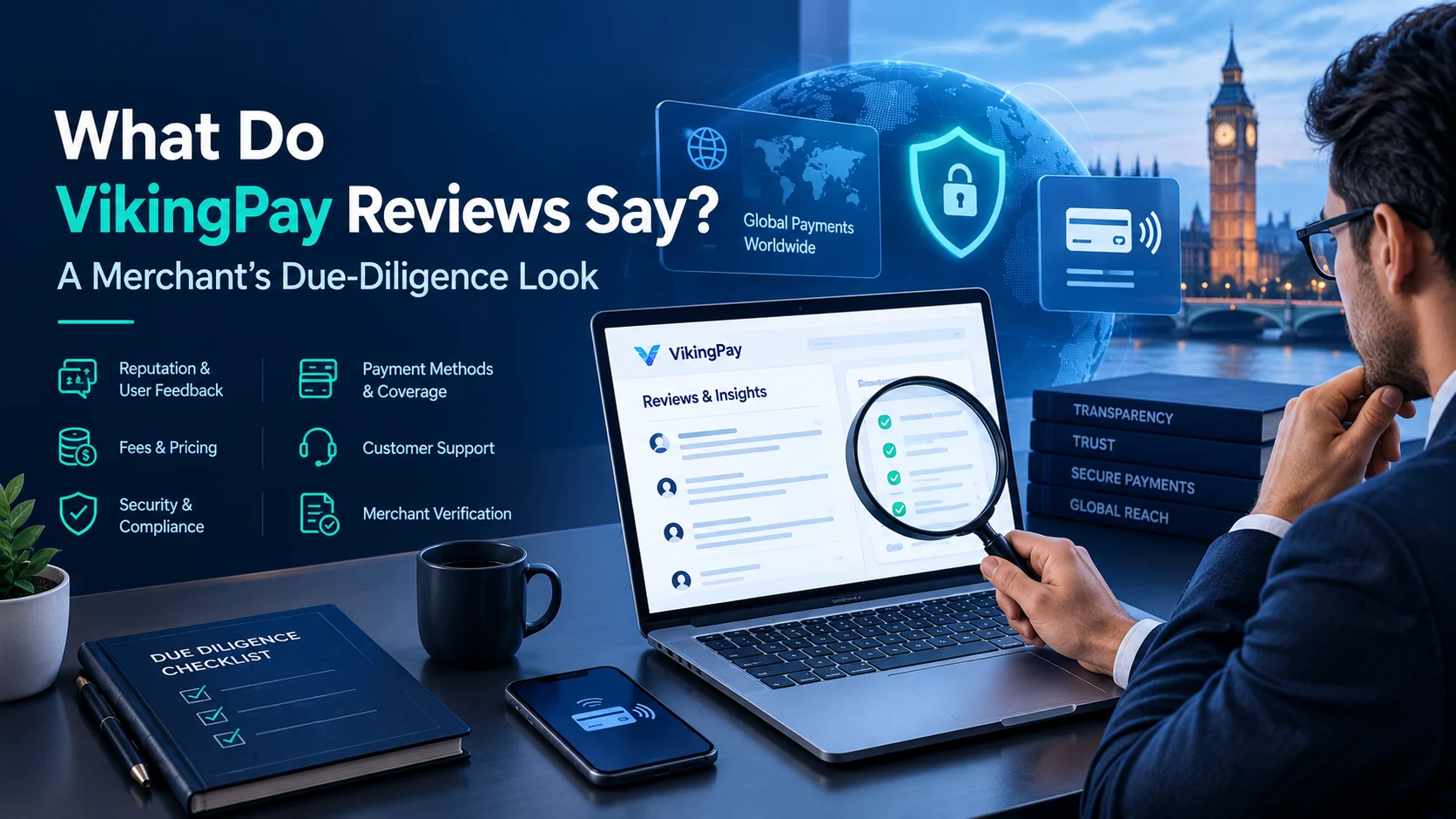
Merchants researching VikingPay before signing up quickly run into a problem: there isn’t much to read. This London-based payments consultancy has been operating since 2014, but it has almost no visible footprint on the review platforms merchants normally check, no dedicated Trustpilot page, no Glassdoor presence, no active Reddit threads. That absence is unusual enough to be worth explaining rather than skipping past.
This piece asked a simple question, what do VikingPay reviews actually say?, and then went looking for an honest answer using corporate records, the company’s own claims, and every review and discussion platform we could check.
Quick Verdict
VikingPay is a real, continuously operating UK limited company with the same two directors since incorporation in 2014 and an unbroken record of statutory filings. That’s a genuine positive signal on corporate stability. What’s missing is any meaningful third-party review record: no Trustpilot profile for vikingpay.com, no employee reviews we could locate, and no forum threads specifically about the company, positive or negative. One review-aggregation directory (PayAtlas) lists VikingPay with zero reviews. The company markets itself as a payments consultancy that connects merchants to acquiring banks and gateways rather than as a bank, acquirer, or licensed payment institution in its own right, and its site does not itself claim FCA authorisation. Because so little independent commentary exists, this assessment rests mainly on what can and can’t be verified, not on merchant sentiment, which simply isn’t public yet.
| Area | Finding |
|---|---|
| Company identity | Verified: VikingPay Ltd, UK company no. 09266612, incorporated 16 Oct 2014, active |
| Operating history | Continuous filings since 2014, no gaps, no insolvency markers |
| Regulatory position | No FCA authorisation claimed on-site; not independently confirmed either way, verify directly |
| Merchant reviews | Essentially none found on major platforms |
| Employee reviews | None found on major platforms |
| Pricing transparency | Not publicly disclosed (typical for this business model) |
| Overall evidence confidence | Low, limited independently verifiable public commentary |
What Is VikingPay?
VikingPay Ltd was incorporated in London on 16 October 2014 and is still active under company number 09266612, registered at 3rd Floor, 207 Regent Street, London W1B 3HH. Companies House lists its business activity under SIC code 66190, “activities auxiliary to financial intermediation not elsewhere classified”, a support-services classification, not a banking or payment-institution licence category.
The company has had the same two directors since day one: Tryggvi Björnsson, an Icelandic national resident in Iceland, and Mark Dominic Lambrou, a British national resident in Cyprus. Both have completed Companies House identity verification, and neither has resigned in over a decade, a degree of continuity that’s uncommon among small payments intermediaries, many of which change ownership or rebrand every few years.
On its own site, VikingPay describes itself as connecting merchants to card acquiring institutions and banking partners, rather than being an acquirer or bank itself. It says it was established in 2014 in London with “more than 50 years of combined experience” among its team, and that it offers access to over 100 card acquiring institutions and 120-plus alternative payment methods through what it calls a PCI DSS Level-1 certified gateway. Its stated services are payment gateway access, card processing, banking-services introductions, and what it calls “senior expert consultancy.” LinkedIn posts from the company describe 2023 as its best year by portfolio growth and mention a 2024 site relaunch and team expansion, including a Head of Operations hire, all company-published statements, not independently verified figures.
Third-party business-data aggregators give a rough sense of scale: one lists roughly four employees and estimated revenue near £1 million; another, drawing on a 2023 Companies House filing, cites roughly £1 million in cash and £703,000 in working capital at that time. These are useful context but should be read as secondary estimates rather than confirmed financials, VikingPay files small-company “total exemption” accounts, which disclose limited detail publicly.
Is VikingPay Legitimate?
On the question of whether VikingPay is a real, operating company: yes, and this is well supported. It has an unbroken filing history at Companies House stretching back to 2016 (its first full-year accounts), with confirmation statements and accounts submitted on schedule every year through 31 October 2025, most recently filed in March 2026. There are no insolvency notices, no struck-off warnings, and no compulsory-strike-off actions on record. That is a genuinely positive signal, a large share of short-lived or fraudulent payment “companies” either never file properly or disappear within a couple of years.
Where the picture gets thinner is on independent verification of what VikingPay does day to day. The company’s website makes specific claims, over 100 acquiring relationships, 200-plus merchants, 30 million-plus transactions, 24/7 support from offices “across Europe and Asia”, that we could not independently confirm through regulatory filings, news coverage, or third-party sources. This is common for privately held payments consultancies of this size and isn’t, by itself, evidence of a problem. But it does mean a merchant should treat these figures as company claims pending their own verification, not as facts this article can vouch for.
Regulation and Corporate Transparency
VikingPay’s own marketing is relatively careful here: it does not describe itself as a bank, an acquirer, or an FCA-authorised payment institution. It presents itself instead as a consultancy and gateway provider that routes merchants to underlying regulated acquiring banks and payment institutions, a common model in the high-risk payments space, where intermediaries manage relationships across a panel of acquirers rather than holding a licence themselves.
We were unable to independently confirm an FCA Financial Services Register entry under the VikingPay name through the sources available to us. That is not the same as confirming one doesn’t exist, firms can be listed under a different legal name, or a principal/agent arrangement, and register entries are best checked directly and recently rather than relied on secondhand. Any merchant evaluating VikingPay should search the FCA Register themselves (register.fca.org.uk) using both “VikingPay” and “VikingPay Ltd,” and separately ask VikingPay which specific acquiring banks or licensed payment institutions actually process and safeguard the funds, since that is where the regulatory protection in this kind of model actually sits.
Corporate transparency, by contrast, is reasonably strong: the legal entity, registration number, directors, and registered address are all easy to verify and consistent across sources. That’s a meaningfully different (and better) position than many high-risk-sector providers that operate through opaque or frequently changing entities.
Products, Processing and Merchant Offering
Based on its own published materials, VikingPay positions itself around four services: a payment gateway supporting a large number of payment methods, card processing across a stated 100-plus currencies via partner acquirers, introductions to business banking services through partner banks, and consultancy-style support from staff with payments-industry backgrounds. It advertises support for major card schemes and wallets (Visa, Mastercard, Apple Pay, Google Pay) and lists fraud management, chargeback protection, and point-to-point encryption among its risk-management capabilities.
None of these capabilities were independently testable from public sources, which is normal for a B2B provider that doesn’t operate a public self-serve signup flow. Merchants considering VikingPay should ask directly which acquiring banks are actually behind the processing relationships offered to their specific vertical and jurisdiction, since “over 100 card acquiring institutions” describes the breadth of VikingPay’s panel, not a guarantee that any individual merchant will be placed with all, or even most — of them.
Pricing, Reserves and Settlement
VikingPay does not publish MDR, fixed fees, monthly fees, or rolling-reserve terms, and its website invites prospective merchants to describe their business and expected turnover directly. This is standard for high-risk merchant acquiring, where pricing and reserve terms are usually set per merchant based on vertical, geography, processing history, and risk profile, a provider not publishing a universal rate card is not, on its own, a red flag.
We found no publicly available information, from reviews, forums, or news coverage, describing VikingPay’s actual settlement timelines, reserve practices, or account-closure patterns. This is a gap worth naming honestly: it isn’t evidence of a problem, but it also means a merchant currently has no independent way to gauge how VikingPay handles reserves or settlement disputes in practice, beyond asking the company directly and requesting sample contract terms before signing anything.
What Do Merchants Say About VikingPay?
This is the central question for this article, and the honest answer is: almost nothing publicly. We checked Trustpilot directly and could not locate a review profile for vikingpay.com specifically, searches instead return dozens of unrelated companies that happen to share the “Viking” name (a cruise line, an office-supplies retailer, a tyre retailer, and others), none of which are this payments company. A payments-focused business directory, PayAtlas, lists a VikingPay profile explicitly marked “No reviews (yet).” We found no Glassdoor, Indeed, or CareerBliss listings that could be confidently matched to VikingPay Ltd rather than to unrelated companies of the same name. Reddit and general web searches for VikingPay alongside terms like “scam,” “complaint,” or “review” turned up no threads discussing this specific company.
The only first-party commentary available is VikingPay’s own LinkedIn page, which, unsurprisingly, since the company controls it, describes positive growth, new hires, and team milestones. That’s useful for understanding how the company presents itself, but it is not independent evidence of merchant experience and should be weighted accordingly.
Classification: Insufficient Evidence: We are not in a position to say merchants are satisfied or dissatisfied with VikingPay, because the review record that would normally support either conclusion simply doesn’t exist in public view yet. That is different from a company having a mix of good and bad reviews, and it’s also different from a company actively suppressing negative reviews, there’s no evidence of the latter either. It most likely reflects a small, relationship-driven B2B provider whose merchants aren’t in the habit of posting public reviews, which is common in this corner of the industry.
Complaints and Red Flags
We found no regulatory enforcement actions, no consumer-protection warnings, and no credible fraud allegations tied to VikingPay in the sources checked. The absence of a public review record is worth flagging as a caution rather than a red flag: it means a merchant can’t currently lean on crowd-sourced due diligence the way they could with a more widely reviewed provider, so more of the verification burden falls on direct questions to the company and independent checks (FCA Register, references from existing merchants if VikingPay will provide any, and a careful read of the actual contract).
Is VikingPay a Scam?
Nothing in the public record supports that conclusion. VikingPay is a genuine, continuously filing UK limited company with stable, identity-verified leadership going back over a decade, traits that are inconsistent with the short-lived shell structures typically associated with scam payment operations. At the same time, the absence of independent merchant feedback means this article cannot rule concerns in or out based on reputation, because there isn’t a reputation on record yet to examine. The fair statement is that the evidence available neither supports nor contradicts a “scam” framing, it simply doesn’t exist in sufficient quantity to answer the question either way.
Who Might VikingPay Be Suitable For?
Based on published information, VikingPay’s model looks oriented toward merchants who value a consultative, relationship-based onboarding process and are comfortable working with a small team rather than a large self-serve platform, often the case in higher-risk verticals where a panel of acquiring relationships matters more than an automated signup flow. Merchants who prioritise being able to check extensive public reviews before committing, or who need documented, verifiable performance data (uptime history, named acquiring partners, third-party audit results) before onboarding, will currently find little to work with here and should ask VikingPay to provide that evidence directly, or should treat this gap as a reason to also evaluate alternatives with a stronger public track record.
Alternatives to VikingPay
Because merchant acquiring outcomes depend heavily on vertical, geography, processing history, volume, and risk appetite, no alternative is universally “better.” Merchants who specifically want a provider with an extensive, checkable public review history might compare VikingPay against larger high-risk-focused PSPs that maintain active Trustpilot or industry-forum presences, where settlement and reserve experiences are more discussable in public. Merchants prioritising a similarly consultative, panel-based acquiring model should still ask any alternative the same core questions raised in this article: which specific acquiring banks are involved, what the reserve and settlement terms look like in writing, and what independent evidence supports the provider’s stated transaction volumes and merchant count.
Final Verdict
What’s credible: VikingPay is a real, stable, continuously compliant UK company with unusually consistent leadership since 2014, and nothing in the public record suggests fraudulent intent. What’s missing: any independent merchant or employee review record, confirmed regulatory status, or third-party verification of its stated scale and capabilities. What a merchant should verify before signing: VikingPay’s FCA Register status (checked directly, recently, under multiple possible names), the identity of the actual acquiring bank(s) that will process and safeguard their funds, and full written pricing, reserve, and termination terms before any commitment is made. Given the thinness of the public review record specifically, our confidence in this assessment is Low to Moderate, solid on corporate facts, low on the merchant-reputation question the article’s title actually asks.
Sources & Methodology
This assessment draws on UK Companies House filings for VikingPay Ltd (company no. 09266612), VikingPay’s own website and job postings, LinkedIn company posts, third-party business-data aggregators (RocketReach, GlobalDatabase, Crunchbase), the payments directory PayAtlas, and direct searches of Trustpilot, Glassdoor, Reddit, and general web sources for merchant or employee commentary. No regulatory enforcement records or FCA Register confirmation were located for VikingPay specifically; readers should verify current regulatory status directly at register.fca.org.uk before relying on this article for that determination.
Comments
No comments yet. Be the first to share your thoughts.
Leave a comment