Introduction
A forex broker needs a reliable way to receive customer deposits and process approved withdrawals. Customers may use cards, bank transfers, digital wallets, local payment methods, or cryptocurrency. If the broker offers only one option, it may lose potential customers and become too dependent on one payment channel.
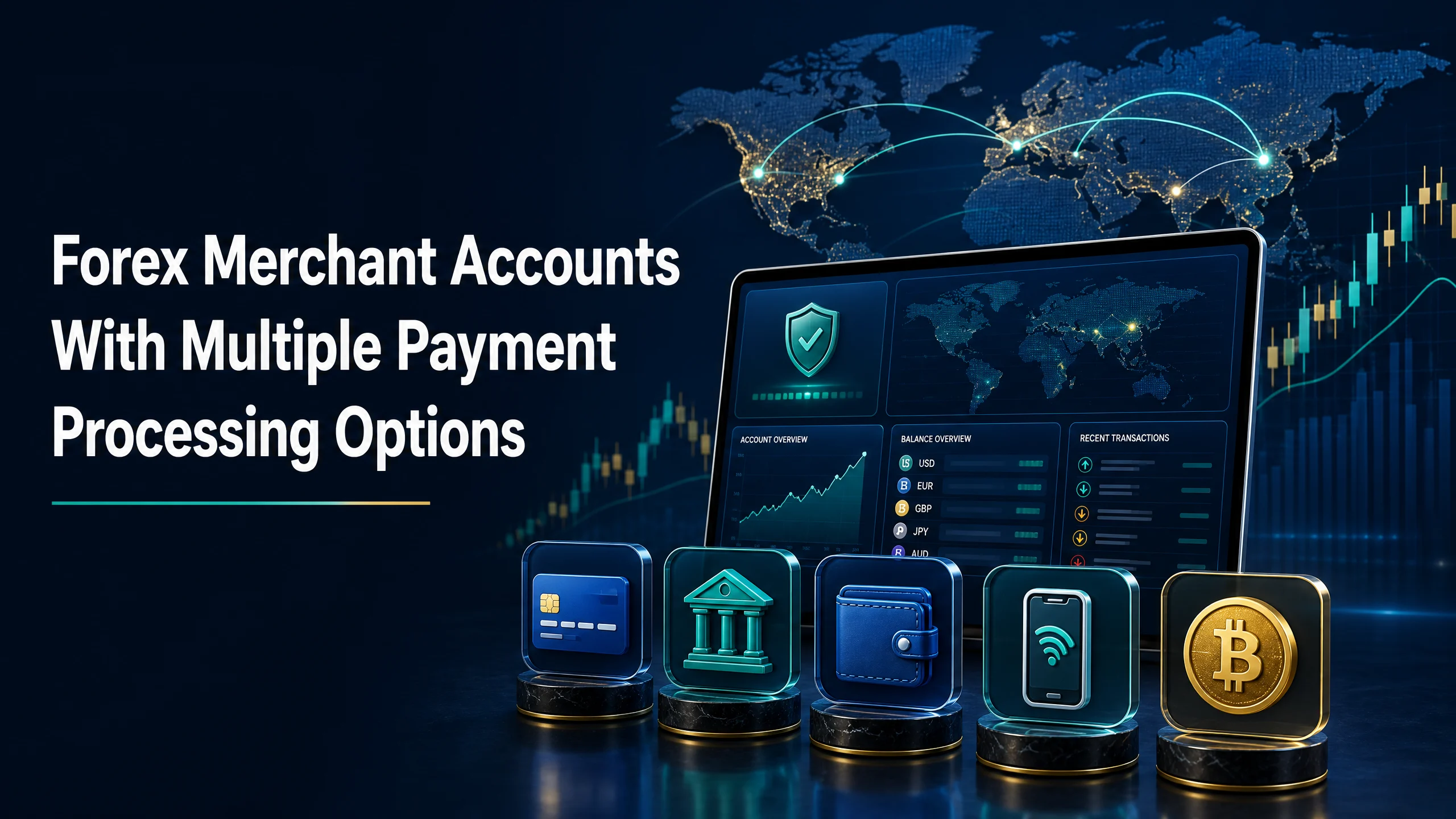
A forex merchant account with multiple payment processing options gives the broker a structured way to manage several payment methods. It can support customer convenience, reduce payment friction, and help the broker serve different regions.
However, multiple options also require more control. Each payment method has different fees, settlement times, refund rules, fraud risks, and compliance requirements. The account provider must therefore understand the forex business and its customer-funding workflow.
What Is a Forex Merchant Account?
A merchant account is a business payment account used to receive card settlements and, depending on the provider, other electronic payment proceeds. A forex merchant account is arranged for a broker or trading business that may be classified as high risk by a bank, acquirer, or processor.
The merchant account and the payment gateway are related but not identical:
Some providers offer all of these services through one platform. Others connect a broker to separate acquiring banks, gateways, and alternative payment providers.
Why Forex Is Often Treated as High Risk
Forex and contracts for difference are financially complex products. A broker may serve customers internationally, process high-value deposits, accept frequent transactions, and manage withdrawals after trading activity. These conditions can create greater exposure to fraud, disputes, regulatory issues, and liquidity pressure.
A provider may therefore ask for more information than it would request from a low-risk online retailer. The broker may need to provide its corporate documents, license information, customer agreement, website, terms, risk disclosures, compliance procedures, expected volume, and customer locations.
High-risk classification is not automatically a statement that the broker is illegitimate. It means that the payment relationship requires additional underwriting and monitoring.
Why Multiple Payment Options Matter
They serve different customer preferences
Customers do not all use the same payment method. Cards may be convenient for smaller retail deposits. Bank transfers may be preferred for larger amounts. E-wallets may be popular in certain regions. Local payment methods may be essential for customers who do not regularly use international cards.
They support different transaction sizes
A card can be convenient for a first deposit, while a bank transfer may be more suitable for a larger account funding. The broker can design limits and review procedures for each channel.
They reduce dependence on one channel
If a single card route experiences an outage, policy change, or high decline rate, alternative methods can help maintain continuity. This does not eliminate risk, but it can give the broker more operational flexibility.
They can improve regional reach
Local payment methods may be more familiar to customers than an international card checkout. The broker should select methods based on real customer demand rather than adding a large number of options that it cannot support properly.
Main Payment Processing Options for Forex Brokers
1. Credit and debit cards
Cards are widely recognized and can provide quick deposit authorization. They require strong controls because a transaction may later be disputed by the cardholder.
A broker should use a clear billing descriptor, display accurate terms, support customer authentication where applicable, and maintain evidence of the transaction and customer relationship. It should also understand how refunds and chargebacks are handled.
2. Bank transfers
Bank transfers can be useful for larger deposits and professional customers. They may have lower card-chargeback exposure, but they usually require more reconciliation work.
The broker should provide precise bank details, a unique payment reference, and a clear process for unmatched payments. It should not credit a trading account until the transfer has been received and verified.
3. Open banking and instant bank payments
In some markets, customers can authorize a direct bank payment through an open-banking or instant-payment service. These methods may provide a smoother experience than manually entering bank details.
The broker should confirm settlement timing, customer authentication, refund capability, transaction limits, and coverage for the countries it serves.
4. Digital wallets
Digital wallets can make deposits convenient and may support fast withdrawals. The provider’s terms should be reviewed carefully because some wallets restrict financial services, third-party funding, or particular customer jurisdictions.
5. Local payment methods
Local payment methods can include regional bank rails, mobile wallets, cash-based vouchers, and country-specific payment schemes. They can be valuable for customer acquisition, but each method adds another reconciliation and support workflow.
6. Crypto payments
Crypto payment processing can support customers who prefer Bitcoin, Ether, stablecoins, or other digital assets. It can also create additional compliance requirements.
The FATF states that countries should assess and mitigate the risks associated with virtual-asset activities and providers, and that relevant providers should be subject to appropriate anti-money-laundering and counter-terrorist-financing measures.
A broker should implement wallet screening, transaction monitoring, source-of-funds procedures, restricted-jurisdiction controls, and clear rules for deposits and withdrawals. It should also confirm whether it will settle in crypto or convert funds into fiat currency.
What a Strong Forex Merchant Account Should Include
Broad but relevant payment coverage
A provider should support the currencies and customer countries that matter to the broker. A long list of payment methods is not useful if those methods are unavailable to the broker’s licensed markets or cannot be reconciled efficiently.
Multi-currency settlement
The broker should ask whether it can settle in USD, EUR, GBP, or other required currencies. It should also understand the provider’s conversion rates, markups, settlement schedule, and refund rules.
Deposit and withdrawal workflows
The account should support both sides of the customer journey. Deposits should be credited only after reliable confirmation. Withdrawals should go through appropriate approval, ownership, fraud, and compliance checks.
Fraud and chargeback management
Useful tools may include 3-D Secure, risk scoring, device analysis, velocity checks, transaction rules, chargeback alerts, and case management. These tools should integrate with the broker’s internal review process.
Platform integration
The provider should support API integration or a secure hosted checkout. The broker may also need webhooks, transaction references, refunds, reconciliation reports, and integration with its CRM and trading platform.
Clear account stability terms
The broker should understand reserve requirements, settlement delays, volume limits, compliance reviews, and account-suspension procedures before accepting customer funds.
How the Payment Workflow Should Operate
A controlled workflow normally follows these stages:
1.The customer opens an account and completes the required verification.
2.The customer selects a payment option and currency.
3.The provider authorizes or receives the transaction.
4.The provider sends a secure status notification to the broker.
5.The broker verifies the notification and checks for duplication.
6.The broker credits the trading account according to its internal rules.
7.The transaction is recorded for accounting and reconciliation.
8.A withdrawal request is reviewed before payment is released.
The broker should define what happens when a payment is pending, reversed, refunded, disputed, partially received, or received from an account that does not match the customer’s verified identity.
Documents Usually Needed for Approval
The application process varies, but providers commonly want to understand the legal entity, ownership, business model, customer journey, and risk controls.
The broker should keep its website, application, marketing, and contractual documents consistent. Inconsistent information can delay approval or trigger a later review.
Costs, Reserves, and Settlement
A forex merchant account may have higher costs than a standard retail account because the provider is managing additional risk. The broker should compare the total cost of every payment option.
Potential charges include transaction fees, fixed fees, cross-border charges, currency-conversion markups, gateway fees, refund fees, chargeback fees, monthly fees, and reserve requirements.
A rolling reserve is a portion of funds held for a defined period to cover future refunds or disputes. The agreement should state the reserve percentage, release timing, calculation method, and treatment after the account is closed.
Settlement timing is equally important. A low processing fee may not be attractive if funds are settled too slowly to support normal customer withdrawals and operating costs.
Payment Security and Customer Protection
The PCI Security Standards Council states that PCI DSS protects environments where payment account data is stored, processed, or transmitted and provides baseline technical and operational requirements for protecting that data.
A broker should ask how payment data is handled and whether the provider offers hosted payment pages, tokenization, encryption, and secure API practices. It should also establish internal access controls, incident procedures, and data-retention rules.
Because forex and CFD trading can involve significant losses, customer-facing information should be accurate and prominent. The FCA warns that high-risk investments can result in the loss of some or all of an investment and that they are suitable only for a minority of consumers who understand the risks. Requirements vary by jurisdiction, but brokers should avoid misleading claims, guaranteed-return language, and unclear risk disclosures.
How to Choose the Right Provider
Start with regulatory fit
Confirm that the provider can serve the broker’s legal entity, license, customer countries, products, and marketing model. This is more important than the number of payment methods shown on a sales page.
Compare the complete payment stack
Review the gateway, merchant account, acquiring relationships, local methods, crypto support, fraud tools, settlement, reporting, and support together. A cheap gateway may not provide the acquiring coverage the broker needs.
Test the technical integration
Ask for documentation and test the most important workflows. The test should include successful deposits, failed payments, pending status, refunds, duplicate notifications, chargebacks, withdrawals, and reconciliation.
Review the commercial agreement
Look for reserve terms, settlement timing, prohibited activities, data responsibilities, volume limits, termination rights, and the provider’s ability to request additional documents.
Plan for continuity
Where permitted, the broker may consider more than one payment route or a backup provider. Any backup should be approved, tested, and included in the broker’s reconciliation and compliance procedures.
Questions to Ask a Merchant Account Provider
1.Do you explicitly accept licensed forex brokers?
2.Which payment methods can be offered to my customer countries?
3.Which currencies can customers use, and which currencies can I settle in?
4.Are deposits and withdrawals both supported?
5.What are the processing, conversion, refund, and chargeback fees?
6.Is a rolling reserve required?
7.What settlement schedule and payout limits apply?
8.Which fraud, authentication, and chargeback tools are included?
9.Can the service integrate with my CRM and trading platform?
10.What happens if transaction volume changes or a compliance review begins?
Conclusion
A forex merchant account with multiple payment processing options can help a broker serve more customers and reduce dependence on one payment channel. Cards, bank transfers, digital wallets, local payment methods, and crypto payments each have a place, but each also requires its own controls.
The best account provider should offer relevant payment coverage, multi-currency settlement, secure integration, fraud management, transparent pricing, and stable operational support. It should also understand the broker’s licensing obligations and customer-risk profile.
A thoughtful payment strategy is not about offering every possible method. It is about offering the right methods, in the right markets, with reliable reconciliation, clear disclosures, and responsible risk management.

Comments
No comments yet. Be the first to share your thoughts.
Leave a comment