
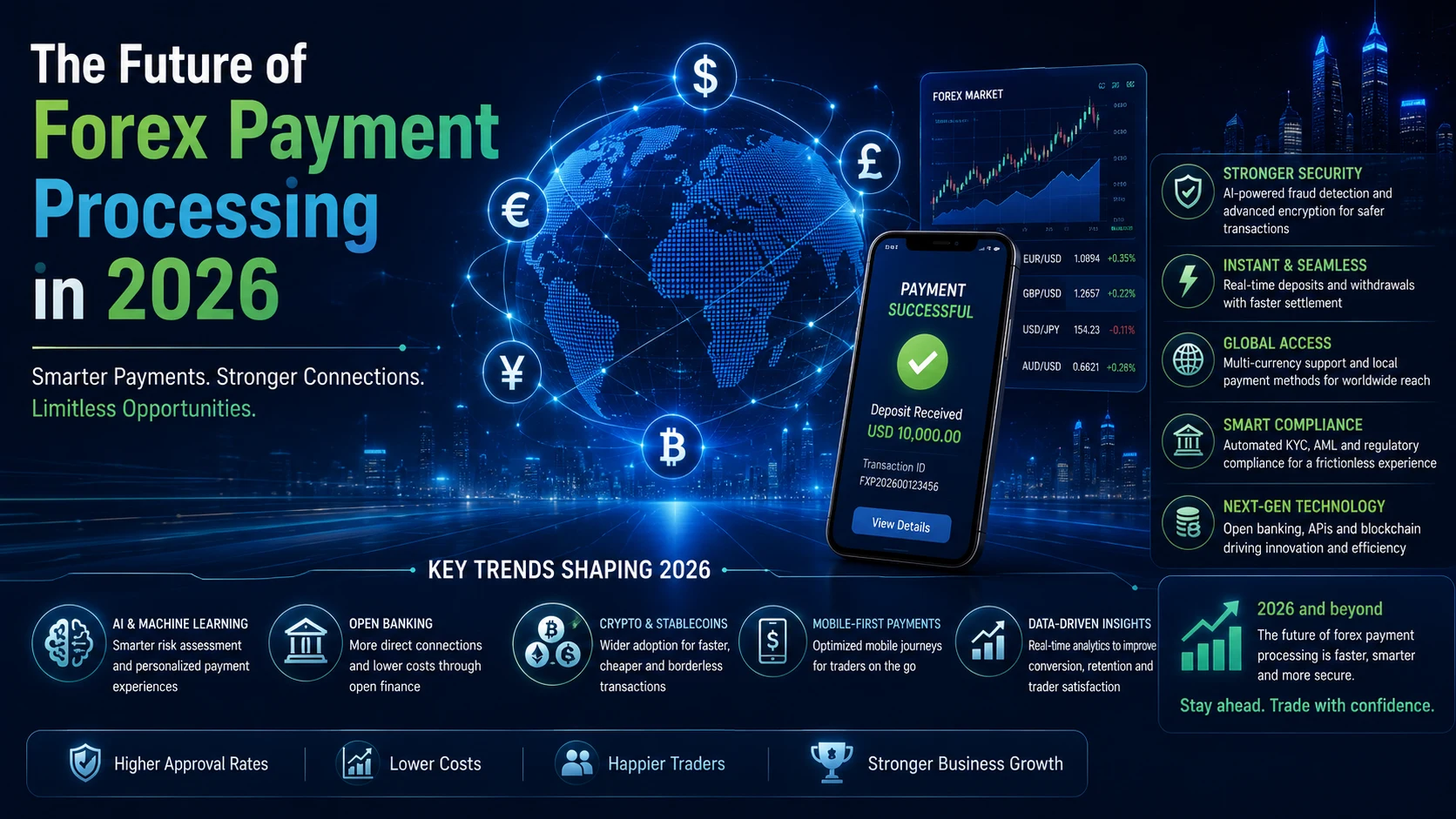
Forex brokers operate in one of the most scrutinized corners of financial services. Regulators watch closely, chargeback risk runs high, and clients expect deposits and withdrawals to move as fast as the markets they trade. In 2026, the brokers winning market share are the ones treating payment infrastructure as a growth lever, not a back-office afterthought.
This shift is being driven by AI-powered fraud detection, Open Banking rails, real-time cross-border settlement, and a new generation of orchestration platforms built specifically for high-risk verticals like Forex. Brokers that get this right convert more traders, retain them longer, and expand into new markets faster than competitors stuck on legacy processing stacks.
Why Forex Payment Processing Is a Different Game
Forex brokers don’t fit the profile of a standard e-commerce merchant. Trading accounts move large sums, clients fund from dozens of countries, and chargeback ratios sit well above what most acquiring banks tolerate.
That’s why most Forex brokers need a Forex merchant account, a specialized high-risk payment setup, not a generic small-business account. Standard merchant accounts are typically underwritten for retail transaction profiles and will freeze or terminate a Forex business the moment volume or dispute patterns look unusual.
The three defining pain points brokers face in 2026:
- Banking instability: acquiring banks periodically exit the Forex category entirely, forcing brokers to re-platform on short notice
- Cross-border friction: funding from LATAM, Southeast Asia, and the Middle East often means slow settlement and high FX conversion costs
- Compliance load: KYC, AML, and card network rules are tightening in parallel across every major jurisdiction
AI Is Rewriting Fraud Prevention for Forex Brokers
AI-driven risk scoring has moved from “nice to have” to baseline infrastructure across payment processing in 2026. Machine learning models now flag suspicious funding patterns, mismatched geolocation, rapid account creation, unusual deposit-to-withdrawal ratios, in real time, before funds settle.
For Forex brokers specifically, this matters because chargeback exposure directly threatens the relationship with acquiring banks and payment providers. A broker with a rising dispute ratio risks losing access to card rails altogether.
Modern AI fraud tools also reduce false declines. Older rules-based systems often blocked legitimate high-value traders simply because their transaction size looked anomalous. AI models trained on Forex-specific behavior patterns are far better at separating real fraud from a trader making a large, legitimate deposit.
Visa VAMP and Chargeback Thresholds
Visa’s VAMP (Visa Acquirer Monitoring Program) framework tightened again in 2026, with an effective chargeback-to-transaction threshold of 1.5%. Forex brokers sitting above this line risk monitoring fees, reserve requirements, or termination from acquiring partners.
This makes proactive fraud prevention and dispute management a direct financial priority, not just a compliance checkbox. Brokers pairing a high-risk payment gateway with real-time AI monitoring are far better positioned to stay under VAMP thresholds than those relying on manual review alone.
Open Banking Is Becoming a Core Funding Rail
Open Banking has moved well past its early adoption phase in the UK and EU and is now expanding into North America and parts of LATAM. For Forex brokers, this means clients can fund trading accounts by authorizing a direct bank-to-bank transfer instead of routing through a card network.
The advantages for brokers are significant:
- Lower processing costs compared to card-based online payments
- Reduced chargeback exposure, since Open Banking transfers are authenticated and largely irreversible
- Faster settlement, often same-day rather than the multi-day card settlement cycle
- Stronger KYC data captured directly from the client’s bank
Brokers integrating Open Banking as a funding option alongside traditional payment gateways are seeing meaningfully lower dispute rates on that channel specifically.
Instant and Cross-Border Payments Are Now the Expectation
Traders don’t tolerate slow withdrawals. A broker that takes three to five business days to release funds is handing clients a reason to switch providers. In 2026, instant payout capability is a competitive differentiator, not a premium feature.
Cross-border payments infrastructure has improved substantially, with real-time payment rails now live across more than 70 countries. For brokers with an international client base, this means:
- Faster deposit confirmation, reducing time-to-trade
- Same-day or near-instant withdrawal processing
- Lower FX conversion costs when settlement happens in local currency rather than routing through USD intermediaries
Brokers expanding into new regions increasingly rely on an offshore merchant account to access local payment rails and reduce cross-border settlement friction. An offshore merchant setup can also provide banking continuity when a broker’s primary jurisdiction tightens Forex-specific regulation.
Digital Wallets Are Reshaping How Traders Fund Accounts
Payment wallets have become a default funding method for a large share of retail Forex clients, particularly in Asia, LATAM, and parts of Africa. Wallet-based funding offers speed and familiarity, especially for younger traders who may not hold a traditional card product.
For brokers, supporting a broad range of digital payments methods, wallets, bank transfers, and cards, widens the addressable client base without requiring separate banking relationships for each region. This is where payment orchestration platforms earn their value, routing each transaction to the funding method most likely to succeed for that specific client.
Payment Orchestration: The Infrastructure Layer Brokers Actually Need
Payment orchestration platforms sit between the broker and multiple payment providers, routing transactions intelligently based on success rate, cost, and risk profile. Rather than depending on a single payment gateway, brokers can distribute volume across several providers and fail over automatically if one goes down or gets flagged.
This matters enormously for Forex brokers because:
- Redundancy: if one acquiring bank exits the Forex category, the broker isn’t left without a funding channel
- Approval rate optimization: orchestration platforms route transactions to the provider most likely to approve a given client profile
- Cost efficiency: routing logic can prioritize the lowest-cost rail for a given transaction type or region
Orchestration has effectively become the operating system for merchant services in high-risk verticals, and Forex brokers scaling into multiple regions in 2026 are treating it as core infrastructure rather than an optional add-on.
Compliance Pressure Is Rising Everywhere at Once
Regulatory scrutiny on Forex brokers isn’t concentrated in one region, it’s intensifying globally and in parallel. The FCA, CySEC, ASIC, and a growing list of LATAM regulators have all tightened client fund segregation, marketing disclosure, and KYC/AML requirements over the past 18 months.
For payment infrastructure specifically, this translates into:
- Stricter source-of-funds verification during onboarding
- Enhanced due diligence requirements for high-value deposits
- Mandatory transaction monitoring and suspicious activity reporting
- Tighter documentation standards from acquiring banks and payment providers
Brokers working with a high-risk payment gateway provider that has built-in compliance tooling, automated KYC checks, AML screening, and audit-ready transaction logs, spend far less time on manual compliance work and reduce the risk of banking relationship termination.
Building a Payment Stack That Scales Globally
Brokers looking to scale internationally in 2026 need a payment infrastructure strategy built around several core components working together:
- A dedicated Forex merchant account: with an acquirer experienced in high-risk, high-chargeback verticals
- Multiple payment gateways: connected through orchestration, so no single point of failure exists
- Open Banking and wallet support: to reduce card dependency and reach unbanked or underbanked traders
- AI-driven fraud and compliance tooling: to stay under card network chargeback thresholds
- Offshore merchant account options: to support regional expansion and banking continuity
No single provider covers all five components perfectly. The brokers building durable payment infrastructure in 2026 are working with a small portfolio of specialized payment providers rather than betting everything on one gateway relationship.
Conclusion
Forex payment processing in 2026 rewards brokers who treat infrastructure as strategy. AI fraud prevention, Open Banking, instant cross-border settlement, and orchestration aren’t isolated trends, they’re converging into a single expectation from traders: fast, reliable, low-friction funding, wherever they are in the world.
Brokers still running on a single legacy merchant account with no redundancy are exposed to exactly the kind of banking disruption that has forced competitors offline overnight. Building a diversified stack, a proper Forex merchant account, orchestrated payment gateways, Open Banking rails, and offshore banking options where needed, isn’t just risk mitigation. It’s the infrastructure that lets a broker scale into new markets without rebuilding its payment stack every time one relationship falls through.
Frequently Asked Questions
Q: What is a Forex merchant account, and why can’t Forex brokers use a standard merchant account?
A: A Forex merchant account is a specialized high-risk payment setup built to handle the chargeback ratios, transaction volumes, and regulatory scrutiny typical of Forex brokerages. Standard merchant accounts are underwritten for low-risk retail transactions and are frequently terminated once a Forex business’s volume or dispute pattern is identified.
Q: How does Visa’s VAMP threshold affect Forex brokers?
A: Visa’s VAMP framework sets a chargeback-to-transaction threshold, 1.5% effective April 2026, above which acquirers face monitoring fees, reserve requirements, or account termination. Forex brokers need proactive fraud prevention to stay under this threshold and protect their banking relationships.
Q: Is Open Banking a viable funding method for Forex trading accounts?
A: Yes. Open Banking transfers are authenticated bank-to-bank payments that settle faster than cards, cost less to process, and carry lower chargeback risk since they’re largely irreversible once authorized.
Q: What is payment orchestration, and do Forex brokers actually need it?
A: Payment orchestration is a layer that routes transactions across multiple payment providers based on approval likelihood, cost, and risk. For Forex brokers, it provides redundancy against sudden acquirer exits and improves approval rates across diverse client geographies.
Q: When should a Forex broker consider an offshore merchant account?
A: An offshore merchant account is worth considering when a broker is expanding into new regions, facing banking instability in its home jurisdiction, or needs access to local payment rails that a domestic acquirer doesn’t support.
Q: What’s the biggest payment infrastructure mistake Forex brokers make?
A: Relying on a single payment gateway or acquiring bank with no redundancy. When that relationship ends, which happens often in the Forex category, the broker can lose funding capability overnight.
Comments
No comments yet. Be the first to share your thoughts.
Leave a comment