
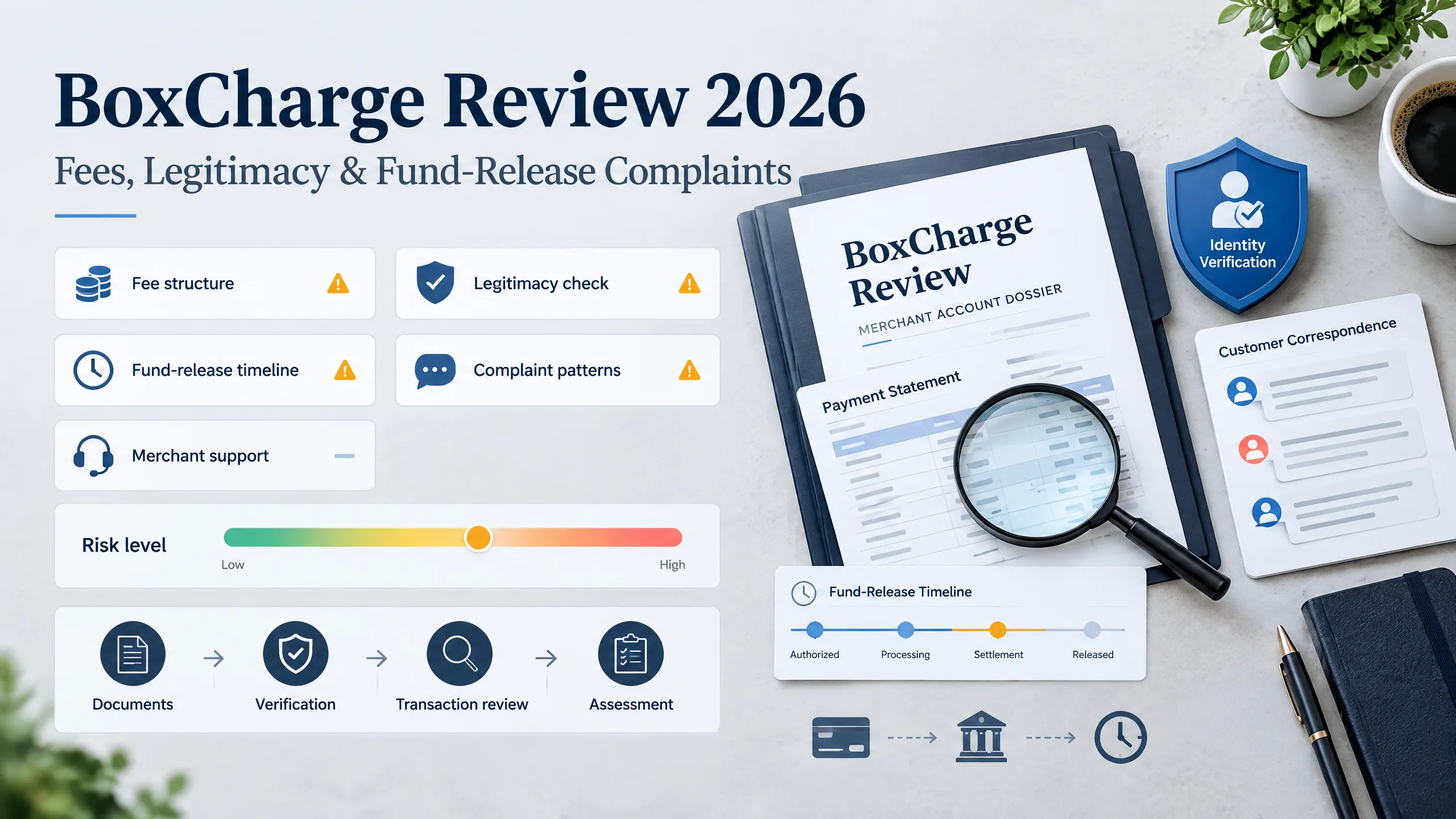
BoxCharge (boxchrge.com) markets itself as a payment orchestration platform, one API sitting on top of dozens of acquiring banks and alternative payment methods, designed to boost approval rates through “smart routing” and “cascading” transaction retries. Its target customer looks broader than a typical high-risk specialist: SaaS companies, travel agencies, marketplaces, and offshore or cross-border merchants who want one integration instead of juggling multiple regional processors.
The company’s website is unusually polished for this space, with an interactive product tour, live-looking dashboard mockups, and detailed technical documentation. That level of production is worth noting on its own, but it also raises the bar for what merchants should expect to verify before trusting the platform with settlement funds. This review focuses on what can actually be confirmed: BoxCharge’s corporate identity, its regulatory and compliance disclosures, and what independent merchant feedback exists, including a recent complaint specifically about withheld payouts, which sits in the highest-priority category of due-diligence concerns for any payment processor.
Quick Verdict
BoxCharge presents itself as a global payment orchestration layer connecting merchants to 70+ acquiring partners and 40+ local payment methods, with cascading transaction routing, developer-friendly APIs, and its own hosted checkout. The site itself is technically impressive, but its legal and compliance pages (Terms of Use, AML Policy, Privacy Policy) are largely templated placeholder text that names no specific jurisdiction, regulator, or legal entity. An older company listing on Trustpilot names a Singapore business address, but the current live website does not repeat this address or make any specific Singapore regulatory claim. Independent review volume is extremely limited, just two Trustpilot reviews, but one of them, posted in May 2026, is a serious and specific allegation that BoxCharge withheld a merchant’s payout and told them they needed to keep processing transactions to get paid. BoxCharge has not publicly responded to that review. Given the thin review base, minimal corporate disclosure, and one unresolved fund-related complaint, our overall assessment confidence is Low, and merchants should treat the fund-withholding complaint as a specific item to investigate directly with the company before signing.
| Area | Finding |
|---|---|
| Company identity | No legal entity name or jurisdiction confirmed on the live site; an older Trustpilot listing shows a Singapore address |
| Operating history | Trustpilot profile claimed since February 2025; no founding date or company history published on-site |
| Regulatory position | No specific licence, registration number, or regulator named on the current website |
| Merchant reviews | Only 2 public reviews found; one 5-star (positive, general), one 1-star alleging withheld payout (May 2026) |
| Pricing transparency | No published rates; interchange-plus/blended pricing implied, consistent with industry norms for orchestration platforms |
| Overall evidence confidence | Low |
What Is BoxCharge?
BoxCharge describes itself as a global merchant services and payment orchestration company offering a single API that connects to card networks, digital wallets, bank transfer rails, and cryptocurrency (USDT on TRC-20/ERC-20) across multiple regions. Its core pitch is that a single integration should let a merchant access dozens of acquiring relationships and local payment methods rather than negotiating and reconciling with each one separately. The company’s product pages describe cascading payment logic (automatically retrying a declined transaction through a different acquirer), smart MDR-based routing, 3DS2 authentication, tokenization, and both pay-in (collections) and pay-out (disbursement) functionality through the same settlement balance.
Industry coverage on the site spans e-commerce, SaaS, travel, education, marketplaces, professional services, logistics, and subscription/D2C brands, a broader, more mainstream mix than a typical “high-risk only” processor, though a separate solutions page also references offshore merchant accounts, suggesting the company also serves higher-risk or harder-to-place merchants. No founder names, leadership team, or company history beyond a short “why we exist” narrative are published. The company’s Trustpilot profile has been claimed since February 2025, which is the only independently dated marker of BoxCharge’s operating history that we could find.
Is BoxCharge Legitimate or Safe?
There is no confirmed regulatory action, lawsuit, or credible fraud allegation against BoxCharge in the sources we reviewed. The platform’s technical documentation, API code samples, webhook structures, a described PCI-DSS Level 1 environment, and a genuinely detailed product walkthrough, reflects real engineering investment, which is not something typically associated with a purely fraudulent shell operation.
At the same time, the company’s own legal documentation is a Material Concern from a transparency standpoint. Its published Terms of Use, AML Policy, and Privacy Policy pages are close to identical in structure and largely consist of generic statements (“information is used to operate the platform,” “operational, technical, and organizational measures are designed to support secure handling of information”) without naming a governing jurisdiction, a specific regulatory framework, or the legal entity that the merchant would actually be contracting with. For a company whose own AML Policy page contains no reference to sanctions screening, PEP checks, suspicious activity reporting, or any named regulatory framework, this is a more significant gap than simply omitting an address, an AML policy that describes no actual AML controls provides little assurance to a merchant relying on it for compliance purposes.
Regulation and Corporate Transparency
We could not locate a named legal entity, company registration number, or specific financial licence anywhere on BoxCharge’s current website. An older cached listing of the company (visible via Trustpilot’s “About” section, sourced from the company itself) lists a Singapore address, Suntec Tower 1, 7 Temasek Boulevard, but this address does not appear anywhere on the live boxchrge.com site we reviewed, and the current site makes no specific claim about Singapore licensing or regulatory status. We searched for a BoxCharge entry on Singapore’s Monetary Authority (MAS) payment services licensing framework and found no confirmable public match; this should be read as “no match found via the search tools available to us,” not as definitive proof that no such registration exists.
This combination, an address that appeared in one channel but has since disappeared from the company’s own site, paired with no specific regulatory claim anywhere, is worth flagging as a Caution rather than a confirmed problem. It may simply reflect a website redesign or brand consolidation (the domain itself, boxchrge.com, omits the “a” from “Boxcharge,” which is consistent with a rebrand or a deliberately distinct short domain). But it does mean a merchant cannot currently point to a specific regulator or registered entity and verify BoxCharge’s standing independently.
Products, Processing and Merchant Offering
BoxCharge’s stated technology stack includes: a payment orchestration layer with cascading retries across what it describes as 70+ acquiring partners; support for 40+ local payment methods across the EU, UK, MENA, LATAM, APAC, and Australia; hosted checkout and server-to-server API integration with SDKs for several common languages; 3DS2 and EMV authentication; card tokenization; velocity controls and fraud rules; and combined pay-in/pay-out functionality allowing a merchant to both collect from customers and disburse to suppliers or contractors from a single balance.
Several of the site’s most specific-looking figures, a “94.3% approval rate,” “$7.42M” processing volume, and a “0.18%” chargeback rate shown in an interactive dashboard demo, are presented within a section labeled as a “Live Product Tour” walking through what the merchant console looks like. It is not clear from the page whether these are real aggregate platform statistics or illustrative product-demo data, and the page does not label them either way. Given that ambiguity, these figures should be treated as unverified marketing illustrations rather than confirmed performance metrics, and merchants should ask BoxCharge directly whether these numbers reflect real platform-wide data or a demo scenario. Client case studies on the About page are also explicitly labeled as “anonymized,” meaning the named brands and outcomes described cannot be independently confirmed.
Pricing, Reserves and Settlement
BoxCharge does not publish a rate card, which is standard for an orchestration platform whose actual cost structure depends on which acquiring partners and payment methods a given merchant is routed through. The site references “smart MDR-based routing” and a modeled “MDR efficiency” from cost-optimal routing, alongside an interactive estimator that models potential recovered revenue from reduced declines, explicitly labeled as a “scenario model,” not a guarantee. This kind of illustrative tool is a reasonable sales aid but should not be treated as a projection of actual results for any specific merchant.
No specific reserve terms, settlement timing guarantees, or termination/exit fees are published. The site states typical onboarding takes 2–4 weeks depending on business profile and jurisdiction. As with any orchestration or aggregator-style processor, merchants should get exact settlement timing, reserve policy (if any), and exit terms in writing during onboarding rather than relying on marketing copy, since none of these terms are independently verifiable in advance.
What Do Merchants Say About BoxCharge?
Public review coverage of BoxCharge is minimal, Trustpilot shows only two reviews total, giving the company an average “Average” rating of 3.3 out of 5. Trustpilot’s own transparency flags note that BoxCharge has “no recent history of asking for reviews” and “hasn’t replied to negative reviews,” both of which are neutral facts about review-collection behavior rather than evidence of wrongdoing, but they do mean the existing two reviews are effectively the entire public record.
One reviewer, posting a 5-star review in early 2026, described the onboarding and support experience positively, calling BoxCharge “a trusted partner for payment solutions” with smooth integration. The second reviewer, posting a 1-star review in May 2026, made a specific and serious allegation: that BoxCharge completed onboarding smoothly but subsequently refused to release a payout, telling the merchant they needed to continue processing transactions before receiving their funds. The reviewer stated they would remove the review if the funds were released, and as of this research we found no public follow-up confirming resolution either way.
We found no discussion of BoxCharge on Reddit, no news coverage, and no court or regulatory records referencing the company.
Complaints and Red Flags
The single most important finding in this review is the May 2026 Trustpilot complaint alleging withheld settlement funds, a category the master due-diligence framework treats as a high-priority area precisely because merchant cash flow is at stake. With only two total reviews, this is not evidence of a pattern of fund-withholding, and providers can legitimately delay or condition payouts for contractual, compliance, fraud-prevention, or chargeback-related reasons. However, the specific detail that the merchant was reportedly told to keep processing volume in order to receive payment is the kind of claim that, if accurate, would warrant serious concern, and BoxCharge’s lack of a public response to the complaint means it remains unaddressed in the public record. We classify this as a Potential Material Concern requiring context, serious enough that a prospective merchant should ask BoxCharge directly about it, but not something we can independently confirm or refute from the evidence available.
Separately, the absence of any named legal entity or specific regulatory registration on the live site, combined with legal policy pages that read as templated placeholders rather than substantive AML/compliance documentation, is a Caution on corporate transparency grounds, consistent with (though somewhat less severe than) similar gaps seen at other newer high-risk-adjacent processors.
Is BoxCharge a Scam?
We found no regulatory findings, lawsuits, or credible third-party reporting that would support calling BoxCharge a scam. The depth of its technical documentation and product build suggests genuine operational investment rather than a fly-by-night operation. The single fund-withholding complaint is a serious allegation, but one unresolved merchant dispute, without a company response either confirming or denying the circumstances, is insufficient evidence to establish a pattern of fraudulent fund retention. Several apparently independent, recent, and materially similar complaints would meaningfully raise our concern level; we do not have that here.
The honest position is that the evidence is insufficient to call BoxCharge either clearly trustworthy or a scam. Merchants considering the platform, especially those planning meaningful processing volume, should treat the payout complaint as a specific question to raise directly with BoxCharge, asking about typical settlement timing, reserve conditions, and what circumstances (if any) could delay a payout, before committing significant volume.
Who Might BoxCharge Be Suitable For?
Merchants who want a single integration across many payment methods and geographies, particularly SaaS, subscription, marketplace, or cross-border e-commerce businesses expanding into new regions without standing up local entities or acquiring relationships, may find BoxCharge’s orchestration model relevant on paper. The developer tooling (multiple SDKs, webhooks, hosted checkout) suggests a reasonably mature technical integration path for teams that want to move quickly.
Merchants who prioritize verified corporate and regulatory transparency, or who plan to process significant volume and cannot tolerate settlement uncertainty, should treat the current gaps here, an unnamed legal entity, no confirmable licence, and an unresolved payout complaint, as reasons to proceed cautiously and to request documented settlement guarantees, reference checks, and a smaller initial processing volume before scaling up.
Alternatives to BoxCharge
As with any payment-orchestration or cross-border acquiring evaluation, the right alternative depends on the merchant’s vertical, target geographies, volume, and risk profile, a SaaS company processing recurring EU subscriptions has different needs from a LATAM-facing marketplace. Merchants comparing BoxCharge should weigh disclosed regulatory status, review volume and recency (particularly around settlement reliability), the breadth of genuinely confirmed acquiring relationships versus advertised totals, and stated versus real-world settlement timing. Providers with a longer, better-documented independent review history and named regulatory registrations relevant to the merchant’s specific corridors are generally easier to vet than newer platforms with thin public track records.
Final Verdict
BoxCharge presents a technically sophisticated payment orchestration platform with a broad advertised feature set spanning routing, checkout, and payouts. What’s credible: the depth of its developer documentation and product design suggests a real, functioning platform rather than a bare-bones shell site. What remains a concern: no publicly named legal entity or specific regulatory registration on the current site, templated rather than substantive compliance documentation, an extremely thin independent review base, and one unresolved, unaddressed complaint alleging withheld merchant funds.
Before signing, a merchant should verify BoxCharge’s full legal entity name and jurisdiction of incorporation; confirm whether it holds any relevant payment services licence in the markets it serves; get exact settlement timing, reserve conditions, and exit terms in writing; and, ideally, speak directly with existing merchants in a comparable vertical or region for a reference check that the public record currently cannot provide. Given the limited independent evidence, and particularly the unresolved payout complaint, our confidence in this assessment is Low, and we’d treat that complaint specifically as something to ask BoxCharge to address directly rather than something to dismiss because of the small sample size.
Sources & Methodology
This assessment is based on publicly available information reviewed in September 2026, including BoxCharge’s own website (homepage, About, Contact, Terms of Use, AML Policy, and product/solution pages), independent review coverage on Trustpilot, general web search for news coverage and forum discussion, and a search of Singapore’s Monetary Authority payment services licensing information. No acquiring-bank relationships, internal risk policies, or merchant-specific commercial terms were available publicly and none have been assumed or invented in this article. Where information could not be independently verified, including the Trustpilot-listed Singapore address, and the specific figures shown in BoxCharge’s product-tour demo, it is labeled accordingly rather than presented as fact.
Comments
No comments yet. Be the first to share your thoughts.
Leave a comment