
I’ve sat in on enough underwriting reviews to know the pattern by heart: a merchant applies, gets declined, and calls me confused because “the business is completely legitimate.” It usually is. The problem is almost never legitimacy, it’s that nobody explained what underwriters are actually looking for before the application went in. After years of watching Hong Kong crypto applications succeed and fail, I can tell you the checklist isn’t a mystery. It’s just rarely written down in plain language. So here it is.
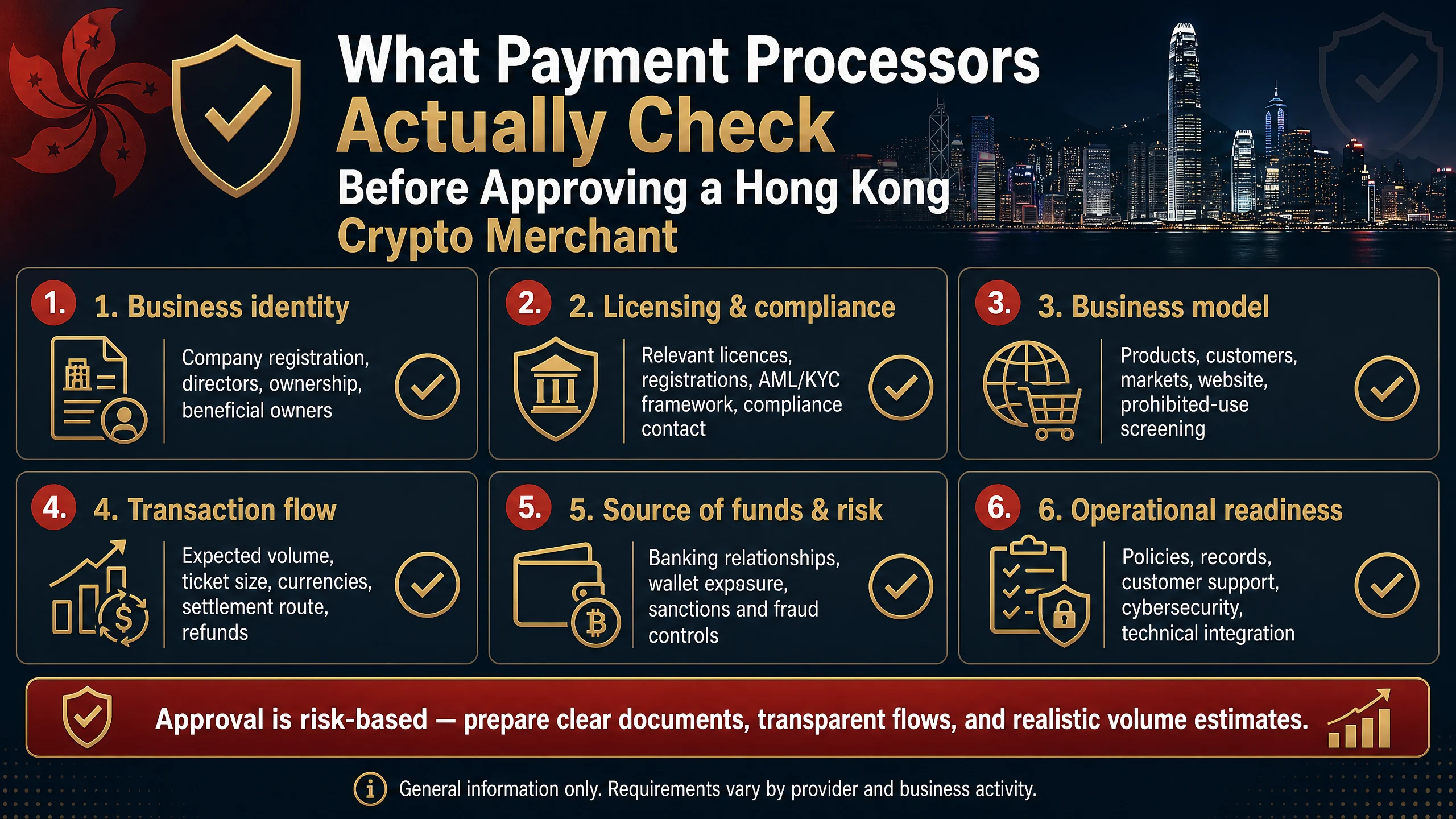
Underwriters approving Hong Kong crypto merchants verify five things, in roughly this order: corporate structure and beneficial ownership, licensing status under SFC or HKMA rules, source of funds, prior processing history, and website/disclosure accuracy. In my experience, licensing ambiguity, not fraud risk, is the single biggest cause of preventable declines. Businesses in gambling, forex, adult, or unlicensed custody almost always need a high-risk payment gateway rather than a standard merchant account, and applying to the wrong category wastes weeks.
Why I Treat Hong Kong Underwriting as a Different Discipline Entirely
I’ve underwritten and reviewed crypto merchant files across several APAC jurisdictions, and Hong Kong is genuinely stricter than most people expect going in. That’s not an accident, the SFC and HKMA operate what regulators themselves describe as a “trust but verify” model, shaped by real scandals that damaged confidence in unregulated platforms. I’ve seen direct VASP licensing quotes run past HKD 8 million with 14-to-22-month timelines, which is exactly why most of the merchants I work with pursue a processor relationship or introducer model instead of chasing a standalone license.
Here’s the part that took me a while to fully internalize, and that I now explain to every new client: a processor approving a Hong Kong crypto merchant isn’t only evaluating the merchant. It’s evaluating whether approving that merchant creates licensing exposure for the processor itself. Once you see underwriting through that lens, the entire checklist makes a lot more sense, it’s risk transfer, not just risk assessment.
The Checklist, In the Order I’ve Watched Underwriters Actually Apply It
1. Business Registration and Corporate Structure
This is the floor, not the differentiator. A valid Hong Kong Business Registration Certificate, incorporation documents, and a clean, explainable ownership chart. I’ve watched otherwise strong applications stall for weeks over a corporate structure nobody on the merchant’s side could clearly diagram. If your own team can’t explain the ownership chain in two minutes, neither can the underwriter, and that ambiguity gets treated as risk.
2. Licensing Status
This is where crypto underwriting genuinely diverges from standard merchant services review, and it’s the check I see trip merchants up most. If the business operates as a VASP, trading, custody, or dealing, underwriters check for SFC licensing or a properly documented exemption. If it issues or handles stablecoins, the HKMA’s Stablecoins Ordinance applies instead. I’ve had merchants tell me confidently “we’re exempt” with nothing on paper to back it up. That’s an instant flag, every time.
3. Beneficial Ownership and “Fit and Proper” Screening
Licensed VASPs need at least one SFC-approved Responsible Officer who passes a fit-and-proper test. Even non-VASP merchants get a lighter version of this scrutiny, ultimate beneficial owners screened against sanctions lists and adverse media. I always tell clients: assume every owner above 10% equity gets individually checked, because they will be.
4. Source of Funds and Transaction Purpose
Wallet transaction logs alone have never been enough in any file I’ve reviewed. Underwriters want invoices, supplier contracts, or other evidence that real goods and services sit behind the transaction volume. This is the step merchants most often underestimate, because they assume blockchain transparency substitutes for documentation. It doesn’t.
5. Prior Processing and Chargeback History
If you’ve had a prior processor, expect to hand over statements. A pattern of terminations or elevated chargeback ratios doesn’t automatically kill an application in my experience, but it almost always triggers a rolling reserve requirement as the price of approval.
6. Website, Terms, and Disclosure Compliance
I check this myself before I let a client submit anything: does the live website’s service description match what was actually told to the processor, and is the regulatory disclosure, if the business is subject to SFC or HKMA rules, visible and accurate? Mismatches here are one of the most common decline triggers I’ve personally seen, and one of the easiest to fix before applying.
Industries I Automatically Flag for Extra Scrutiny
Certain business types get routed to enhanced due diligence regardless of how clean the paperwork looks, and I tell clients this upfront so nobody’s surprised:
- Unlicensed token issuance or ICO-adjacent activity: treated as high-risk by default given SFC enforcement history.
- OTC crypto desks: I’ve seen enforcement reach operations turning over as little as HKD 180,000 a month, so this gets scrutinized closely no matter the size.
- Gambling, forex, and adult industry crypto acceptance: high chargeback and reputational risk regardless of the payment rail underneath.
- Custody or wallet services without a clear license path: the SFC’s expanding licensing categories mean unlicensed custody is close to an automatic decline now.
- Cross-border remittance-style crypto activity: overlaps with money service operator rules and invites deeper AML review.
If your business sits in any of these categories, my honest advice is to skip mainstream processors entirely and go straight to a high-risk payment gateway specialist. I’ve watched merchants burn a month collecting declines before someone finally pointed them toward the right category of provider.
What I Tell Clients to Prepare Before They Apply
| Document Category | What Underwriters Actually Want to See |
|---|---|
| Corporate | Business Registration Certificate, incorporation documents, org chart |
| Licensing | SFC/HKMA license (if applicable) or documented exemption rationale |
| Ownership | Beneficial ownership declaration, ID and address proof for UBOs |
| Financial | Bank statements, source-of-funds documentation, prior processor statements |
| Operational | Website audit, terms of service, AML/KYC policy documentation |
| Compliance | Sanctions screening results, adverse media check summary |
Every client I’ve walked through this checklist before applying, rather than after a decline, has moved through underwriting noticeably faster. It’s the difference between weeks of document requests and a single clean submission.
What Happens After You’re Approved
Approval isn’t the finish line, and I make sure clients understand that going in. Processors run ongoing monitoring, refreshed sanctions checks, transaction pattern review, and periodic document updates for higher-risk accounts. I’ve seen clean, approved merchants get pulled back into review purely because volume spiked sharply or a beneficial owner changed without anyone flagging it.
This mirrors the discipline licensed VASPs themselves operate under, material changes like new ownership or new senior personnel need SFC pre-clearance before they happen. My advice to every approved merchant: tell your processor about material changes before they notice on their own. I have never seen voluntary disclosure treated worse than a discovered discrepancy. Never.
The Introducer Route: What I Actually Think About It
Given how expensive and slow direct SFC licensing is, a lot of the merchants I advise route through an introducer model instead, partnering with an already-licensed VASP rather than seeking a standalone license. It’s faster and dramatically cheaper. The trade-off I make sure every client understands: your activity is now dependent on that partner’s licensing standing, so the due diligence has to run both directions. I always tell clients to verify the introducer’s own licensing documentation and SFC standing with the same rigor the introducer is applying to them.
A Pattern I Wish More Merchants Understood Before They Apply
The single biggest gap I see isn’t in documentation quality, it’s in sequencing. Merchants tend to build the product, launch the website, start taking orders, and only then think about payment infrastructure. In a standard online payments context, that order works fine. In Hong Kong crypto underwriting, it backfires constantly, because by the time the merchant applies, the website already exists with whatever disclosures, or lack of them, the team happened to write months earlier.
I now tell every client to treat the compliance and underwriting conversation as a pre-launch step, not a post-launch fix. That means drafting terms of service and regulatory disclosures with an underwriter’s checklist already in mind, not scrambling to patch a live site after a decline letter arrives. It sounds like a small operational shift. In practice, it’s the difference between a same-week approval and a month of resubmissions.
The second pattern worth naming: merchants who’ve been declined once tend to reapply to a near-identical processor expecting a different outcome. I understand the instinct, but if the decline reason was licensing ambiguity or an unclear ownership structure, applying to another mainstream processor with the same unresolved gaps just produces the same result. The fix isn’t a different processor, it’s fixing what triggered the decline in the first place, then reapplying with that resolved. I’ve seen merchants save real time simply by asking the declining processor for the specific reason, rather than guessing.
What Separates a Fast Approval From a Slow One, in My Experience
Having reviewed enough of these applications, the fastest approvals share a few traits every time: the licensing position is stated clearly and backed with documentation, the beneficial ownership chart is a single clean diagram rather than something pieced together on request, and the website matches the application word for word. None of that is complicated. It’s just rarely prioritized until after the first decline forces the issue.
Frequently Asked Questions
How long does crypto merchant approval take in Hong Kong? In my experience it varies sharply by risk profile, a few days for clean, well-documented applications, several weeks for anything requiring enhanced due diligence.
Do all Hong Kong crypto merchants need an SFC license? No. It depends entirely on the specific activity. A merchant simply accepting crypto as payment is a different risk category than a business running a trading platform or custody service.
What is a rolling reserve and why do crypto merchants get one? It’s a percentage of transaction volume held back for a set period to cover potential chargebacks or losses. I see it applied most often to merchants with a prior termination or elevated risk profile.
Can a merchant with a prior account termination still get approved? Sometimes, but only with full disclosure upfront. I generally steer these clients toward specialist high-risk payment gateway providers rather than mainstream processors.
Does using a licensed VASP as a payment partner help approval odds? Yes, in my experience it consistently does. Routing through a licensed VASP or introducer reduces the processor’s own licensing exposure, which tends to improve approval odds for the merchant.
What’s the single biggest reason for a quick decline? Undisclosed or unclear licensing status. I’ve seen it outweigh almost every other risk factor in an underwriter’s decision.
Comments
No comments yet. Be the first to share your thoughts.
Leave a comment