
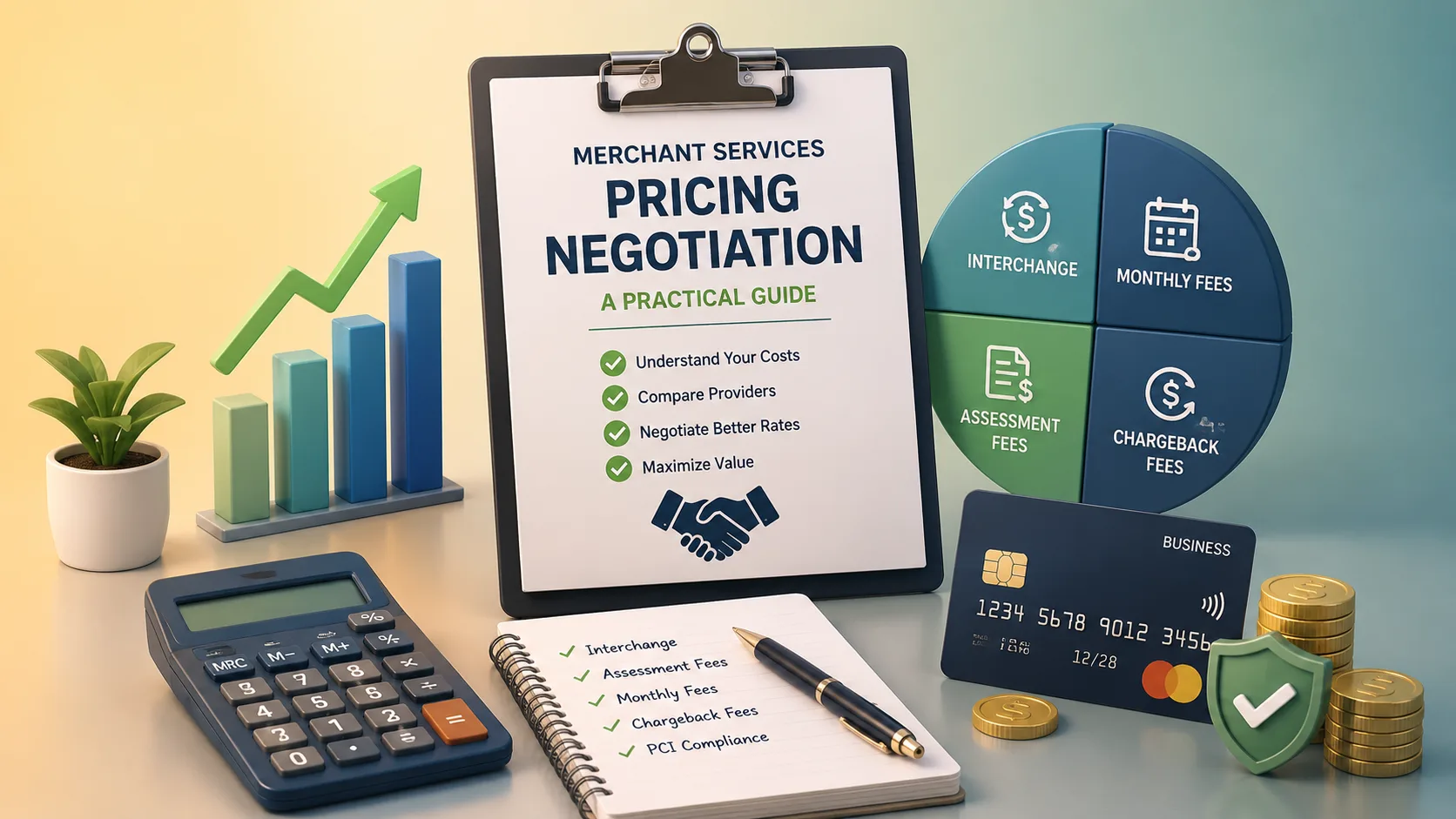
Most small businesses accept whatever rate their payment provider quotes and never look at the statement again. That’s a mistake. A meaningful part of a typical merchant payment bill is negotiable, you just need to know which line items to push on and which ones are fixed by the card networks no matter who you call.
TL;DR:
You can’t negotiate interchange, it’s set by Visa and Mastercard and identical across every processor. What you can negotiate is your processor’s markup, monthly fees, gateway costs, and contract terms. SMBs that separate these line items, get competing quotes, and negotiate from a position of transaction data, not guesswork, typically shave real basis points off their effective rate.
Why Merchant Services Pricing Is Negotiable (But Not All of It)
Every card transaction has three cost layers: interchange, network assessments, and processor markup. Understanding which layer is fixed and which is flexible is the foundation of any negotiation.
- Interchange fees: go to the card-issuing bank and are set by the networks. They’re identical whether you process through a giant acquirer or a two-person payment processing startup, and they update twice a year, typically in April and October.
- Network assessments: are small fees charged directly by Visa, Mastercard, and the other card networks. Also fixed, also non-negotiable.
- Processor markup: is what your merchant services provider adds on top. This is pure profit for the provider, and it’s the only layer where negotiation actually moves the needle.
Any sales rep who promises to “get you a better interchange rate” is either misinformed or hoping you don’t know better. The real conversation should be about markup, not interchange.
Know Your Numbers Before You Negotiate
Walking into a renegotiation without data is the single biggest reason SMBs leave money on the table. Before calling your provider, pull the last 90 days of statements and calculate:
- Effective rate: total fees divided by total processing volume, expressed as a percentage
- Total monthly fees: everything beyond per-transaction costs, statement fees, PCI compliance fees, gateway fees, terminal rental, batch fees
- Downgrade rate: how often transactions fail to qualify for the best interchange category and get bumped into a more expensive tier
- Card mix: the split between debit, standard credit, and rewards or corporate cards, since rewards cards carry meaningfully higher interchange than basic ones
If your statement doesn’t clearly separate these buckets, that itself is a signal. Bundled and tiered pricing models are structured to obscure where the money actually goes, which makes it far harder to know what’s negotiable and what isn’t.
Push for Interchange-Plus Pricing First
Before negotiating a lower number, negotiate a more transparent pricing model. Interchange-plus (sometimes called cost-plus) pricing separates the fixed interchange cost from the processor’s markup, showing exactly what you’re paying for each.
This matters because bundled or flat-rate pricing folds everything into one number, making it nearly impossible to tell whether your provider’s markup is competitive or padded. Once you’re on interchange-plus:
- You can directly compare markup percentages across competing payment providers
- You can spot and challenge downgrade fees, since they show up as separate line items
- You can negotiate the markup specifically, rather than an opaque blended rate
A competitive markup for most SMBs lands in a modest percentage plus a few cents per transaction, though the exact range depends on volume, average ticket size, and risk profile. Even without changing anything operationally, tightening the markup and removing junk fees can shave a noticeable amount off the effective rate.
Fix Downgrades Before You Negotiate Anything Else
Downgrades are one of the quietest profit killers in merchant services. They happen when a transaction fails to meet a card network’s criteria for its best-qualified rate, a missing AVS match, a delayed batch settlement, an incomplete data field, and gets reprocessed at a higher-cost tier.
Even a small downgrade rate compounds into meaningful losses over a year. Before asking a processor for a better markup, ask them to audit your downgrade rate. A provider that can’t explain your downgrades, or won’t help fix them, isn’t a provider worth staying with, regardless of the quoted rate.
What You Can and Can’t Negotiate: A Quick Reference
| Line Item | Negotiable? | Notes |
|---|---|---|
| Interchange fees | No | Set by card networks, identical everywhere |
| Network assessments | No | Fixed fees from Visa/Mastercard/etc. |
| Processor markup | Yes | The main lever, negotiate this directly |
| Monthly account fees | Yes | Often waivable, especially for established accounts |
| PCI compliance fees | Yes | Some providers absorb this entirely |
| Gateway fees | Yes | Varies widely by payment gateway provider |
| Early termination fees | Sometimes | Negotiate at signing, not after |
| Batch/statement fees | Yes | Frequently negotiable or waivable |
Getting Competing Quotes Without Wasting Everyone’s Time
Leverage in a merchant services negotiation comes almost entirely from having a real alternative. Requesting quotes from two or three payment providers, including at least one that specializes in your business category, gives you actual comparison data instead of a single number to react to.
When requesting quotes:
- Share your actual 90-day statement, not a rough estimate, so quotes are apples-to-apples
- Ask each provider to quote interchange-plus pricing specifically
- Request a full fee schedule, not just the headline rate
- Ask directly about contract length, early termination penalties, and rate-increase clauses
Once you have two or three real quotes, bring the best one back to your current provider. Most established processors would rather renegotiate markup than lose an account outright, and retention pricing is often the fastest path to savings without the operational disruption of switching merchant accounts.
Special Considerations for Higher-Risk and Cross-Border SMBs
Not every SMB negotiates from the same starting point. Businesses with higher chargeback exposure or international sales face a different pricing conversation entirely.
- High-risk categories: subscription businesses, high-average-ticket sellers, or industries card networks flag as elevated risk, are often pushed toward a high-risk payment gateway with higher markup and rolling reserves. Negotiation here focuses less on matching standard-merchant rates and more on reserve terms, chargeback thresholds, and reserve release timelines.
- Travel and booking businesses: sit in an unusual spot: high average order values, long gaps between booking and fulfillment, and a naturally elevated dispute rate from cancellations and itinerary changes. That combination often pushes travel SMBs toward higher processor markup by default, so negotiation should focus on reserve percentage and chargeback allowances as much as the headline rate.
- Cross-border sellers: should confirm currency conversion markup and local acquiring costs separately from domestic processing fees, these are frequently priced as an add-on and rarely disclosed upfront.
- Multi-channel merchants: running online payments alongside in-person sales should negotiate gateway and terminal fees as a bundle, since providers often have more flexibility when quoting the full digital payments and in-person stack together rather than piece by piece.
What to Actually Say During the Negotiation
Having the data is only half the battle, how you frame the conversation matters too. A few approaches that tend to work better than a blunt “lower my rate” request:
- Lead with the comparison, not the complaint: “I’ve got a quote from another provider at X% interchange-plus, can you match or beat that?” is far more effective than simply asking for a discount with no anchor point.
- Separate the ask into specific line items: Instead of one vague request, ask for the markup reduced to a specific figure, the monthly fee waived, and the PCI fee removed, three concrete asks are easier to act on than one broad one.
- Ask what’s included in the renewal, not just the new-customer rate: Promotional rates are common at signup; the real number that matters is what happens after the first year.
- Get any verbal concession in writing: before treating it as final, updated pricing should show up in an amended agreement or written confirmation, not just a phone call.
If a rep says a rate simply “can’t be changed,” ask to speak with a retention or account management team, the first line of support often has less pricing authority than the team responsible for keeping accounts from leaving.
Common Negotiation Mistakes SMBs Make
- Negotiating without statement data: which leaves no anchor point for the conversation
- Focusing only on the headline rate: while ignoring monthly, PCI, and gateway fees that add up separately
- Accepting a long contract term for a small discount: which locks in pricing that becomes uncompetitive within a year or two
- Assuming loyalty earns better pricing automatically: most providers only adjust rates when a merchant demonstrates they’re willing to leave
- Skipping the renewal conversation entirely: letting a promotional rate quietly expire into a much higher standard rate
When to Revisit Your Merchant Services Pricing
Pricing isn’t a one-time negotiation. Interchange rates update twice yearly, processing volume changes, and providers frequently introduce new fees without much notice. A reasonable cadence is:
- Review statements quarterly for new or increased fees
- Renegotiate markup annually, or sooner if processing volume grows significantly
- Re-shop competing quotes every 12-18 months, even if you don’t plan to switch, simply to keep your current provider’s pricing honest
Frequently Asked Questions
Can I negotiate interchange fees directly with my processor?
No. Interchange is set by the card networks and is identical across every processor. What’s negotiable is the markup your processor adds on top of interchange.
What’s a reasonable processor markup for a small business?
It varies by volume, average ticket size, and industry risk, but interchange-plus pricing typically lands in a modest percentage plus a small per-transaction fee for most SMBs. The specific number is less important than being able to see it clearly and compare it against competing quotes.
Is switching merchant accounts worth the disruption if my current provider won’t budge? Sometimes, but it’s worth exhausting the renegotiation conversation first using a competing quote as leverage. Many providers will match or beat a competitor’s offer rather than lose the account.
Do payment gateways and merchant accounts get negotiated separately?
They can be, but bundling the negotiation, gateway fees, merchant account markup, and any add-on fraud or reporting tools, often gives you more leverage than negotiating each piece individually.
How often do interchange rates change?
Typically twice a year, in April and October, as set by Visa, Mastercard, and other card networks. Processor markup can change at any time per your contract terms, which is why reviewing statements regularly matters.
Comments
No comments yet. Be the first to share your thoughts.
Leave a comment