
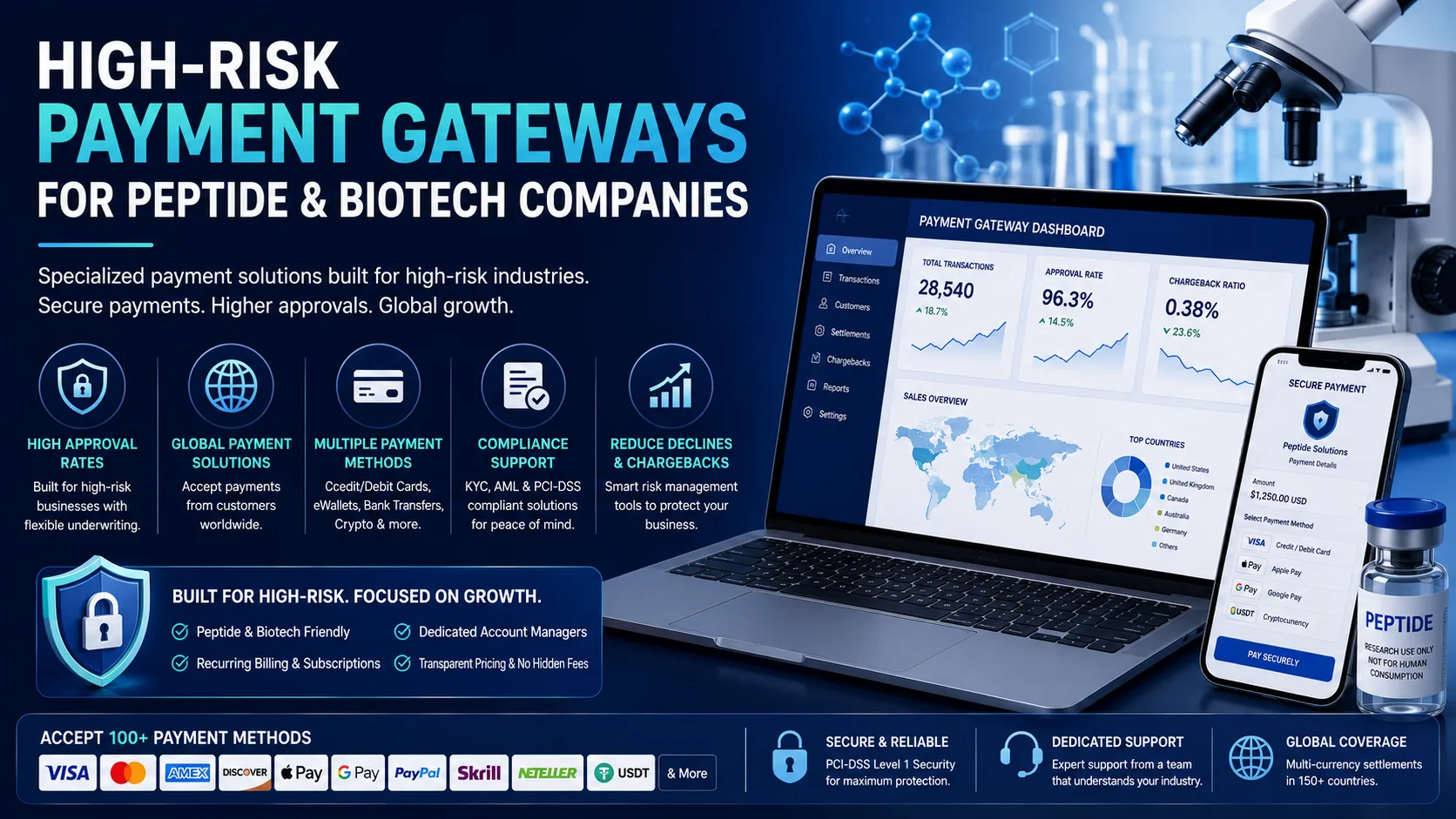
Peptide retailers aren’t the only businesses in this category struggling with payment infrastructure. Contract research organizations, compounding pharmacies, GMP-certified peptide manufacturers, and biotech startups selling research reagents all hit the same wall, mainstream payment gateways treat the entire life-sciences-adjacent space as one undifferentiated risk bucket, regardless of whether the buyer is an individual consumer or an accredited research institution.
This guide takes a more technical angle than the rest of this content cluster: what actually makes a high-risk payment gateway suitable for peptide and biotech businesses specifically, how the integration and compliance architecture differs from a standard e-commerce gateway, and, because this space attracts more than its share of overstated marketing claims, what to verify before trusting a vendor’s promises.
Peptides and Biotech Aren’t Identical Risk Profiles
Before getting into gateway architecture, it’s worth separating two audiences this guide serves, because they need meaningfully different infrastructure:
- Direct-to-consumer peptide retailers: selling research peptides to individual buyers online, facing high chargeback exposure, MCC-based rejection, and the compliance issues covered in depth elsewhere in this cluster
- B2B biotech and research-adjacent businesses: labs, CROs, compounding pharmacies, and manufacturers selling primarily to institutional buyers, where transaction sizes are larger, chargeback risk is lower, but underwriting scrutiny around regulatory compliance and product legitimacy is often just as strict
A gateway well-suited to high-volume consumer card transactions isn’t automatically well-suited to a biotech company invoicing research institutions for six-figure orders, the payment rails, settlement expectations, and documentation requirements diverge meaningfully between the two.
What Makes a Payment Gateway “High-Risk” vs. Standard
Technically, the difference between a standard and high-risk payment gateway isn’t just pricing, it’s the underlying architecture and risk tooling built around the transaction flow.
Standard gateways (built for low-risk retail):
- Fast, largely automated underwriting with minimal manual review
- Standard fraud tooling calibrated for typical e-commerce fraud patterns
- Flat-rate or simple tiered pricing
- Limited tolerance for elevated chargeback ratios before automatic review or termination
High-risk gateways (built for peptide/biotech-adjacent categories):
- Manual, documentation-heavy underwriting that reviews the actual business model, not just an MCC lookup
- Layered fraud tooling, velocity checks, device fingerprinting, AVS/CVV verification, and gateway-provided risk APIs, calibrated for categories with elevated dispute rates
- Interchange-plus or negotiated pricing that reflects actual risk rather than a one-size-fits-all flat rate
- Rolling reserve structures built to absorb elevated chargeback exposure without triggering automatic termination at the first sign of volatility
- Multiple acquiring bank relationships, since a single-bank dependency recreates the same termination risk the merchant is trying to solve
Understanding this distinction matters because it explains why “just use a high-risk-friendly setting on a mainstream gateway” doesn’t actually solve the underlying problem, the architecture underneath isn’t built for the category, regardless of what settings are toggled on.
Core Technical Components of a Properly Built Gateway
1. Tokenization and PCI-Compliant Data Handling
A gateway should replace sensitive card data with tokens immediately, vaulting payment methods within the gateway’s PCI-compliant environment rather than storing raw card data in the merchant’s own systems. For peptide and biotech businesses running subscription or repeat-purchase models, this token reuse also reduces the merchant’s own PCI compliance scope significantly, since sensitive data never touches internal systems directly.
2. Hosted Fields or Tokenized Client-Side Integration
Rather than handling raw card numbers directly, well-architected gateways provide hosted fields or client-side tokenization SDKs, meaning the merchant’s servers never see or process unencrypted card data at all. This isn’t just a security best practice, for high-risk categories specifically, it also reduces the underwriter’s perceived liability exposure when reviewing an application, since the merchant demonstrably isn’t handling sensitive data directly.
3. Strong Customer Authentication and 3DS2 Support
For biotech and peptide businesses selling into Europe or other regions with mandatory authentication requirements, 3DS2 support is not optional, it’s required under frameworks like PSD2, and a gateway lacking proper 3DS2 flow support will see meaningfully more declines and disputes in those markets regardless of how good the underlying underwriting is.
4. Real-Time Monitoring and Decline-Reason Reporting
A gateway suited to high-risk categories should provide real-time dashboards showing authorization rates, decline reasons, and transaction volume broken down by country and payment method, not just aggregate numbers. For a peptide or biotech business trying to distinguish between currency-related declines, fraud-flag declines, and genuine underwriting issues, this level of reporting granularity is the difference between being able to fix a problem and just guessing at it.
5. Webhook-Based Reconciliation
Given how often high-risk merchant accounts face reviews, holds, or reserve adjustments, a gateway with robust webhook infrastructure, notifying the merchant’s systems in real time about captures, refunds, disputes, and account status changes, meaningfully reduces the operational blind spots that turn a manageable account review into a full-blown cash flow crisis.
6. Payment Orchestration Compatibility
For biotech and peptide businesses running multiple processors for redundancy (a practice covered in depth elsewhere in this cluster), the gateway should support integration into an orchestration layer that routes transactions across multiple providers, optimizing for cost and approval success rate rather than depending on a single processor’s performance.
B2B Payment Infrastructure for Biotech Buyers
Biotech and research-adjacent businesses selling to institutional buyers need payment infrastructure that looks meaningfully different from a peptide retailer’s consumer checkout:
- ACH and wire transfer support: for large invoiced orders, where card processing fees on six-figure transactions would be economically impractical
- Net-terms and invoicing integration: since research institutions and labs often operate on purchase-order and net-30/60 payment cycles rather than point-of-sale card payment
- Multi-currency B2B settlement: for biotech companies selling to international research institutions, distinct from the consumer-facing multi-currency checkout concerns covered in this cluster’s currency-focused guide
- KYB (Know Your Business) verification: built into onboarding for institutional buyers, which differs meaningfully from the KYC processes built around individual consumers
A gateway that only offers consumer card checkout, with no ACH, wire, or invoicing capability, is poorly matched to a biotech company whose actual revenue mix skews heavily toward institutional buyers rather than individual consumers.
Fiat-to-Crypto Settlement: What’s Real and What’s Overstated
Crypto settlement has become an increasingly visible option marketed to peptide and biotech merchants specifically, and it’s worth addressing directly because the marketing around it has gotten ahead of what the infrastructure can actually deliver.
What fiat-to-crypto gateways genuinely offer:
- Customers pay with standard cards (Visa, Mastercard, digital wallets), while the merchant receives settlement in cryptocurrency rather than fiat
- Faster settlement in many cases, since crypto transfers to a merchant’s own wallet can clear faster than traditional card network settlement cycles
- A genuine supplementary channel that reduces total dependence on any single card-network-classified processor
Claims worth verifying carefully before trusting them:
- “No MCC classification” or “the processor doesn’t categorize you by merchant type”: card transactions still route through standard Visa/Mastercard networks on the customer-facing side, meaning some form of risk classification is still happening upstream even if the settlement-side gateway itself doesn’t apply an MCC. Ask specifically how the underlying card acquiring relationship classifies the transaction, not just how the settlement layer is marketed
- “Instant approval, no compliance review”: a genuine lack of compliance review is itself a red flag, not a benefit, for a category already under heightened regulatory scrutiny; it typically means risk is being absorbed somewhere the marketing isn’t disclosing, or the arrangement is more fragile than it appears
- Marketing content claiming to be “the best” from multiple “independent” bylines: a pattern worth watching for in this specific niche is near-identical promotional articles published under different author names across different outlets, all pointing to the same product. That doesn’t necessarily mean the product doesn’t work, but it does mean the claims deserve independent verification rather than being taken at face value
The practical takeaway: fiat-to-crypto settlement is a legitimate supplementary tool worth evaluating, particularly for reducing single-point-of-failure risk, but it should be evaluated with the same documentation and verification rigor as any other high-risk payment gateway, not treated as a loophole that makes the underlying regulatory and card network dynamics disappear.
Compliance Architecture Specific to Peptide and Biotech Gateways
LegitScript Certification
Some processors require LegitScript certification for peptide and biotech-adjacent accounts specifically, given its role as a widely recognized healthcare and life-sciences compliance verification standard. Others work with research-focused sellers under alternative compliance frameworks. This varies enough by provider that it’s worth confirming directly rather than assuming a standard requirement applies universally.
Data Retention and Regional Privacy Compliance
For biotech companies selling internationally, gateway infrastructure needs to align with regional data protection requirements, minimal PII retention, GDPR-aligned data handling for European transactions, and clear data retention policies matched to local law rather than a single global default.
Documentation the Underwriter Actually Reviews
Regardless of gateway architecture, the underlying underwriting review for peptide and biotech accounts typically covers:
- Certificates of analysis and product sourcing documentation
- Business licensing and, where applicable, GMP certification
- Website and marketing material review for consistent “research use only” labeling
- Processing history and chargeback ratio from any prior payment relationship
- For B2B-focused biotech sellers, evidence of the institutional buyer base (contracts, purchase orders, existing client relationships)
Decision Framework: Choosing a Gateway for Your Business Model
If you’re a direct-to-consumer peptide retailer:
- Prioritize a gateway with strong consumer card checkout architecture, tokenization, hosted fields, real-time decline reporting
- Layer in fiat-to-crypto settlement as a supplementary channel if it reduces dependence on a single card-network-classified processor, but verify claims about classification and compliance independently rather than accepting vendor marketing at face value
- Build in payment orchestration compatibility from the start if you’re running (or planning to run) multiple processors for redundancy
If you’re a B2B biotech, CRO, or research-institution-focused seller:
- Prioritize ACH, wire, and invoicing capability over consumer card checkout optimization, since that’s where your actual transaction volume sits
- Ensure KYB verification and net-terms billing integration are genuinely supported, not bolted on as an afterthought to a consumer-first platform
- Evaluate multi-currency B2B settlement separately from consumer-facing currency display, since institutional buyers care more about invoice accuracy and settlement reliability than checkout localization
If you operate both consumer and institutional sales channels:
- Consider whether one gateway can genuinely serve both use cases well, or whether running a coordinated primary consumer gateway alongside a separate B2B payment infrastructure makes more sense
- Prioritize unified reporting across both channels regardless of how many underlying providers are involved, to avoid the reconciliation burden of managing disconnected systems
Red Flags When Evaluating a Gateway Provider
- Implausible claims about eliminating classification or compliance review entirely: as covered above, this typically means risk has moved somewhere the marketing isn’t disclosing
- No clear documentation of PCI compliance architecture: if a provider can’t clearly explain their tokenization and data handling approach, that’s a meaningful technical and liability gap
- Vague or undisclosed reserve terms: a legitimate high-risk gateway states reserve percentage and hold period clearly in writing
- No support for the payment rails your actual business needs: a consumer-card-only gateway is the wrong fit for a B2B biotech seller, regardless of how well-reviewed it is for peptide retail specifically
- Single acquiring bank dependency with no disclosed backup: recreates the exact single-point-of-failure risk a dedicated high-risk gateway is supposed to solve
Conclusion
Choosing a high-risk payment gateway for a peptide or biotech business isn’t just a vendor selection exercise, it’s an architecture decision that has to match the actual shape of your revenue, whether that’s high-volume consumer card transactions, large B2B invoiced orders, or some mix of both. The technical details, tokenization, webhook reconciliation, 3DS2 support, orchestration compatibility, matter as much as the underwriting relationship itself, because a gateway that’s compliant but poorly integrated creates its own operational risk.
And in a niche that attracts more than its share of overstated marketing, the businesses that build durable payment infrastructure are the ones that verify claims independently, match gateway capability to their actual business model, and treat “sounds too good to be true” as a prompt to dig deeper rather than a reason to sign up faster.
Frequently Asked Questions
Q: Is a peptide-specific payment gateway better than a general high-risk gateway?
A: Often yes, for consumer-facing peptide retail specifically, category-specific underwriting means fewer surprises during account review. But general high-risk gateways with strong B2B rails may be a better fit for biotech companies selling primarily to institutional buyers rather than individual consumers.
Q: What does tokenization actually protect against?
A: Tokenization replaces sensitive card data with a non-sensitive token immediately upon capture, meaning the merchant’s own systems never store or process raw card numbers, reducing both fraud exposure and the merchant’s PCI compliance scope significantly.
Q: Do biotech companies need the same payment gateway as consumer peptide retailers? A: Not necessarily. Biotech and research-institution-focused sellers often need ACH, wire transfer, and invoicing capability more than consumer card checkout optimization, since their transaction volume skews toward large, institutionally-billed orders rather than individual consumer purchases.
Q: Are fiat-to-crypto payment gateways a legitimate option for peptide businesses?
A: They can be a legitimate supplementary channel, but claims about eliminating MCC classification or compliance review entirely should be verified carefully rather than accepted at face value, the underlying card network transaction is still classified somewhere in the chain even if the settlement layer is marketed as classification-free.
Q: What is 3DS2, and why does it matter for peptide and biotech gateways?
A: 3DS2 (3D Secure 2) is a strong customer authentication standard required under European frameworks like PSD2. A gateway lacking proper 3DS2 support will see meaningfully more declines and disputes on European transactions, regardless of how strong the underlying underwriting is.
Q: Does LegitScript certification apply to all peptide and biotech payment gateways?
A: Not universally, some processors require it specifically, others work with research-focused sellers under alternative compliance frameworks. This varies enough by provider that it’s worth confirming directly during the underwriting conversation rather than assuming one standard applies across the industry.
Comments
No comments yet. Be the first to share your thoughts.
Leave a comment