
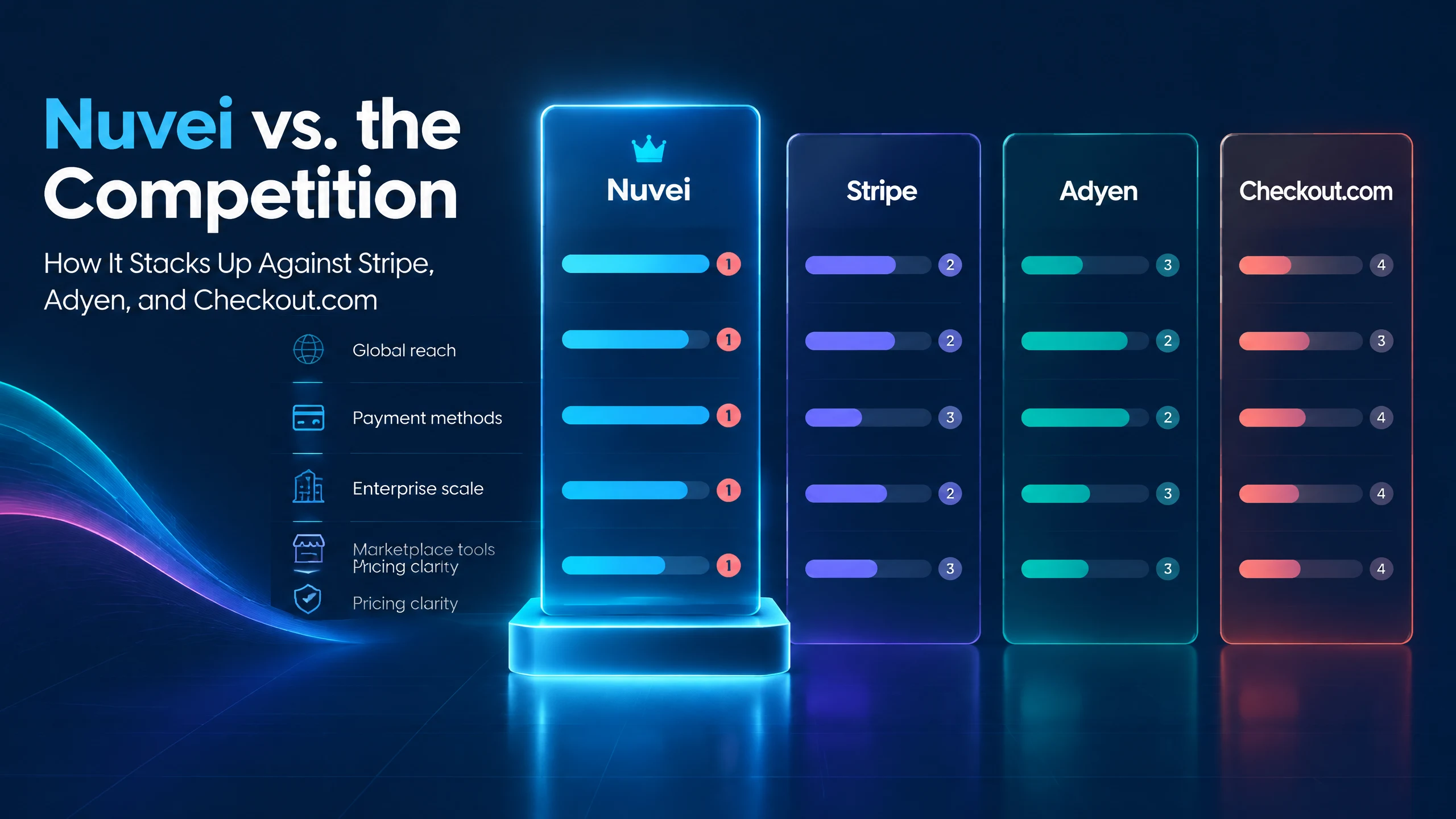
No payment processor exists in a vacuum, and no risk assessment is complete without asking the obvious follow-up question: compared to what? Nuvei’s licensing, PCI DSS certification, and review scores look solid in isolation, but merchants ultimately choose between real alternatives, and the payments space has no shortage of them. This article places Nuvei directly against three of its most commonly cited competitors, Stripe, Adyen, and Checkout.com, across ownership and scale, pricing philosophy, platform fit, review data, and dispute handling, to help merchants understand not just whether Nuvei is safe, but where it actually wins and loses against the field.
Ownership and Scale: A Tale of Different Trajectories
Understanding who stands behind a processor, and what that ownership structure incentivizes, matters more than most fee comparisons, because it shapes long-term investment, stability, and disclosure.
Stripe: remains privately held but operates at extraordinary scale: it processed $1.9 trillion in total payment volume in 2025, up 34% year-over-year, equivalent to roughly 1.6% of global GDP, and carries a $159 billion valuation following a tender offer for current and former employees. Its infrastructure reportedly underpins 90% of Dow Jones Industrial Average companies and 80% of the Nasdaq 100. That scale funds a broad, continuously expanding product suite spanning billing, tax, fraud tooling, and platform infrastructure, signaling sustained reinvestment rather than a business preparing for exit or consolidation.
Adyen: is publicly listed on Euronext Amsterdam and licensed as a bank in the Netherlands, a structurally different regulatory position than either Stripe or Nuvei, since it holds its own banking license rather than operating solely as an EMI or payment institution. It processed €1.4 trillion in 2025 at €2.4 billion in net revenue, and its public listing means continuous financial disclosure is baked into its operating model, a transparency advantage for merchants conducting due diligence.
Nuvei: by contrast, ceased being a publicly traded company on November 15, 2024, when Advent International completed a $6.3 billion all-cash take-private transaction at $34.00 per share, alongside existing shareholders Novacap and CDPQ. Private ownership can mean faster decision cycles and more capital available for acquisitions, and Nuvei has been actively deploying that capital. In June 2026, Nuvei agreed to acquire Payoneer for $2.75 billion ($7.40 per share in cash), a deal still subject to shareholder and regulatory approval with an expected close in mid-2027. If completed as structured, the combined company would represent roughly $500 billion in annual payment volume, $3 billion in annual revenue, access to Payoneer’s 2.4 million existing customers, and same-day settlement across more than 150 markets, including licenses in jurisdictions like mainland China and India. That’s a materially larger ambition than Nuvei’s current standalone footprint, but merchants evaluating Nuvei today should judge the company on what’s operational now, not on a pending deal’s roadmap, and should confirm directly with their account team which (if any) Payoneer-related capabilities are actually live before building projections around them.
The practical implication for risk assessment: Stripe and Adyen offer more continuous public financial transparency by virtue of their scale and (for Adyen) public listing; Nuvei’s private-equity ownership means less ongoing public disclosure, offset somewhat by the residual transparency habits carried over from its own 2020–2024 run as a public company.
Platform Philosophy: Specialized Acquiring vs. Developer Ecosystem
The most useful lens for comparing Nuvei against Stripe specifically isn’t “which is better”, it’s “which is built for what.” Nuvei is positioned as a global payments platform emphasizing payment-method breadth, local acquiring, and tailored solutions for merchants with specialized geographic or industry requirements, travel, gaming, marketplaces, and complex cross-border operations where a generalist platform’s default coverage falls short. Stripe is positioned as a modular, developer-first platform bundling payments with billing, marketplace tooling, fraud controls, and a broad self-serve ecosystem, optimized for digital-first businesses, SaaS companies, and engineering teams that want to build quickly on well-documented APIs.
Neither approach is objectively superior: they serve different operating realities. A founder shipping a new digital product typically cares most about speed to launch and clean developer documentation, Stripe’s traditional strength. A payments or finance leader inside a larger organization with complex geographic footprint, industry-specific risk profiles, or a need for consultative account management is more likely to prioritize local acquiring, commercial support, and configurable risk tooling, closer to Nuvei’s positioning. Adyen sits in a similar enterprise/omnichannel space to Nuvei but distinguishes itself with a unified online-and-in-store platform architecture and transparent Interchange++ pricing as a default rather than a negotiated option. Checkout.com, meanwhile, competes most directly with both Nuvei and Adyen for mid-market and enterprise merchants, with G2 comparison data (discussed below) suggesting an edge in ease of use and support responsiveness specifically against Nuvei.
Pricing Philosophy: Published Rate vs. Negotiated Quote
This is one of the sharpest structural differences in the comparison. Stripe publishes a standard US rate of 2.9% + $0.30 per successful card transaction, with clearly listed add-ons for manually entered cards, international cards, and currency conversion, and no setup or monthly fee on its standard plan, a rate any merchant can check before ever speaking to a sales representative. Adyen similarly markets transparent Interchange++ pricing as a default. Nuvei, as detailed in our companion fee-transparency breakdown, publishes no standard rate card at all; merchants receive a quote after consultation, with pricing structured as tiered, flat-rate, or interchange-plus depending on transaction mix, market, and negotiated terms.
This doesn’t automatically make Nuvei more expensive, bespoke pricing can be cheaper than a one-size-fits-all published rate for the right merchant profile, particularly at higher volumes where a negotiated interchange-plus markup undercuts a flat 2.9%. But it does mean the burden of comparison-shopping falls more heavily on the merchant. The responsible way to compare costs, as any credible analysis of this space will stress, is never to stack one advertised headline rate against another. A defensible total-cost-of-ownership model needs to account for domestic and cross-border card processing, local payment method fees, currency conversion, monthly and gateway fees, refund and payout handling, dispute and chargeback fees, and integration or migration costs, built across at least three scenarios: current volume, projected volume a year out, and a stress case with heavier international or dispute activity.
Who’s the Merchant of Record? A Question Worth Asking Before Any of the Others
One structural distinction that gets less attention than pricing but matters just as much for risk: who is legally the merchant of record on a given transaction, since that determines who is responsible for tax remittance, regulatory compliance, and in some structures, chargeback liability.
Stripe operates primarily as a payment facilitator for the large majority of transactions, the merchant’s own business entity remains the official merchant of record, meaning that entity directly carries compliance, tax, and dispute-handling obligations, while Stripe provides processing infrastructure and dispute tooling. (Stripe Connect changes this configuration for platforms and marketplaces routing payments to sub-merchants, so the exact mode in use is worth confirming for platform-model businesses.) Nuvei, by contrast, offers merchant-of-record programs alongside its standard acquiring services, under which Nuvei’s own entity can handle local tax registration, regulatory authorization, and transaction settlement in markets where the merchant lacks a local presence, a structure that can meaningfully accelerate expansion into a new country, but which also inserts a third party between the merchant and the transaction records needed if a dispute ever goes to arbitration. Any merchant evaluating either provider should ask directly, in writing, before signing: for this specific product and country, whose legal name appears on the cardholder statement, and who is contractually liable if a dispute is escalated?
Review Data Head-to-Head
Nuvei vs. Checkout.com – Review Platform Scores
|
Review Source |
Checkout.com | Nuvei | Notes |
|
Blended aggregator index (proprietary) |
4.3 |
3.9 |
Based on 1,000+ combined reviews across 5 platforms |
|
G2 |
4.6 |
4.3 |
Checkout.com leads |
|
Trustpilot |
Lower in some snapshots |
3.8 |
Nuvei holds a narrow edge |
| Gartner Peer Insights | 5.0 | 5.0 |
Tied; both based on very small sample sizes |
Gartner Peer Insights – Nuvei vs. Named Alternatives (by dimension)
|
Competing Product |
Dimension Compared | Result |
|
Checkout.com (Connected Payments) |
Evaluation & contracting experience |
Rated ahead of Nuvei |
|
Spreedly (Payments Orchestration Platform) |
Service and support |
Rated ahead of Nuvei |
|
Stripe Payments |
— |
Listed as a top alternative to Nuvei; no dimension-specific score given |
|
Payflow Gateway |
— |
Listed as a top alternative to Nuvei; no dimension-specific score given |
|
Adyen Payments Platform |
— |
Listed as a top alternative to Nuvei; no dimension-specific score given |
Takeaway: Nuvei tends to hold its own or lead on breadth (payment methods, currencies, market coverage) and data security/fraud tooling, while trailing more developer-centric or newer entrants like Checkout.com on ease of use, onboarding speed, and pricing clarity.
Dispute and Chargeback Handling: Two Different Operating Models
How each platform handles chargebacks says a lot about its target merchant profile. Nuvei documents chargeback lifecycles and reason codes for merchants, with response windows set by the relevant card scheme, 30 days for Visa allocation disputes, 45 days for Mastercard second presentment, and 20 days for American Express representment, and automatically disputes chargebacks tied to previously refunded or fully authenticated transactions. The exact response route and service level depend on the merchant’s configured solution and acquiring relationship, meaning the experience can vary account to account. Stripe surfaces disputes directly in a self-serve Dashboard and via API, letting merchants accept or challenge cases and submit reason-specific evidence themselves, with a “Smart Disputes” automation tool available for eligible cases.
Neither model is objectively better, Nuvei’s approach suits merchants who prefer a relationship-managed account with scheme-specific deadlines handled in coordination with an account team, while Stripe’s suits merchants who want self-serve visibility and programmatic control. What’s worth flagging for any merchant, regardless of which provider they choose: no reliable, apples-to-apples dataset exists that lets you compare chargeback win rates across processors, because outcomes depend on dispute reason, merchant category, fraud mix, evidence quality, and issuer behavior, a processor’s dispute interface being polished doesn’t guarantee it’s where your delivery, product-usage, and customer-service evidence actually lives.
A Practical Way to Choose
Rather than asking “which processor is best,” the more useful question for any merchant evaluating Nuvei against Stripe, Adyen, or Checkout.com is which one fits your specific distribution channels, markets, internal engineering resources, and growth plan:
- Choose Nuvei: when payment-method breadth, local acquiring in complex or specialized markets, industry-specific tooling (gaming, travel, high-risk verticals), and a consultative, relationship-managed account fit how your team already operates.
- Choose Stripe: when a unified developer ecosystem, payments, billing, fraud controls, and platform tooling in one place, plus transparent published pricing and self-serve dispute tooling matter more than a dedicated account relationship.
- Choose Adyen: when you need a single platform spanning online and in-store payments with a bank-license-backed regulatory position and default transparent Interchange++ pricing, particularly for large omnichannel or international enterprises.
- Choose Checkout.com: when independent review data on ease of use, setup speed, and support responsiveness is a bigger priority than Nuvei’s specific breadth of specialized-market coverage.
What the Pending Payoneer Deal Signals About Nuvei’s Trajectory
It’s worth spending a moment on the Payoneer acquisition specifically, since it’s the single most consequential piece of forward-looking information available about Nuvei relative to its competitors. Payoneer brings a large existing base of cross-border freelancer, marketplace-seller, and SMB customers, plus licenses in markets, including mainland China and India, where Nuvei’s own acquiring footprint has historically been thinner than Stripe’s or Adyen’s. If the deal closes on schedule in mid-2027, it would push Nuvei’s combined annual volume toward roughly $500 billion, a figure that would put it in a meaningfully different scale bracket relative to its current standalone size, though still short of Stripe’s $1.9 trillion in 2025 volume. For merchants weighing a multi-year platform decision today, the deal is a reasonable signal of Nuvei’s strategic direction, deepening cross-border and emerging-market reach rather than pivoting toward a developer-first model, but it shouldn’t be treated as a current capability. Shareholder and regulatory approval are still pending, and any Payoneer-linked feature a sales conversation references should be confirmed as live, not roadmap, before it factors into a purchasing decision.
Bottom Line
Against its most commonly cited peers, Nuvei is neither a clear winner nor a clear laggard, it’s a specialist. Its case is strongest for merchants with genuinely complex, multi-market, or industry-specific needs that a generalist platform’s default coverage doesn’t fully serve, backed by real regulatory breadth and PCI DSS Level 1 certification that hold up against any of these competitors. Its case is weakest against Stripe’s transparent published pricing and self-serve tooling, and against Checkout.com’s edge in ease-of-use review scores. None of that changes the safety assessment from earlier in this series, Nuvei remains a legitimate, well-regulated processor, but “safe” and “best fit for your business” are different questions, and this comparison is meant to help answer the second one with the same evidence-based rigor applied to the first.
Comments
No comments yet. Be the first to share your thoughts.
Leave a comment