
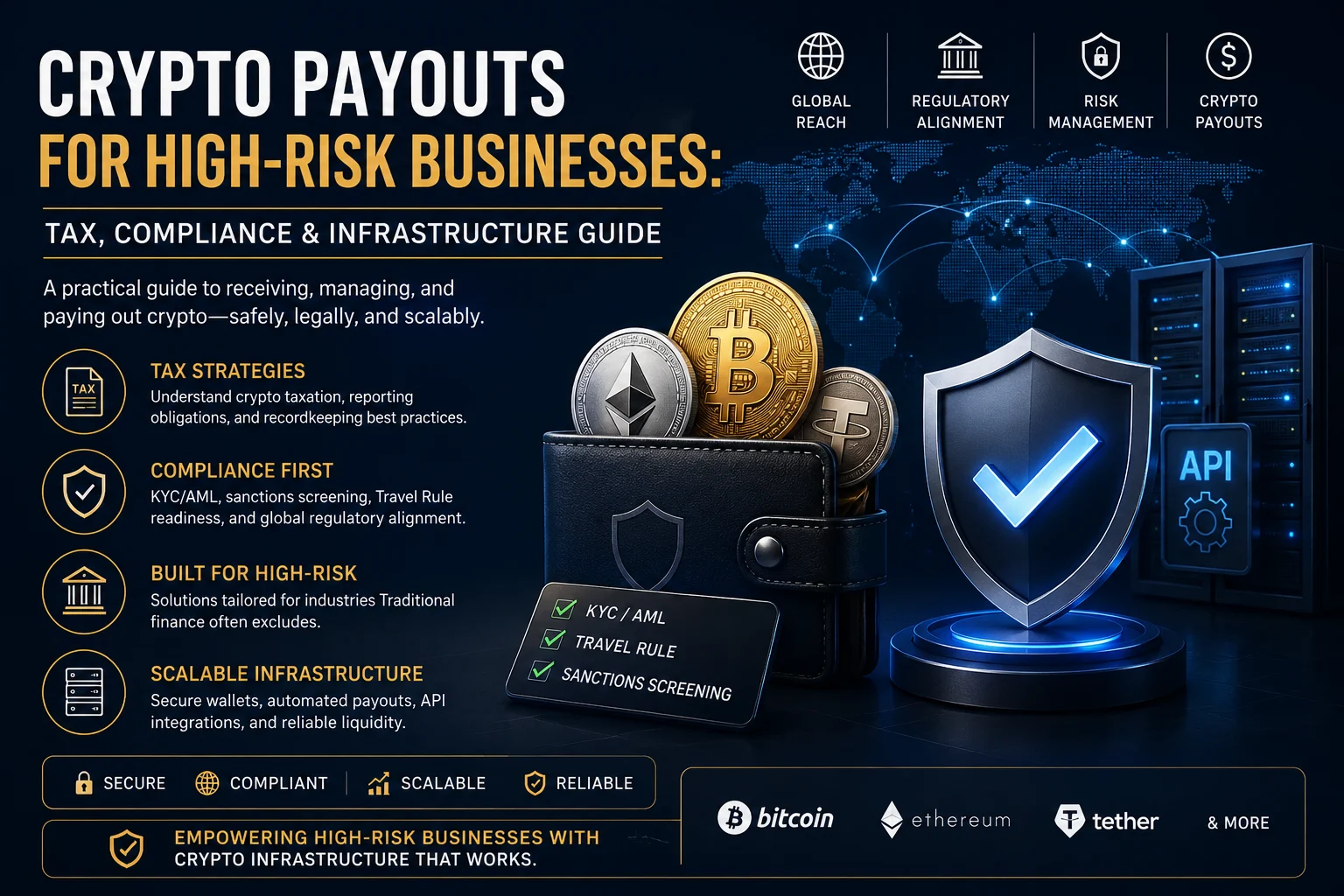
Crypto payouts have moved from a niche workaround to a serious infrastructure option for high-risk merchants who can no longer depend on traditional payment rails. In 2026, as banks continue to de-risk aggressively and chargeback thresholds tighten, blockchain-based payout solutions are filling a critical gap across gaming, adult content, forex, nutraceuticals, and online gambling verticals. This guide covers everything high-risk operators need to know, from tax obligations and compliance frameworks to building a payout stack that holds up under regulatory scrutiny.
TL;DR
- Crypto payouts give high-risk merchants faster settlement, lower fees, and no acquiring bank dependency
- Most jurisdictions treat crypto received as business income valued at fair market price on the date of receipt, every conversion event may be a taxable disposal
- Compliance requirements include AML/KYC procedures, transaction monitoring, and VASP licensing in key markets
- Infrastructure setup requires a crypto payment gateway, wallet layer, and treasury management module
- Stablecoins (USDT, USDC) are the preferred settlement denomination for eliminating volatility risk
Why High-Risk Businesses Are Moving to Crypto Payouts in 2026
Traditional merchant services have become increasingly inaccessible for high-risk verticals. An estimated 30-40% of high-risk merchant account applications are declined by acquiring banks, according to payment consultancy Paynetics. When accounts are approved, merchants often face rolling reserves of 5-10%, elevated processing fees, and the constant threat of account termination.
Crypto payout rails sidestep the need for acquiring bank relationships entirely. Settlement goes direct, from the payment gateway to the merchant’s wallet, often within minutes. This makes crypto particularly valuable for offshore merchants who cannot maintain stable banking relationships in regulated jurisdictions.
The global crypto payment market was valued at approximately $2.1 billion in 2025 and is projected to reach $4.6 billion by 2028 at a CAGR of 30.1% (Grand View Research, 2025). Much of this growth is being driven by high-risk payment operators adopting stablecoin and multi-chain infrastructure to replace fragile fiat payment flows.
How Crypto Payout Rails Work
At a high level, crypto payouts replace the fiat banking leg of the payment flow. Instead of funds settling into a business bank account via ACH, SEPA, or SWIFT, they settle directly into a blockchain wallet address, denominated in Bitcoin, Ethereum, or a stablecoin like USDT or USDC.
Key Infrastructure Components
A functional crypto payout stack for high-risk merchants typically includes:
- Crypto payment gateway: handles inbound payment processing and converts fiat to crypto at point of sale, or accepts crypto directly from the customer
- Wallet layer: custodial (managed by the payment provider) or non-custodial (merchant controls private keys); most operators starting out use custodial for compliance simplicity
- Treasury and conversion module: converts crypto holdings to fiat or stablecoins on a scheduled cadence to control volatility exposure
- Transaction monitoring software: screens wallet addresses against sanctions lists and flags suspicious activity for AML compliance
- Reporting and reconciliation tools: essential for accurate tax filings and audit trails across multiple jurisdictions
Crypto vs. Traditional High-Risk Payment Gateways
| Factor | Traditional High-Risk Gateway | Crypto Payout Gateway |
|---|---|---|
| Approval difficulty | High – acquiring bank required | Low – no bank sponsorship needed |
| Settlement speed | 1-5 business days | Minutes to hours |
| Processing fees | 3.5-8% for high-risk | 0.5-2.5% (network + provider) |
| Chargeback exposure | High | Minimal – transactions are irreversible |
| Regulatory complexity | Card scheme rules + banking law | AML, KYC, VASP licensing |
| Volatility risk | None | Manageable via stablecoins |
| Geographic reach | Varies by acquirer | Global by default |
Tax Treatment of Crypto Payouts
Tax is the most frequently misunderstood element of crypto payout infrastructure. Getting it wrong creates serious liability, especially for businesses operating across multiple jurisdictions simultaneously.
Most tax authorities treat crypto received as business income valued at fair market price at the point of receipt. If you receive USDT at $1.00 and later convert it at $1.00, there may be no capital gain, but many jurisdictions still classify each conversion as a taxable disposal event. This creates a compliance overhead that merchants need to plan for from day one.
How Major Jurisdictions Treat Crypto Payouts in 2026
| Jurisdiction | Crypto as Business Income? | Capital Gains on Conversion? | Reporting Required? |
|---|---|---|---|
| United States | Yes – ordinary income at fair market value | Yes – on every disposal event | Yes – FinCEN reporting + IRS Form 8949 |
| United Kingdom | Yes – Corporation Tax applies | Yes – HMRC crypto asset rules | Yes – detailed transaction logs required |
| European Union | Varies by member state | MiCA framework applies | Yes – DAC8 reporting directive |
| Singapore | Yes – income tax applies | No capital gains tax | Yes – MAS regulatory guidelines |
| UAE (Dubai) | No corporate tax in most cases | No capital gains tax | Minimal – VARA registration |
| Cayman Islands | No income or capital gains tax | No | Minimal compliance obligations |
For high-risk merchants operating through offshore structures, the UAE, Cayman Islands, and Seychelles remain attractive because they eliminate or significantly reduce the tax burden on crypto income. However, merchants serving customers in US, UK, or EU markets still face reporting obligations tied to where business activity occurs, not just where the entity is registered.
The safest approach is maintaining a per-transaction cost basis record: log the date, asset type, amount, and USD-equivalent value for every payout received. Most crypto payment processing platforms now generate this data automatically in API-exportable formats compatible with tax software like Koinly, TaxBit, and Accointing.
Compliance Requirements for Crypto Payouts
Compliance is not optional in 2026, and regulators are paying close attention to crypto flows in high-risk sectors. The FATF Travel Rule, which requires sharing originator and beneficiary information for transfers above $1,000, is now enforced across 40+ jurisdictions and applies directly to merchant-level crypto settlement flows.
AML/KYC Obligations
AML and KYC requirements apply at both the gateway and wallet level. Payment providers offering crypto merchant services must verify the identity of merchants during onboarding, a process that mirrors enhanced due diligence for traditional high-risk merchant accounts. Merchants operating in verticals like gambling and forex are also required to KYC their end customers before processing transactions.
VASP Licensing Requirements
Virtual Asset Service Provider (VASP) licensing is increasingly mandatory for businesses facilitating crypto payments. Under the EU’s MiCA regulation, fully applied as of December 2024, any entity that facilitates crypto payments commercially must be registered as a VASP in at least one EU member state. Similar frameworks are active in the UK under the FCA, Singapore under MAS, and the UAE under VARA. Offshore merchants processing for EU or UK customers may be captured under these rules even without a local entity.
Transaction Monitoring
Transaction monitoring must be continuous. Real-time screening against OFAC, UN, and EU sanctions lists is required by most payment providers, and is strongly recommended for any merchant maintaining direct wallet custody. Tools like Chainalysis, Elliptic, and TRM Labs are widely used for on-chain compliance screening, particularly for detecting funds linked to illicit wallets.
Stablecoin-Specific Considerations
Stablecoin rules are tightening under MiCA. Merchants using USDT or USDC should confirm their payment provider is operating with MiCA-compliant stablecoin infrastructure to avoid future operational disruption. USDC (Circle) is generally preferred in compliance-sensitive contexts given Circle’s US regulatory positioning and transparent reserve reporting.
Setting Up Crypto Payout Infrastructure
Building a crypto payout stack requires more planning than a standard payment gateway integration. Here is a practical sequence for high-risk operators setting up in 2026:
Step 1: Choose a compliant crypto payment provider. Prioritise providers with built-in AML/KYC tooling, stablecoin settlement support, and audit-ready reporting dashboards. B2BinPay, CoinsPaid, TripleA, and NOWPayments are among the providers active in the high-risk merchant services space.
Step 2: Decide on custodial vs. non-custodial wallets. Custodial wallets managed by the payment provider offer simpler compliance and easier recovery. Larger operators with in-house treasury teams typically migrate to non-custodial setups for greater control over funds.
Step 3: Default to stable-coin settlement. Configure payouts to USDT or USDC by default, and schedule conversion to fiat on a daily or weekly cadence aligned with your treasury policy. This eliminates cryptocurrency volatility from your receivables.
Step 4: Integrate on-chain transaction monitoring. Before going live, connect your wallet addresses to a blockchain analytics tool. This protects against inadvertently receiving funds from sanctioned wallets, a real operational risk in open-network environments where any party can initiate a transfer.
Step 5: Establish a tax reporting workflow. Work with a crypto-experienced accountant to set up per-transaction reporting from day one. Most leading payment providers offer API access to complete transaction histories in formats that integrate directly with crypto tax platforms.
Pros and Cons of Crypto Payouts for High-Risk Merchants
Pros
- No acquiring bank dependency: eliminates account termination risk for high-risk merchants operating in restricted verticals
- Near-instant settlement: critical for cash flow in high-volume operations where fiat delays compound quickly
- Lower processing fees: 0.5-2.5% vs. 3.5-8% for traditional high-risk payment processing channels
- Chargeback elimination: blockchain transactions are irreversible, removing a major cost driver for high-risk operators
- Global reach by default: crypto-enabled payment providers can serve merchants and customers in virtually any jurisdiction
- Stablecoin-based stability: removes volatility exposure when USDC or USDT is used as the settlement denomination
Cons
- Regulatory complexity: VASP licensing, Travel Rule compliance, and MiCA obligations require meaningful legal and operational investment
- Tax reporting burden: every conversion event may constitute a taxable disposal in most jurisdictions
- Customer friction: a portion of end customers are not yet comfortable paying in cryptocurrency or managing wallets
- Banking off-ramp friction: converting large crypto volumes to fiat can trigger AML scrutiny at correspondent banks
- Irreversibility: while chargebacks are eliminated, merchants also lose standard payment dispute protections
- Sanctions exposure: risk of receiving funds from blacklisted wallet addresses if real-time monitoring is not in place from launch
FAQ: Crypto Payouts for High-Risk Businesses
Can a high-risk merchant use crypto payouts without a VASP licence? It depends on jurisdiction and transaction volume. In the EU, UK, and Singapore, any business facilitating crypto payments commercially is likely required to register. Offshore merchants serving these markets may also be captured under extraterritorial provisions. Always obtain jurisdiction-specific legal advice before operating.
Are crypto payouts more reliable than traditional high-risk payment gateways?
They eliminate chargeback risk but introduce different risks, volatility (manageable via stablecoins), sanctions exposure, and regulatory complexity. With stablecoin settlement and proper compliance tooling in place, crypto payout rails can be highly reliable for high-risk operators.
Which stablecoins are best for high-risk payout settlements?
USDT (Tether) and USDC (Circle) are the most widely supported. USDC is generally preferred for compliance-sensitive use cases given Circle’s US regulatory standing and transparent reserve disclosures.
How do crypto payment providers handle AML for high-risk merchants?
Leading providers conduct enhanced due diligence during merchant onboarding, require full KYC documentation, screen all wallet addresses against international sanctions lists, and apply transaction monitoring thresholds aligned with FATF guidance.
Do I still need a merchant account if I use crypto payouts?
You do not need a traditional bank-issued merchant account for crypto-only operations. However, if you also process card payments alongside crypto, you will need a separate merchant account for that fiat payment flow.
What happens if crypto volatility causes a loss between receipt and conversion?
This is a legitimate treasury risk. If you default to stablecoin settlement (USDT/USDC), volatility is effectively eliminated. For Bitcoin or Ethereum settlements, most payment providers offer auto-conversion at the point of receipt to lock in the fiat-equivalent value immediately.
Comments
No comments yet. Be the first to share your thoughts.
Leave a comment