
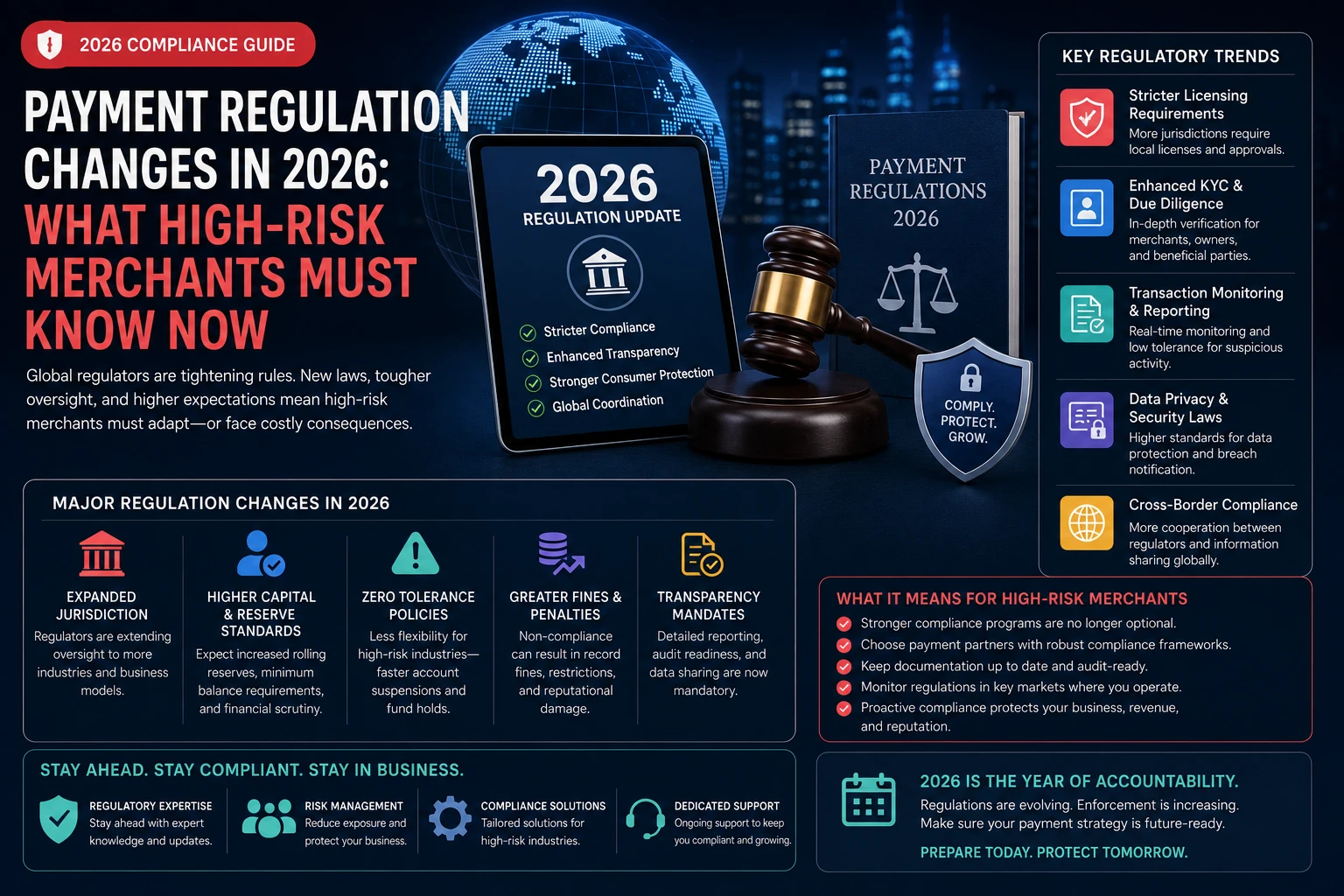
2026 has already produced more regulatory change affecting high-risk payment processing than any year since the original wave of EU open banking reform. Card network monitoring thresholds have tightened, the EU’s payments framework is being fundamentally rebuilt, the US has begun implementing its first comprehensive federal stablecoin law, and crypto Travel Rule enforcement has crossed a meaningful adoption threshold globally. For high-risk merchants and the payment providers serving them, treating any one of these as background noise is a mistake, together they are reshaping underwriting, reserve requirements, and account stability across every high-risk vertical. This roundup is updated quarterly and covers what has actually changed, what is still moving through the legislative process, and what high-risk merchants should be doing right now.
TL;DR
- Mastercard’s Excessive Chargeback Programme threshold dropped from 220 to 150 basis points (1.5%) on April 1, 2026 across the US, EU, Canada, and Asia-Pacific, a materially tighter compliance margin for high-risk merchants
- Mastercard now requires an initial website scan, including password-protected and members-only areas, before any merchant’s first transaction under its revised Merchant Monitoring Programme
- The EU’s PSD3 and Payment Services Regulation reached final compromise text in April 2026, with formal adoption expected mid-2026 and application following roughly 21 months later
- The US GENIUS Act, the first comprehensive federal stablecoin framework, is moving through OCC and Treasury rulemaking in 2026, with full effect expected by January 2027 at the latest
- FATF’s Travel Rule has now been legislated in 85 of 117 surveyed jurisdictions (73%), up from 65 the previous year, global enforcement convergence is accelerating
- UK payment service providers must now give 90 days’ notice (up from 60) before closing a merchant account, with mandatory written justification, effective April 28, 2026
Card Network Rules: The Ground Has Shifted Under High-Risk Merchants
Card network compliance frameworks are where high-risk merchants feel regulatory change first and most directly, and 2026 has brought the most consequential update to these frameworks in several years.
Mastercard’s Excessive Chargeback Programme: A Lower Threshold
Mastercard lowered its Excessive Chargeback Programme (ECP) threshold from 220 basis points to 150 basis points, 1.5% of transaction volume, effective April 1, 2026, across the US, EU, Canada, and Asia-Pacific. For high-risk merchants who have historically operated close to but below the prior threshold, this change moves a meaningful number of accounts into active monitoring territory without any change in their underlying chargeback behaviour.
The practical effect is that high-risk merchants in verticals with structurally elevated dispute rates, coaching, dating, nutraceuticals, adult content, now have less margin for error before triggering programme enrolment, fines, and the elevated reserve requirements that follow. Merchants who were managing chargebacks to a 1.8-2.0% target as a buffer against the old 2.2% threshold now need to target well below 1.5% to maintain the same operational safety margin.
Mastercard’s Revised Merchant Monitoring Programme (MMP)
Mastercard’s enhanced MMP standards, effective through 2026, require an initial website scan before a merchant is onboarded to accept Mastercard payments at all, a structural departure from the historical model where monitoring began only after transactions started flowing. This scan now extends to restricted, members-only, and password-protected areas of a merchant’s platform, closing what had previously been a meaningful gap in card network visibility into actual business activity.
For high-risk merchants whose member-only content or product access differs materially from their public-facing marketing, this change removes the ability to present a different risk profile to the card network than what customers actually experience. Brand Reputation and Misuse (BRAM) violations, prohibited content or activity that could damage card network reputation, are the primary enforcement focus, and payment providers underwriting new high-risk accounts are now expected to demonstrate this level of oversight before the first transaction clears, not after a pattern of violations emerges.
Mastercard’s Scam Merchant Monitoring Criteria
A parallel 2026 update introduced more specific scam merchant monitoring triggers. New merchants, defined as those with less than six months of processing history and more than 500 monthly transactions, face active risk if their combined refund and chargeback rate approaches 5%. Sudden volume drops, expansion into new high-risk markets without graduated testing, and processor or gateway outages are all monitored as potential precursors to scam-pattern enforcement action, even when the underlying cause is operational rather than fraudulent.
EU Payments Framework: PSD3 and the Payment Services Regulation
The most structurally significant change moving through the EU regulatory pipeline in 2026 is the replacement of PSD2 with a new two-part framework: the Third Payment Services Directive (PSD3) and a directly applicable Payment Services Regulation (PSR).
What’s Actually Changing
The European Parliament and Council reached provisional political agreement on PSD3 and the PSR in November 2025, with the Council publishing final compromise texts on April 23, 2026. As of this writing, the European Parliament’s ECON Committee and a subsequent plenary vote were the final procedural steps before formal adoption, with publication in the Official Journal of the European Union anticipated for mid-2026, though some legal analysts have flagged a possible slip to September 2026. The new rules are expected to apply approximately 21 months after that publication, placing practical compliance deadlines sometime in 2027 or early 2028.
The architectural shift matters as much as the substantive content. PSD2 was a Directive, meaning each EU member state interpreted and transposed it into national law, creating fragmentation that high-risk payment providers operating across multiple EU markets have had to navigate for years. The PSR, by contrast, is a directly applicable Regulation that sets identical conduct-of-business rules across all member states without national transposition, while PSD3 retains Directive status for the organisational and licensing elements of payment institution supervision.
Provisions High-Risk Merchants and Providers Should Track
Extended verification of payee: to all credit transfers, not just the subset currently covered under the EU’s Instant Payments Regulation, a direct response to the growth of authorised push payment fraud, with liability shifting toward payment providers when verification mechanisms fail.
Mandatory spending limits and blocking measures: that payment service providers must offer to customers, alongside a new reimbursement requirement specifically covering employee impersonation fraud, a category increasingly relevant to high-risk merchants managing B2B payment flows.
Single licensing regime: eliminating the separate Electronic Money Directive framework, consolidating e-money institutions and payment institutions under one licensing structure, a simplification that should, over time, reduce the compliance overhead of operating EMI and PI licences in parallel.
US Stablecoin Regulation: The GENIUS Act Moves Into Implementation
The Guaranteeing Effective and National Innovation for US Stablecoins (GENIUS) Act, enacted in July 2025, represents the first comprehensive federal regulatory framework for payment stablecoins in the United States, directly relevant to any high-risk merchant using crypto payout infrastructure denominated in USD-pegged stablecoins.
2026 has been the year of GENIUS Act implementation rulemaking. The Office of the Comptroller of the Currency issued a notice of proposed rulemaking covering permitted payment stablecoin issuers and foreign payment stablecoin issuers under its jurisdiction, with the comment period closing May 1, 2026. In parallel, FinCEN and the Office of Foreign Assets Control issued a joint proposed rule implementing the Act’s anti-money laundering and sanctions compliance requirements, treating permitted payment stablecoin issuers as financial institutions under the Bank Secrecy Act.
The Act’s effective date is the earlier of January 18, 2027, or 120 days after the relevant federal regulators issue final implementing regulations, meaning high-risk merchants relying on USDT or USDC settlement should expect the regulatory landscape underlying their stablecoin payout infrastructure to be substantially settled well before the end of 2026, with full compliance obligations active no later than early 2027. Issuer-level reserve, supervision, and reporting standards are the core of the framework, and the Act explicitly prohibits deceptive statements implying that a stablecoin is government-backed or covered by federal deposit insurance where this is not the case.
FATF Travel Rule: Global Enforcement Convergence Accelerates
The FATF Travel Rule, requiring Virtual Asset Service Providers to collect and share originator and beneficiary information on crypto transfers, has crossed a meaningful adoption threshold in the most recent FATF survey data. As of the 2025 survey, 85 of 117 responding jurisdictions (73%) have passed Travel Rule legislation, up from 65 the prior year. FATF’s broader Global Network spans 205 jurisdictions, though not all responded to the most recent survey, and non-respondents are treated as non-implementing for assessment purposes.
For high-risk merchants and payment providers using crypto payout rails, the practical significance is twofold. First, enforcement intensity continues to vary significantly even among jurisdictions with formal legislation, what FATF terms the “sunrise issue,” where staggered global adoption creates compliance friction for cross-border transfers between jurisdictions at different implementation stages. Second, the EU’s Transfer of Funds Regulation, in effect since December 30, 2024, applies a zero-threshold standard, every crypto transfer, regardless of size, requires full originator and beneficiary information, the strictest implementation standard currently in force anywhere.
The US, UK, Singapore, and Japan all maintain active enforcement regimes as of 2026, and FATF has signalled it will continue increasing monitoring pressure on lagging jurisdictions throughout the year, meaning the operational gap between strict and lenient enforcement environments is likely to narrow further before it widens.
UK Account Closure Reform: Longer Notice, Mandatory Justification
A consequential but lower-profile 2026 change for UK-facing high-risk merchants is new legislation requiring payment service providers to give customers at least 90 days’ notice, up from the previous 60-day requirement, before closing a merchant account or terminating a payment service contract. The legislation, in force from April 28, 2026, also requires a clear, specific written explanation for the termination decision, giving merchants a documented basis to challenge the closure through the Financial Ombudsman Service if they believe it was unjustified.
This is a meaningful operational improvement for high-risk merchants who have historically experienced abrupt account terminations with minimal explanation, a pattern that has been a persistent source of business disruption across every high-risk vertical. The requirement applies to contracts agreed from and including April 28, 2026, meaning the protection will phase in gradually as existing agreements are renewed or replaced rather than applying retroactively to contracts predating the rule.
PCI DSS: Where Compliance Stands in 2026
PCI DSS v4.0.1 remains the active standard, with the PCI Security Standards Council confirming that the March 31, 2025 effective date for future-dated requirements was not altered. Two requirements carry particular relevance for high-risk e-commerce merchants: Requirement 6.4.3, governing the security of scripts loaded on payment pages, and Requirement 11.6.1, focused on detecting and preventing e-skimming attacks against checkout flows. High-risk merchants running complex, multi-vendor checkout pages, common in subscription and high-ticket verticals, should confirm with their payment provider that script inventory and change-detection monitoring required under these provisions is fully operational, not simply scheduled.
What High-Risk Merchants Should Do Right Now
Re-baseline your chargeback rate target: With Mastercard’s ECP threshold at 150bps, merchants previously managing toward 1.8-2.0% need a materially lower operating target, ideally below 1.0%, to maintain a genuine safety margin against programme enrolment.
Audit member-only and gated content against BRAM standards: Mastercard’s pre-onboarding website scanning now reaches behind login walls. Content, claims, or product access inconsistent with public marketing is now visible to card network monitoring from day one of a new merchant relationship.
Review crypto payout infrastructure against GENIUS Act and Travel Rule timelines: Merchants relying on stablecoin settlement should confirm their payment provider’s compliance roadmap aligns with the GENIUS Act’s expected 2026-2027 implementation window and maintains Travel Rule data-sharing capability appropriate to the jurisdictions they transact with.
Document account relationship history for UK operations: UK merchants should understand their rights under the new 90-day notice and written justification requirement, and should maintain documentation that supports an Ombudsman challenge if a closure decision appears inconsistent with the new standard.
Track PSD3/PSR implementation timing for EU expansion plans: With application expected roughly 21 months after Official Journal publication, EU-facing high-risk merchants have a defined but moving compliance runway, treating 2026 planning cycles as the time to prepare rather than wait is the lower-risk approach.
Pros and Cons of the 2026 Regulatory Environment for High-Risk Merchants
Pros
- The UK’s 90-day notice and written justification requirement directly addresses one of the most disruptive historical pain points for high-risk merchants
- PSD3/PSR’s single licensing regime should reduce long-term compliance fragmentation for payment providers and merchants operating across multiple EU member states
- The GENIUS Act provides long-overdue federal clarity for US stablecoin payment infrastructure, replacing a patchwork of state-level approaches
- FATF Travel Rule convergence reduces the “sunrise issue” friction that has historically complicated cross-border crypto payment compliance
Cons
- Mastercard’s lowered ECP threshold and enhanced MMP scanning create materially less margin for error for high-risk merchants with elevated dispute rates
- PSD3/PSR’s extended timeline (formal application potentially not until 2027–2028) means merchants must plan for an extended period of regulatory uncertainty
- GENIUS Act implementation complexity, spanning OCC, FinCEN, OFAC, the Federal Reserve, FDIC, and NCUA, creates a multi-agency compliance landscape that smaller stablecoin-reliant merchants may struggle to track independently
- Uneven FATF Travel Rule enforcement intensity across jurisdictions continues to create real compliance friction despite the formal legislative adoption increase
FAQ: 2026 Payment Regulation for High-Risk Merchants
Does the Mastercard ECP threshold change apply retroactively to existing merchant accounts?
Yes – the 150 basis point threshold applies to ongoing monitoring of all merchant accounts as of April 1, 2026, regardless of when the account was originally established. There is no grandfathering provision under the revised programme.
When will PSD3 and the PSR actually take effect for EU payment providers?
Formal adoption is expected by mid-2026, with application generally following approximately 21 months after Official Journal publication. Realistic compliance deadlines fall in 2027 to early 2028, though high-risk payment providers should begin preparation well in advance given the scope of the changes.
Does the GENIUS Act affect crypto payout providers outside the US?
The Act has extraterritorial provisions intended to apply where a stablecoin is offered or sold to a person located in the United States, regardless of the issuer’s location. Non-US payment providers serving US-based high-risk merchants or processing payouts to US persons should review their compliance posture against the Act’s requirements even without a domestic US presence.
What should a high-risk merchant do if a UK payment provider attempts to close their account without 90 days’ notice?
Merchants should request the mandatory written explanation required under the new rule and, if the closure does not appear to comply with the notice or justification requirements, escalate through the Financial Ombudsman Service. Maintaining documented correspondence with the payment provider strengthens any subsequent Ombudsman complaint.
How often is this regulatory roundup updated?
TheFinRate updates this report quarterly to reflect material regulatory developments. Given the pace of change across card network rules, EU payments reform, and US stablecoin regulation in 2026, merchants relying on this page for compliance planning should confirm the “last updated” date reflects the current quarter.
Comments
No comments yet. Be the first to share your thoughts.
Leave a comment